Best JDM Reels for Eging (Squid Jigging): Daiwa & Shimano Compared
ちゃんま
マイボ!

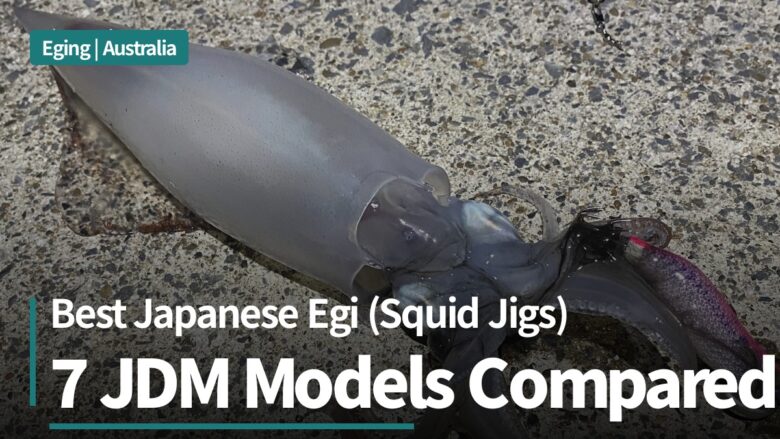
Picture a shallow weed flat on a grey afternoon, the tide pushing in over the ribbon weed, and a southern calamari lifting off the bottom to follow your jig before it thinks better of it and drops away. What happens on the next cast comes down to the small prawn-shaped lump of cloth and weight on the end of your line: the egi (餌木 / エギ), a squid jig Japanese anglers have been refining for well over a hundred years. The rod and reel set the tone, but the egi is the bit the squid actually grabs, and the difference between a good one and a dead one is the difference between a bag of calamari and a blank session.
Eging here has quietly gone from a niche import trick to the way a lot of us now target southern calamari off the rocks, jetties and shallow flats. The problem is what you meet when you go looking for jigs. The Japan Domestic Market (JDM) egi range is enormous and the naming is a maze: Yamashita alone runs several sub-series with tin sinkers, warm jackets and 490 glow; Daiwa’s Emeraldas line splits into rattle, dart, sight and shallow variants; and Yo-Zuri (which sells its squid gear under the Duel brand in Japan) covers everything from a cheap cloth-wrapped classic to a patented rattling caster. Most English-language pages just list whatever a shop happens to stock, with no read on which model suits which situation.
So this guide is sorted by the session, not the brand. Seven Japanese egi, grouped by the six situations they actually solve on Australian ground: your first sessions, dirty water, the everyday rock edge, shin-deep weed, clear and hard-fished flats, and ground that eats jigs. Sizes #2.5 to #3.5 cover nearly all of it, and our southern calamari fire up hardest from autumn into winter. If you are still building the setup, start with our complete guide to eging in Australia, then match these jigs to a proper JDM egi rod and a light eging reel.
A note on links and pricing: where a jig is sold globally the buy links point to Amazon.com (available with international shipping to Australia); JDM-focused models link to Amazon Japan, which ships internationally (check availability and shipping cost at checkout; orders over A$59 may qualify for free international delivery). Egi prices move around a lot between retailers, so figures here are approximate street prices in JPY (tax excluded) with an approximate AUD conversion at the time of writing (~A$1 = ¥100, mid-2026). Always check live pricing, and check your local state regulations on squid size and bag limits before you head out.
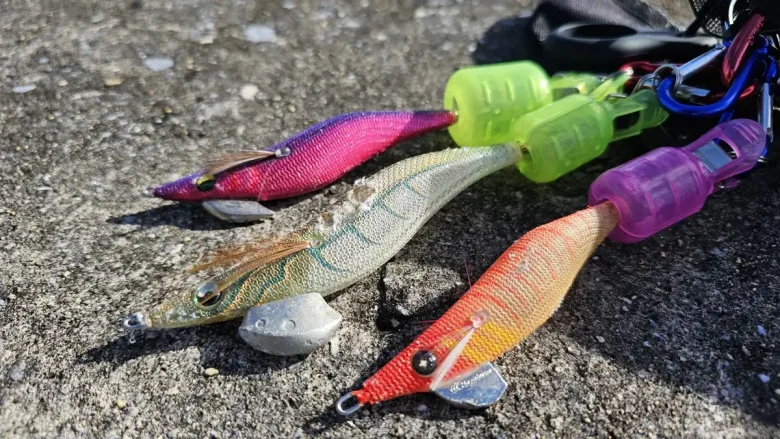
The first few squid sessions are mostly about learning what a falling egi feels like, and while you are working that out a jig that keeps appealing on its own is worth more than a technical one. That is the Yo-Zuri Duel EZ-Q Cast Rattle’s whole reason for existing. It carries a set of patented rubber “patapata” feet plus a rattle chamber, so it works on a plain twitch-and-retrieve without a practised cadence behind it.

The EZ-Q Cast Rattle stacks several patented tricks: wave-motion body, fluttering feet, coloured rattle balls and a UV glow finish, plus a snagless bumper and flexible “trick” hooks that bend to release from snags. All of it adds up to an egi that keeps appealing even when you are just twitching and winding.
| Feature | Detail |
|---|---|
| Type | Casting egi with rattle |
| Signature tech | Patapata feet, wave-motion body, coloured rattle balls, UV glow |
| Action | Appeals on a plain twitch-and-retrieve |
| Rattle | Yes (coloured rattle balls) |
| Best for | Beginners, coloured water, easy searching |
Duel publishes clean numbers for this one. The #2.5 to #3.5 sizes fall at a steady, fishable 3.2 to 3.9 sec/m, right in the useful band for Australian calamari.
| Size | Weight | Sink rate |
|---|---|---|
| #2.5 | 10 g | ~3.9 sec/m |
| #3.0 | 14 g | ~3.2 sec/m |
| #3.5 | 17 g | ~3.2 sec/m |
This is the egi to hand a mate who has never chased squid, or to fish yourself when you want results without thinking too hard. The rattle and feet do the work on a simple retrieve, the snagless bumper and flexible hooks save jigs on rocky ground, and it is cheap enough to lose without wincing.
Some days you are not fishing a spot so much as hunting for one: a wide flat you do not know, run-off colour in the water, no clue where the squid are sitting. The Yamashita Egi-Oh SEARCH is built for exactly that. Where the standard LIVE is a quiet dart machine, the SEARCH advertises with both light and sound: a strobing fin that flashes on the fall and a rattle tuned to around 600 Hz, the frequency Yamashita’s research says squid hear best. It pulls squid to the jig rather than asking you to land it on their nose.
The two headline features are the Strobe Fin, which throws a hard sideways flash on the rip, and the 600 Hz Search Rattle, backed by Yamashita’s 490 glow and Neon Bright UV finishes. It is a slightly faster fall than the basic egi, so it searches active squid at a brisk tempo. When you want to slow the drop for shallow weed, Yamashita make a separate SEARCH Shallow model rather than a slow option within this one.
| Feature | Detail |
|---|---|
| Type | High-appeal search egi (slightly fast fall) |
| Signature tech | Strobe Fin (flash), 600 Hz Search Rattle, 490 Glow, Neon Bright UV |
| Sink type | Standard SEARCH is a fast fall; a separate SEARCH Shallow gives the slow fall |
| Rattle | Yes (600 Hz, tuned to squid hearing) |
| Best for | Coloured water, big searches, calling active fish in |
The SEARCH runs 2.5 to 3.5 for our fishing, and because it is a deliberately faster fall it is heavier than the same-size LIVE: the #3.5 is a hefty 24 g that punches into wind and current. If you need the jig to hang over shin-deep grass, reach for the SEARCH Shallow instead.
| Size | Weight | Length | Sink rate |
|---|---|---|---|
| #2.5 | 12 g | 79 mm | ~3.6 sec/m |
| #3.0 | 17 g | 95 mm | ~3.2 sec/m |
| #3.5 | 24 g | 107.5 mm | ~2.8 sec/m |
Reach for the SEARCH when the water is dirty, the flat is huge, or the squid are scattered and you need to advertise. On clear, calm, hard-fished ground the silent LIVE further down this page usually wins, so keep the SEARCH as the loud tool for wide, murky and unknown water, and add a SEARCH Shallow for the skinny stuff.
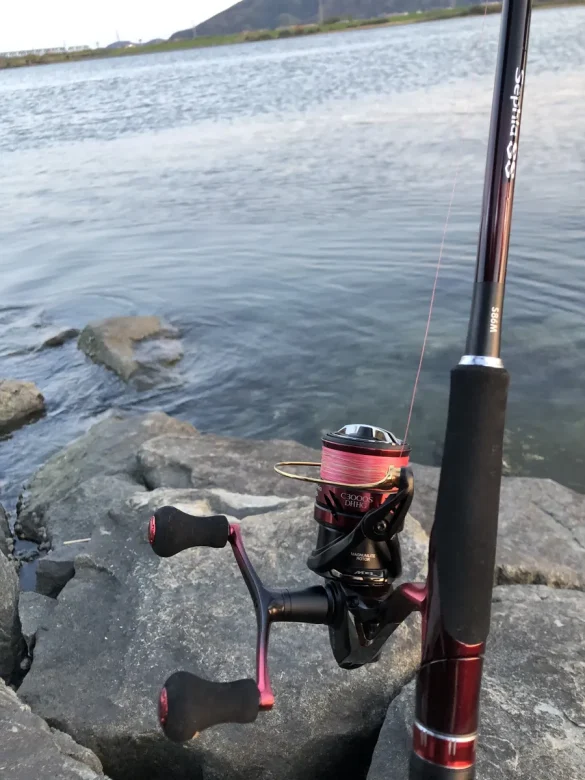
Most sessions are nothing extreme. You are on a familiar rock edge or a flat you have fished before, the water is somewhere between clean and stirred, and you just want to cover it at a sensible pace. That is the Yamashita Egi-Oh LIVE’s job, and it is why you will find one in nearly every serious Australian squid box. Yamashita more or less invented the modern egi, and the LIVE is their flagship search jig: a sharp, tin-sinker egi that darts wide and covers water fast.

The LIVE’s headline change was swapping the sinker from lead to tin, which lifts the jig higher and darts it sharper for the same rod input. It also carries Yamashita’s signature squid tech: a patented Warm Jacket cloth that warms slightly in water to feel more like live bait, and the 490 glow finish tuned to the blue-green light squid detect best.
| Feature | Detail |
|---|---|
| Type | Basic / search egi (wide dart) |
| Sinker | Tin (higher jump, sharper dart than lead) |
| Signature tech | Warm Jacket (thermo cloth), 490 Glow (490 nm blue-green) |
| Sink type | Basic, with Shallow (S) and Deep (D) options in some sizes |
| Rattle | Silent (standard LIVE); Search variant adds a rattle |
| Best for | Searching flats and rocks for active calamari |
The everyday span for Australia is #2.5 to #3.5. The #3.0 and #3.5 are the workhorses; drop to #2.5 for shallow, calm or heavily fished water where the bigger jig spooks fish. Basic-model sink rates run from roughly 5.5 sec/m at #2.5 down to about 2.8 sec/m at #3.5 (the #3.5 Deep is heavier again at ~22.5 g).
| Size | Weight | Length | Sink rate (basic) |
|---|---|---|---|
| #2.5 | ~10 g | 75 mm | ~5.5 sec/m |
| #3.0 | 15 g | 90 mm | ~3.5 sec/m |
| #3.5 | 21 g (basic) | 105 mm | ~2.8 sec/m |
If you want one egi family to learn on and to trust, start here. The sharp tin-sinker dart searches water quickly, the finishes are proven on our calamari, and it is stocked in most Australian tackle shops that carry any squid gear at all.
Over grass in a metre of water a standard egi is on the bottom, and in the weed, before the squid has made up its mind. The fix is a slower drop, and the Daiwa Emeraldas Dart II is the jig that lets you dial it. Its narrow-tipped head is built to dart sharply left and right on the rod stroke, and it comes in a run of fall speeds so you can match the drop to the mood of the squid rather than the other way round.

The clever part is the choice of fall types: standard, Type S (slow) and Type SS (super slow), all in the same body, plus Daiwa’s double SaqSaq hook crown for solid squid holds. When calamari are sulking, dropping from the standard fall to Type S or SS to slow the descent is often the change that turns lookers into takers.
| Feature | Detail |
|---|---|
| Type | Darting egi (wide, sharp dart) |
| Signature tech | Narrow-tip dart head, double SaqSaq hooks |
| Fall options | Standard, Type S (slow), Type SS (super slow) |
| Rattle | Silent |
| Best for | Working water hard, fine-tuning fall speed to mood |
Here are approximate figures for the popular Type S (slow) fall. The Type S is a genuine slow fall at around 6 sec/m, and the Type SS is slower again at about 8 sec/m, both far slower than a basic egi, which is exactly the point over shallow weed and for sulking squid.
| Size (Type S) | Weight | Sink rate (approx.) |
|---|---|---|
| #2.5 | ~8.5 g | ~6 sec/m |
| #3.0 | ~13 g | ~6 sec/m |
| #3.5 | 18 g | ~6 sec/m |
Pick the Dart II if you enjoy the active, twitchy side of eging and want to treat fall speed as a variable rather than a fixed number. Three fall types in one shape make it a genuinely versatile buy, and the SaqSaq hooks hold squid that would pull off softer crowns.
Late in the run, on a flat that everyone fishes, the calamari have seen every bright jig in the shop and follow without committing. Daiwa build two answers to that problem, and they work from opposite directions: one hides, the other whispers.
Instead of loud finishes the Emeraldas Nude uses a translucent, lifelike body that fools squid by sight in clear, calm, heavily pressured water, the exact conditions where flashy egi get refused. It is the jig you tie on when the obvious ones have stopped raising anything.

Beyond the natural finish, the Nude is designed to be tuned with Daiwa’s Ago-rig sinker system: clip a sinker to the keel eye for a slow 30 to 45 degree glide, or to a snap for a rapid 75 degree drop. That lets one egi cover very different fall angles and depths, which is unusual and useful.
| Feature | Detail |
|---|---|
| Type | Sight / finesse egi |
| Signature tech | Translucent lifelike body, Ago-rig sinker tuning |
| Action | Smooth glide and slide; fall angle adjustable |
| Rattle | Silent |
| Best for | Clear, calm, pressured water where flashy egi fail |
The Nude runs the same core #2.5 to #3.5 sizes; the #3.5 is 19.5 g and falls at about 3.5 sec/m in its standard rig. Because it is built around the Ago-rig sinker system, you can bias that fall slower or faster by where you clip the weight, so treat the drop as a tunable base number rather than fixed.
| Size | Use |
|---|---|
| #2.5 | Shallow, ultra-clear, spooky squid |
| #3.0 | All-round clear-water egi |
| #3.5 | Bigger clear-water calamari, deeper flats |
The Nude is a problem-solver, not a first egi. Buy it once you fish clear, shallow, hard-hit ground where the calamari have seen every bright jig going. On its day, when nothing else raises a squid, the natural body and adjustable fall get bites the loud jigs cannot.
The other approach is to keep the noise but lose the crudeness. The Emeraldas Peak RV is the top shelf of Daiwa’s squid range: the “RV” tells you it carries a rattle, and the Peak is Daiwa’s most refined, premium-cloth egi, tuned for a stable glide and best worked with small, subtle twitches rather than a hard rip.
The Peak RV pairs a low-resistance premium cloth body with an internal rattle and a redesigned premium hook crown. Because it is tuned for balance and a clean glide, it rewards a light touch: short twitches keep it stable and darting where a heavy rip would blow it out.
| Feature | Detail |
|---|---|
| Type | Premium rattle egi |
| Signature tech | Internal rattle (RV), premium cloth, upgraded hook crown |
| Action | Stable glide; best on small twitches, not hard rips |
| Rattle | Yes |
| Best for | Anglers who want a high-appeal, finesse rattle jig |
The Peak RV runs the standard #2.5 to #3.5 sizes, with the #3.5 at 19.5 g falling at a controllable 3.75 sec/m. If you want it slower over shallow weed, Daiwa also make a Peak Type S RV that drops the same #3.5 at around 6 sec/m.
| Size | Weight | Notes |
|---|---|---|
| #2.5 | ~10.5 g | Shallow, pressured water |
| #3.0 | ~14.5 g | All-round |
| #3.5 | 19.5 g (~3.75 sec/m) | Depth, distance, big squid |
The Peak RV suits the angler who wants rattle appeal without giving up finesse, and does not mind paying a bit more for the best cloth and hooks Daiwa makes. In clear water where a crude action gets ignored but a subtle, noisy glide gets bitten, this is the jig.
There is one more situation nobody plans for: the session where the ground eats jigs. Low tide over oyster-covered rock, a stiff cross wind, and a A$17 egi hanging off a ledge is a bad combination. The Yo-Zuri Aurie-Q RS is the old-school workhorse for those days, and it still earns a spot on value alone. It is a cloth-wrapped egi with a glow insert and a tough ABS body, so it shrugs off rocks and squid beaks better than many flashier jigs and costs less.
Nothing exotic here, and that is the appeal: a durable cloth finish over a rugged body, an internal glow insert and lifelike eyes, in the classic prawn shape squid have always eaten. It swims and flashes on a standard eging retrieve and does not mind a bit of abuse.
| Feature | Detail |
|---|---|
| Type | Classic cloth-wrapped egi |
| Signature tech | Durable cloth finish, internal glow insert, tough ABS body |
| Action | Swim and flash on a standard retrieve |
| Rattle | Silent |
| Best for | Value, durability, rocky ground, a big spare box |
The Aurie-Q RS spans a wide range from a tiny #1.6 up to #4.0. The #2.5 to #3.5 sizes are the everyday ones for our calamari, and across the range the RS falls at a steady ~3 to 4 sec/m; the small #2.0 that Duel lists on the current RS page is 8.3 g at ~3.0 sec/m.
| Size | Weight | Sink rate |
|---|---|---|
| #2.5 | ~11 g | ~3.9 sec/m |
| #3.0 | 16 g | ~3.0 sec/m |
| #3.5 | ~21 g | ~3.0 sec/m |
Buy the Aurie-Q RS in a handful when you want a cheap, tough box that catches fish and survives the rocks. It will not out-fish a top Yamashita or Daiwa on a fussy day, but as a durable everyday jig, and as spares you can afford to snag off, it is hard to beat on price.
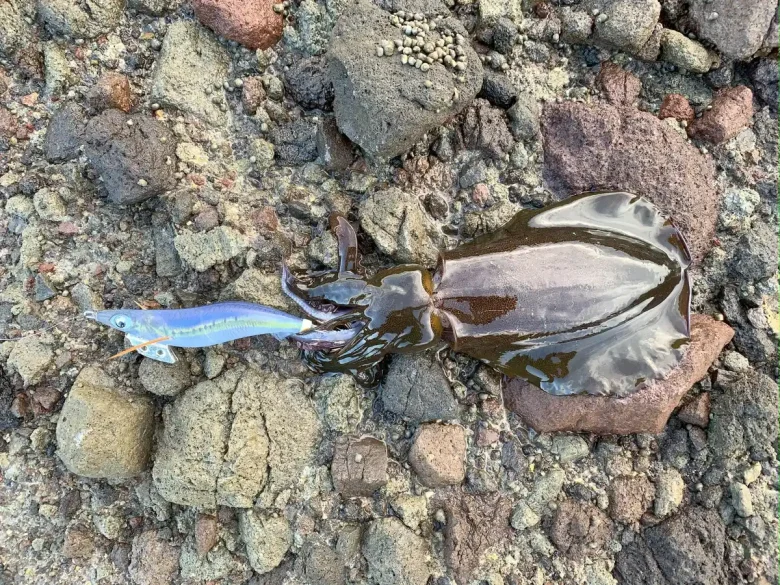
Those six situations all come back to the same handful of numbers printed on every egi packet. Here is how to read them, roughly in the order they matter on Australian ground.
One habit worth borrowing from the Japanese eging scene is treating the fall, not the retrieve, as the main event. The standard sequence is two or three sharp rod jerks to make the egi dart, then a controlled slack-line pause while it flutters back down: the vast majority of squid grab the jig on that fall, so the win is staying in light contact so you feel the weight go heavy. A common way to search a spot is to start with a #3.0 basic egi, count the sink to gauge depth, and change only one thing at a time after that, dropping to a slower Shallow or Type S fall over shin-deep weed, or up a size for depth and distance, rather than swapping the whole box at once. Sink rate is usually the more productive dial to turn than colour.
The whole field in one place, for when you are standing in the shop with your phone out.
| Egi | Brand | Rattle | Strength | Sizes | Approx. price |
|---|---|---|---|---|---|
| Yamashita Egi-Oh LIVE | Yamashita | Silent | Sharp tin dart, all-round search | #2.5–3.5 | ¥900–1,300 (~A$9–13) |
| Yamashita Egi-Oh Q LIVE Search | Yamashita | Yes | Calls fish in coloured/wide water | #2.5–3.5 | ¥1,000–1,400 (~A$10–14) |
| Daiwa Emeraldas Peak RV | Daiwa | Yes | Premium finesse rattle | #2.5–3.5 | ¥1,300–1,700 (~A$13–17) |
| Daiwa Emeraldas Dart II | Daiwa | Silent | Wide dart, tunable fall (S/SS) | #2.5–3.5 | ¥1,000–1,400 (~A$10–14) |
| Daiwa Emeraldas Nude | Daiwa | Silent | Sight egi for clear, pressured water | #2.5–3.5 | ¥1,300–1,700 (~A$13–17) |
| Yo-Zuri Duel EZ-Q Cast Rattle | Yo-Zuri / Duel | Yes | Easy action, beginner-friendly | #2.5–3.5 | ¥900–1,300 (~A$9–13) |
| Yo-Zuri Aurie-Q RS | Yo-Zuri / Duel | Silent | Durable classic, best value | #2.5–3.5 | ¥700–1,100 (~A$7–11) |
Seven jigs is a shopping list, not an answer. If you are starting the box from nothing, this is the order we would spend in.
Top pick: Yamashita Egi-Oh LIVE
The one to trust. The tin-sinker dart, Warm Jacket cloth and 490 glow make it a proven, high-performance search egi for our calamari, and it is stocked almost everywhere squid gear is sold in Australia. If you buy one family and learn it, make it this. Approx. ¥900–1,300 (~A$9–13).
Easiest to fish: Yo-Zuri Duel EZ-Q Cast Rattle
The most fish for the least effort. Its patented feet and rattle keep working on a plain twitch-and-retrieve, so beginners catch on it straight away, and the snagless bumper saves jigs on rocky ground. Cheap, effective and forgiving. Approx. ¥900–1,300 (~A$9–13).
Best value: Yo-Zuri Aurie-Q RS
The value pick and spare-box staple. A durable cloth-wrapped classic with a glow insert and tough body that catches squid and survives the rocks, at a price that lets you carry plenty. Buy a handful in a couple of colours. Approx. ¥700–1,100 (~A$7–11).
The #2.5 to #3.5 range covers almost all Australian southern calamari fishing. Use #2.5 for shallow, calm or pressured water, #3.0 as the everyday all-rounder, and #3.5 for depth, distance, current and the bigger squid that move in to spawn through late autumn and winter. Match the size to depth and conditions, not just squid size.
Sink rate is how many seconds the egi takes to fall one metre, so a higher number means a slower fall. A basic #3.5 sinks at about 3 sec/m, while a Shallow or slow-fall model of the same size might take 5 to 6 sec/m. Slower falls keep the jig in front of squid longer over shallow weed; faster falls get you down quickly in deep water or current. Squid take the egi on the fall, so matching sink rate to depth is one of the most important choices you make.
Both. A rattle egi like the Egi-Oh Q LIVE Search, Emeraldas Peak RV or EZ-Q Cast Rattle pulls squid in from further away, which helps in coloured or wide water. A silent egi like the standard Egi-Oh LIVE or Emeraldas Nude often out-fishes a noisy one on clear, calm, heavily fished flats where squid are spooky. Carry a couple of each and let the squid tell you.
You want a few of these rather than one, because squid change their mind with the tide, the light and the water clarity. Read as a shopping list, the sections above come out like this:
For the rest of the setup, see our full guide to eging in Australia, our pick of the best JDM egi rods, and the matching best JDM reels for eging.
All specifications were taken from the manufacturers’ official product information (Yamashita, Daiwa and Yo-Zuri/Duel). Egi prices are approximate street prices, tax excluded, with an approximate AUD conversion at the time of writing, because squid jigs are not sold at a fixed RRP. Sink rates vary between Basic, Shallow and Slow (Type S/SS) versions of the same size, and a few figures are given as ranges where the maker publishes them that way. Product images are from Amazon and the makers’ official pages and are representative of each series. Affiliate links may earn us a commission at no extra cost to you. Always check your local state fishing regulations for current squid size and bag limits.