Eging in Australia: A JDM Angler's Guide to Squid Jigging
ちゃんま
マイボ!
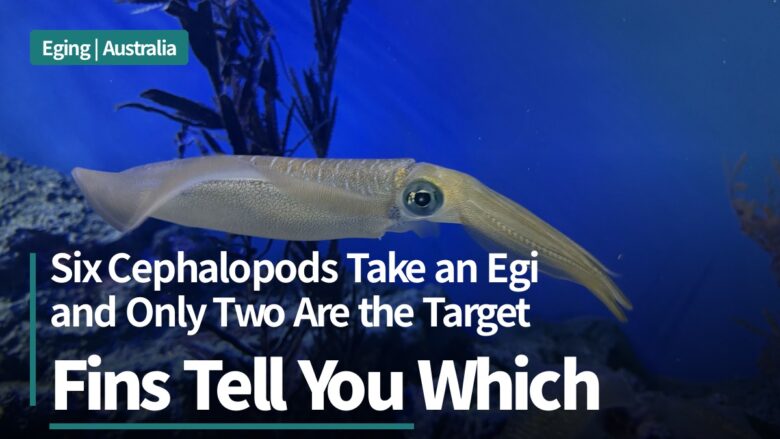
You work an egi back over the weed, the line goes heavy, and what comes up isn’t the broad-finned squid from the tackle catalogue. It’s torpedo-shaped and brick red. Or it’s a cuttlefish with the heft of a house brick, clamped onto the jig and unwilling to discuss it. Six cephalopods regularly end up on an egi in Australian water, and only two of them are what the technique was built for.
Telling them apart takes about three seconds once you know where to look, and it changes what you do next: whether to keep fishing that patch of weed, whether to move to the lit end of the jetty, whether you’re allowed to keep it at all. Fin shape does most of the identification work. Depth and bottom type do the rest.
Our eging guide for Australia covers reading the water and working the jig, and our egi size and colour guide covers the goh sizing and colour calls. Size limits, bag limits and area closures for squid, cuttlefish and octopus differ between states and change from year to year, so check your state’s current rules before you keep anything: PIRSA for South Australia, the Victorian Fisheries Authority guide for Victoria, and the equivalent fisheries page for your own state.
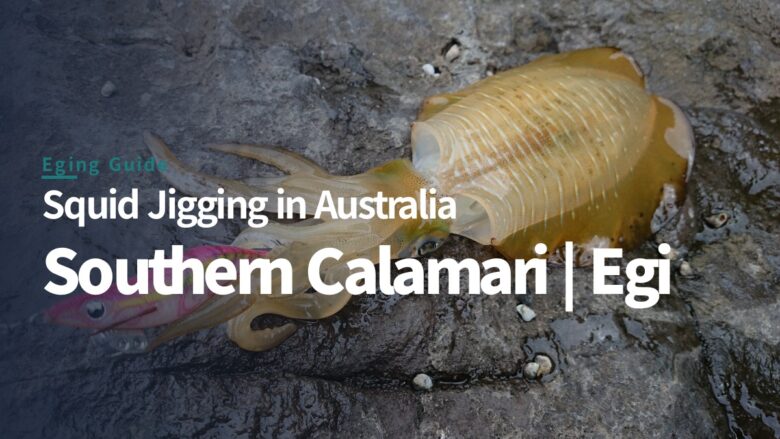
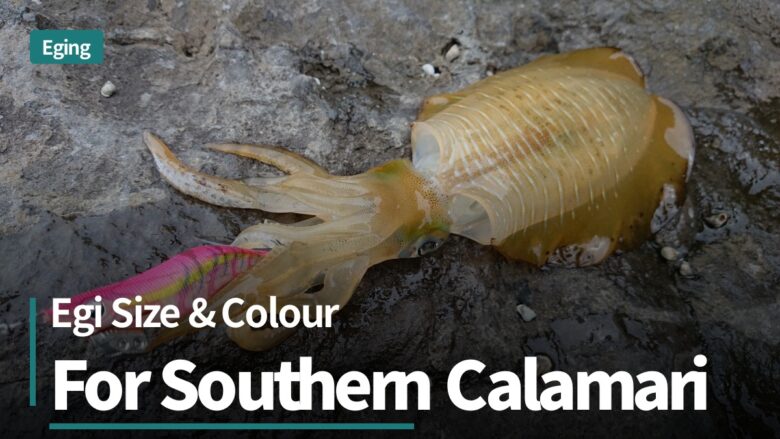
Southern calamari (Sepioteuthis australis) carries diamond-shaped fins that run the entire length of the body and are at their widest about halfway along it (Australian Museum). Colour is no help: the same animal ranges from even orange-brown to white with black bands to nearly transparent. The fin outline is the tell, and once you’ve seen it you won’t confuse it with any of the others.
They reach around 50 cm of mantle length (Australian Museum), and the national stock report puts the maximum at 550 mm and 3 to 4 kg, with a life of under a year and half the population mature at three to six months and 150 to 200 mm (Status of Australian Fish Stocks, 2023). A squid you catch in November was an egg in the weed the previous spring, which is why a good season and a poor one can sit right next to each other.
This is why eging works from shore here. It’s a shallow, inshore animal over reef, sand and seagrass, commonly from the surface down to about 10 m (Australian Museum), and the main spawning run is spring and summer in inshore coastal water, with eggs laid into seagrass and reef algae (Victorian Fisheries Authority, Review of key Victorian fish stocks). The range runs from the southern end of the Great Barrier Reef right around to Ningaloo Reef in Western Australia, plus the North Island of New Zealand (Australian Museum).
Stock status differs by state: sustainable in South Australia, Victoria and New South Wales, depleting in Tasmania (Status of Australian Fish Stocks, 2023). South Australia’s recreational catch alone came to an estimated 219 tonnes in 2021-22, more than any other state. A #3.0 egi is the everyday size for this squid and a #3.5 takes over when there’s depth or current, with the model-by-model options in our comparison of Japanese egi.
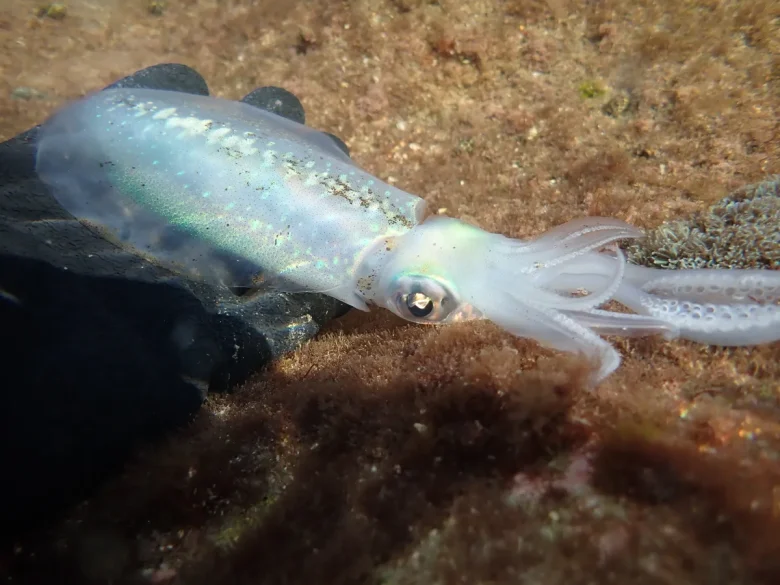
Move north and the broad-finned squid on your line changes species. Northern calamari, also sold as bigfin reef squid (Sepioteuthis lessoniana), runs from northern New South Wales and southern Queensland around the top to Shark Bay in Western Australia (Australian Museum). Japan’s aori-ika (アオリイカ) carries the same scientific name, and that is the squid Japanese eging tackle was designed around, so the rods and egi in every JDM catalogue were built for the animal off Queensland, not the one off Tasmania. Genetic work has since found more than one species under that name in both Japanese and Australian water, which the Australian Museum flags on its own page.
The fins separate the two calamari. On S. lessoniana they’re pear-shaped and widest closer to the rear of the body, and there’s a pair of iridescent transverse spots on the mantle (Australian Museum). Body length runs to about 40 cm, and they hold in shallow water down to roughly 100 m over coral reef and seagrass, moving onto the reef at night to feed.
Where you cast changes as well. Females lay their egg strings on hard objects, including mangrove roots, twigs, stones and coral (Australian Museum), so up here you are casting at structure rather than at open seagrass. They school in tight size classes, probably because the bigger ones eat the smaller ones. Through southern Queensland and northern New South Wales you can catch either calamari on the same jig.
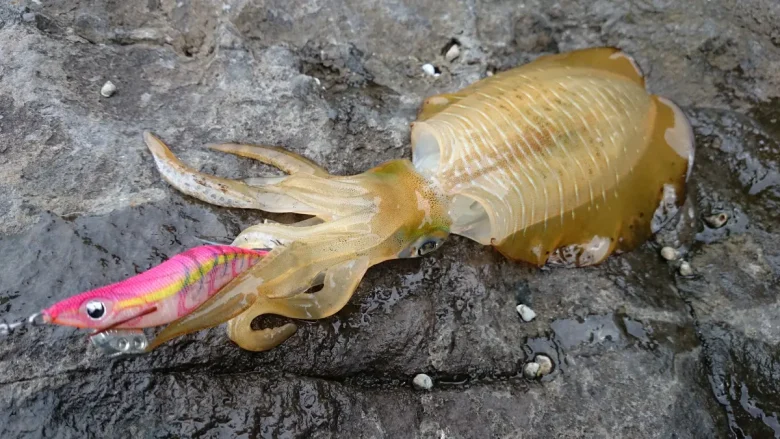
Gould’s squid (Nototodarus gouldi) is the one that looks wrong in the net. Heavily muscled mantle tapering gradually to wide triangular fins and then sharply to the tail, smooth skin in light brownish-pink to brick red, with a bluish purple stripe down the back (Australian Fisheries Management Authority). It answers to aeroplane squid or torpedo squid, and runs to 40 cm of mantle and 1.6 kg, though the usual weight is nearer 0.7 kg.
You don’t meet many of them from a beach. They live in temperate and subtropical water around Australia and New Zealand and have been recorded to 825 m, but they’re most abundant over the continental shelf between 50 and 200 m, and the commercial jig fleet works the 60 to 120 m contours (AFMA). What brings one within reach of an angler is that they sit near the sea bed through the day and rise into the water column at night to feed (AFMA). They grow up to 4 cm a month in south-eastern Australia, mature at six to nine months, and die shortly after spawning.
So the arrow squid you hook comes at night, in deeper water, usually in the light line off a jetty or from a boat. Tasmania’s auto jig sector targets them commercially and recreational fishers there take small amounts (AFMA). Working a weed edge in three metres at midday will not find one. Our guide to night eging in Australia covers the lit water after dark, and tip-run eging covers reaching deeper squid from a boat.
The giant Australian cuttlefish (Sepia apama) is the largest cuttlefish in the world, with a mantle reaching half a metre and a total length up to a metre, and it’s identified by two rows of three skin flaps above each eye (Australian Museum). It’s endemic to southern Australia, reaching Moreton Bay in Queensland on the east coast and Ningaloo Reef on the west. Spawning runs April to September with a peak in May and June, and lifespan is thought to be only two to four years.
In South Australia you have to know the rules for this one before you fish. Each winter tens of thousands of them gather to spawn at Point Lowly in the northern Spencer Gulf, the only known site in the world where they form large breeding aggregations (PIRSA). PIRSA holds permanent fishing closures for cephalopods, meaning squid, cuttlefish and octopus, in the False Bay and Point Lowly spawning area, and for cuttlefish throughout the waters of the Upper Spencer Gulf. Both closures prohibit targeting and taking those animals at all times (PIRSA, Giant Australian Cuttlefish management). Both areas stay open for other species, so you can fish there, just not for these.
Outside the closed waters, cuttlefish are taken on a small scale on jigs, baited hooks and spears, and fishing limits apply (Australian Museum; PIRSA). A cuttlefish does not chase a darting egi through mid-water the way a calamari does. It comes off the bottom, so what you change is the sink rate, not the size of the egi.
The mourning cuttlefish (Sepia plangon) is the small one you’ll meet in a harbour, reaching around 15 cm. It usually shows two narrow black bands across the mantle and two large eye spots towards the rear, with a bluish tinge around the eye socket that gives the species its name (Australian Museum). It’s an estuarine animal, typically in shallow bays and harbours at 3 to 9 m though recorded as deep as 83 m, ranging down the east coast from the Gulf of Carpentaria to Sydney. Juveniles sit in seagrass and adults hold near rocky reef and dwarf kelp.
Two useful habits: it forages during the day, and it rests on the bottom in a tripod, propped on its two lower arms. Daylight and on the bottom, the reverse of arrow squid, so a slow presentation dragged along an estuary bottom is what turns one up. Its cuttlebones wash up in numbers on beaches north and south of Sydney, so it is common even if you rarely catch one on purpose.
An octopus will take hold of an egi that has sat on the bottom too long. Victorian stock reviews cover Maori octopus (Macroctopus maorum) and pale octopus (Octopus pallidus) as commercial species (Victorian Fisheries Authority), and PIRSA’s False Bay closure covers octopus too.
Luminous bay squid (Uroteuthis noctiluca) grow to a body length of just 8 cm. They’re squat, marked with large dark spots and yellow and pink chromatophores on the fin and mantle margins, and their fins are half the body length and form a heart shape rather than running the full length of the mantle (Australian Museum). That is the tell: a fin that stops short is not a calamari, whatever size it is.
They live inshore in bays and estuaries, mostly amongst seagrass in water to 50 m, along the eastern coastline from the tropics to cool temperate water, and they tolerate low salinity well enough to forage in brackish water (Australian Museum). The light organs on the ink sac run on luminescent bacteria and hide the squid from anything looking up at it. Nobody plans a session around an 8 cm squid, and a small one hanging off a #3.0 tells you you’re on an estuary flat rather than calamari ground.
My own experience here is Japanese and it isn’t squid: it’s trout, in the managed trout ponds back home. Fishing for one particular species on purpose is still beyond me there. But the depth I fish and the action I give the lure can shift the size of what turns up on the day. Deeper water tending to bigger fish, that kind of thing. Only ever a tendency on the day, though, not something that repeats at every pond every time.
If the same thing holds for cephalopods, then what you can change isn’t the species. It’s the water: how deep, what’s on the bottom, what time of day. Shallow weed in daylight leans calamari, lit deep water at night leans arrow squid, and a slow presentation on the bottom in an estuary leans cuttlefish. You’re shifting the odds, not choosing the animal, and some days the odds ignore you.
| Species | How you know it | Main range | Water it holds in | Egi size | Target or bonus? |
|---|---|---|---|---|---|
| Southern calamari (Sepioteuthis australis) | Diamond fins the full length of the body, widest mid-body | Southern GBR around to Ningaloo, plus NZ | Reef, sand and seagrass, surface to about 10 m | #3.0, #3.5 with depth or current | The target |
| Northern calamari / bigfin reef squid (Sepioteuthis lessoniana) | Pear-shaped fins widest towards the rear, iridescent spots on the mantle | Northern NSW and southern QLD around to Shark Bay | Coral reef and seagrass, shallow to about 100 m | #3.0, #3.5 with depth or current | The target up north |
| Gould’s squid, arrow squid (Nototodarus gouldi) | Torpedo mantle, wide triangular fins, purple-blue dorsal stripe | Temperate and subtropical Australia and NZ | Shelf water, most abundant 50 to 200 m, up in the column at night | Sinking presentations at night or from a boat | Night and deep-water bonus |
| Giant Australian cuttlefish (Sepia apama) | Two rows of three skin flaps above each eye, mantle to half a metre | Southern Australia, Moreton Bay to Ningaloo | Rocky reef, spawning aggregation at Point Lowly in winter | Bottom-focused, sink rate over size | Closed in Upper Spencer Gulf, limits elsewhere |
| Mourning cuttlefish (Sepia plangon) | Around 15 cm, two black bands, two eye spots, blue tinge at the eye | Gulf of Carpentaria to Sydney | Estuaries, bays and harbours at 3 to 9 m | Smallest sizes, worked on the bottom | Estuary bycatch |
| Luminous bay squid (Uroteuthis noctiluca) | Body to 8 cm, heart-shaped fins half the body length | Eastern Australia, tropics to cool temperate | Bays, estuaries and seagrass to 50 m, tolerates brackish water | Too small to fish for | Release it |
Ranges, depths and sizes come from the Australian Museum species pages, AFMA’s species profile for Gould’s squid, and the national and Victorian stock reports. Peak timing moves by state and by year, so local reports and water temperature beat any published season.
South of about the Queensland border, southern calamari is the species to build a session around: shallow, reachable from rock and jetty, active in daylight, spawning inshore through spring and summer. North of it, northern calamari does the same job on the same tackle. Everything else is something you meet rather than something you plan for.
The one to leave alone is the giant cuttlefish in South Australia’s Upper Spencer Gulf, closed at all times. Elsewhere, treat it as a species with rules attached rather than a target.
Look at where the fins start and stop. A calamari’s diamond-shaped fins run the whole length of the mantle and are widest about halfway down. An arrow squid has a torpedo-shaped mantle with wide triangular fins at the tail end only, and usually a bluish purple stripe along the back. Colour is useless for this, since both species change it at will.
Cuttlefish are taken on jigs on a small scale, but they come off the bottom rather than chasing the jig through mid-water, so slow the fall and keep contact with the bottom. In South Australia, check the closures first: cephalopods are closed in the False Bay and Point Lowly spawning area, and cuttlefish are closed throughout the Upper Spencer Gulf at all times.
No. Size and sink rate answer to depth, current and wind rather than to the species on the end, and a #3.0 with a #3.5 for deeper or windier water covers both calamari and most of what else turns up. The detail sits in our egi size and colour guide.
Southern calamari run right across the south, from the southern end of the Great Barrier Reef around to Ningaloo. Northern calamari take over from northern New South Wales and southern Queensland around to Shark Bay, so on the mid to northern NSW coast you can get either one. Arrow squid are a shelf species and come up at night. Giant cuttlefish are southern, with South Australian rules attached, and mourning cuttlefish run the east coast down to Sydney.
Two fin shapes and a rough depth settle which animal you’re holding, and that settles everything after the hookup: keep casting at the weed edge, walk to the lights, or put it back.
The tackle barely cares. One eging outfit and a handful of egi cover all six, and the only one that asks anything different is the giant cuttlefish, where the question isn’t the jig. It’s whether you’re allowed to fish for it.