Shimano Sephia XR vs XTUNE for Australian Eging: 20 Models, and When XR Is Enough
ちゃんま
マイボ!

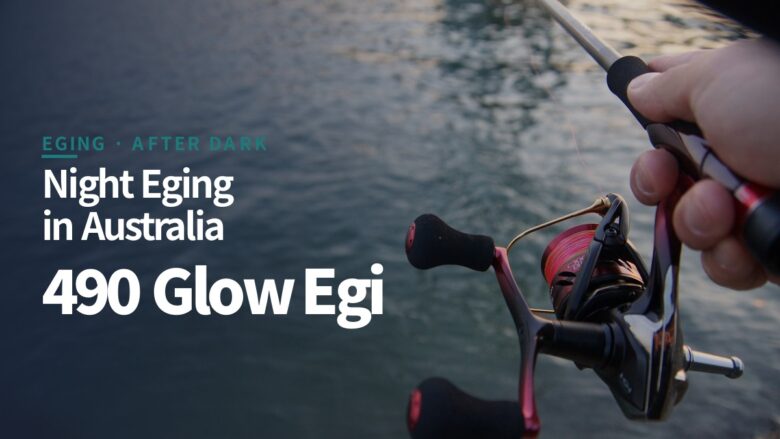
Jetty lights flick on, the last of the day goes out of the water, and most squid anglers start winding in. In Japan that’s roughly when the eging crowd turns up. Fishing an egi (エギ, the Japanese squid jig) after dark is an ordinary weeknight there rather than a novelty, and the approach travels well to an Australian breakwall in spring.
What changes at night isn’t really the technique. It’s the job the lure has to do. In daylight an egi can lean on foil, flash and a natural silhouette to get noticed. Once it’s properly dark, the egi has to advertise itself, and the water around a light behaves like a completely different piece of structure from the same spot at noon.
Southern Calamari (Sepioteuthis australis) push onto shallow weed through the cooler months and into spring, and September and October are when plenty of shore anglers start finding them thick in close. Mild evenings arrive at the same time, which is the other reason the night shift catches on. Check your state’s current size and bag limits before you keep any squid.
New to the method? Our complete guide to eging in Australia covers the daytime basics. This one is about what changes after sunset.
A note on prices and links: gear here is Japanese-domestic (JDM), so prices are in Japanese yen with an approximate AUD conversion at A$1 = ¥110 (August 2026). Some makers publish tax-excluded prices and others publish tax-inclusive ones, so each figure below is labelled. JDM items link to Amazon Japan. Ships internationally from Amazon Japan — check availability and shipping cost at checkout. Orders over A$59 may qualify for free international delivery. The Yamashita egi link to Amazon.com, which ships internationally to Australia.
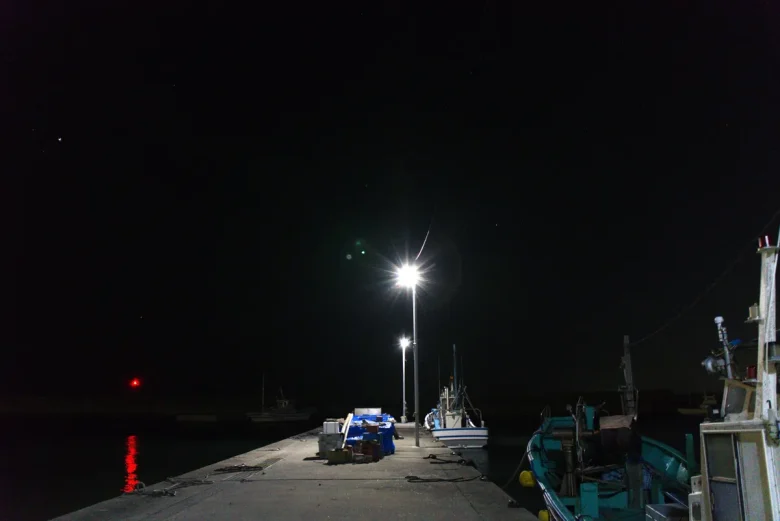
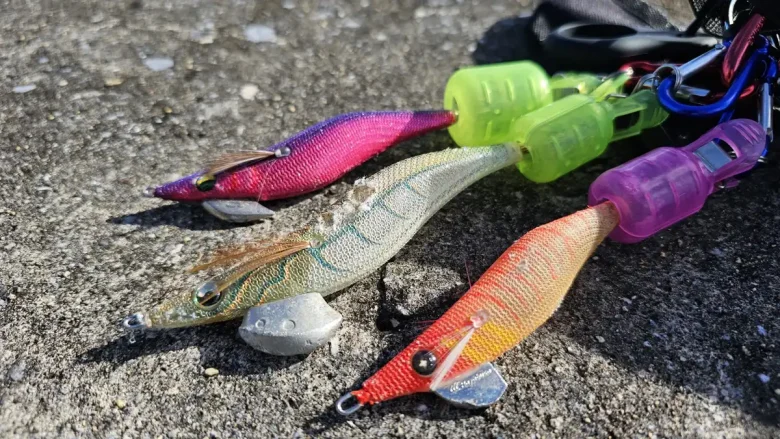
Often, yes, and for a reason that has little to do with squid being nocturnal. Calamari hunt by contrast. A lit jetty, a moored boat running a deck light, a bridge span throwing a hard line across the surface: each one builds a wall of glare with a dark edge to it. Bait stacks up in the bright part. Squid hang just outside, facing in. The strike zone is the boundary, not the middle of the light, so cast past the glow and work the egi back into that seam.
It isn’t automatic, though. A full moon on flat, clear water can make an evening feel dead, and a jetty with no bait under it is just a jetty with a light on it. Arrow squid (Nototodarus gouldi) turn up around the deeper lights too and pull a lot harder than a calamari of the same size, which is either a bonus or a shredded leader depending on your night.
There’s a less glamorous factor as well. Popular calamari ground gets walked over all weekend. Fish it on a Tuesday at nine at night and the weed is yours.
Here’s where a lot of imported Japanese egi get used at the wrong hour. Yamashita, which runs its own research on how squid see, splits its bodies three ways: keimura (ケイムラ, UV-reactive clear) for bright, clean water; yakou (夜光, ordinary glow) for low light and stained water; and 490 Glow for the ground in between. Keimura only fluoresces under ultraviolet, and after sunset there’s almost none of it around. The bodies that do damage at midday quietly stop working at ten at night.
490 Glow is the one worth understanding properly. Yamashita’s figure is 490 nanometres, the wavelength most squid species perceive most easily, so a body emitting there produces the biggest light-and-dark contrast an egi can generate in dark water. It sits between a full glow body, which can be too loud in clear and calm conditions, and a natural finish that simply vanishes.
| Body finish | What it does | Where it earns a spot after dark |
|---|---|---|
| Keimura (UV clear) | Fluoresces under ultraviolet light | Daytime and clear water. Nothing excites it at night |
| Yakou (standard glow) | Charges under light, then emits | Black nights, stained water, deep weed |
| 490 Glow | Emits at 490 nm, the wavelength squid read best | Dusk, moonlight, light-edge work, faint stain |
| Red or solid body | Blocks light and hardens the silhouette | Directly under a jetty light, or against a moonlit surface |
Two models from that range cover an Australian night box between them. Sizes below are given in Japanese gō (号) numbers, the standard grading for egi.
Egi-Oh LIVE is the dart-first body in the family. The Blade Sinker is cast in tin rather than lead, and the low centre of gravity is what keeps the thing stable in the air on a long cast and sharp when you kick it sideways. For night sessions the colour chart matters more than the action. 042 Luna White is an unpainted glow body, 039 and 040 put a glow base under an orange or pink back, and 036 and 037 hide a 490 Glow base under a natural aji or iwashi pattern. Luna White is the one to tie on when it’s genuinely black out.
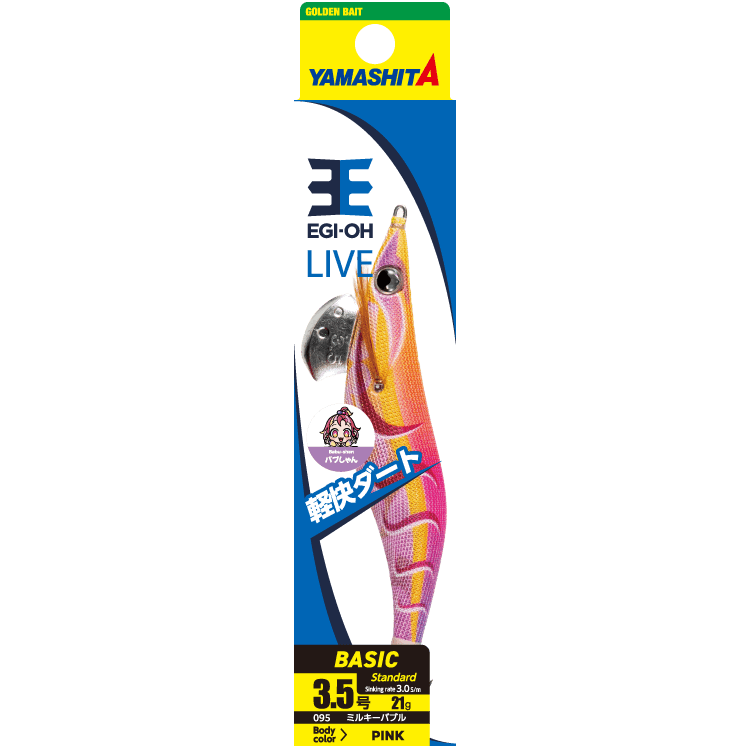
| Technology | What Yamashita says it does |
|---|---|
| Blade Sinker (ブレイドシンカー) | Tin sinker, redesigned in both material and shape for a sharper dart. Guide holes in the sides let you tune the weight yourself |
| Quick Dart (クイックダート) | Same dart width as the previous LIVE with forward travel cut by 33 percent. Yamashita counts 200 actions on a 50 m cast against 150 for the Egi-Oh Q LIVE |
| Low centre of gravity (低重心設計) | Lower than the old LIVE, which steadies the dart and the flight attitude on the cast |
| 490GLOW eye cups | Eyes that emit at 490 nm, the wavelength aori squid perceive most easily, as a single-point attractor |
| Model | Size | Weight | Length (hooks excl.) | Sink rate |
|---|---|---|---|---|
| Egi-Oh LIVE 2.0 | 2.0 gō | 6.5 g | 60 mm | approx. 5.5 sec/m |
| Egi-Oh LIVE 2.5 | 2.5 gō | 10 g | 75 mm | approx. 5.5 sec/m |
| Egi-Oh LIVE 3.0 | 3.0 gō | 15 g | 90 mm | approx. 3.5 sec/m |
| Egi-Oh LIVE 3.5 | 3.5 gō | 21 g | 105 mm | approx. 3 sec/m |
Egi-Oh K is the awkward-conditions body: cross-wind, current, casts at bad angles. Adding 490 Glow colours to that hull gives you the shape that behaves plus the emission wavelength, which is why it’s the more useful of the two for a night box. 054 Hotaru Ebi carries the strongest 490 Glow body of the set, and Yamashita’s own note on the colour points to moonlight and sand as where it sits right. The range also runs to a 4.0 at 26 g and 120 mm, handy when you’re punching into a spring southerly for bigger calamari. One catch: 053 Ultramarine is made in 3.5 only, so don’t build a whole box around it.
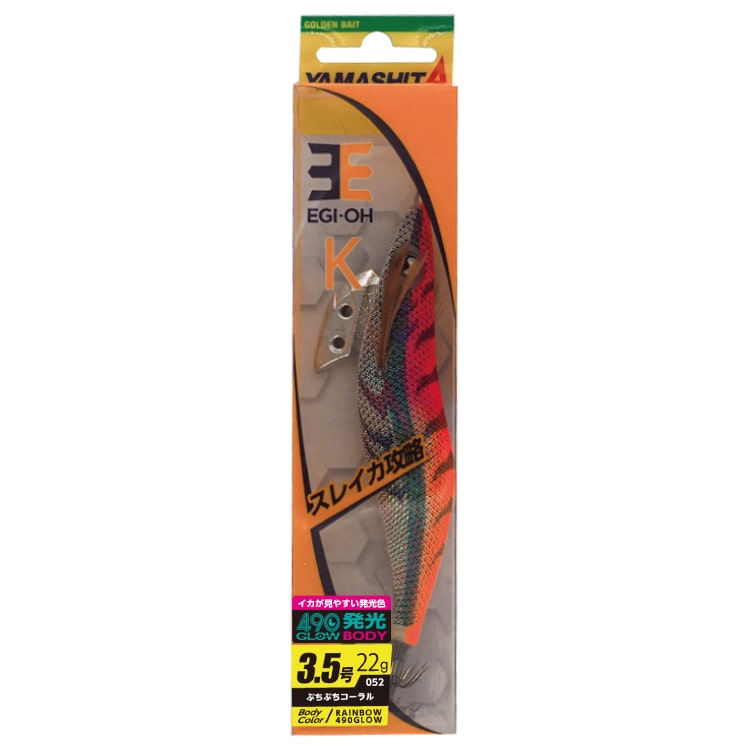
| Technology | What Yamashita says it does |
|---|---|
| 490 Glow body (490グロー) | Emits at 490 nm, the wavelength most squid species read most easily, producing the largest light-and-dark contrast an egi can make in dark water |
| Where Yamashita places it | Keimura for clear water in daylight, yakou for low light and heavy stain. 490 Glow is built for the ground between the two |
| 490 rainbow body (490虹ボディ, colour 052) | Rainbow base with mottled 490 Glow emission leaking through it, aimed at squid that have seen too many egi |
| Model | Size | Weight | Length (hooks excl.) | Sink rate |
|---|---|---|---|---|
| Egi-Oh K 490 Glow 2.5 | 2.5 gō | 11 g | 75 mm | approx. 5 sec/m |
| Egi-Oh K 490 Glow 3.0 | 3.0 gō | 16 g | 90 mm | approx. 3 sec/m |
| Egi-Oh K 490 Glow 3.5 | 3.5 gō | 22 g | 105 mm | approx. 3 sec/m |
| Egi-Oh K 490 Glow 4.0 | 4.0 gō | 26 g | 120 mm | approx. 3 sec/m |
Sizing and colour choice deserve more room than a night article can give them. We go through gō numbers, cloth versus tape and how to change one variable at a time in egi size and colour for southern calamari, and the wider range of Japanese egi worth importing in our guide to the best Japanese egi.
You need one. What surprises people is which mode ends up doing the work.
Swing a thousand lumens of white light across the water in front of you and you can watch squid leave. Use the same beam to re-tie a leader and your night vision is gone for the next ten minutes. The lamp that suits eging is one you can run on red, at low output, for hours on end, keeping the white beam for walking in and for landing a squid at your feet.
Zexus, built by Fuji-Toki, is the brand you’ll see on Japanese breakwalls more than any other. Two models bracket the range, and they’re genuinely different tools rather than two rungs of the same ladder.
| Feature | ZX-R730 | ZX-195 |
|---|---|---|
| Light sources | Super LED white ×1, warm-white chips ×8, red chip ×1 | Super LED white ×1, red chips ×5 |
| Red output | approx. 15 lm, wide | approx. 60 lm, wide |
| Power | ZR-02 lithium-ion pack (also works as a power bank) | 3 × AAA alkaline, or the ZR-01+ pack |
| Longest red burn | approx. 80 hours at 100% | approx. 48 hours at 10% |
| Best suited to | All-night sessions, long walks in, charging a phone | Two to five hours on a jetty, thrown in a bag |
The R730 is the one Japanese anglers buy when they fish until the tide turns. It boosts to about 1,200 lumens with the main and warm-white LEDs together, throws roughly 200 m, and still weighs only 130 g in the body because the ZR-02 pack sits on the back of the strap. Eighty hours of red at full output means you never think about the battery. The ZX-195 does something different for well under half the money: 400 lumens of white, a proper 60-lumen red, 50 g on your head and three AAAs you can buy anywhere. Both are rated IPX4, which covers rain and spray and nothing else. Drop either off the wall and it’s finished.
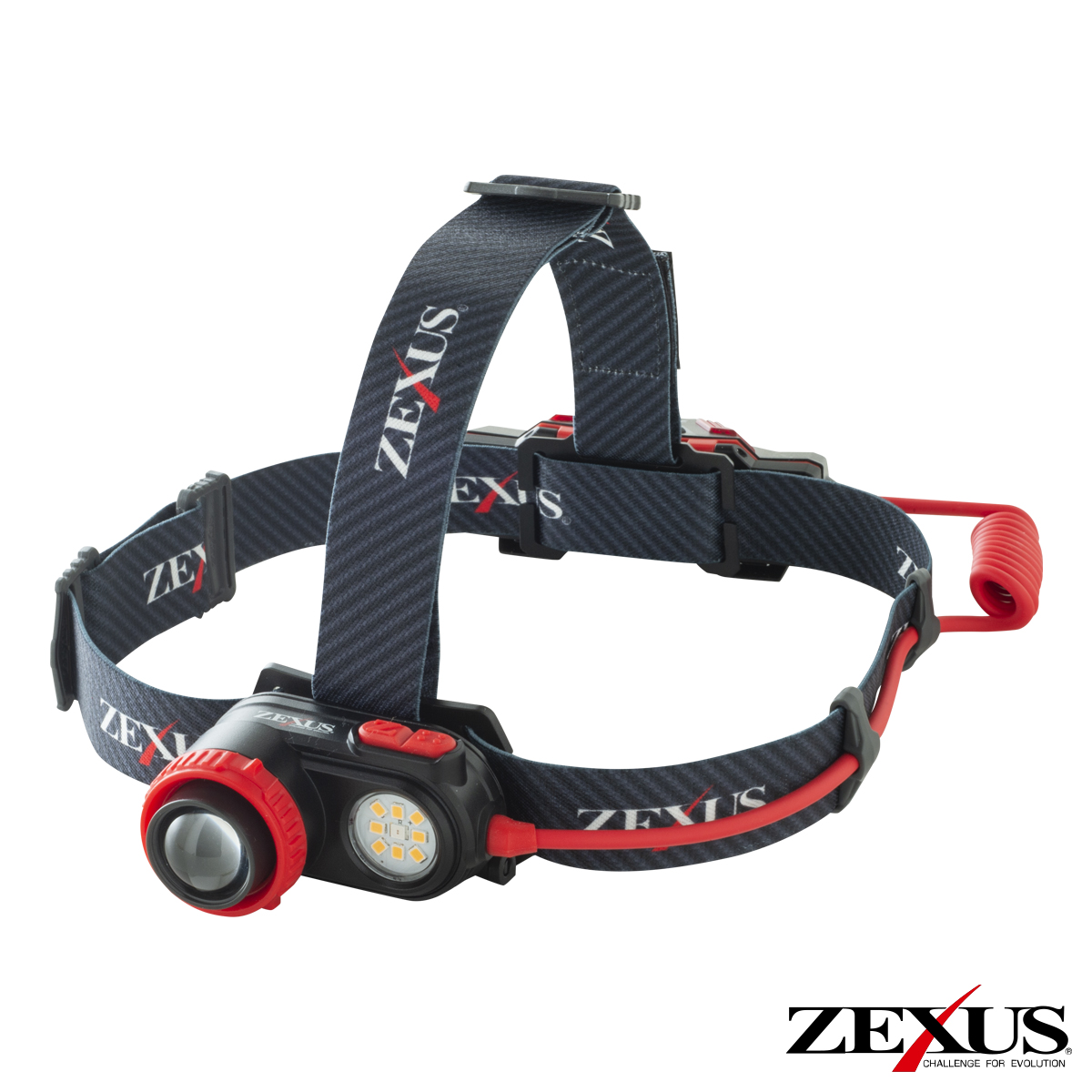
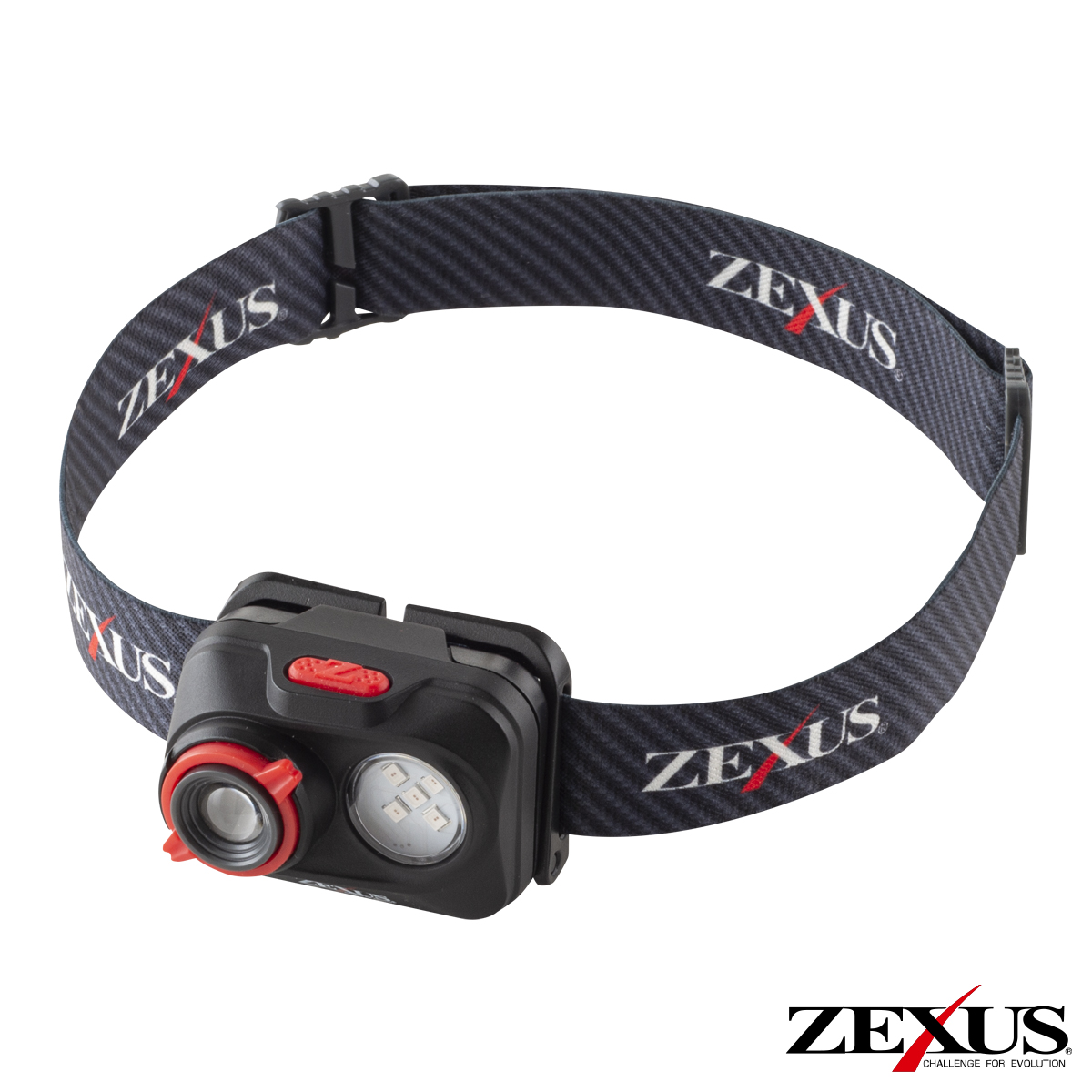
| Model | Max white | Red | Battery | Beam distance | Body weight | Water resistance | Price (incl. tax) |
|---|---|---|---|---|---|---|---|
| ZEXUS ZX-R730 | approx. 1,200 lm (boost) | approx. 15 lm | ZR-02 Li-ion | approx. 200 m | approx. 130 g (excl. battery) | IPX4 | ¥19,360 (~A$176) |
| ZEXUS ZX-195 | approx. 400 lm | approx. 60 lm | 3 × AAA (or ZR-01+) | approx. 120 m (white spot) | approx. 50 g (body only) | IPX4 | ¥7,480 (~A$68) |
Glow pigment doesn’t make light, it stores it. An egi that’s been sitting in a closed box glows for a few seconds after you clip it on, then it’s a lump of moulded plastic with cloth over it. If you fish glow or 490 Glow bodies, you’re charging them whether you plan to or not.
The neat way to do it is a chip UV torch, and Daiwa’s Emeraldas UV Light α exists for that single job. Aluminium body, one AAA cell, about 35 g, roughly the size of a fat pen, splash-resistant enough to survive an evening of spray. Charge the egi in the seconds before the cast, not after the retrieve. Your white headlamp will push some light into the body as well, at the cost of your night vision every single time you use it.
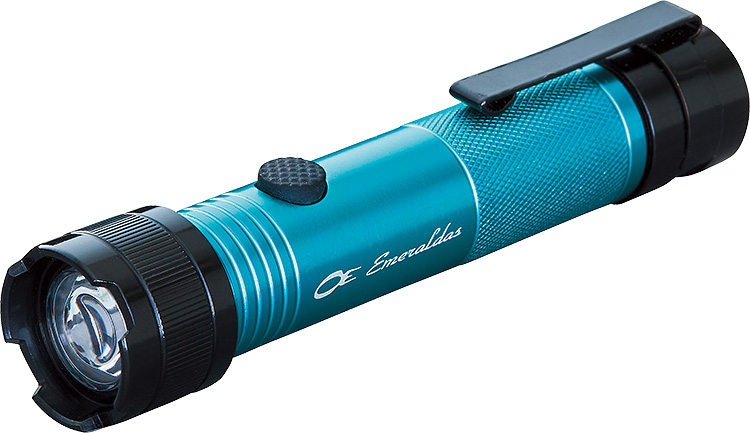
| Feature | What Daiwa says it’s for |
|---|---|
| Chip-type UV LED | Illuminating glow (yakou) egi to keep their appeal up |
| Aluminium alloy body | Durability, with simple water resistance for rain |
| Single AAA cell | Holds initial brightness for longer than the cell size suggests |
| Model | Body weight | Dimensions | Battery | Price (excl. tax) |
|---|---|---|---|---|
| Daiwa Emeraldas UV Light α | approx. 35 g (excl. battery) | approx. Ø19.5 × 96 mm | 1 × AAA (sold separately) | ¥3,750 (~A$34) |
Save your money on the rod. Line and leader are a different question.
Your usual 8’0″ to 8’6″ shore eging rod is the right tool. If anything, a slightly softer tip helps, because everything you learn about the fall at night comes through your hands rather than your eyes. We’ve compared the JDM options in best eging rods from Japan, and none of the reasoning changes after sunset.
Line is where one habit stops earning its keep. High-visibility braid is sold on being easy to track against the water, and at midnight you can’t see it anyway. Leader matters more instead. Lit pylons come with oysters and growth you can’t inspect, so a slightly longer and slightly heavier fluorocarbon leader is cheap insurance. Our eging line setup guide covers gō sizing, leader length and snaps in detail.
Snaps deserve a line of their own here, because you’ll be changing egi by feel. A clip you can open with cold fingers and no light is worth more at 11pm than any other piece of terminal tackle you own.
One last thing, and it isn’t tackle. Walk any ledge or wall in daylight before you fish it in the dark. Wear a life jacket, tell somebody where you are, and leave rock platforms alone at night unless you know them well and have company.
Japanese harbour walls come with jouyatou (常夜灯), permanent night lights, on almost every corner, and squid anglers treat them as structure in their own right. We’ve fished them with an egi rather than with the live-bait yaen (ヤエン) rig that plenty of Japanese squid anglers still prefer for aori squid, and the routine is dull enough to be repeatable.
Stand back from the pool of light so your own shadow isn’t sitting in it. Cast beyond the edge, work the egi in toward the boundary, then let it hang there longer than feels sensible. Ink stains on the concrete tell you which corners have been producing, which is about as good as local knowledge gets when you’re not talking to anyone. The discipline that carries over to an Australian jetty is all about light: keep your headlamp off the water, keep your movements slow on the skyline, and let the egi be the brightest thing in the picture.
| Item | Type | Key night spec | Price | Store |
|---|---|---|---|---|
| Yamashita Egi-Oh LIVE 3.0 | Egi, dart action | Glow and 490 Glow colours; 15 g, approx. 3.5 sec/m | No published RRP | Amazon.com |
| Yamashita Egi-Oh K 490 Glow 3.5 | Egi, wind and current | 490 nm emission; 22 g, approx. 3 sec/m | No published RRP | Amazon.com |
| ZEXUS ZX-R730 | Headlamp, rechargeable | approx. 80 h on red; power bank; 130 g | ¥19,360 incl. tax (~A$176) | Amazon Japan |
| ZEXUS ZX-195 | Headlamp, AAA | 60 lm red; 50 g; approx. 48 h at 10% | ¥7,480 incl. tax (~A$68) | Amazon Japan |
| Daiwa Emeraldas UV Light α | UV charging torch | Chip UV LED; 35 g; 1 × AAA | ¥3,750 excl. tax (~A$34) | Amazon Japan |
If one egi goes in the box for a spring night on a lit wall, this is it. The K hull holds its line when there’s wind or run on the water, which is most nights on an exposed jetty, and the 490 Glow body gives you contrast without the blaring of a full glow finish. 22 g and roughly 3 sec/m suits the depth most shore anglers are fishing. No published RRP from Yamashita, so shop on price. Check the Egi-Oh K 490 Glow 3.5 on Amazon.com, which ships internationally to Australia.
Sixty lumens of red, fifty grams and three AAAs covers the way most of us actually fish: a few hours after work, then home. At ¥7,480 including tax (~A$68) it costs less than a couple of egi and it’s the single upgrade that changes a night session most. Step up to the ZX-R730 at ¥19,360 (~A$176) if you fish through to first light or want the pack to charge your phone. Check the ZX-195 on Amazon Japan.
This is the one people leave off the list, then wonder why their glow bodies quit on them after the first drop. Thirty-five grams on a lanyard, ¥3,750 excluding tax (~A$34), and every glow body you clip on is actually lit when it hits the water. Buy it with the egi rather than after them. Check the Emeraldas UV Light α on Amazon Japan. JDM items ship internationally from Amazon Japan; confirm availability and freight at checkout.
Pick a jetty you already know in daylight, wait for spring, and give the first two hours of dark a proper go before you judge it. If you want the daytime groundwork first, the eging in Australia guide is the place to start. And check your state’s size and bag limits for squid before every trip, because they do change.