LRF for Bream and Trevally in Australia: The Japanese Finesse Setup
ちゃんま
マイボ!

Whiting on the surface is the one Australian fishery where a lure the length of your little finger outfishes everything else in the box. The fish are small, the water is often knee deep, and the take is a fast swirl that misses as often as it connects. That is the kind of problem Japanese lure makers like: narrow, repeatable, and solved with millimetres rather than marketing.
The technique side is already well covered by people fishing it every week. What nobody has written down in English is the shelf: which Japanese surface lures exist in this size class, and which one you reach for when the wind comes up.
One of the seven is stocked in Australian tackle shops and needs no importing. The other six come from Japan. Amazon Japan ships internationally: check availability and shipping cost at checkout, and orders over A$59 may qualify for free international delivery. Whiting size and bag limits are set by each state, so check your local regulations before you keep anything.
Sand whiting (Sillago ciliata) and yellowfin whiting (Sillago schomburgkii) belong to the same genus as Japan’s shirogisu (Sillago japonica), the fish Japanese anglers call kisu. Same body shape, same sand, same habit of grubbing along in water too shallow to anchor in. That shared genus is why the Japanese small-plug shelf transfers here without anyone having to redesign anything, and Bassday even carries a colour called MT Kisu in the Sugapen range.
What separates one of these lures from the next comes down to four things.

Glassy water on a rising tide over pale sand is the hardest version of this fishing. The fish see everything, including you, and a lure that lands heavily puts a hole in the session. This is where the smallest thing in the box wins.
Forty-five millimetres and 2.5 g. Ecogear’s stated design brief is a prawn fleeing across the flats, and the lure is built around a small cup face that throws a forward splash without turning into a popper. The retrieve Ecogear publishes is a constant sideways slide with pauses, and they say most fish strike after the lure has settled. Their other note is about terminal tackle rather than the lure: run mono or a floating leader so the action is not dragged down.

The catch is the price. Ecogear publishes no list price for any of its lures, so what you pay is whatever the shop asks. Twelve colours are catalogued for the 45F. Australian shops also carry a 55 mm PX, which Ecogear does not catalogue at all, so with that one you are buying on the shop’s word.
| Design brief | Surface movement of a prawn fleeing across the flats |
| Face | Small cup, forward splash, streamlined body behind it |
| Retrieve note | Constant sideways slide with pauses; strikes come after the lure settles |
| Leader note | Mono or floating leader to keep the action free |
| Model | Length | Weight | Depth | Colours | JDM RRP |
|---|---|---|---|---|---|
| Ecogear PX 45F | 45 mm | 2.5 g | Surface | 12 | Not published |
Infeet is one of Daiwa Australia’s family brands, so this one sits in local tackle shops at a local RRP with a local warranty. No parcel, no customs, no guessing at a Japanese size chart.
A walk-the-dog lure built as a prawn imitation, re-tuned with tungsten weighting that Daiwa says improves how the lure sits in the water and sharpens its response on the retrieve. The TG Tune models carry two small plastic rattle beads in the head, which Daiwa describes as the clicking sound of prawns fleeing on the surface.
The detail worth paying attention to is the hook. Each one comes fitted with BKK Striker Assist hooks on the rear eyelet, which hang below the lure at rest and swing across as the fish takes. Daiwa’s product copy credits whiting anglers specifically for that change. Everything else in this size class runs trebles, which makes that hook the one real structural difference between them.

Daiwa splits the two sizes by situation rather than by fish. The 65F is for water that is exceptionally clear, or fish that are fleeting and spooky. The 80F is for fish feeding hard, or for when casting distance is the thing you need most. The same eight colours cover both. One correction to anything you read elsewhere: the current Australian range is these two sizes only, and Daiwa’s own 80F copy treats the pair as the whole range. The 85 and 97 that still circulate on forums and old retailer listings are out of the catalogue.
| Weighting | Tungsten, for water posture and retrieve response |
| Sound | TG Tune: two plastic rattle beads in the head |
| Hooks | BKK Striker Assist on the rear eyelet, free swinging |
| Action | Walk the dog, prawn imitation |
| Model | Length | Weight | Type | Colours | AU RRP |
|---|---|---|---|---|---|
| Infeet Slippery Dog 65F TG Tune | 65 mm | 3.8 g | Topwater | 8 | A$25.99 |
| Infeet Slippery Dog 80F TG Tune | 80 mm | 6.7 g | Topwater | 8 | A$26.99 |
Find it through Daiwa Australia’s dealer finder rather than ordering from Japan. No imported lure beats it on availability.
Most sessions are not glassy calm or blowing fifteen knots. They are somewhere in between, with a light ripple and fish spread over a couple of hundred metres of sand. The lure you want here is the one you can fish all day without thinking about it.
Seventy millimetres and 4.3 g, on #10 trebles and #2 split rings. The 70F is the middle of the Sugapen range and the size that does the most work: light enough not to spook fish in a metre of water, heavy enough to reach past the first gutter. Bassday’s claim for it is low air resistance, so it casts further than 4.3 g normally would, and it gets eighteen colours, more than any other size in the range.
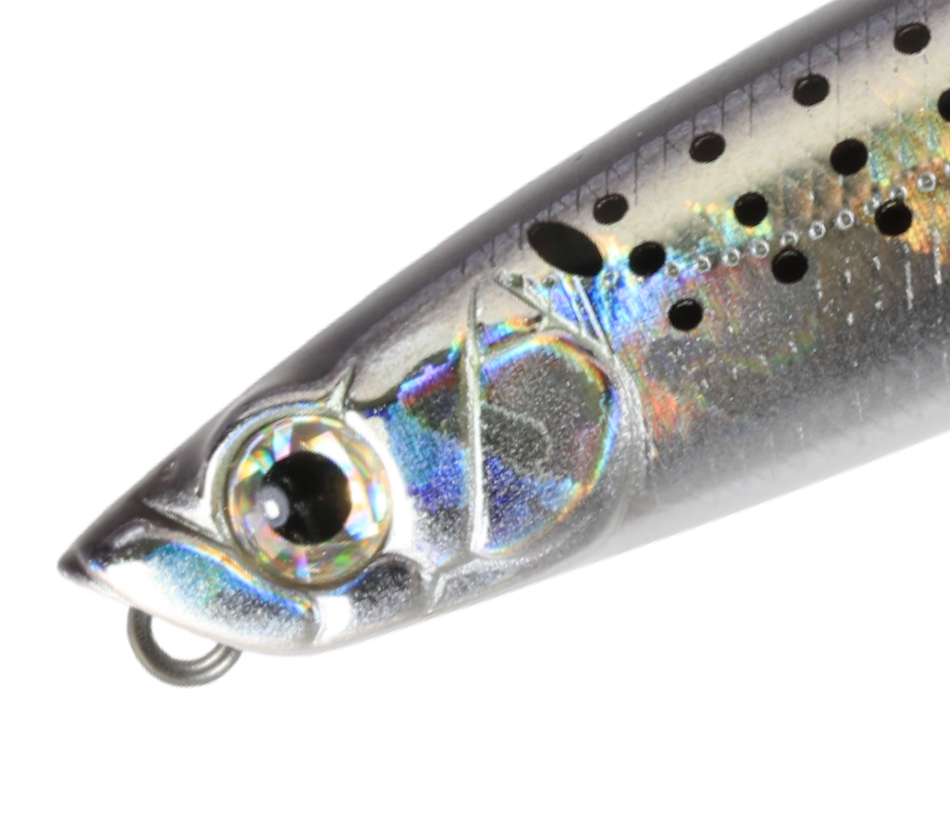
Bassday’s published target list for the Sugapen is seabass, kurodai, meki and kamasu, so whiting appear nowhere in it. The colour chart says something different: MT Kisu, Shiba Ebi, S Shirasu. The fish the lure was drawn for and the fish it gets thrown at in Australia are not quite the same, and that is fine. Every Sugapen is also tagged MZ-19 on the product page, a build spec Bassday defines nowhere on the site, so treat MZ-19 as an internal designation rather than a feature you can compare between brands.
| Claim | Low air resistance for the weight, so it casts well |
| Stated use | Feeding-mode fish on the surface |
| Published targets | Seabass, kurodai (black bream), meki, kamasu |
| MZ-19 | Carried on every Sugapen; undefined on the maker’s site |
| Model | Length | Weight | Hook / Ring | Colours | JDM RRP (excl. tax) | Approx. AUD |
|---|---|---|---|---|---|---|
| Bassday Sugapen 70F | 70 mm | 4.3 g | #10 / #2 | 18 | ¥1,750 | A$15.4 |
If you would rather not wait on a parcel for a lure in this size class, the 65F Slippery Dog covers the same job off an Australian shelf at A$25.99. You give up half a gram of casting weight and gain a rear assist hook.
A cross wind ruins a 3 g lure. The cast falls short, the line bellies, and the lure stops walking because you are fighting slack instead of working the rod tip. The fix is mass.
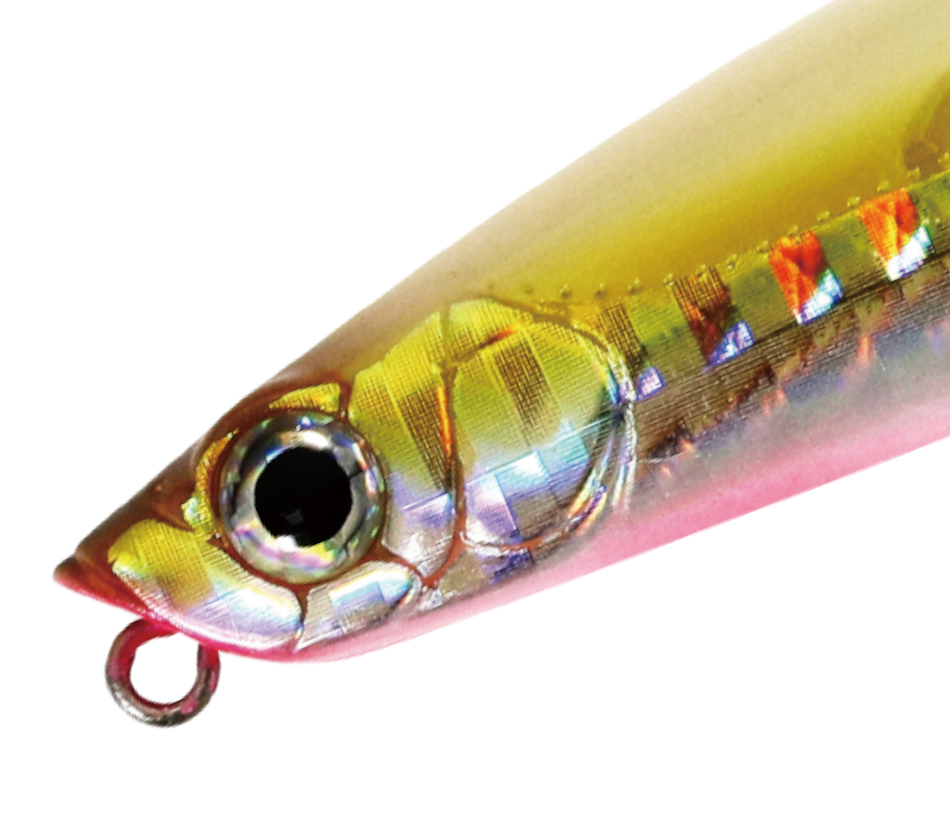
Ninety-five millimetres and 8.5 g, which is double the 70F, on #6 trebles and #3 rings. That hook jump from #10 to #6 is the part people miss: much heavier wire, so a 30 cm whiting feels it differently, and anything bigger that turns up on the flats has something to hold onto. Seventeen colours. At 95 mm you are at the top of what most people would throw at whiting, and on a calm day it is simply too much lure.
| What changes against the 70F | Weight roughly doubles; hooks #10 to #6, rings #2 to #3 |
| Stated use | Same feeding-mode brief as the rest of the range |
| Best conditions | Wind, chop, bars further out than a light lure will reach |
| Model | Length | Weight | Hook / Ring | Colours | JDM RRP (excl. tax) | Approx. AUD |
|---|---|---|---|---|---|---|
| Bassday Sugapen 95F | 95 mm | 8.5 g | #6 / #3 | 17 | ¥1,850 | A$16.2 |
Every whiting session has a stretch where you get four boils and no hook-ups. Sometimes the answer is a smaller lure. Sometimes it is a louder one that pulls fish from further away, so the ones that do commit have made up their minds before they arrive.
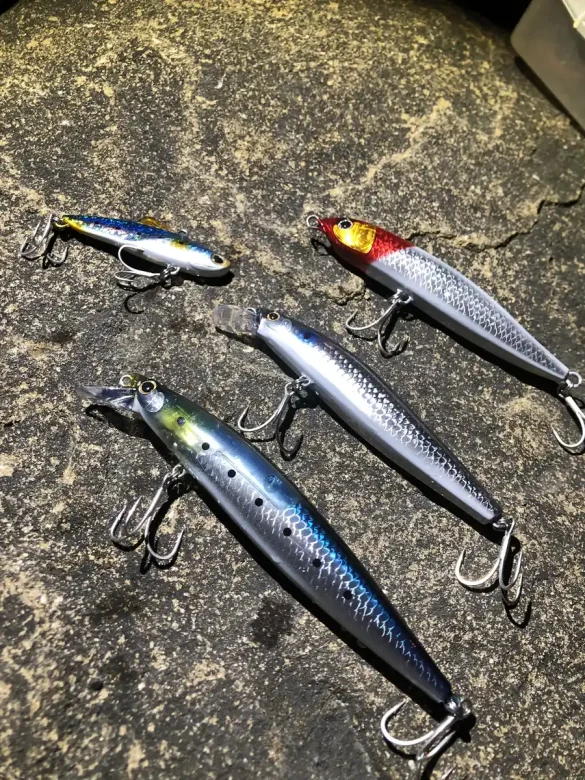
New for spring 2026 and the first Sugapen built to make noise. Bassday calls it the opposite approach to the original: where the standard Sugapen is deliberately natural, the Splash is the appeal model. The body is shaped as a shrimp, with segmented abdominal plates that scatter light underwater and a fan tail that Bassday says holds the action steady.
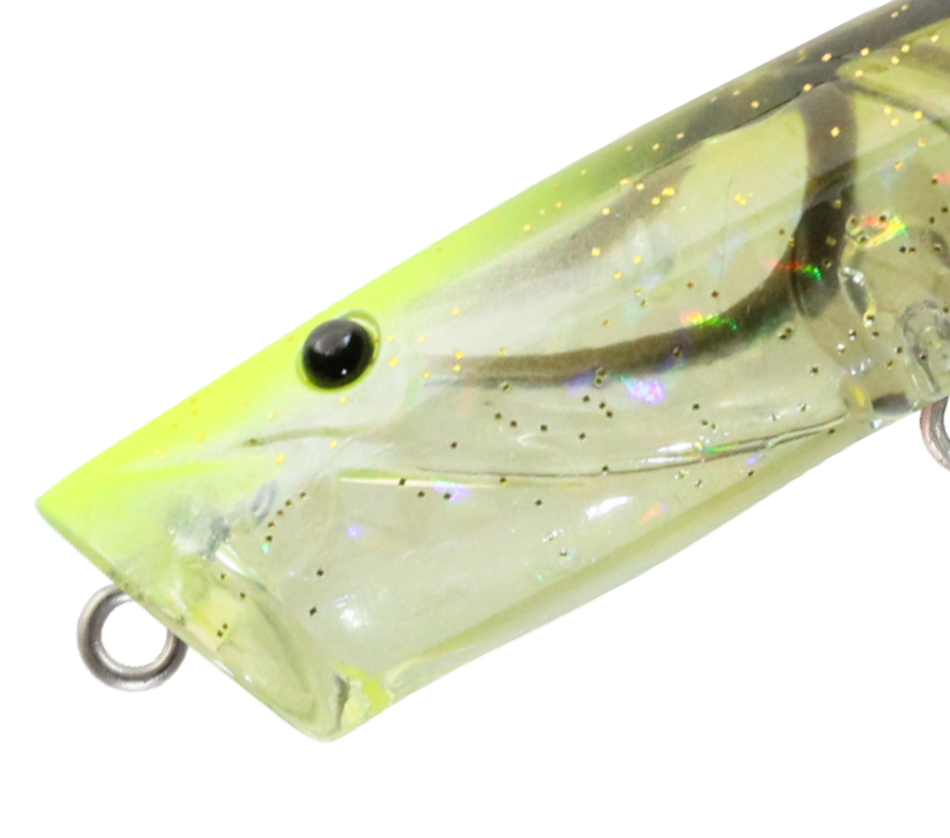
Seventy-five millimetres, 5.3 g, #6 hooks and #3 rings. It runs the heavier hooks of the 95F in a body two centimetres shorter, which is worth knowing before you clip it to 6 lb leader. The cup is oversized for a slim body, which is where the splash and the sound come from, and Bassday’s own point is that it tracks straight enough to keep popping quickly with the run of the tide instead of skating off line. Eight colours so far, all prawn and baitfish patterns.
It is the only lure here that Bassday positions as a search bait, which is a different job from the rest of the list. If your water holds fish in loose scattered pockets rather than in a known patch, that matters.
| Positioning | High-appeal counterpart to the natural Sugapen action |
| Shape | Shrimp imitation; segmented plates scatter light, fan tail stabilises |
| Face | Oversized cup on a slim body, wide high splash with sound |
| Stated role | Search bait; tracks straight under fast popping in current |
| Model | Length | Weight | Hook / Ring | Colours | JDM RRP (excl. tax) | Approx. AUD |
|---|---|---|---|---|---|---|
| Bassday Sugapen Splash 75 | 75 mm | 5.3 g | #6 / #3 | 8 | ¥1,600 | A$14.0 |
Not all of this fishing happens on open sand. Plenty of it happens in the corner of a boat harbour or at the mouth of a drain on a run-out, where you have a rod length of water to work with and a 70 mm lure is too big for the space.
Forty-six millimetres, 3.4 g, a single #14 treble, and the smallest of the seven by a clear margin. Jackson built it by shrinking the RA Pop, a full-size saltwater popper, and their stated design decision is the interesting part: they deliberately suppressed the tail action, because unnecessary tail movement was costing hook-ups at the strike. That is a fix aimed squarely at the short, snapping bite this whole category suffers from.

Jackson catalogues it as a light salt water lure without naming a target species, so you are choosing it on size and behaviour rather than on anything the maker claims about whiting. Four colours. At ¥1,210 it is also the cheapest here, and a #14 treble is small enough that a solid fish will straighten it, so take that as the ceiling on what you can land with it.
| Origin | Scaled-down version of the RA Pop saltwater popper |
| Key design call | Tail action suppressed to raise hook-up rate at the strike |
| Maker’s category | Light salt water lure; no target species published |
| Model | Length | Weight | Type | Hook | Colours | JDM RRP (incl. tax) | Approx. AUD |
|---|---|---|---|---|---|---|---|
| Jackson PY Popper | 46 mm | 3.4 g | Floating | #14 | 4 | ¥1,210 | A$10.6 |
| Model | Type | Length | Weight | Hooks | Price | Approx. AUD |
|---|---|---|---|---|---|---|
| Ecogear PX 45F | Cup-face slider | 45 mm | 2.5 g | Not published | Not published | Not published |
| Jackson PY Popper | Micro popper | 46 mm | 3.4 g | #14 | ¥1,210 incl. | A$10.6 |
| Daiwa Infeet Slippery Dog 65F TG Tune | Walker, rear assist | 65 mm | 3.8 g | BKK Striker Assist | A$25.99 RRP | A$25.99 |
| Bassday Sugapen 70F | Surface pencil | 70 mm | 4.3 g | #10 | ¥1,750 excl. | A$15.4 |
| Bassday Sugapen Splash 75 | Pencil popper | 75 mm | 5.3 g | #6 | ¥1,600 excl. | A$14.0 |
| Daiwa Infeet Slippery Dog 80F TG Tune | Walker, rear assist | 80 mm | 6.7 g | BKK Striker Assist | A$26.99 RRP | A$26.99 |
| Bassday Sugapen 95F | Surface pencil | 95 mm | 8.5 g | #6 | ¥1,850 excl. | A$16.2 |
Top pick: Daiwa Infeet Slippery Dog 65F TG Tune
A$25.99 RRP, 65 mm, 3.8 g. The rear assist hook is the one structural answer on this page to the short sideways grab that defines whiting bites, and Daiwa credits whiting anglers for putting it there. It also happens to be the only lure here you can buy on a Saturday morning without planning ahead.
Budget pick: Jackson PY Popper
¥1,210, about A$10.6, and 46 mm of very little. Buy two or three and the small, quiet end of the box is covered for the price of one Australian hardbody. The #14 treble sets the ceiling on what you can land, which is the trade you are making.
Something I do that most people do not: take a lure sold on the strength of its action and just wind it in. No rod work, no rhythm, straight retrieve. It catches surprisingly often. That is from light shore jigging around the Seto Inland Sea and Osaka Bay rather than off a sandflat, so read it as a habit of mine rather than a rule. It is worth noting all the same that Ecogear’s own instruction for the PX is a constant slide with pauses rather than anything elaborate.
The other thing I will admit to. Every trip starts with a plan to work out what the fish actually want, and every trip ends with me having thrown the lure that worked last time and nothing else. The untested ones stay in the box, the session finishes earlier than intended, and the drive home is a long list of what I should have tried. Which is the honest caveat: none of this is worth anything unless you actually tie the other one on.
Below the surface, the same flats are covered in our guide to JDM jig heads and light lures, which has a section on whiting and flathead over sand. The JDM bream lure guide carries the smallest Sugapen, the 58F, plus Jackall’s Bleeker Toppy, both of which belong in bream water rather than out on the sand. For the rod and line end of it, see JDM rods for bream and LRF and Japanese finesse tactics for bream and trevally.
Roughly November to March across NSW, Victoria, South Australia and southern WA, which is when water temperature climbs past the low twenties. Outside that window these lures still catch, but the fish are far less willing to come up for them.
They are sized for the target, not for what else swims past. The Jackson PY Popper’s #14 is genuinely small, and the Sugapen 70F’s #10 is finer than a typical Australian hardbody of that length. If your flats hold decent flathead or trevally, upgrade the trebles and accept that the action changes.
Ecogear does not publish a list price for any of its lures, so there is no RRP to work back from. Budget from Australian retail for that one.
Something in the 65 to 70 mm band. The Slippery Dog 65F and the Sugapen 70F both sit there, and between them they cover most of what an average session throws at you. Add the 95F once the wind starts costing you casts.