Best Ajing Jig Heads, Worms and Rigs (JDM) for Australian Light Game
ちゃんま
マイボ!

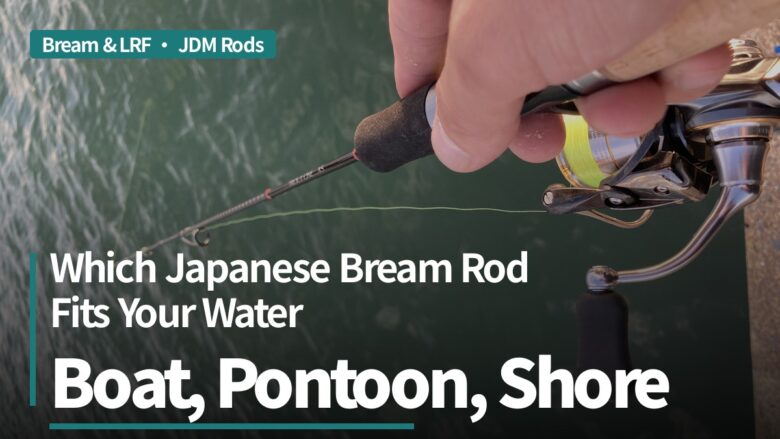
Australian bream anglers worked out a while ago that Japan makes good gear. Ecogear worms, Jackall vibes, a Bassday surface bait or two. The rods are the part that stays invisible, and the reason is dull: they’re filed under a Japanese word most people here have never had to learn.
That word is chinu, also written kurodai. It’s Acanthopagrus schlegelii. Yellowfin bream is Acanthopagrus australis, southern black bream is Acanthopagrus butcheri. Same genus, near enough the same habits, and Shimano’s own product taxonomy files its Brenious range under “bream” in Japanese. Japan has a dedicated bream rod category, and almost none of it gets written about in English.
Below are five series with every model listed and priced: two from Shimano, three from Daiwa. Four are bream rods in the Japanese sense. The fifth is a light game series, for the days that aren’t only about bream.
Prices are Japanese RRP in JPY, tax excluded, with approximate AUD conversion at A$1 ≈ ¥114 (September 2026). Every rod here is JDM only, so the buy links go to Amazon Japan. Ships internationally from Amazon Japan: check availability and shipping cost at checkout, and orders over A$59 may qualify for free international delivery. Bream size and bag limits are set state by state, so check your local regulations.
Chinning, the Japanese term for lure fishing for chinu, took off through the 2010s and now has its own tournaments, its own rig vocabulary and its own tackle-shop shelf. The dominant rig is the free rig: a pear-shaped sinker running loose above an unweighted crab or shrimp plastic, dragged along the bottom. The dominant structure is oyster shell beds, tetrapods and harbour walls.
If that sounds like your Tuesday afternoon behind an oyster lease, it should. The brief a Japanese chinning rod is built to lands here almost unchanged: 7 ft to 8 ft 10 in, ML power, lure ratings that start at 2 to 5 g and stop around 18 to 21 g, PE 0.4 to 1.5. That’s a bream rod. Give or take a foot, it’s also the rod half the people on your local pontoon are already holding.

What Japan doesn’t do is call these light rock fishing rods. LRF, in the Japanese scheme, is ajing and mebaring: sub-gram jig heads, 0.3 g to 5 g, PE 0.1 to 0.3. Those are separate shelves with separate rods. If you want a single outfit that covers small stuff and bream together, our guide to the LRF setup for bream and trevally makes that case with one rod and one reel. This one does the opposite: it lines the bream rods up side by side.
Four things move the needle, and none is the brand on the blank.
The bottom of the lure rating, not the top. Every rod here handles a 7 g free rig. The number that decides whether you can also fish a 2 g grub on a still morning is the lower figure, and across these five series it ranges from 0.3 g to 5 g. If your water is shallow and your fish are spooky, that column is your first filter.
Solid tip or tubular. Both makers code this into the model number. A trailing S means a solid carbon tip section, a trailing T on a Daiwa means tubular, and a B anywhere in the code means baitcaster. Shimano brands its solid tips in this class High Response Solid; Daiwa calls its version MEGA TOP.
| Tip type | What it does well | Where it costs you |
|---|---|---|
| Solid (S) | Bends further before the fish feels resistance, so short picky bites convert. Reads bottom texture through deflection rather than vibration | Slower to move a hard body, and a little more effort to walk topwater |
| Tubular (T, or no suffix) | Crisper lure control. Better for a surface bait or twitching a hardbody against a rack | Pulls hooks out of a soft-mouthed bite more often on light leader |
Length against where you stand. Japanese chinning is heavily boat and pontoon based, which is why 7 ft 2 in to 7 ft 6 in models dominate every lineup. Fishing off a bank, a flat or a long rock wall, you want the 8 ft 2 in to 8 ft 10 in models instead, and only six models across the five series get there, two of them baitcasters.
How many pieces, because you’re paying freight. Two-piece rods here close at 105 cm to 129 cm. The three-piece models close at 92.7 cm and 95.5 cm, which is the difference between a normal parcel and an oversize one on most services out of Japan. Shipping is where a cheap rod stops being cheap, and our guide to buying JDM tackle from overseas covers the proxy and freight side. If the model codes below look like alphabet soup, our breakdown of Japanese rod specs decodes them.
Brenious is Shimano’s bream name and the XR sits one rung below the flagship. Shimano rebuilt it for 2025 around three staff anglers, which is why the six models don’t form a neat ladder. Some are specialists rather than a step up from the one below.

The blank package explains the price. Spiral X Core plus Hi-Power X is Shimano’s full anti-twist construction, the same structural family Shimano uses in rods well above this price. The carbon monocoque grip is the part you’ll actually notice: a hollow moulded rear grip instead of EVA, lighter and considerably louder through the palm when a fish mouths a plastic on the drop.
What Shimano puts in it
| Blank | Spiral X Core (high-strength resin carbon tape wound from both sides) plus a Hi-Power X outer wrap |
| Tip | High Response Solid on four models; the other two are tubular |
| Guides | X Guide 3D Titanium, micro guide layout |
| Grip | Carbon Monocoque Grip, edge type. Spinning models add a side-slice compact fore grip |
| Reel seat | Perfection Seat XT (CI4+) with cork on spinning; Perfection Seat VI on bait |
| Ferrule | Put-over (namitsugi) |
Full lineup, JDM RRP tax excluded
| Model | Length | Pcs | Closed | Weight | Tip | Lure | PE | Taper | Price |
|---|---|---|---|---|---|---|---|---|---|
| S72L+-S | 7’2″ / 2.18 m | 2 | 112 cm | 93 g | Solid, 0.9 mm | 2-14 g | 0.4-1.0 | FF | ¥37,800 (~A$332) |
| S76ML-S | 7’6″ / 2.29 m | 2 | 117.5 cm | 96 g | Solid, 1.3 mm | 4-18 g | 0.5-1.2 | FF | ¥39,900 (~A$350) |
| S810ML/M | 8’10” / 2.69 m | 3 | 95.5 cm | 112 g | Tubular, 1.6 mm | 5-21 g | 0.8-1.5 | F | ¥42,500 (~A$373) |
| B72ML | 7’2″ / 2.18 m | 2 | 112 cm | 90 g | Tubular, 1.6 mm | 4-18 g | 0.6-1.5 | RF | ¥38,300 (~A$336) |
| B74ML-S | 7’4″ / 2.24 m | 2 | 115 cm | 100 g | Solid, 1.1 mm | 3-18 g | 0.5-1.2 | FF | ¥39,400 (~A$346) |
| B76ML-S | 7’6″ / 2.29 m | 2 | 117.5 cm | 96 g | Solid, 1.3 mm | 4-18 g | 0.5-1.2 | F | ¥39,900 (~A$350) |
S76ML-S, at ¥39,900. Shimano’s own name for it translates as “Fundamental 76”. Extra-fast taper, solid tip, 96 g, and a 4 to 18 g window that swallows every free rig, blade and small hardbody you’d throw at a bream. Its designer notes that the spinning version is tuned to handle light rigs a shade better than the identically labelled baitcast model, on the assumption that spinning users reach for them more often.

S72L+-S was built by a tournament angler for rigs under 3 g, which Shimano’s own copy calls unexplored ground in Japanese chinning. Rated 2 to 14 g on a 0.9 mm tip and PE 0.4 to 1.0, it’s the only rod on this list that crosses properly into light game weights while keeping enough butt to stop a 40 cm fish leaving for the pylons. Fish 1/16 oz to 1/8 oz heads at pressured bream, and want to pick off whiting and pinkies with the same stick? Look here first.
Worth knowing if you buy secondhand. Shimano published a notice on 30 April 2025 that four XR models shipped in March 2025 with the wrong tip-material name printed on the reverse of the separate grip. Those blanks carry High Response Solid. The affected codes are B74ML-S, B76ML-S, S72L+-S and S76ML-S, so the list covers both picks above. Shimano confirms the rods perform as designed and the printing is the only error, so a grey-market listing with that marking isn’t a fake or a different blank.
Above the XR sits the Brenious XTUNE, four models at ¥47,000 to ¥48,000. It’s a narrower range with no long shore model, so the extra outlay buys fewer options rather than more.
Shimano renewed the BB for 2026 and cut it to five deliberately chosen models. It drops Spiral X Core, keeps Hi-Power X, and swaps the carbon monocoque grip for separate EVA. Carbon content falls to 94 to 96.7 percent against the XR’s 99. What it doesn’t drop is the dedicated bream blank geometry, which is the actual reason to import a chinning rod instead of buying a light seabass rod locally.

What Shimano puts in it
| Blank | Hi-Power X outer wrap. No Spiral X Core at this grade |
| Tip | Tubular on four models. High Response Solid on one |
| Grip and seat | Side Slice EVA grip, CI4+ reel seat |
Full lineup, JDM RRP tax excluded
| Model | Length | Pcs | Closed | Weight | Tip | Lure | PE | Carbon | Price |
|---|---|---|---|---|---|---|---|---|---|
| S72ML | 7’2″ / 2.18 m | 2 | 112 cm | 104 g | Tubular, 1.7 mm | 4-18 g | 0.6-1.5 | 94% | ¥21,000 (~A$184) |
| S76ML | 7’6″ / 2.29 m | 2 | 118 cm | 98 g | Tubular, 1.5 mm | 4-18 g | 0.6-1.5 | 94% | ¥22,000 (~A$193) |
| S86ML/M | 8’6″ / 2.59 m | 3 | 92.7 cm | 115 g | Tubular, 1.7 mm | 5-21 g | 0.8-1.5 | 96.7% | ¥24,000 (~A$211) |
| B72ML | 7’2″ / 2.18 m | 2 | 112 cm | 100 g | Tubular, 1.7 mm | 4-18 g | 0.6-1.5 | 96% | ¥21,500 (~A$189) |
| B74ML-S | 7’4″ / 2.24 m | 2 | 115 cm | 104 g | Solid, 1.4 mm | 3-18 g | 0.5-1.2 | 95.7% | ¥23,500 (~A$206) |
The one worth the postage is S86ML/M. It’s the longest rod in the range and the only one Shimano lists for shore alone. It runs an ML tip over an M butt so it casts a 5 g rig and still turns a fish, and it breaks into three pieces that close at 92.7 cm, the shortest travel length of anything here. At ¥24,000 it lands here for roughly what a mid-shelf domestic bream rod costs, freight included. The trade is weight and tip: 115 g against the XR’s 96 g, and a 1.7 mm tubular tip that will pull hooks on soft bites more readily than the solids further up the range.
My bias should go on the table, because it colours the next three sections.
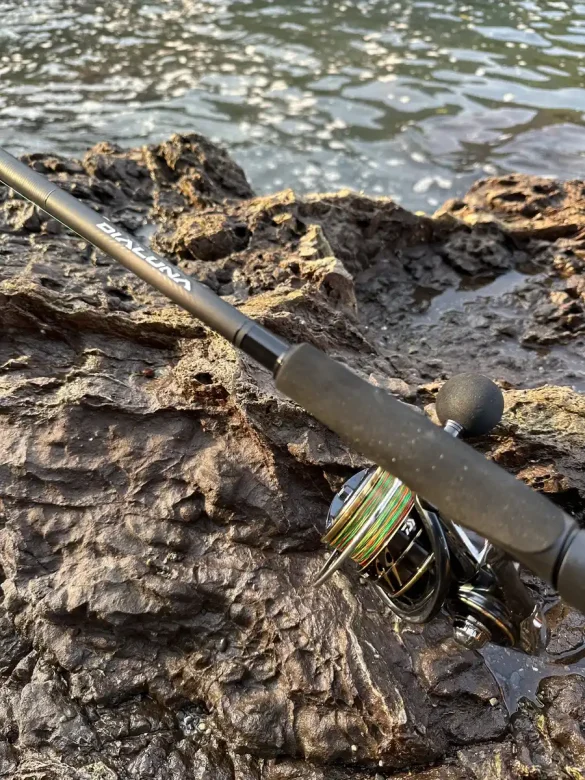
Fishing in Japan, mostly light shore jigging and seabass rather than bream, I’ve run Shimano and Daiwa rods of the same lure rating side by side for more than ten years, going back to the first Dialuna. Same numbers on the label, different rod in the hand. Shimano has always felt firmer from the butt up, with more to push against on the cast and more to load against when you work a lure. Daiwa has felt softer through the whole blank. That’s my hands and my habits talking, not a measurement, and it’s completely a matter of taste. The bias runs strong enough that I’ve bought Shimano for years, which is exactly why I wanted to try the recent Daiwa rods.
So I tested it. In July 2023 I bought a Daiwa Seabass Flat X, half hoping to be proved wrong. I wasn’t. Still too soft for my taste. It didn’t get sold on, though. It turned into the do-anything rod, for light bottom bait fishing and sabiki off the breakwater, and it comes out with me constantly.
Carry that into the two Silver Wolf sections below. Softer isn’t a lower grade, it’s a different job. A softer blank loads on a lighter rig, cushions a hook hold on 6 lb fluorocarbon, and forgives the head shake a bream gives you at the net. Fish plastics on light heads more than you fish hardbodies tight to structure, and softer is the feature you’re paying for.
Silver Wolf is Daiwa’s chinning name and MX is the mid grade. The two 7 ft 6 in spinning models line up almost exactly, ¥37,500 for the Daiwa against ¥39,900 for the Shimano, which makes this the most direct head-to-head in the article.

Daiwa spends the money differently. Where Shimano’s headline is blank construction, Daiwa’s is the tip and the seat: a MEGA TOP carbon solid that bends evenly in any direction, and the AIR SENSOR SEAT, a carbon-filled resin seat that puts your finger closer to the blank. On the 7 ft 6 in spinning model that combination reads 93 g against the Shimano’s 96 g, a real if small difference once you’ve held a rod up for four hours.
What Daiwa puts in it
| Blank | SVF carbon with X45, a bias-angle carbon wrap that resists blank twist |
| Tip | MEGA TOP carbon solid on the S models; tubular on the one model without the suffix |
| Seat | AIR SENSOR SEAT, lightweight carbon-filled resin |
| Ferrule | V-JOINT spigot joint, designed to bend through the join |
Full lineup, JDM RRP tax excluded
| Model | Length | Pcs | Closed | Weight | Tip / butt | Lure | PE | Nylon | Price |
|---|---|---|---|---|---|---|---|---|---|
| 76ML-S・Q | 2.29 m (7’6″) | 2 | 118 cm | 93 g | 1.3 / 10.8 mm | 4-18 g | 0.4-1.0 | 4-12 lb | ¥37,500 (~A$329) |
| 76MLB-S・Q | 2.29 m (7’6″) | 2 | 118 cm | 98 g | 1.3 / 12.9 mm | 4-18 g | 0.4-1.0 | 4-12 lb | ¥37,000 (~A$325) |
| 82ML・Q | 2.49 m (8’2″) | 2 | 128 cm | 100 g | 1.5 / 11.8 mm | max 18 g | 0.4-1.0 | 4-12 lb | ¥38,400 (~A$337) |
| 83MB-S・Q | 2.51 m (8’3″) | 2 | 129 cm | 108 g | 1.4 / 12.9 mm | 5-21 g | 0.4-1.5 | 4-14 lb | ¥38,500 (~A$338) |
Throw hardbodies and surface baits at oyster racks, and the Shimano’s stiffer feel gives cleaner control of the lure and quicker hook sets at range. Fish mostly plastics on light jig heads, or free rigs dragged along a sand flat, and the Daiwa’s softer overall bend is the one that keeps fish pinned. Neither is a spec you can read off a table, which is the honest limit of comparing rods on paper. The 8 ft 2 in model needs a separate flag: it’s the tubular-tip one, built for dropping plastics down a wall, and Daiwa publishes its lure rating as a maximum with no stated floor.
The base Silver Wolf is a 2023 range at roughly 60 percent of the MX price. It keeps the MEGA TOP tip and the V-JOINT ferrule, and gives up SVF carbon for standard HVF, plus the AIR SENSOR SEAT for a conventional one.

One model here does something none of the others do. 73LML-S・W runs an L tip into an ML butt, rated 3 to 14 g on a 1.1 mm solid, and at 85 g it’s the lightest bream rod of the lot. Daiwa puts it on light free rigs, small plugs and vertical presentations dropped down a wall. That’s a bream-around-pontoons rod, described in Japanese.
| Model | Length | Pcs | Closed | Weight | Tip / butt | Lure | PE | Nylon | Price |
|---|---|---|---|---|---|---|---|---|---|
| 73LML-S・W | 2.21 m (7’3″) | 2 | 114 cm | 85 g | 1.1 / 10.4 mm | 3-14 g | 0.4-1.0 | 4-10 lb | ¥23,200 (~A$204) |
| 76ML-S・W | 2.29 m (7’6″) | 2 | 118 cm | 93 g | 1.4 / 10.8 mm | 4-18 g | 0.4-1.0 | 4-12 lb | ¥23,500 (~A$206) |
| 76MLB-S・W | 2.29 m (7’6″) | 2 | 118 cm | 100 g | 1.4 / 12.9 mm | 4-18 g | 0.4-1.0 | 4-12 lb | ¥22,500 (~A$197) |
| 83MB-S・W | 2.51 m (8’3″) | 2 | 129 cm | 110 g | 1.5 / 12.9 mm | 5-21 g | 0.4-1.5 | 4-14 lb | ¥22,800 (~A$200) |
What you give up against the MX
| Carbon | HVF instead of SVF: resin reduced and fibre density raised, but a step below the higher fibre-volume grade |
| Blank structure | No X45 bias wrap, so more twist under a sideways load |
| Seat | Standard seat rather than AIR SENSOR SEAT, which costs a little contact feel |
| Weight | Level with the MX model for model, except the 7 ft 3 in, which has no MX equivalent |
Where it shows is casting a 3 g rig into a crosswind, when the blank moves in ways you didn’t ask for. For a first import, that’s a fair trade for a saving of about A$125.
Everything above is built around a 3 g floor. Plenty of Australian sessions don’t stay there. Whiting on 1 g heads, small trevally busting up at dusk, a pinkie or a flathead on the drop: those are Japanese light game weights, and Gekkabijin is Daiwa’s light game name. The MX mebaru sub-series overlaps with bream, because mebaru fishing in Japan means plugs and jig heads worked around structure at night.

What Daiwa puts in it
| Blank | HVF NANOPLUS nano-resin carbon with X45 |
| Tip | MEGA TOP solid on the S models, tubular on the T models |
| Seat | ZERO SEAT |
| Ferrule | V-JOINT |
Full lineup, JDM RRP tax excluded
| Model | Length | Pcs | Closed | Weight | Tip / butt | Lure | PE | Price |
|---|---|---|---|---|---|---|---|---|
| 68L-T・J | 2.03 m (6’8″) | 2 | 105 cm | 66 g | 1.1 / 8.4 mm | 0.5-8 g | 0.1-0.4 | ¥39,500 (~A$346) |
| 610L-S・J | 2.08 m (6’10”) | 2 | 108 cm | 68 g | 0.7 / 8.4 mm | 0.5-8 g | 0.1-0.4 | ¥39,500 (~A$346) |
| 72L-T・J | 2.18 m (7’2″) | 2 | 113 cm | 69 g | 1.2 / 8.4 mm | 0.5-8 g | 0.1-0.4 | ¥40,000 (~A$351) |
| 74UL-S・J | 2.24 m (7’4″) | 2 | 116 cm | 69 g | 0.8 / 8.4 mm | 0.3-5 g | 0.1-0.3 | ¥40,000 (~A$351) |
| 710ML-T・J | 2.39 m (7’10”) | 2 | 123 cm | 81 g | 1.2 / 10.4 mm | 1.5-10 g | 0.15-0.5 | ¥40,500 (~A$355) |
| 83M-T・J | 2.51 m (8’3″) | 2 | 129 cm | 86 g | 1.3 / 10.4 mm | 2-15 g | 0.2-0.6 | ¥41,000 (~A$360) |
| 73ULB-T・J | 2.21 m (7’3″) | 2 | 114 cm | 71 g | 1.2 / 8.4 mm | 2-8 g | 0.2-0.6 | ¥42,000 (~A$368) |
| 76LB-T・J | 2.29 m (7’6″) | 2 | 118 cm | 75 g | 1.3 / 8.4 mm | 2-10 g | 0.25-0.6 | ¥43,500 (~A$382) |
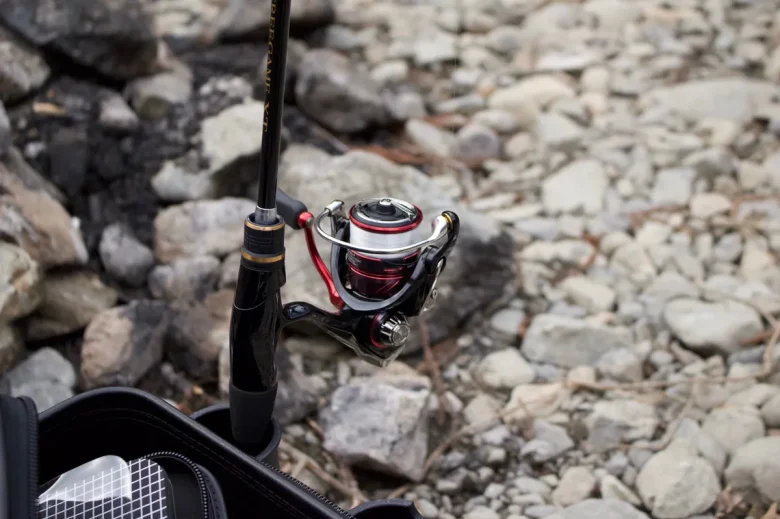
The crossover model is 710ML-T・J. Daiwa built it for float rigs and plugs over distance, rated 1.5 to 10 g on PE 0.15 to 0.5, and at 81 g it’s lighter than every bream rod above it here. That 1.5 g floor sits below every chinning rod above, which opens up the 1/16 oz heads bream want on flat calm days.
The limit sits at the other end. PE 0.5 as a published maximum is thin line to be dragging over oyster shell, and a 10 g ceiling rules out the heavier free rigs you’d want in current. Treat it as a light game rod that bream fit into, not as a bream rod. For the reel to go with it, the reel side of Japanese light game is covered in our JDM ajing and LRF rods and reels guide, and what to tie on the end is in our pick of Japanese bream lures.
| Model | Grade | Length / pcs | Weight | Lure | Tip | Best at | Price |
|---|---|---|---|---|---|---|---|
| Shimano Brenious XR S76ML-S | High-end | 7’6″ / 2 | 96 g | 4-18 g | Solid | The all-round bream rod | ¥39,900 (~A$350) |
| Shimano Brenious XR S72L+-S | High-end | 7’2″ / 2 | 93 g | 2-14 g | Solid | Pressured fish, rigs under 3 g | ¥37,800 (~A$332) |
| Shimano Brenious BB S86ML/M | Entry-mid | 8’6″ / 3 | 115 g | 5-21 g | Tubular | Shore and flats, cheapest freight | ¥24,000 (~A$211) |
| Daiwa Silver Wolf MX 76ML-S | Mid | 7’6″ / 2 | 93 g | 4-18 g | Solid | Plastics and free rigs | ¥37,500 (~A$329) |
| Daiwa Silver Wolf 73LML-S | Entry-mid | 7’3″ / 2 | 85 g | 3-14 g | Solid | Pontoons, dropping down a wall | ¥23,200 (~A$204) |
| Daiwa Gekkabijin MX 710ML-T | Mid | 7’10” / 2 | 81 g | 1.5-10 g | Tubular | Light game with bream included | ¥40,500 (~A$355) |
Across five series and 27 models, these three give the most back per dollar landed in Australia.
Full Spiral X Core and Hi-Power X blank, titanium micro guides and a carbon monocoque grip, in the length and rating that covers almost everything an Australian bream angler does. It sits well above the BB and just under the XTUNE, and unlike the XTUNE its range includes a long shore model if you want a second rod later.
85 g, a 1.1 mm MEGA TOP solid tip and a 3 g lure floor, for the price of a mid-shelf domestic rod. The L tip over ML butt layout suits dropping plastics beside pontoon legs, and the softer overall bend keeps hooks in on light fluorocarbon. The compromise is blank twist in a crosswind.
The only shore-length three-piece here, closing at 92.7 cm, which keeps freight out of oversize territory. An ML tip over an M butt handles 5 to 21 g, so it covers flats, walls and the odd flathead. Heavier at 115 g and tubular in the tip, but it is a genuine dedicated bream blank for a bit over two hundred dollars.
Start with where you stand and what you throw. The rest follows.
Anything in the 7 ft 2 in to 7 ft 6 in group, which is most of what these makers build. Take the Brenious XR S76ML-S for the best blank on offer at sane money, or the Silver Wolf 73LML-S for the lightest and softest of the bream blanks at a lot less.
Six models reach 8 ft or longer and two of those are baitcasters. The spinning four: Brenious XR S810ML/M at ¥42,500, Brenious BB S86ML/M at ¥24,000, Silver Wolf MX 82ML at ¥38,400, and Gekkabijin MX 83M-T at ¥41,000, though that last one is a light game blank rather than a bream one. The first two break into three pieces, which also happens to solve your shipping problem.
The Gekkabijin MX 710ML-T if you want the light end covered properly, or the Brenious XR S72L+-S if bream stay the priority and the small stuff is a bonus. The Gekkabijin goes lighter; the Brenious keeps more backbone for a fish heading into structure.
One last note on money. Plenty of Australian bream get caught every weekend on a 7 ft 2 to 4 kg spin stick. What you’re buying here is a lure rating that starts low enough to fish properly, a tip built for a fish that mouths a bait rather than eating it, and a blank designed around the structure you actually fish. Whether that’s worth A$200 or A$350 depends on how many hours a year you hold it.