Best JDM Rods for Bream and LRF in Australia: Five Japanese Series Compared
ちゃんま
マイボ!
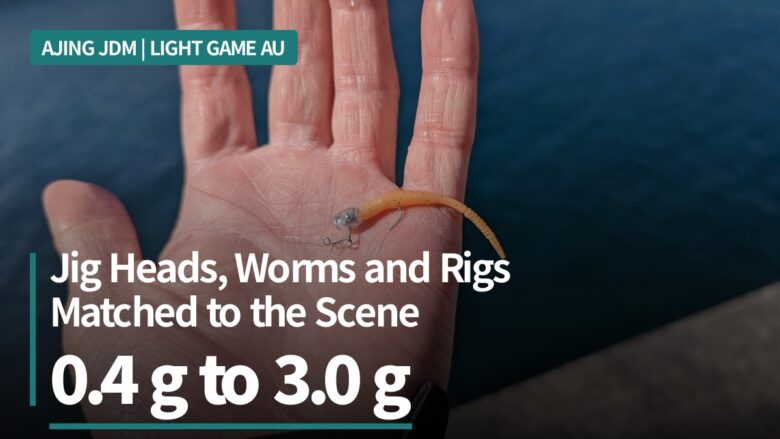
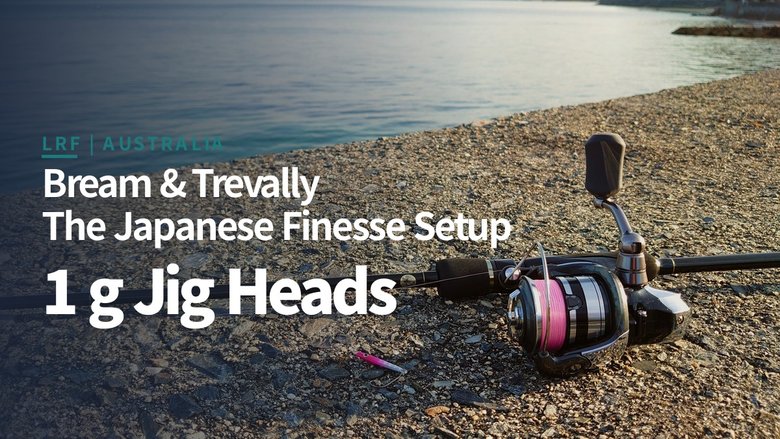
A good bream sitting under a pontoon in three metres of clear water will watch a 1/8 oz jig head drop past its nose and do absolutely nothing. Put something in front of it that falls at a quarter of that speed, on wire fine enough to sit inside a 40 mm plastic, and the same fish eats. That gap is the whole reason Japanese ajing tackle is worth importing.
Ajing (アジング) is the Japanese light game built around aji, or Japanese horse mackerel (Trachurus japonicus), a fish with a small soft mouth that inhales a lure rather than smashing it. Everything designed for that problem, sub-gram heads, short-shank hooks with an open gape, ribbed worms barely longer than your thumbnail, suits a surprising number of the fish an Australian angler can reach from a jetty. This guide is organised by the situation you’re standing in rather than by brand, and every weight, hook size and price below comes from the maker’s own product page.
For the rod and reel side of the same setup, we’ve covered that separately in our guide to JDM LRF rods and reels. If you want heavier ground, our super light shore jigging piece and the broader light shore jigging guide pick up where this one stops.
A note on links and pricing: every product here is a Japan Domestic Market item, so the buy links point to Amazon Japan, which ships internationally (check availability and shipping cost at checkout; orders over A$59 may qualify for free international delivery). One link points to Amazon.com, available with international shipping to Australia, for readers who’d rather order in USD. Prices are the makers’ own list prices in JPY with an approximate AUD conversion at A$1 = ¥110 (August 2026); note that some makers publish tax-inclusive prices and others publish tax-excluded prices, so both are marked. Bream, whiting and flathead have size and bag limits that differ between states, so check your local regulations before you keep anything.
Bream (Acanthopagrus australis and A. butcheri) that live around structure spend their day inspecting things. They see boat traffic, they see bait, and by autumn they’ve seen most of your lure box. The fall rate is what convinces them, and in two to four metres of water that means a head somewhere between 0.4 g and 1.0 g, not the 2 to 3 g most people default to. Anything heavier drops past the fish before it has finished deciding.
Hook geometry matters just as much. A long-shank hook buried through a small worm kills the tail movement that makes the thing look alive at rest, which is exactly the presentation a suspicious bream wants.
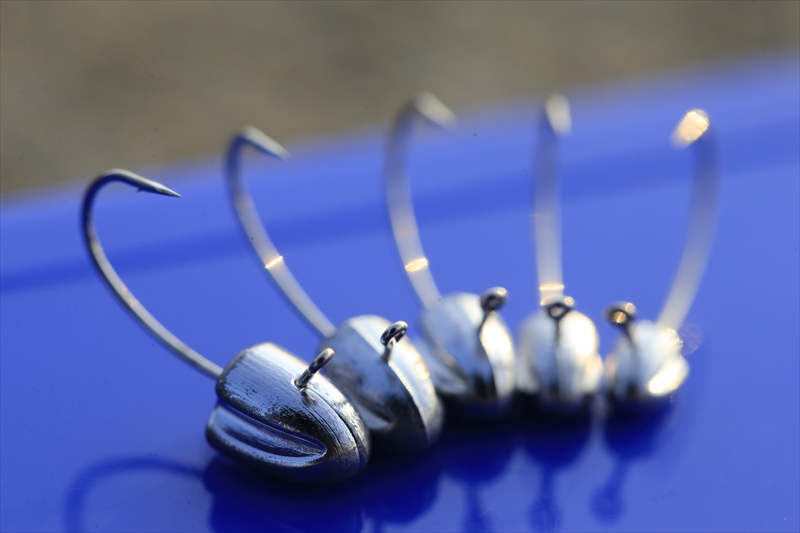
34 (Thirty Four) is a small Fukuoka company that makes nothing except ajing gear, and the Stream Head is their best seller. The hook is an original short shank, chosen so the worm keeps a wide working range instead of being splinted straight, and the bend uses an open gape with slits cut into the head to give feedback on the current. 34’s own line is that a fish finds it easy to inhale and hard to spit out, and that holding tension is often enough to set the hook. The Stream Head and the Jr. worm below were developed alongside each other over about a year.
| Feature | Detail |
|---|---|
| Hook | Original short-shank design with an open gape |
| Head | Slits cut in the body to read the current |
| Concept | Easy for a fish to inhale, hard to eject; tension alone often hooks up |
| Materials | Lead (standard) and tungsten (TG version) |
| TG size comparison | The 3 g tungsten is roughly the size of the 1.8 g lead |
| Designed with | The 34 Jr. worm, developed at the same time |
| Version | Weights | Per pack | Price (JPY, tax incl.) |
|---|---|---|---|
| Stream Head (lead) | 0.3 / 0.5 / 0.8 / 1.0 / 1.3 / 1.5 / 1.8 g | 5 | ¥528 (~A$4.80) |
| Stream Head TG (tungsten) | 2.0 / 2.5 / 3.0 g | 3 | ¥605 (~A$5.50) |
Buy the 0.5 g and the 0.8 g first. They cover the shaded-structure job almost entirely, and the 1.3 g gives you something for a bit of run in the tide. 34 doesn’t publish a hook size for the Stream Head, which is a genuine nuisance if you’re trying to match gape to a bigger-mouthed fish, and it’s the reason the Daiwa head further down earns its place rather than being a duplicate.
There are nights when the fish are clearly feeding and every baitfish imitation gets refused. In Japan that’s the ami pattern, fish grazing on tiny shrimp and plankton, and 34 built the Jr. for it. Shrinking a worm isn’t enough on its own, so the sawtooth triangular ribs were re-angled for the 1.3 in body, and the slit that runs down one face of the bigger worms was cut into both faces here, because a short body otherwise goes stiff and stops moving at rest.
| Item | Detail |
|---|---|
| Length | 1.3 in |
| Ribs | Sawtooth triangular ribs, angled specifically for the 1.3 in body |
| Slits | Cut into both faces (one face on the larger 34 worms) |
| Intended pattern | Ami and plankton feeding, slow presentations held in the zone |
| Per pack | 8 |
| Price | ¥583 (~A$5.30), tax included |
Eight worms for A$5.30 sounds cheap until a bream nips the tail off three of them. Treat the Jr. as a specialist you pull out when the standard 2 in plastic gets followed and refused.
Move onto sand and the numbers change. Dusky flathead (Platycephalus fuscus) have a mouth like a shovel and swallow a small plastic whole, so a fine short-shank hook meant for a 15 cm aji is the wrong tool. Sand whiting (Sillago ciliata) sit at the other extreme, with a small mouth and hard lips that need a sharp point rather than a big one. Both fish want the lure on or near the bottom, in wind, which pushes you up to 1.5 g to 3.0 g, and makes hook size a separate decision from weight.
Gekkabijin (月下美人, roughly “beauty under the moon”) has been Daiwa’s light salt brand since 2005, and this is the workhorse head in it. The hook carries SaqSas, Daiwa’s fluorine plating, rated at up to 40 per cent better penetration than a painted hook and around 20 per cent on average. That figure earns its keep twice: it drives the point through a whiting’s lip, and it makes threading a tough super-soft plastic onto the shank far easier. There’s an oversized line eye for tying on in the dark, and the weight is stamped on the side of the head.
What sells it for Australian sand work, though, is the grid. Daiwa builds the same head in four hook sizes across six weights, so you can run a #4 hook at 1.5 g for flathead, or a #10 at the same weight for whiting, without changing anything else about your presentation.
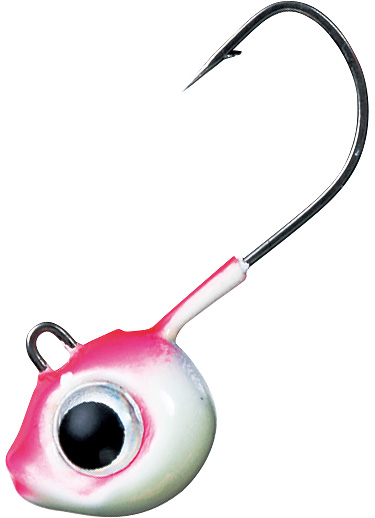
| Feature | Detail |
|---|---|
| Hook treatment | SaqSas fluorine plating, up to 40% better penetration (approx. 20% average, Daiwa’s own figures) |
| Line eye | Oversized, for threading line in the dark |
| Head | Lead, with the weight stamped on the side |
| Colours | Glow and Red Glow |
| Per pack | 4 |
| Price | ¥430 (~A$3.90), tax excluded |
| Hook size | Weights available | Suits |
|---|---|---|
| #10 | 0.5 / 1.0 / 1.5 / 2.0 g | Whiting, small bream, 1.5 in worms |
| #8 | 0.5 / 1.0 / 1.5 / 2.0 / 2.5 / 3.0 g | The all-round size |
| #6 | 1.0 / 1.5 / 2.0 / 2.5 / 3.0 g | Bigger bream, 2 in worms |
| #4 | 1.5 / 2.0 / 2.5 / 3.0 g | Flathead and 2.2 in worms |
Two things separate the Beam Stick from a normal soft plastic. It’s moulded in elastomer rather than PVC, and Daiwa concentrates sardine oil in a core running down the middle of the body, so the outside keeps its translucency while the smell and taste last longer; on a clear colour you can see the core as a faint yellow band. For Australian water the elastomer is the bigger deal, because pickers shred conventional plastics and this material takes far more abuse.
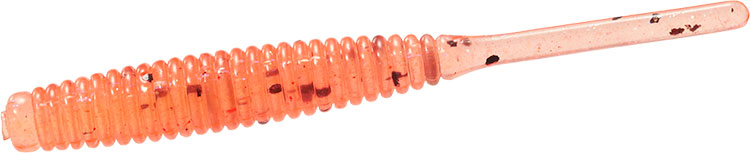
| Size | Material | Per pack | Price (JPY, tax excl.) | Pair with |
|---|---|---|---|---|
| 1.5 in | Elastomer, sardine oil core | 10 | ¥500 (~A$4.50) | #10 or #8 hook |
| 2.2 in | Elastomer, sardine oil core | 10 | ¥500 (~A$4.50) | #6 or #4 hook |
One habit to build straight away: keep elastomer worms in their own packet, away from ordinary soft plastics. The two materials react against each other in a shared tray and you’ll open the box to find both ruined.
The oddest item here is a jig head whose hook doesn’t point out of the head at all. It hangs off the front on a short assist, swinging free, because aji have a soft mouth and a weak suck. Shimano’s argument is that a freely moving hook travels deeper into the mouth on a light take, so it holds instead of tearing out. Anyone who has lost a good trevally at the net on a rigid head will recognise the problem.
Kakegami (掛け頭) means something close to “hooking head”. The TG version keeps the assist system and swaps the lead body for tungsten, which shrinks the head for a given weight. Shimano’s field tester Yoshitsugu Niwa describes the difference plainly: fall a 1 g lead Kakegami on a tight line and it drops slowly, while a 1 g Kakegami TG cuts through the water and drops noticeably faster with the hook trailing below. That makes it the head to reach for in strong current, water over 10 m deep, and wind, and the harder head also telegraphs the bottom more clearly, so you can feel whether you’re on sand or rubble. The compact tungsten body gives sharper darts on a twitch too, which is why Niwa pushes it for daytime fishing rather than only after dark.
| Feature | Detail |
|---|---|
| Head material | Tungsten, for a compact head at a given weight |
| Hook system | Original assist hook with free movement, sits deep on a weak take |
| Hook change | Easy assist hook change system |
| Worm keeper | Fitted, to hold the plastic through short bites |
| Rigging | Worm threads straight on, so colour changes are quick |
| Best conditions | Current, depth beyond 10 m, wind, and daytime action fishing |
| Model | Weight | Hooks | Per pack | Price (JPY, tax excl.) |
|---|---|---|---|---|
| JK-T08V | 0.8 g | Large #7, small #6 | 2 | ¥720 (~A$6.50) |
| JK-T10V | 1.0 g | Large #7, small #6 | 2 | ¥720 (~A$6.50) |
| JK-T13V | 1.3 g | Large #7, small #6 | 2 | ¥720 (~A$6.50) |
| JK-T16V | 1.6 g | Large #7, small #6 | 2 | ¥720 (~A$6.50) |
| JK-T18V | 1.8 g | Large #7, small #6 | 2 | ¥720 (~A$6.50) |
| JK-T20V | 2.0 g | Large #7, small #6 | 2 | ¥720 (~A$6.50) |
Do the arithmetic before you order a handful. Two heads for ¥720 is about ¥360 each, roughly three and a half times a Gekkabijin head per piece, and a fast-sinking tungsten head is the wrong answer in shallow, still water, which is where a lot of Australian light game happens. Buy it for the deep side of the wharf.
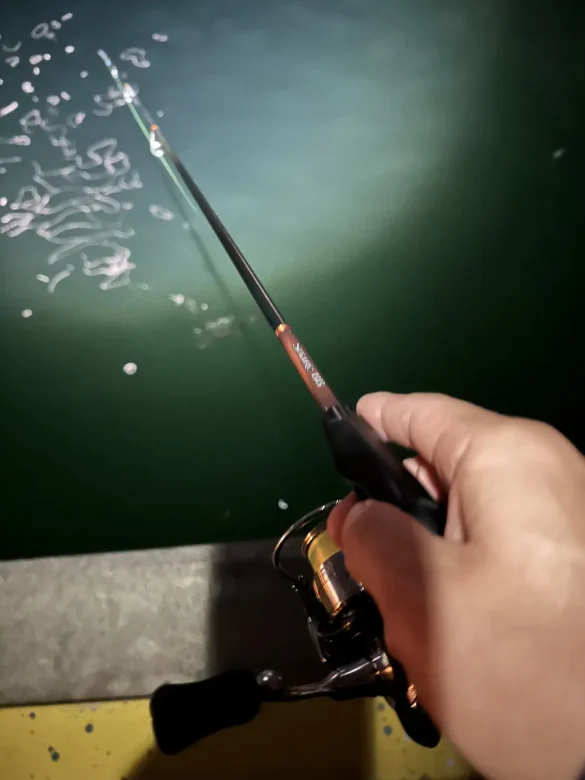
Sooner or later you’ll stand on a breakwall watching fish work bait forty metres out with a 0.8 g head that flies about fifteen. Japanese ajing has four standard answers to that, and it’s worth knowing all of them before you spend money on the fourth.
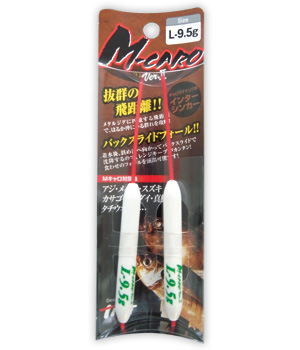
TICT is another ajing-only house, based in Tokushima, and the M-Caro is the rig most associated with them. Its defining trait is what TICT call a back-slide fall: after it lands, the sinker sinks diagonally away from the angler rather than swinging back on the line. Because the rig keeps being pulled offshore after every twitch, the leader and worm trail behind naturally, and the whole thing holds a depth band across a wide range of retrieve speeds. That’s the part worth paying for, and it’s much harder to achieve with a plain running sinker.
Version II widened the fall angle from about 30 degrees to a range spanning roughly 15 to 60 degrees, and added heavier sizes. The body is a through-design built around a wide-bore internal pipe, which TICT specify for bite transmission; it also makes finding a current line easier. A separate Tuned Weight series at 3 g and 4 g lands quietly enough not to scatter a surface school.
| Feature | Detail |
|---|---|
| Fall | Back-slide fall, sinking diagonally away from the angler after landing |
| Fall angle (ver.II) | Roughly 15 to 60 degrees, against a single ~30 degrees on the original |
| Body | Through-body running sinker with a wide-bore internal pipe for bite transmission |
| Range | Heavier sizes added over the original M-Caro |
| Purpose | Reaching schools well offshore while keeping the worm in a depth band |
| Version | Weights | Per pack | Price (JPY, tax incl.) |
|---|---|---|---|
| M-Caro ver.II | Multiple weights across three fall-angle types | 2 | ¥825 (~A$7.50) |
| M-Caro ver.II Tuned Weight | 3 g, 4 g | 2 | ¥825 (~A$7.50) |
A caro rig also asks more of your rod than a plain jig head does. Anything under about 5 g of casting weight will struggle to load with a 7 g sinker on the end, so check your rod’s rating before you buy. If your only stick is a 0.5 to 5 g ajing rod, the split shot rig above is the honest answer.
Our own ajing happens on harbour walls and small jetties in Japan, mostly at night under lights, and the routine has settled into something fairly boring. We tie on a 1.0 g head, cast, count the sink in seconds, and change the count before we change anything else. Weight comes next, then worm shape, and colour last of all. Most of the time a fish that refuses a lure is telling you it fell through the zone too fast, not that it dislikes the shade of pink.
Three habits transfer straight to Australian water. We keep elastomer worms in their own packet, which sounds fussy until it saves a box. We carry one tungsten head purely for windy nights and leave it in the case otherwise. And we only reach for a caro when we’ve watched fish feeding out of range, because the moment you add a sinker you lose some of the feel that made the light gear worth carrying in the first place.
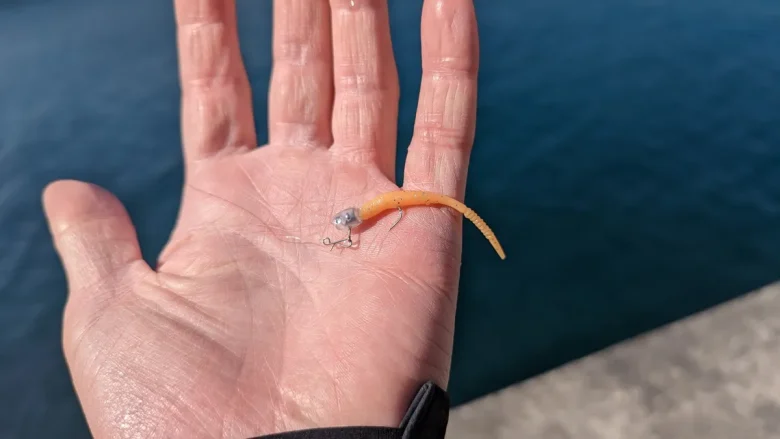
The six items side by side, with the numbers that decide which one goes in the basket.
| Product | Type | Key numbers | Pack / price | Best job |
|---|---|---|---|---|
| 34 Stream Head | Lead jig head | 0.3 to 1.8 g, 7 weights | 5 / ¥528 incl. | Shaded structure, slow falls, fussy bream |
| 34 Stream Head TG | Tungsten jig head | 2.0 / 2.5 / 3.0 g | 3 / ¥605 incl. | Same shape, more weight, less bulk |
| 34 Jr. 1.3 in | Worm | 1.3 in, ribs and twin slits | 8 / ¥583 incl. | Fish grazing on tiny food |
| Daiwa Gekkabijin SW Light Jig Head SS | Lead jig head | 0.5 to 3.0 g, hooks #10 to #4 | 4 / ¥430 excl. | Matching hook size to whiting or flathead |
| Daiwa Gekkabijin Beam Stick | Elastomer worm | 1.5 and 2.2 in, oil core | 10 / ¥500 excl. | Surviving pickers, long sessions |
| Shimano Soare Kakegami TG | Tungsten head, assist hook | 0.8 to 2.0 g, hooks #7 and #6 | 2 / ¥720 excl. | Current, depth, wind, soft-mouthed fish |
| TICT M-Caro ver.II | Casting sinker (rig) | 15 to 60 degree fall angles; 3 g and 4 g tuned | 2 / ¥825 incl. | Fish feeding well beyond casting range |
If you’re placing one order and want it to count, these two cover most of what an Australian light game session throws at you.
Top pick: Daiwa Gekkabijin SW Light Jig Head SS
Four hook sizes across six weights means one product covers whiting, bream and flathead without compromise, and the SaqSas point handles the hard-mouthed ones. At ¥430 (~A$3.90, tax excluded) for four heads it’s also the cheapest per piece here, which matters when you’re fishing over oyster racks. Buy #8 in 1.0 and 1.5 g, plus #4 in 2.0 g.
Budget pick: Daiwa Gekkabijin Beam Stick 1.5 in
Ten elastomer worms for ¥500 (~A$4.50, tax excluded) is the cheapest way to stop replacing chewed plastics every twenty minutes, and the sardine oil core keeps working after the colour has gone dull. Start with a glow and a clear, and add the 2.2 in later if flathead become the target.
What weight should I start with in Australia? One gram. It sits in the middle of every range on this page, casts on any ajing rod, and sinks slowly enough to be refused rather than ignored, which itself tells you something. Move to 0.5 g in shallow water and 2.0 g when wind or run stops you feeling the lure.
Are ajing hooks strong enough for Australian fish? For bream, whiting, small trevally and pickers, yes. 34 state the Stream Head has enough strength for big aji and mebaru, and the Daiwa head runs up to a #4. The limit is usually drag setting and a leader too heavy to let a light hook flex. Expecting a big flathead, run the #4 at 2.5 or 3.0 g.
Do I actually need tungsten? Only for depth, current and wind. The advantage is a smaller head for the same weight, and Shimano’s own comparison shows a 1 g tungsten Kakegami falling faster than a 1 g lead one on the same line tension. In two metres of still water that’s a disadvantage, not a feature.
Can I buy this gear locally? Daiwa and Shimano light game terminal tackle turns up in Australian stores occasionally, but the 34 and TICT items are Japan-only, and the full weight and hook-size grids are only sold there. Amazon Japan ships internationally, and a small selection of Japanese ajing tackle is also listed on Amazon.com if you’d rather pay in USD. Jig heads and worms are light and cheap to post, so a combined order is worth doing.
Almost every Australian light game situation resolves to a small set of choices. A sub-gram lead head and a tiny ribbed worm for bream under structure. A head where hook size is chosen separately for whiting and flathead on sand. A compact tungsten head for nights when the tide runs hard. A caro or a split shot when the fish are further out than a 1 g lure can go.
Start with the Gekkabijin head and the Beam Stick, add 34 Stream Heads in 0.5 and 0.8 g, and you’ve spent less than A$25 on the sharp end of your tackle. To go further, see our JDM LRF rod and reel guide, the light shore jigging guide for heavier ground, or browse all of our Australia fishing guides.
All specifications in this article were taken from the manufacturers’ official product pages (34 / Thirty Four, Daiwa, Shimano and TICT), checked in August 2026. Prices are maker list prices in JPY with approximate AUD conversions at A$1 = ¥110; 34 and TICT publish tax-inclusive prices while Daiwa and Shimano publish tax-excluded prices. TICT publish the individual M-Caro ver.II weights as a chart image rather than as text, so only the Tuned Weight figures they state in writing are quoted here. Product images are from the makers’ official pages. Affiliate links may earn us a commission at no extra cost to you. Bream, whiting and flathead size and bag limits differ between states, so always check your local regulations.
If whiting are working the same flats, see the Japanese surface lures we would use for whiting.
If your plastics are 3 inches and up, the heavier heads are in our guide to Japanese jig heads from 3.5 g to 28 g.