How to Buy JDM Tackle Overseas: Proxy, Shipping & Import Guide
ちゃんま
マイボ!

Two tairaba rods, same brand, nearly the same price. One is labeled N-B66ML-FS, the other C-S68M-T. Below each sits a row of numbers: 30–100 g, PE MAX 1, 1.98 m. If your tackle brain runs on ounces and feet, that listing reads like a customs form.
Here’s the good news. Japanese spec sheets are unusually thorough; almost everything you need is printed right there, in metric and in code. Once the grammar clicks, a JDM (Japan Domestic Market) model number hands you the reel type, the length, the relative power and often the tip construction before you open a translation app.
I’ve done this dance from the other side, squinting at American rod specs with a calculator, so I know how disorienting the swap is. This guide works through three real shopping scenarios using current models and their official specs, then leaves you with conversion tables to keep. Think of it as the rod-side companion to our JDM reel size numbering guide.
Tairaba (鯛ラバ / タイラバ) is Japan’s slow-retrieve technique for madai (red sea bream), fished with a skirted head jig on light PE line. If the method itself is new to you, our complete tairaba fishing guide covers it from rigging to retrieve. Here we only care about the rod wall.
Take Shimano’s Engetsu XR series and pull N-B66ML-FS apart, left to right:
The length digits look strange exactly once. 610 isn’t six hundred and ten; it’s 6’10”. Feet first, inches after, no separator.
| Model code | Length | Lure weight | Max PE | Tip |
|---|---|---|---|---|
| N-B66ML-FS | 6’6″ | 30–100 g | 1 | Full solid |
| N-B66M-FS | 6’6″ | 40–150 g | 1.2 | Full solid |
| N-B67ML-T | 6’7″ | 30–100 g | 1 | Tubular |
| C-S68M-T | 6’8″ | 20–100 g | 1.2 | Tubular |
Look at the first two rows. Identical length, identical tip, and the only working difference is the letter: ML carries 30–100 g on PE up to size 1, while M carries 40–150 g on PE up to 1.2. A power letter only means something relative to its neighbors in the same series. It’s a rung on a ladder, not a measurement.
The tip suffixes in this lineup follow Shimano’s published key: -FS is a full solid blank, -S a solid tip section, -T a tubular tip. Tairaba leans hard on solid designs because the fish loads up on a moving lure and a soft tip lets it eat without feeling the rod. Tubular models suit anglers who’d rather feel every tick and set the hook themselves.
One practical note on that lure weight column while we’re here. Tairaba head weights track depth and current, so the range tells you which water the rod was really drawn for. A 30–100 g model lives happily over the middling depths most tairaba boats work, while the 40–150 g version keeps its composure when the drift speeds up and you size up to stay vertical. Pick the rod whose middle, not its edge, covers the heads you tie on most.
Now the warning. Series prefixes like N-, D- and C- are one maker’s private shorthand, and another brand can recycle the same letters for a completely different idea. This same Engetsu XR lineup also holds a D-B611M+-T rated 50–250 g, where M+ slots between M and MH. Nobody expects you to memorize any of that. When a letter puzzles you, skip it and read the spec row. The numbers don’t play games.
Already shopping rather than studying? Our roundup of the best JDM tairaba rods walks the actual lineups tier by tier.
Light jigging is Japan’s bay-water metal jig game for yellowtail, mackerel and whatever else crashes the sonar mark; the full picture lives in our light jigging guide. Tenryu’s Horizon LJ series makes a perfect decoding specimen because the lineup pairs bait and spinning builds almost model for model.
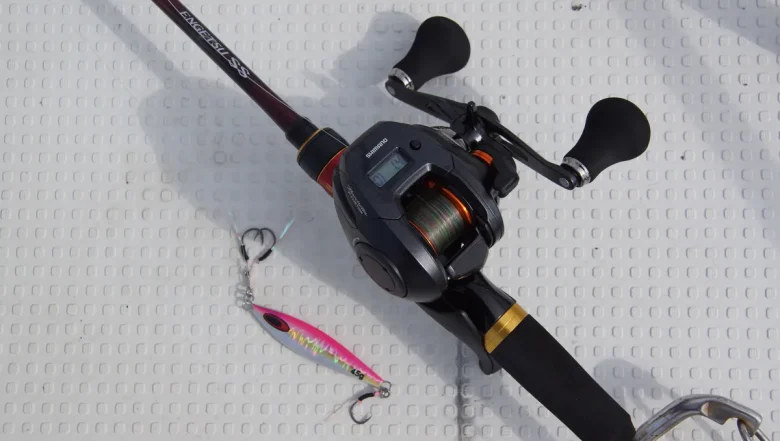
Decode HLJ622B-FML the same way as before. HLJ is the series. 62 is the length, 6’2″. The trailing 2 is the piece count, so this is a two-piece rod. B is the bait build, confirmed in Tenryu’s own spec table where every B model is listed as baitcasting and every S as spinning. Notice what Shimano’s 66 didn’t have: a piece digit. Some makers embed the piece count in the digits and some don’t, so a “622” and a “66” can both be two-piece rods.
| Model code | Type | Jig weight | Max PE | Action |
|---|---|---|---|---|
| HLJ612B-FM | Bait | 100–230 g | 2.5 | R |
| HLJ622B-FML | Bait | 80–200 g | 2 | R |
| HLJ642B-FLL | Bait | 40–150 g | 1.5 | RS |
| HLJ622S-ML | Spinning | 80–200 g | 2 | RF |
That Action column is the taper code. The letters come from the fast-regular-slow family: F bends near the tip, R through the middle, S deep into the butt, and combinations like RF or RS sit between. The suffixes after the hyphen (FM, FML, FLL, ML) are Tenryu’s power ladder for this series. Relative again, always relative.
Run one number through the math before moving on. The HLJ612B-FM tops out at 230 g of jig, which is about 8.1 oz. Half a pound of metal on a rod wearing an M in its name. File that away; it matters in a minute. If you’d rather see which models justify importing, we ranked the best JDM light jigging rods separately.
One more category, because shore casting rods stretch the digit system further. LSJ stands for Light Shore Jigging (ライトショアジギング), the Japanese school of throwing 15–50 g metal jigs off jetties and surf. Major Craft’s Crossride 7G is the example here.
In XR7LSJ-962M, the 962 unpacks as 9’6″ and two pieces. Its sibling 1002 is a 10’0″ two-piece. Once you’ve seen it, you can’t unsee it, and suddenly half the JDM shore rod market reads itself.
The prefix carries information too. Major Craft splits the Crossride 7G family into XR7LSJ for the light shore jigging models and plain XR7 for the full-power shore jigging builds, and the spec gap is anything but cosmetic: the 9’6″ LSJ build carries 15–50 g on PE 0.8–2.0, while its full-power sibling of the same length is rated to 100 g on PE 2.0–4.0. Same series name on the blank, two different fisheries.
| Model code | Length | Jig weight | Plug max | PE range |
|---|---|---|---|---|
| XR7LSJ-962M | 9’6″ | 15–50 g | 40 g | 0.8–2.0 |
| XR7LSJ-1002M | 10’0″ | 15–50 g | 40 g | 0.8–2.0 |
| XR7-962MH | 9’6″ | Max 100 g | 80 g | 2.0–4.0 |
Notice the two separate weight ratings. Jigs and plugs load a blank differently: a compact 40 g jig punches out clean, while a 40 g minnow drags air and slams the blank at the end of the stroke. When a JDM shore rod lists a jig rating and a plug rating, respect the lower plug number for anything with a lip or a large profile.
The PE range works on the gou (号) system, which sizes line by thickness class rather than breaking strain. A rating of 0.8–2.0 names the braid sizes the guides and blank were designed around. Pound-test for a given size varies by line brand, so match the number, then read strength off the line’s own packaging. JDM rod sheets rarely quote lb at all; where you see a strength figure rod-side, it’s usually the drag limit, printed in kilograms. Multiply by 2.2 for pounds.
Everything here is straight arithmetic: 1 oz = 28.35 g and 1 ft = 0.3048 m. Two anchors are worth memorizing outright, because so many JDM ratings orbit them: 45 g sits at about 1.6 oz, and 100 g is 3.5 oz. The rest you can look up.
| Grams | Ounces |
|---|---|
| 20 g | 0.7 oz |
| 30 g | 1.1 oz |
| 40 g | 1.4 oz |
| 45 g | 1.6 oz |
| 60 g | 2.1 oz |
| 80 g | 2.8 oz |
| 100 g | 3.5 oz |
| 120 g | 4.2 oz |
| 150 g | 5.3 oz |
| 200 g | 7.1 oz |
| 250 g | 8.8 oz |
| Meters | Feet & inches |
|---|---|
| 1.68 m | 5’6″ |
| 1.83 m | 6’0″ |
| 1.98 m | 6’6″ |
| 2.13 m | 7’0″ |
| 2.29 m | 7’6″ |
| 2.44 m | 8’0″ |
| 2.90 m | 9’6″ |
| 3.05 m | 10’0″ |
Sheets list both units more often than you’d expect. Shimano prints 1.98 m next to the 66 in the code; when both appear, they’re describing the same stick, so use whichever your brain parses faster.
For mental math on the water, dividing grams by 28 gets you ounces almost exactly, and dividing by 30 gets you close enough to sort a tackle box. Going the other way, each ounce is just shy of 30 g. Nobody needs decimals to decide between a 60 g jig and an 80 g jig; you need them once, when the rod and the order form are in front of you.
The evidence is already on this page. The Engetsu XR’s ML carries 30–100 g. The Horizon LJ’s ML-class spinning model carries 80–200 g. Same two letters, wildly different jobs, and neither lines up with what a US brand stamps M on its inshore rods. There is no shared standard behind the letters, not between countries, not between brands, not even between two series from the same maker.
The design culture underneath deepens the gap. Japanese saltwater rods are built PE-first: thin braid, light leaders, drag-led fights on parabolic blanks that protect the connection instead of overpowering the fish. A rod that feels almost delicate in hand will happily work jigs that sound heavy on paper. So an American angler picking up a JDM “M” expecting broomstick backbone usually finds something softer, deeper-bending and lighter than the letter suggested.
The fix is mechanical rather than clever. Translate your own habits into grams first: if your bread-and-butter jig is 2 oz, that’s about 57 g, so you want that number sitting comfortably inside the rated range, ideally near its middle. Do the same for your braid against the PE column. Two conversions, and the letters stop mattering.
Every rod on my boat was bought off spec tables exactly like the ones above. I fish tairaba and light jigging out of a small boat in Japan through most of the season. Once you can read the lure weight range, the max PE and the tip type, the power letter becomes the least important part of the code: a tie-breaker between two otherwise identical rows. Trust the grams, not the letter.
A working checklist for reading any JDM rod listing, distilled from the sections above:
The grammar you’ve just learned isn’t rod-specific trivia. The same feet-and-inches digits, B/S markers and relative power ladders run through JDM eging rods, tenya rods and everything else in a Japanese catalog, and the metric habits carry straight over to reels and lines. Save the two conversion tables, read spec rows before letters, and the next N-B66ML-FS you meet will introduce itself in plain English.