Best JDM PE Lines for Offshore Fishing: Braid Guide
ちゃんま
マイボ!

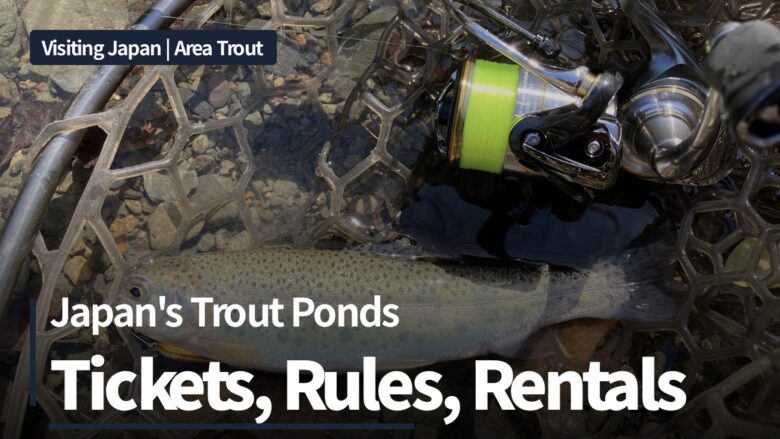
Search for trout fishing near Tokyo or Osaka and you’ll get two kinds of place that look alike in a listing and feel nothing alike on the day. At one, you’re handed a bamboo pole and a tub of salmon eggs, you pay for what you catch, and someone grills it for lunch. At the other, everyone is casting spoons the size of a fingernail, treble hooks are usually banned, and most fish go back. Japanese anglers call both of them a managed fishing ground.
Pick the kind of pond first, because the rules follow from it. If you’re after wild rivers or a party boat instead, how to go fishing in Japan as a visitor covers licenses, co-op tickets and boats.
The Japanese term is kanri-tsuriba (管理釣り場), usually shortened to kanatsuri, and the lure version is simply called “area” (エリア). Shimano’s beginner guide describes it as water stocked with fish that you can catch with lures, flies or bait, mostly on private land, where you pay to get in. It’s a business, not a public fishery. Rainbow trout are the staple, and the same guide lists yamame, amago, iwana (char), brown trout and even itou among what different ponds stock.
Most ponds take beginners, and Shimano notes that some have staff on hand to give advice. They range from a few concrete pools beside a mountain stream to a whole lake ringed with casting platforms. Area trout is also a competitive sport in Japan, and ponds often host tournaments, which is why a whole class of JDM area trout rods exists for it.
English listings rarely make this clear, so check the Japanese name or the price list. A sign with 釣り取り, 釣堀 or エサ釣り means bait. ルアー, フライ or エリア means the lure side. Plenty of places run both, in separate pools with separate tickets.
The bait side is the family day out. You get a pole with no reel, a long bamboo one or a stream rod, and a bait such as salmon roe. There are a few ways to pay for it. Some ponds charge an entry fee and then a price per fish. One weighs what you catch and charges by the 100 g, and its rule is blunt: every fish you land is yours to buy, and you can’t put it back. Others sell a day ticket with a cap, such as up to seven fish, and one of those hands you two anyway if you catch nothing.
The lure side is area trout proper. You pay for time, not fish, and the hooks and lures are regulated. What happens to the trout varies more than you’d guess. One area runs on catch-and-release in principle and lets you take five home. A big lake pond doesn’t let any fish leave alive. And a stream-side lure area lets you keep as many as you catch.
| Pay-per-fish pool | Bait day ticket | Lure and fly area | |
|---|---|---|---|
| What you pay for | Each fish, or the weight | Time, often with a fish cap | Time: day, half day or a few hours |
| Tackle | Pole and bait from the counter; at one pond your own rod isn’t allowed | Rental pole and bait, priced separately or in the ticket | Your own, or a rental lure rod where offered |
| Releasing fish | Not allowed | Depends on the pond | From release-first with a small take-home limit to keep-everything |
| Who it suits | Kids, a 30-minute stop, lunch | A relaxed day with a grill | Anyone who wants to fish lures properly |
On the lure side, tickets are cut by the clock. The lure areas I looked at sell a full day from early morning, a half day split at noon, an afternoon or evening ticket, and in one case a three-hour ticket. Some ticket types only run in certain months, because opening hours shrink in winter.
| Ticket | Lure and fly areas (adult) | Bait fishing |
|---|---|---|
| Full day | ¥3,500 to ¥7,000 | ¥3,500 to ¥4,500 |
| Half day or shorter | ¥2,500 to ¥5,500 | ¥2,500 to ¥3,200 |
| Per fish | n/a | ¥360 to ¥500 a fish, or about ¥275 per 100 g, plus a small entry or pole fee |
A few details catch visitors out. A ticket covers one person, or at one bait pond one rod. It’s usually a tag or ribbon that you wear where staff can see it, and it can’t be shared or passed on. Non-fishing companions are treated differently from place to place: one bait pond lets them in free, while another site wants tickets from at least 70% of everyone of junior-high age and up who comes through the gate. JNTO’s listing for a pond in the hills of western Tokyo even shows a lower lure ticket for women and students than for men.
Carry some cash. Not every pond takes cards, and one of them says plainly that it’s taking cash only at the moment. Walk-ins are normal: the two that address booking say individuals don’t need one, and groups renting a whole pool do.
On the bait side, yes. Every bait pond I checked rents poles. One pond’s FAQ says it has rods, bait and everything else ready, so you can turn up empty-handed. Expect to pay a few hundred yen each for the pole and the bait unless the ticket includes them.
Lure rentals are less certain. Of the three lure areas I checked, one includes rental tackle free with its three-hour ticket, one rents a lure rod and a reel at ¥500 each, and one keeps rental lure rods but asks you to phone about them. Carry your passport. The pond that rents rod and reel separately copies an ID at the counter and charges ¥1,000 if the tackle comes back broken. Fly rods weren’t for rent there.
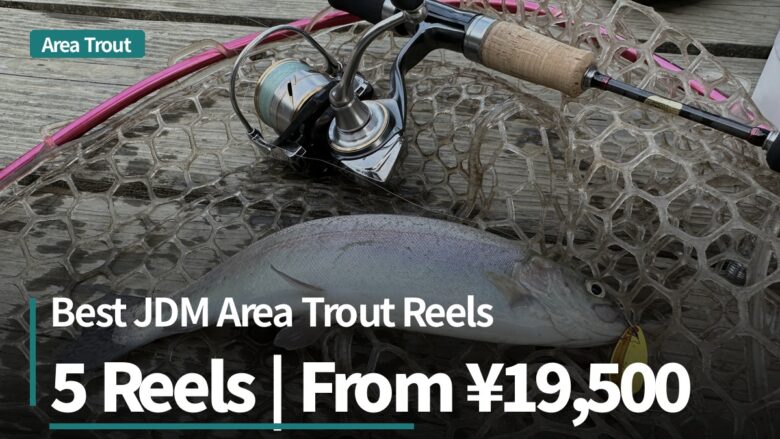
If you’re bringing your own, travel light. Shimano suggests a spinning rod from the mid 5-foot range to 7 feet, a 1000 to 2000 size reel with a shallow spool, and nylon line for a first visit, moving to ester line later once you’re comfortable. One pond’s own tackle page suggests 3 to 5 lb line and spoons of 1.5 to 3 g. For a single day, nylon is the forgiving choice. Our area trout reel comparison covers the reels made for this.
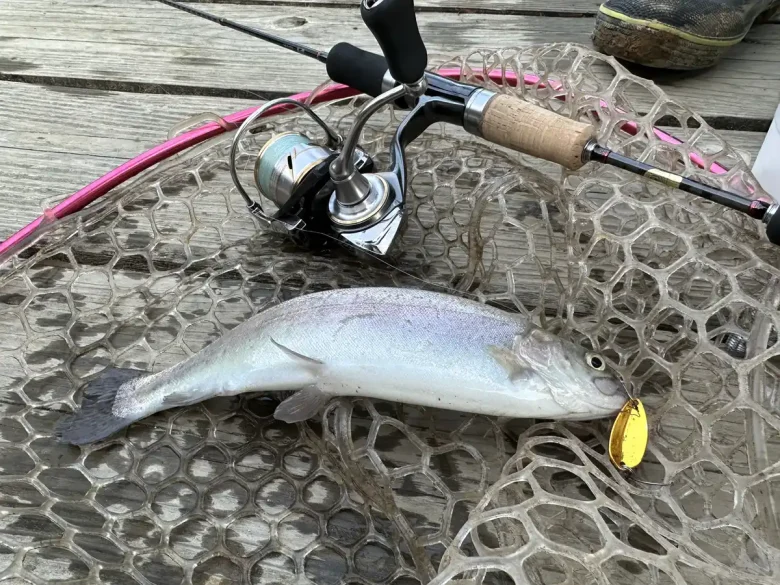
Hooks come first. Two of the three lure areas I read require a single barbless hook and ban trebles, and one of them restated the rule in October 2026 to name double hooks as well. The third, the keep-everything one, asks for barbless hooks, barbs pinched flat, whenever you plan to release a fish. If your spoons came from home with trebles, swap them before you cast. One pond sells spoons and minnows at the counter.
Lures get regulated too. One pond’s list bans soft plastics, feathered lures, lures under 9 mm across, the front hook on a spoon and, on the fly side, egg patterns, and it recommends nothing over 5 g so you don’t hit the far bank. Snagging is banned at every pond I read, and bait, scent and floats are out on the lure side. One area also wants proper lure, fly or tenkara tackle, not a stream pole or a sea rod pressed into service. The bait side mirrors it: at one bait pond you may only use a stream pole with bait, and a reel rod isn’t allowed at all.
Rules get revised mid-season. One of the ponds I read changed its rules twice in 2026. The rule board at the counter is the version that counts.
Trout like cold water, and Shimano puts the best of the season from autumn to spring, with fish getting sluggish in summer. Lowland ponds take that literally. One big lake pond shuts from July to September because the water gets too warm.
Altitude flips it. Ponds fed by mountain streams stay cool, and some of them open all year. One sits at about 600 m and sells itself on cool summers. A mountain pond in Niigata runs only from mid-April to early November, the reverse of the lake. So a July trip points you uphill, and a winter trip points you to the lowland lakes. Hours start early, at 5 or 6 a.m. at two of them, and the grills and gutting areas close when your ticket time ends.
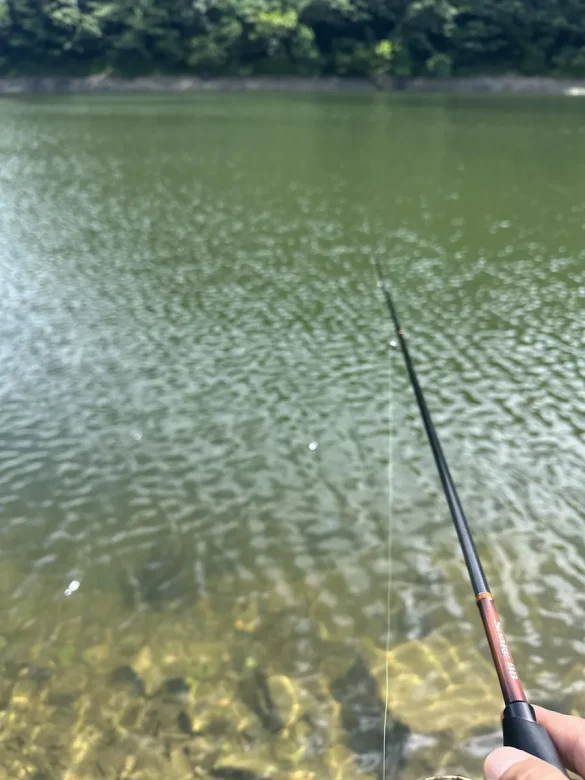
Start with a spoon of around 2 g, which Shimano recommends for beginners because lighter ones are hard to cast. Count as it sinks, and when a trout takes at a certain count, keep fishing that depth. Fish where the water moves, near the inflow pipes and the aerator wheels. When it goes quiet, change one thing at a time: speed, depth, line through the water, action, then color.
A word on expectations, because a pond is less forgiving than it looks. At sea, a blank day has a ready-made excuse. Maybe the fish just weren’t there. A stocked pond takes that excuse away. And the spoon everyone calls a sure thing, worked the way everyone works it, still dies off at certain times of day, in fresh water as much as in salt. When I can’t buy a bite in a pond full of trout, it’s simply that I’m not good enough.
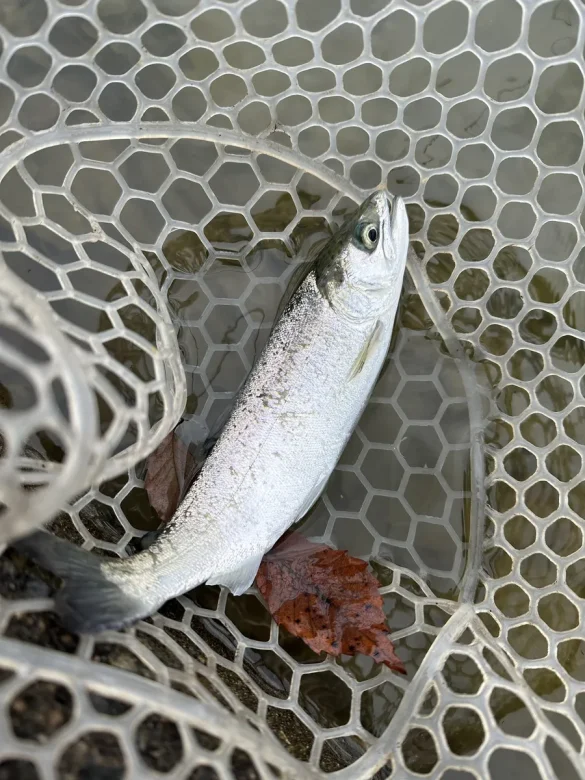
Don’t count on choosing which fish you hook either. Many ponds stock several kinds of trout, and aiming at one of them is still too hard for me… What I do see some days is a size pattern. Change the depth or how the lure swims, and the size of what bites can shift with it, deeper ones running larger, that kind of thing. It’s a pattern for that day, not a rule, and the next visit can be completely different.
At the bait ponds, that’s half the point. Several have a kitchen that will cook your catch, and one prices it by weight, with salt-grilled, deep-fried and arai (thin raw slices rinsed in ice water) on the list. Others give you a barbecue area, open only to people who bought a fishing ticket. At one, charcoal, skewers and salt are on the price list, while another won’t let you bring your own skewers.
On the lure side, it depends on that take-home rule. Where you can keep fish, there’s usually a gutting area, and ice and plastic bags are on at least one pond’s price list.
Decide between bait-and-grill and lure-only. Check the season against the pond’s altitude. Look at the Japanese price list for ticket times and rental, then bring some cash, a passport if you’ll rent, sunglasses and a hat. At the counter, buy the ticket, pin it on and read the rule board before you tie on a spoon.
Want an area rod of your own after that? The guide to buying fishing tackle in Japan tax-free covers what to show at the till.