Buying Fishing Tackle in Japan: Shop Types, Tax-Free Shopping After the November 2026 Refund Change, and What to Check
ちゃんま
マイボ!

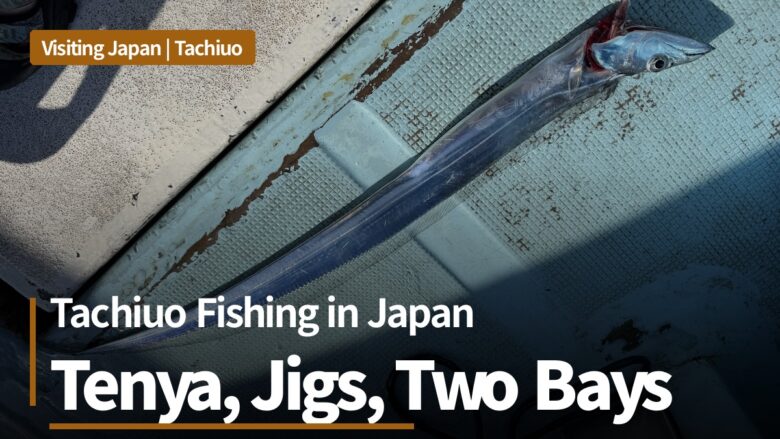
Tachiuo (太刀魚, “sword fish”) is the largehead hairtail, the long, flat, silver fish Americans call ribbonfish. It has a jaw full of needle teeth and almost no tail, and in Japan it’s one of the most popular things a party boat goes out for. Tokyo Bay and Osaka Bay both have whole fleets that sail for it, but the two bays don’t fish it the same way. Before you book, you’ll want to know which rig the boat uses, when it’s running, and what it expects you to bring.
This page covers the fishing side. If you still need the basics of how a Japanese party boat works (licenses, the lifejacket law, rental rods), start with how to go fishing in Japan as a visitor. For phoning or messaging the boat, cancellation fees and seat systems, see booking a Japanese party boat.
A tachiuo tenya (テンヤ) is a heavy lead head with one long hook trailing behind it. You lay a sardine along the shank and bind it on with the fine wire attached to the head, so the bait swims belly-down behind the weight. Boats in both bays list tenya weights of 40 or 50 go. A go (号) is 3.75 g, so that’s roughly 150 to 190 g, dropped straight down under the boat.
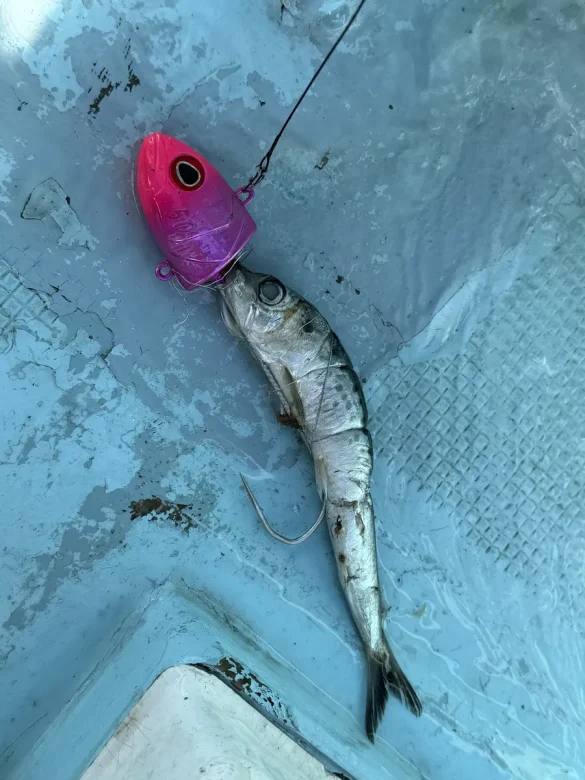
Daiwa describes the tenya as a Kansai idea, from the Osaka region, that has spread across Japan in recent years. You don’t jig it hard. In a 2019 column from Osaka Bay, a Shimano field tester described reeling almost as slowly as the reel would go, adding a short lift of the rod now and then, and pausing. The bites showed on the rod tip a few seconds after he stopped. He set the hook with one or two turns of the handle rather than a big sweep of the rod. A fast, big sweep can make the fish lose track of the tenya, he wrote, while a missed reel-set often leaves it still chasing the bait.
Bait is the part visitors worry about, and usually it’s handled for you. One Kobe boat puts a pack of sardines in the fare. One in southern Osaka sells packs of sardines and strips of saury on board, and asks anglers not to wire on oversized sardines, since they spin and tangle the neighbors. A Yokohama boat that runs tenya in Tokyo Bay sells frozen sardines by the ten. Check the tenya rule before you buy your own: that southern Osaka boat wants 40 go with a single hook, and a Yokohama boat allows 50 go only.
Tachiuo jigging swaps the sardine for a metal jig with assist hooks. Daiwa’s species guide notes that tachiuo cruise in mid-water rather than hugging the bottom, so reading the depth (tana) is what decides it. Listen for the depth the captain calls out.
The boats’ own pages show how far apart the tackle can be within one bay. A Chiba-side lure boat in Tokyo Bay says a 6.5 to 7 ft seabass baitcasting outfit is fine, recommends lures around 1 oz, and has everyone aboard fishing PE 1.0 braid. A Yokohama boat that mixes methods lists jigs of 120 to 200 g for its lure anglers, and an Osaka Bay boat that takes tenya and jig anglers asks for 150 to 200 g. Ask the boat for its jig weight and line size, then pack to that, rather than to a list you found online.
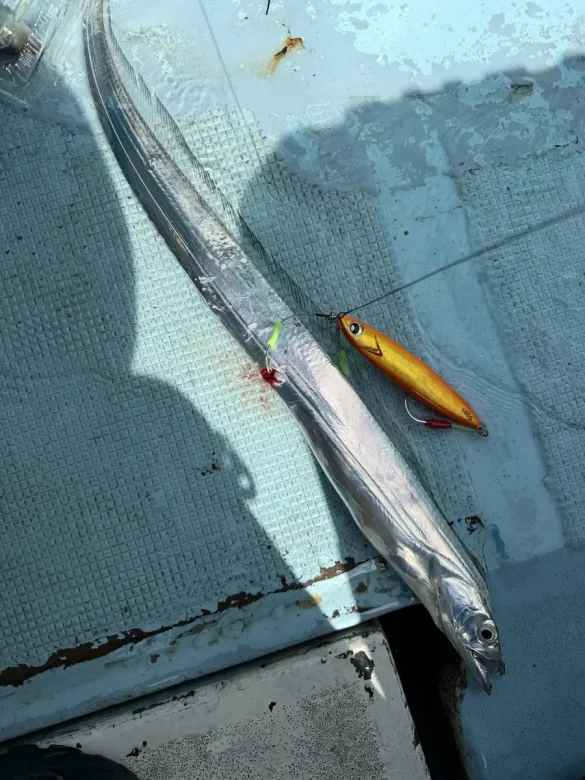
Lure boats also tend to leave more to you. That Chiba boat rents a baitcasting rod, reel and line for ¥1,000, but snaps and lures are yours to bring. It also asks every angler for a hat, sunglasses and pliers. A swinging jig and a thrashing, toothy fish is a good reason for all three.
I’ve fished tachiuo from a boat in Osaka Bay with both rigs going, a tenya on one rod and a jig on the other, from early morning to about noon. This is that one day.
The number of fish came out about even between the two. The size didn’t. The tenya fish ran a bit bigger on average, and the whole catch sat around 指3〜4本, three to four fingers. If you’re choosing between a tenya boat and a lure boat purely for how many fish you’ll take home, that day wouldn’t have given you a reason to pick one over the other.
The other thing was timing. Slow, steady winding did catch fish. But the bites bunched up right after I’d moved the rig and then stopped it: a one-pitch jerk, a fast jakajaka wind, a shake of the rod tip, then a dead stop. Most of the takes came in that pause. It lines up with the Shimano column above, but one trip is one trip, and the next day could easily have gone to the slow winders.
Kanagawa Prefecture calls tachiuo a main target for Tokyo Bay’s party boats, with catches climbing in recent years. Its fisheries research center has tracked why. Since the 2000s, the center found, the bay itself has become where they grow up and where most are caught. They spawn near its mouth from May to November and grow fast: past 300 g within about ten months of hatching, past 1 kg in about two years. The center’s estimate for 2020 put the party boats’ tachiuo catch well above the small-trawl catch landed at one of the bay’s fishing ports.
Tokyo Bay’s traditional way in isn’t the tenya. Honda’s 2019 guide calls the tenbin (天秤) bait rig the mainstream method: a sinker on a wire arm 30 to 50 cm long, a fluorocarbon leader with one or two tachiuo hooks, and a strip of gizzard shad (konoshiro) for bait, worked with lifts of the rod. The guide puts sinkers at 40 to 60 go in summer, when the fish are shallower, and 60 to 80 go in autumn and winter, when the grounds get deeper, and says to follow the captain. A 2020 Shimano column from Tokyo Bay described the tenbin rig as the one for small and medium fish and the tenya as the way to go after bigger ones.
A lot of Tokyo Bay boats don’t make you choose. Both Yokohama boats checked for this page put tenbin and tenya anglers on the same trip, and one adds lure anglers too, each with its own line rule. The tenbin bait usually comes with the fare.
Honda’s species page gives July to December for offshore tachiuo in general. Tokyo Bay boats stretch past that. One Yokohama boat prices tachiuo charters separately for its April to November and December to March seasons. A 2023 Shimano column fished tenya in Tokyo Bay in early February, in a little over 60 m, with the fish averaging five to six fingers. The 2020 column put most of the season at around 40 to 50 m, and Honda’s heavier autumn and winter sinkers follow the deeper grounds, so ask about depth and sinker weight when you book in winter.
Osaka Bay trips start early. One boat takes check-ins from 4:30, another has you at the marina by 5:00 from April to October. Most are back by noon or early afternoon, so a tachiuo morning leaves the rest of the day free. Izumisano, the city next to Kansai Airport, even put on a tachiuo tournament for first-timers on 21 September 2026: tenya only, out at 6:00, back at noon.
The season is long here too. One Osaka-side boat lists tenya and jig trips for tachiuo from May through August, again from August through December, and in January and February. It leaves out March and April. Another runs a tachiuo trip almost every morning through late November. In early October 2026, a Daiwa boat-fishing school out of Izumisano found fish at 55 m, with the skipper telling everyone to search the bottom 10 m. Fish around three fingers were the average lately, the report said.
Osaka Bay boats are strict about tackle, for a simple reason: a full rail of tenya anglers has to stay untangled. Expect a maximum line size. Of the boats checked, one caps braid at PE 2 and two ask for PE 2 to 3. The 2019 Shimano column described a PE 3 cap and no extra hooks or pipe fittings on the tenya, and one boat bans glow sticks, dropper hooks and assist hooks when it’s crowded. One boat also limits you to a cooler and one tackle bag, because deck space is tight.
These are what boats in the two bays were asking on their own pages at the end of October 2026, per angler.
| Area | Trip | Fare | Included or extra |
|---|---|---|---|
| Tokyo Bay, Yokohama | Morning half day, tenbin or tenya, about 7:15 to 11:00 | ¥6,800 | One pack of bait and ice included; extra tenya bait ¥500 |
| Tokyo Bay, Yokohama | Short trip, tenbin, tenya or lure, 7:30 to 14:00 | ¥10,000 | Ice and one pack of tenbin bait; frozen sardines ¥500 for ten; rental rod ¥500 |
| Tokyo Bay, Chiba side | Jigging only, 6:00 to 13:30 | ¥11,000 (women ¥10,000) | Ice; rental baitcasting outfit ¥1,000; sails once five anglers are booked |
| Osaka Bay, Kobe | Tenya | ¥8,000 | One pack of sardines; rental outfit ¥2,000, rigs extra |
| Osaka Bay, southern Osaka | Tenya, 5:30 to 11:30 in summer, 6:00 to 12:00 in winter | ¥9,000 | Ice; tenya ¥700, sardines ¥200 a pack, rental rod ¥1,500 |
| Osaka Bay, Izumisano | 6:00 to 14:00 | ¥10,000 | Bait and ice |
| Osaka Bay | Morning tachiuo trip | ¥10,000 weekdays, ¥12,000 weekends | Cash only; sardines ¥500 a pack |
Several bait boats put a pack of bait in the price. Lure boats don’t need to. On a short Tokyo Bay trip and most Osaka Bay mornings, expect roughly ¥8,000 to ¥12,000 before rental and parking.
Nobody on a Japanese tachiuo boat tells you the length of a fish. They tell you its fingers. Lay your index, middle and ring fingers side by side against the fish’s body, back to belly, and if it’s as deep as all three, it’s 指三本 (yubi sanbon), a “three-finger” fish. Kanagawa Prefecture and Honda both describe it this way.
When a boat’s catch report says 指3〜4本 or 指4〜5本, that’s the size range on board that day.
The general party-boat kit (soft-soled boots, waterproofs, seasickness tablets) is covered in the visitor’s guide. Tachiuo adds a few things.
| Tenbin (bait rig) | Tenya | Jig | |
|---|---|---|---|
| What goes down | A strip of fish on one or two hooks below a wire arm and sinker | A whole sardine wired to a lead head with one big hook | A metal jig with assist hooks, no bait |
| Weight on the boats checked | 40 to 80 go (150 to 300 g), by season | 40 or 50 go (150 to 190 g) | About 1 oz on one Tokyo Bay lure boat; 120 to 200 g on another; 150 to 200 g on one Osaka Bay boat |
| Line limits on the boats checked | PE 2 or lighter | PE 1.5 to 3, depending on the boat | PE 1 or lighter on the Tokyo Bay boats |
| Bait | Usually in the fare | Often in the fare, or sold on board | None |
| Where you’ll see it | Tokyo Bay | Osaka Bay above all; Tokyo Bay boats too | Both bays, often on lure-only boats |
Decide on the method first, since that narrows the boats. If you’ve never fished tachiuo, a mixed Tokyo Bay boat or an Osaka Bay tenya boat with bait in the fare means you can turn up with very little. If you’d rather cast your own jig, look for a lure boat and ask its jig weight and line size. Either way, confirm the meeting time, because in Osaka Bay that can be before 5:00.
Autumn is when tachiuo turn up on almost every list, and the Japan fishing calendar shows what else is running in the month you’re visiting. If the tenya appeals, Japanese boat techniques that haven’t caught on abroad puts tachiuo tenya next to its cousins, like hitotsu tenya for madai.