Best JDM PE Lines for Offshore Fishing: Braid Guide
ちゃんま
マイボ!

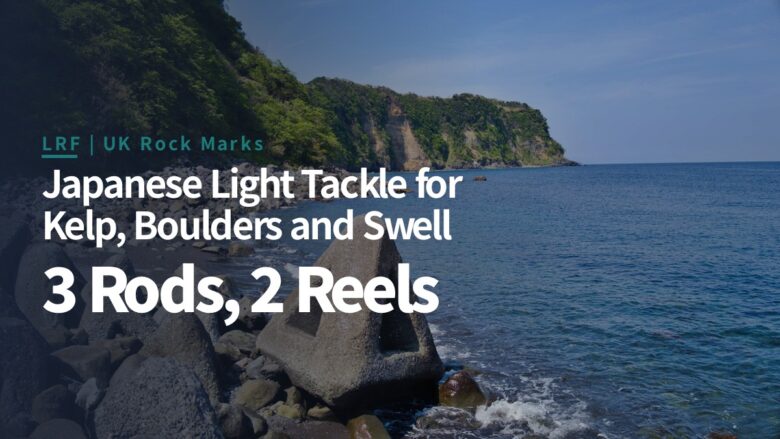
Japanese light game tackle was built for a calm harbour wall at midnight, a 1 gram jig head and a fish the length of your hand. A UK rock mark is nothing like that. Swell lifting and dropping the water, standing kelp in the top two metres, boulders that eat jig heads, and a wrasse that goes straight back into cover the second it feels the hook. The gear still works, better than most of what’s made locally. You just can’t pick it the way a Japanese angler picks it for a marina.
Quick vocabulary. LRF (Light Rock Fishing) is the British term for tiny lures on ultralight tackle. Japan sells the same gear as ajing (アジング), for aji, the Japanese horse mackerel, and mebaring (メバリング), for mebaru, a rockfish that feeds up in the water column after dark. I fish in Japan and have never cast a lure off a British rock mark: the conditions below come from published British sources, the numbers off makers’ own product pages.
These are Japan Domestic Market models, so most buy links point at Amazon Japan, which ships internationally (check availability and cost at checkout); the Stradic C2000S links go to Amazon.com. Prices are the maker’s Japanese RRP, tax excluded, converted at 17 September 2026 rates of $1 to about ¥156 and £1 to about ¥208.
The tide moves an amount of water Japan never sees. The Severn Estuary has the highest tidal range in Europe: spring range over 12 m at Avonmouth, flows around 1.5 m per second, according to the Severn Estuary Partnership. The ledge you started on is dry rock two hours later, and the ground you need to reach was under your feet at high tide.
The fish live inside the cover. Ballan wrasse sit amongst weed-covered rock and in lower-shore pools, in the algal zone from about 5 to 30 m, according to the Marine Biological Association’s MarLIN review. An ajing blank of 50-odd grams reports beautifully that a 15 cm fish breathed on your lure. It has almost nothing in the butt to stop a fish that turns and dives, which is the first two seconds of every wrasse you hook.
Wind and swell attack the line, and you’re usually standing above both. PE 0.2 with a 1 gram head loses contact in a side wind, and kelp starts feeling like a bite. From three metres up you also can’t lift a fish clear of a ledge with a 5’8″ rod. Length is doing two jobs, distance and line control, which is why almost everything below is 7 to 8 and a half feet rather than the 5 to 6 feet that dominates Japanese ajing.
Light game in Japan revolves around two species with narrow habits. British LRF is a species hunt, and the demands pull opposite ways: one session can produce a 5 cm goby and a fish that empties your drag.
| Target | Where it sits | What it asks of the tackle |
|---|---|---|
| Ballan wrasse (Labrus bergylta) | Weed-covered rock, lower-shore pools, algal zone roughly 5 to 30 m. Up to 50 cm, usually around 30 cm | Butt power and a reel that holds under a sudden dive. The one fish that decides whether your rod was the right buy |
| Corkwing and smaller wrasse | Same ground, shallower and tighter to weed | Small hooks and a rig you can fish slowly in a confined pocket |
| Pollack and coalfish | Off the end of the rock, up in the water at dusk, often in the swell line | Casting range and a rod that can swim a 7 to 20 g rig back through broken water |
| Mackerel and scad | Surface and mid-water when they’re in, mostly summer and autumn | Retrieve speed. A high-gear reel earns its money here |
| Mini species: blenny, goby, rockling, poor cod | Right at your feet, in cracks, under weed | 1 g and under, a tip that registers almost nothing, and no length at all. This is where JDM tackle has no real competition |
Flat water, short casts, fish in the shadow line under a pontoon or in the gap between two blocks of stone. The closest Britain gets to the ground Japanese light game was designed for. This is where a species hunt happens: rockling, blenny, goby, small pollack, corkwing. The rod has to load with a 1 gram head and not collect line in the dark.
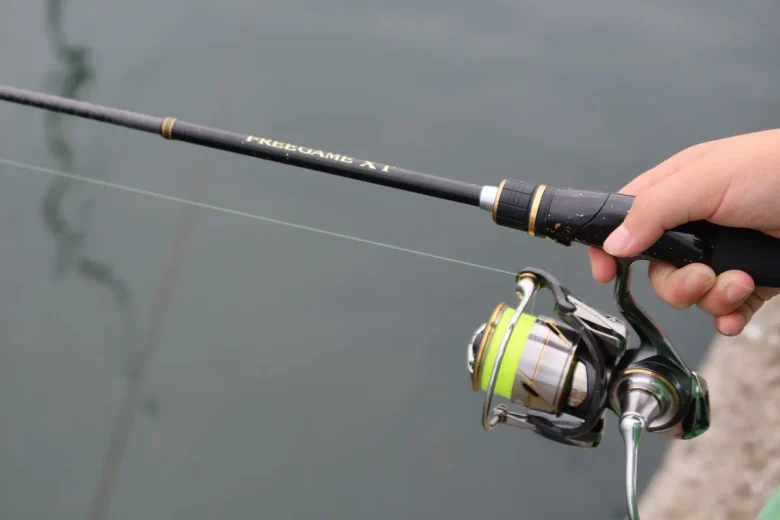
Daiwa sells this as an entry rod for ajing or mebaring beginners, and the description is honest: soft, no quirks, easy to cast light lures with. Two details lift it above the usual budget blank. The butt carries Braiding X to stop the blank twisting under load, and the guides are Alconite-ringed K-guides positioned for ester and fine PE. Daiwa chose that guide layout for fishing at night in wind.
Five models, 5’10” to 7’6″, 64 to 79 grams, ¥12,800 to ¥14,300, which undercuts every rod in our ajing and LRF roundup (the cheapest there starts at ¥16,500). For harbour work take the 76L-S, Daiwa’s long-casting model for split shot and carolina rigs. A lure rating that stops at 8 g rules the whole series out of kelp and boulder work, and the solid tips here aren’t the MEGA TOP carbon the pricier Gekkabijin rods use.
| What it’s built from | What it does |
|---|---|
| Braiding X | Carbon tape wrapped in an X pattern over the butt section to stop the blank twisting, so power reaches the fish instead of being lost in the rod |
| Alconite K-guides | Sloped frames that shed line tangles, ringed for fine ester and PE. Chosen for night and windy conditions |
| Fuji TVS reel seat | Compact seat you can close a hand around, which helps the light tip register a bite |
| Tip type | Solid on 510UL-S, 66L-S, 74UL-S and 76L-S; tubular on 68L-T |
| Model | Length | Weight | Lure | PE | Price (excl. tax) |
|---|---|---|---|---|---|
| 510UL-S | 1.78 m | 64 g | 0.3 to 5 g | 0.1 to 0.3 | ¥12,800 (~$82 / ~£62) |
| 66L-S | 1.98 m | 70 g | 0.5 to 8 g | 0.1 to 0.4 | ¥13,800 (~$88 / ~£66) |
| 68L-T | 2.03 m | 74 g | 0.5 to 8 g | 0.1 to 0.4 | ¥13,800 (~$88 / ~£66) |
| 74UL-S | 2.24 m | 75 g | 0.3 to 5 g | 0.1 to 0.3 | ¥14,300 (~$92 / ~£69) |
| 76L-S | 2.29 m | 79 g | 0.5 to 8 g | 0.1 to 0.4 | ¥14,300 (~$92 / ~£69) |
Here’s where imported ajing tackle gets found out. The wrasse are inside the cover, not cruising past it, and the rig has to swim above the fronds. That wants casting weight, a butt that turns a fish in the first second, and a tip fine enough that a wrasse doesn’t drop the lure.
Yamaga Blanks is a small Kumamoto builder that makes blanks and nothing else. The 82 is the long end of its light game series: 2,495 mm, 83 grams, jig heads from 2 g to 20 g. Yamaga’s own copy has it stopping and lifting good aji and mebaru that run in offshore weed beds and hard tide, with the strongest butt in the series, and covering rockfish on swimming jig heads to 20 g. Kelp and wrasse ask for those same three things.
It starts at 2 g, so it’s the wrong rod for a marina species hunt, and ¥32,500 is real money for a fish most people put straight back. For boulders rather than standing weed, the 78 at ¥31,000 is the one Yamaga builds for bottom work, and the bait-casting 82/B takes fluoro to 10 lb for fish that dive at your feet in tetrapods.
| What it’s built from | What it does |
|---|---|
| Two-piece reverse spigot joint | Yamaga’s reverse parallel ferrule layout, which keeps the bend continuous through the joint |
| Fuji SiC-S K-guides, stainless frame | Hard rings with the tangle-shedding frame angle, for fine braid in wind |
| Fuji VSS16 reel seat | Full-size screw seat rather than a stripped-down light game seat, which matters when you’re leaning on a fish |
| Grip dimensions | 325 mm from reel foot to butt, 390 mm total handle, so two-handed casting works |
| Maker’s recommended reel | Daiwa LT2000 to LT2500C, or Shimano 2000 to 2500 |
| Model | Length | Weight | Lure | Line | Price (excl. tax) |
|---|---|---|---|---|---|
| Blue Current III 78 | 2.35 m | 79 g | Max 15 g (rig 1 to 15 g) | PE 0.3 to 0.8 | ¥31,000 (~$199 / ~£149) |
| Blue Current III 82 | 2.495 m | 83 g | Max 20 g (JH 2 to 20 g) | PE 0.3 to 0.8 | ¥32,500 (~$208 / ~£156) |
| Blue Current III 82/B | 2.495 m | 93 g | Max 20 g (JH 2 to 20 g) | PE 0.4 to 0.8, nylon and fluoro 4 to 10 lb | ¥33,500 (~$215 / ~£161) |
Some marks are just a long way from the fish: deep water off a headland, pollack in the swell line at dusk, a gully you can see and can’t reach with 2 g. Japan’s answer, for big mebaru off exposed rock, was a longer rod that throws float and carolina rigs.
This is not the Gekkabijin MX Ajing, a set of 4’8″ to 5’4″ jig-head sticks. The plain Gekkabijin MX is the mebaru side of the family, and it runs out to 8’3″. Daiwa’s note on the 83M-T calls it the high-power model for big mebaru on the bottom, for rock, surf and boulder ground, fishing heavier jig heads, larger plugs and float rigs over offshore breaks and hard tide, and useful where seabass and black bream are mixed in. Read bass for seabass, wrasse for black bream.
The blank is HVF Nanoplus with X45 on a hollow carbon monocoque butt, and the tip is tubular: Daiwa fits the solid MEGA TOP carbon only to the 610L-S and 74UL-S. ¥41,000 is Blue Current III money plus a third, and it buys reach and lure control rather than power to haul a fish out of standing kelp.
| What it’s built from | What it does |
|---|---|
| X45 | Carbon fibres laid at 45 degrees to block blank twist, so the rod keeps its power and feel under a sideways load |
| HVF Nanoplus | High-density carbon with Toray nano-alloy resin: less resin, more fibre, lighter and stronger |
| V-JOINT | Bias carbon at the ferrule so a two-piece bends like a one-piece |
| Carbon monocoque rear grip | Hollow one-piece carbon butt that transmits bottom contact and bites into the hand |
| Zero Seat (Seamless Fit) | Light reel seat that lets you rest a hand on the blank itself |
| MEGA TOP solid tip | Fitted only to the 610L-S and 74UL-S. The long models run tubular tips |
| Model | Length | Weight | Lure | PE | Price (excl. tax) |
|---|---|---|---|---|---|
| 710ML-T | 2.39 m | 81 g | 1.5 to 10 g | 0.15 to 0.5 | ¥40,500 (~$260 / ~£195) |
| 83M-T | 2.51 m | 86 g | 2 to 15 g | 0.2 to 0.6 | ¥41,000 (~$263 / ~£197) |
| 76LB-T | 2.29 m | 75 g | 2 to 10 g | 0.25 to 0.6 | ¥43,500 (~$279 / ~£209) |
The dedicated Japanese light game reels are lovely and they’re the wrong starting point here. A Soare XR is built around thread-fine braid and fish measured in centimetres, and that whole ladder sits in the ajing and LRF guide. A rock mark wants a drag that doesn’t flinch when a wrasse turns and a body that keeps salt out: one shelf across, in the general-purpose 2000 to 2500 class.
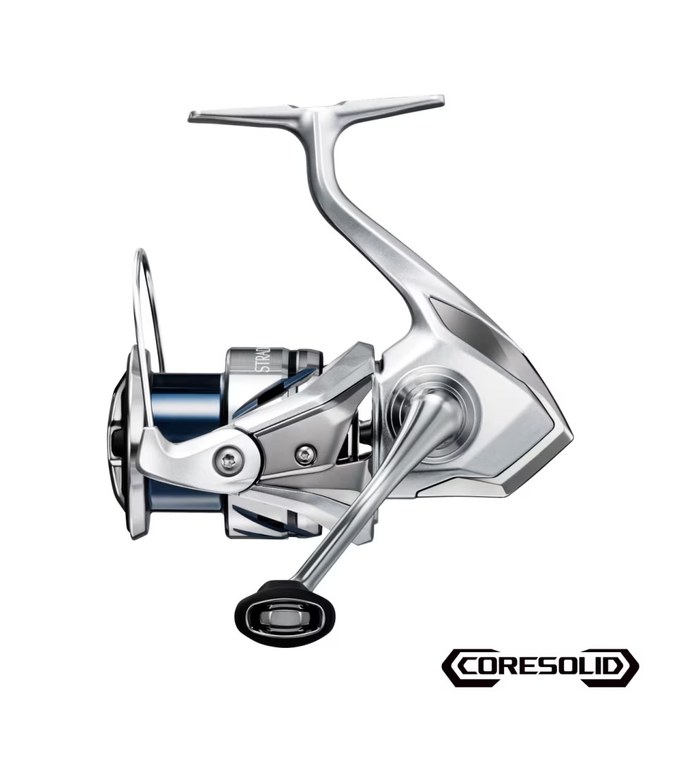
The Stradic has been Shimano’s sensible answer for two decades, and the current one is well specified. An aluminium body and a cold-forged HAGANE drive gear give it a stiffness the carbon-bodied light game reels don’t have, and X-Protect seals the line roller and the stopper bearing: two of the places salt gets in when you fish low on wet rock.
The C2500S is the pick: 185 grams, 70 cm per turn, PE 0.6 for 200 m, 3 kg of drag, ¥27,700 across the C-series. For mackerel, take the C2500SXG at 87 cm. That 3 kg drag is the one number that gives the Daiwa an opening.
| Technology | What it does |
|---|---|
| Aluminium body, HAGANE drive gear | Cold-forged gear in a metal frame: the gear mesh holds its alignment under a hard pull |
| Infinity Cross | Redesigned tooth faces give the gears a larger contact area, so load spreads instead of concentrating on one spot |
| Infinity Drive | Main shaft support that cuts friction, for a lighter wind under load |
| Anti-Twist Fin | Line-roller fin that clears twist out of fine PE before it becomes a tangle |
| X-Protect | Non-contact water-repellent seal at the line roller and the stopper bearing |
| Long Stroke Spool | Longer spool stroke for extra casting distance with light rigs |
| Model | Gear ratio | Weight | Retrieve | Max drag | PE capacity | Price (excl. tax) |
|---|---|---|---|---|---|---|
| C2000S | 5.1 | 185 g | 69 cm | 3 kg | PE0.6-150 | ¥27,700 (~$178 / ~£133) |
| C2500S | 5.1 | 185 g | 70 cm | 3 kg | PE0.6-200 | ¥27,700 (~$178 / ~£133) |
| C2500SXG | 6.3 | 185 g | 87 cm | 3 kg | PE0.6-200 | ¥27,700 (~$178 / ~£133) |
Daiwa’s two headline spinning technologies are both in the 2025 Caldia, and both suit wet rock. The monocoque body drops the side cover, so there’s one less seam and room for a bigger drive gear. Magsealed protects the pinion, and Daiwa deleted the anti-reverse stopper entirely, closing off another route water and grit use to get inside.
Drag decides it against the Stradic: 5 kg in the FC LT2500S at 170 grams, against 3 kg at 185. ATD Type-L slips early and smoothly rather than locking, which is what you want when a wrasse takes off with 8 lb fluoro between you and the rock. At ¥29,300 it’s ¥1,600 more. Magsealed is the part that divides owners: it keeps salt out, and it makes home servicing something you do carefully or not at all.
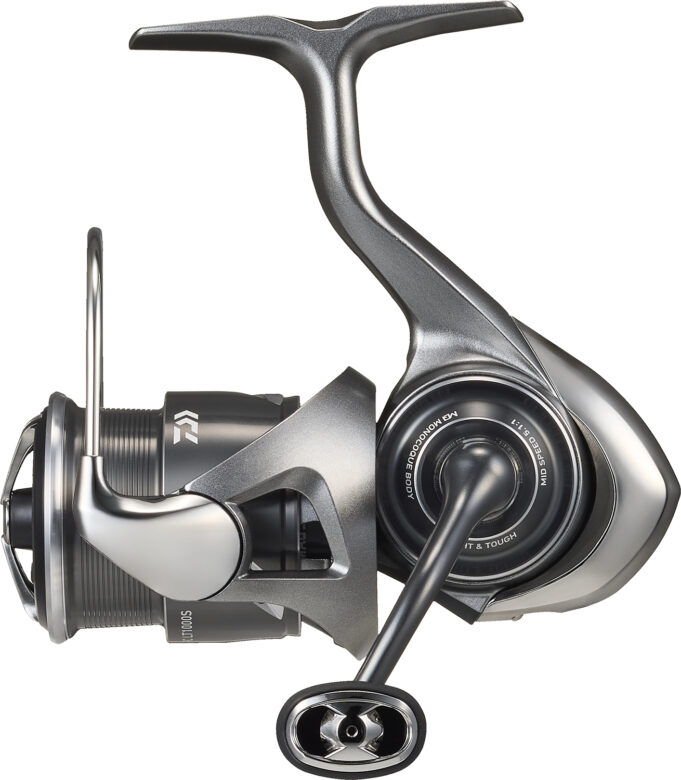
| Technology | What it does |
|---|---|
| Monocoque Body | No side cover, so the frame is stiffer, better sealed, and fits a bigger drive gear |
| Magsealed (pinion) | Magnetic oil barrier that blocks salt and grit at the pinion |
| Stopper-less body | The anti-reverse stopper is deleted, removing a route for water and debris |
| ZAION V body and rotor | Carbon hybrid resin: light, stiff and corrosion-proof |
| Air Drive rotor, bail and spool | Lower rotational inertia and an easier wind-start, which is where bite detection comes from |
| ATD Type-L | Auto-adjusting drag tuned to start slipping early, for fine line |
| LC-ABS spool | Contact point moved forward for smoother line release, roughly 5 percent more distance than ABS II |
| Model | Gear ratio | Weight | Retrieve | Max drag | PE capacity | Price (excl. tax) |
|---|---|---|---|---|---|---|
| FC LT2000S | 5.1 | 165 g | 67 cm | 5 kg | PE0.4-200 | ¥28,800 (~$185 / ~£138) |
| FC LT2500S | 5.1 | 170 g | 72 cm | 5 kg | PE0.6-200 | ¥29,300 (~$188 / ~£141) |
| FC LT2500S-H | 5.8 | 170 g | 82 cm | 5 kg | PE0.6-200 | ¥29,300 (~$188 / ~£141) |
A jig head on the end of the braid is how Japanese light game starts and, for plenty of Japanese anglers, ends. On a British rock mark it’s the rig that costs you the most tackle. The alternatives all do one job: keep a small soft plastic in front of fish that live in cover without feeding the cover a jig head every third cast.
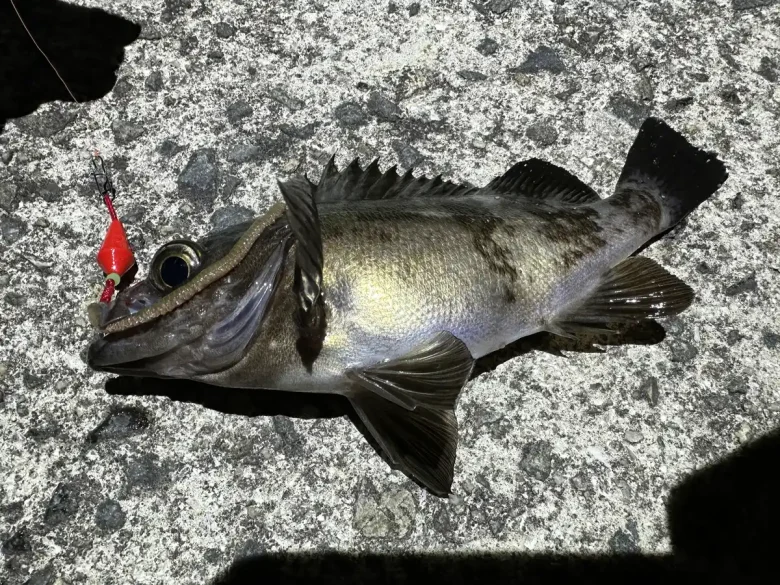
| Rig | What it solves on UK rock | What it costs you |
|---|---|---|
| Single jig head, 0.4 to 3 g | The most direct contact you can have with a small lure. Unbeatable for mini species and fish sitting close | No casting range in wind, and an exposed hook point in weed |
| Split shot rig | Weight moved 20 to 40 cm up the leader, so the lure falls slowly and naturally over a snaggy bottom | Twists if you cast it hard, and the shot itself can wedge in a crack |
| Carolina (through-line) sinker, 3 to 11 g | Distance and depth control with a 1 g head on the business end. The rig that gets a light lure out to a gully | More components to snag, and a longer cast to control in swell |
| Down shot | Holds the lure at a fixed height above rock, with the sacrificial weight below it | Slow to fish, and the weight is the thing that jams |
| Weedless offset hook with a soft plastic | The hook point is buried, so you can fish through standing kelp and over boulders deliberately | Hook-up rate drops, and small-mouthed species miss it entirely |
| Small metal jig, 3 to 20 g | Range and sink rate for pollack, mackerel and scad off the end of the mark | Two or three hooks near rock. Fish it above the bottom or lose it |
| Micro spoon | Slow flutter on a tight line, good over clean rock in daylight | Almost no casting weight, and it fouls easily in weed |
Two habits are worth stealing whichever rig you pick. Tie the jig head on with leader lighter than your main leader, so the head goes and the rest comes back. And count the rig down instead of feeling for the bottom: in kelp the fish are looking up anyway.
Tict is a small Kochi company that sells almost nothing but light game gear, and the M-Caro is the piece worth importing. It’s a through-line sinker with a wide-bore pipe, so bites transmit instead of being absorbed, shaped to slide away from you as it falls rather than dropping straight down. A rig that drifts away from the rock as it sinks holds its depth however fast you wind.
Two per pack at ¥825 including tax makes this the cheapest useful thing here. It needs a rod that can cast it, which is why the Blue Current III 82 lists rigs to 20 g and the Aji-Mebaru X stops at 8 g.
| How it fishes | Detail |
|---|---|
| Type | Through-line (running) carolina sinker, sold in pairs |
| Fall behaviour | Back-slide fall away from the angler; Ver.II covers roughly 15 to 60 degrees depending on shape |
| Sensitivity | Wide-bore inner pipe so bites and tide changes come through the line |
| Tuned Weight models | 3 g and 4 g, for a quiet entry and very slow presentations |
| Item | Role | Per pack | Price |
|---|---|---|---|
| Tict M-Caro Ver.II | Distance and depth control for a light jig head | 2 | ¥825 incl. tax (~$5 / ~£4) |
| Tict Mini M-Caro | The same idea at close range, for tight and shallow ground | 2 | Check current listing |
| Tict M-Caro swivel | Stops the rig twisting on a hard cast | Varies | Check current listing |
For plugs, vibration jig heads and soft plastics aimed at British bass, go to our Japanese lures for UK bass guide; the classic minnow shortlist is in JDM lures for European seabass.
| Item | Key numbers | Where it earns its place | Price (excl. tax unless noted) |
|---|---|---|---|
| Daiwa Aji-Mebaru X 76L-S | 2.29 m / 79 g / 0.5 to 8 g / PE 0.1 to 0.4 | Harbour walls, marinas, mini species, a first Japanese rod | ¥14,300 (~$92 / ~£69) |
| Yamaga Blue Current III 82 | 2.495 m / 83 g / jig heads 2 to 20 g / PE 0.3 to 0.8 | Kelp, rough ground, wrasse that dive for cover | ¥32,500 (~$208 / ~£156) |
| Daiwa Gekkabijin MX 83M-T | 2.51 m / 86 g / 2 to 15 g / PE 0.2 to 0.6 / tubular | Deep water, swell, casts you can’t otherwise make | ¥41,000 (~$263 / ~£197) |
| Shimano Stradic C2500S | 185 g / 5.1 / 70 cm / 3 kg drag / PE0.6-200 | Metal body and X-Protect, the stiffer of the two reels | ¥27,700 (~$178 / ~£133) |
| Daiwa 25 Caldia FC LT2500S | 170 g / 5.1 / 72 cm / 5 kg drag / PE0.6-200 | More drag, lighter, sealed against a wet ledge | ¥29,300 (~$188 / ~£141) |
| Tict M-Caro Ver.II | 2 per pack / back-slide fall 15 to 60 degrees | Getting a 1 g head out to the fish and keeping it off the rock | ¥825 incl. tax (~$5 / ~£4) |
For kelp and wrasse: Yamaga Blue Current III 82 plus Daiwa 25 Caldia FC LT2500S
The ground most British LRF anglers actually fish: 20 g of rig capacity, the strongest butt in the Blue Current range, and 5 kg of early-slipping drag on a sealed body. Around ¥61,800 excl. tax for the pair (~$396 / ~£297).
Check the Blue Current III 82 on Amazon Japan · Check the 25 Caldia
For deep water and swell: Daiwa Gekkabijin MX 83M-T plus Shimano Stradic C2500S
Eight foot three of tubular-tipped carbon on an aluminium-bodied reel, for a headland in a swell where distance and line control decide the session. Around ¥68,700 excl. tax (~$440 / ~£330).
For finding out whether you like it: Daiwa Aji-Mebaru X 76L-S plus a budget light game reel
Pair the ¥14,300 Aji-Mebaru X with a cheap Japanese light game reel and a complete outfit lands around ¥35,800 excl. tax (~$230 / ~£172). It won’t stop a wrasse in kelp. It will tell you inside two sessions whether British mini species are your thing.
Check the Aji-Mebaru X on Amazon Japan · budget reel options in the ajing and LRF guide
Pollack changed recently. After the UK and EU annual negotiations, the Angling Trust reported in December 2025 that a three-fish recreational bag limit had been agreed, the first time the recreational fishery has been managed by a bag limit. The Written Record put implementation at 1 June 2026 at the latest, in principle, and until then the voluntary Pollack Pact measures stand, including descending devices for fish brought up from depth. The Angling Trust announcement has the detail, and the position may have moved since.
Wrasse sit differently. Devon & Severn IFCA states that it has no permit byelaw for angling, though minimum sizes in its inherited byelaws apply to any person whatever the method, and its live wrasse pot fishery is open only to commercial permit holders. Ballan, corkwing, cuckoo and goldsinny wrasse have size requirements inside those permit conditions, and rock cook wrasse can’t be removed at all. Source: Devon & Severn IFCA on minimum conservation reference sizes.
Bass has a 42 cm national minimum size plus seasonal recreational rules, set out in the UK bass lure guide. All of it varies by IFCA district in England, and Wales and Scotland run their own systems, so check the rules for the coast you’re standing on.
Can one rod really cover 0.4 g jig heads and 20 g carolina rigs? No, and the limit turns up as a weight rather than a species. My shore fishing in Japan runs on one outfit, a Shimano 23 Dialuna with a Daiwa 22 Caldia SW, bought for seabass and light shore jigging in 2023 and still the first thing I pick up. It stops working in two places: jigs over 40 g, and jigs under 20 g. Every bit of tackle has a range it suits. That’s Japanese light shore jigging and seabass, not British LRF, but the weight limits carry over.
Will Amazon Japan actually ship a rod to the UK? Reels and terminal tackle, usually yes. Rods are the awkward case: a two-piece light game rod is over 1.2 m in its tube and many sellers won’t send that internationally. Check the listing before you commit, and expect import charges. Our importing guide covers the proxy-service route, which is how most rods leave Japan.
Is PE 0.3 enough for a wrasse in kelp? The braid usually isn’t what fails. It’s the leader against rock and the drag setting in the first second. Fish the heavier end of what the rod allows, use a longer fluorocarbon leader than you would for ajing, and set the drag so it gives before the leader does. Our PE line and leader guide puts the Japanese numbers into pound test.
What do codes like 74UL-S and 83M-T mean? Length in feet and inches, then power, then tip type: 7 feet 4 inches, ultralight, solid tip; 8 feet 3 inches, medium, tubular. Lure weights are in grams and line in Japanese gou. Full decoder in understanding Japanese rod specs.
Work backwards from your nearest mark. The moment to buy a specialist rod is when you catch yourself thinking I want to catch more of these, when the trips have started adding up. Before that, in the right season at a mark with a track record, you’ll catch on whatever tackle you’re holding. A dedicated outfit catches more and it’s more fun, definitely. But for a fishing you’ve only just started, or one you do once a year because a friend asks, a shared outfit is plenty, I reckon.
Marina and harbour wall, and the Aji-Mebaru X plus a handful of jig heads is a complete answer for under £100. Kelp, boulders and wrasse, and the Blue Current III 82 was built for the fight you’re about to have. Deep water in a swell, and the Gekkabijin MX keeps paying. Then check the current pollack rules and accept that the rock will keep some of your jig heads.