Best JDM PE Lines for Offshore Fishing: Braid Guide
ちゃんま
マイボ!

If you’ve started buying Japanese tackle, you’ve run into a wall the spec sheet never warns you about. Your new reel says it holds “PE 1.5 / 200m.” The braid on the shelf is labeled “0.8号.” The leader spool reads “3号 / 12lb.” None of those numbers is a pound test, and that trips up almost every angler coming from the US or Australia. The good news is that the Japanese system is actually more logical than the one you grew up with, once you know what it’s measuring.
This guide breaks down the gou (号) rating used for both braid and leader, shows why there’s no single “PE to lb” number that works everywhere, and gives you practical charts plus real pairings for tairaba, light jigging, shore jigging, and eging. If you’ve already read our explainer on JDM reel size numbering, this is the line-and-leader companion to it.
A quick word on where I’m coming from. I fish tairaba and light jigging from a small boat here in Japan, so gou is just the language on every spool I own. What I can’t do is promise the exact breaking strain of your specific line, and by the end of this you’ll understand why nobody honestly can. What I can do is show you how to read the numbers and rig with confidence.
Gou (号 / ごう) is a Japanese sizing unit built around diameter, not strength. The system goes back to 1947, when Toray set 1号 equal to a monofilament diameter of 0.165mm. The Japan Fishing Tackle Manufacturers Association (JAFTMA) later formalized it, and in 2010 it published a common standard covering nylon, fluorocarbon, and polyester lines. Every step up the scale is a thicker line: 2号 is roughly twice the cross-section of 1号, and so on.
That’s the key mental switch. A gou number tells you how thick a line is, the same way a pound test tells an American angler how strong it is. Thickness matters enormously in Japanese styles: it sets how far a light jig casts, how little a tairaba rig gets pushed around by current, and how much line a small counter reel can pack onto a shallow spool. Japanese anglers optimize for diameter first and treat strength as a consequence.
Here’s where the internet’s conversion charts quietly mislead you. PE braid is also labeled in gou, but braid strength depends on the fiber, the number of strands, and how tightly it’s woven. Two spools can both read “PE 1.0” and break at very different weights. A budget 4-strand might hold 16lb while a premium 8-strand in the same 1.0号 class tests past 23lb. Same number on the label, different pound test in your hand.
The rule of thumb you’ll see quoted is that braid breaks at roughly ten times its PE number, so PE 2.0 lands somewhere near 20lb and PE 5.0 near 50lb. Treat that as a rough floor rather than a promise. Modern Japanese 8-strand lines frequently beat it, and cheaper lines can fall short. This is exactly why the honest answer to “what’s PE 1.5 in pounds?” is a range, not a single figure. Always read the actual breaking strain the maker prints on the box.
Leader is more predictable because mono and fluorocarbon are single strands. For those, gou converts to pounds at roughly four times the number: a 3号 leader is about 12lb, a 5号 about 20lb. In practice the published figures sit at or just above four times: Seaguar rates 3号 at 14 lb and 5号 at 22 lb, while Varivas and Sunline list 12 lb and 20 lb for the same sizes.
Use the table below as a starting reference for Japanese 8-strand braid. One thing worth knowing first: there is no official diameter standard for PE at all. JAFTMA, the Japanese tackle industry body, defines PE gou by denier — weight per 9,000m, where 1号 = 200d — not by thickness. Every diameter printed for braid is the maker’s own measurement, so read the middle column as a reference figure rather than a specification. The pound ranges are wide for the same reason: strength varies by construction.
| PE (号) | Maker diameter (no standard) | Rated strength, 8-strand | Common use (JDM styles) |
|---|---|---|---|
| 0.6 | 0.132mm | 10–14.8 lb | Finesse eging, light tairaba, ajing |
| 0.8 | 0.153mm | 12–18.5 lb | Tairaba, SLJ, eging |
| 1.0 | 0.171mm | 16–23.1 lb | Light jigging, tairaba, LSJ |
| 1.2 | 0.191mm | 20–27.1 lb | Light jigging, light shore jigging |
| 1.5 | 0.209mm | 25–31.8 lb | Shore jigging, light jigging |
| 2.0 | 0.242mm | 33–43 lb | Shore jigging, boat jigging |
| 3.0 | 0.296mm | 49–50 lb | Heavier jigging, kingfish |
| 4.0 | 0.342mm | 53–70 lb | Offshore jigging, big pelagics |
Notice how the diameter climbs slowly while the strength climbs fast. That’s the whole appeal of good braid: you get more pulling power without the thickness penalty that a thicker mono would cost you in casting distance and current resistance.
Where these numbers come from: the strength ranges span the published 8-strand ratings of five Japanese makers — Shimano, Daiwa, YGK, Sunline and Varivas — read from their own spec sheets in August 2026. Diameters are Duel’s published figures — Hardcore X8 for 0.6–4.0号, Super X-Wire 8 Eging for 0.4–0.5号 and Super X8 for 5.0号 — replacing Sunline’s SIGLON PE×8 figures, which now survive only on Sunline’s English site.
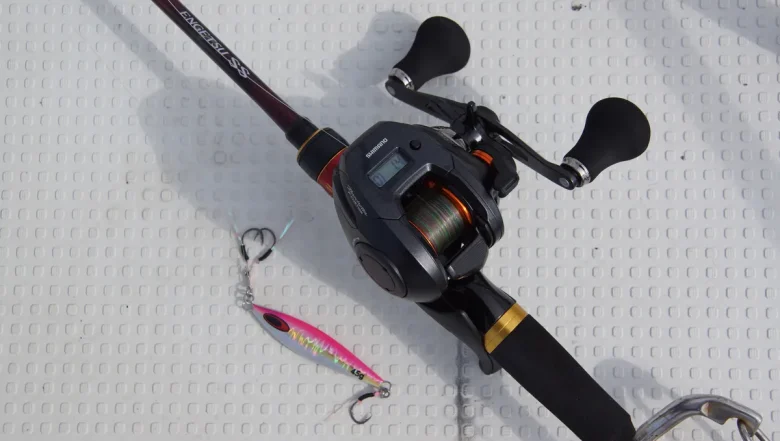
Japanese leader material is sold in gou too, and here the four-times rule holds up well — because unlike braid, leader gou is a published standard. JAFTMA’s JAFS-D1051100 fixes the nominal diameter of nylon and fluorocarbon line, which is why the figures below line up across brands. Because leader is a solid strand, the diameter and strength track together far more tightly than braid does. One thing to watch: a fluorocarbon leader and a braid can share the same gou number and still differ in diameter, which is why a reel’s stated line capacity in gou refers to a specific line type. Don’t assume “3号” on your braid and “3号” on your leader are the same thickness.
| Leader (号) | Nominal diameter | Approx. pound test |
|---|---|---|
| 2 | ~0.235mm | ~8 lb |
| 2.5 | ~0.260mm | ~10 lb |
| 3 | ~0.285mm | ~12 lb |
| 4 | ~0.330mm | ~16 lb |
| 5 | ~0.370mm | ~20 lb |
| 6 | ~0.405mm | ~22–25 lb |
| 8 | ~0.470mm | ~30 lb |
| 10 | ~0.520mm | ~40 lb |
Fluorocarbon is the default leader for most Japanese boat styles because it sinks, resists abrasion on a fish’s teeth and gill plates, and disappears in clear water. Nylon shows up where a little stretch and buoyancy help, such as topwater work. For tairaba, light jigging, and eging, assume fluoro unless a guide tells you otherwise.
Tap a PE rating, or type a value in any of the three units. The tool returns the maker-published diameter, the 8-strand strength range and a suggested fluorocarbon leader, and it converts gram and ounce jig weights on the second tab.
A balanced rig pairs a leader that’s a bit stronger than your braid, so the knot and the abrasion zone can take a hit before the main line does. In practice, Japanese anglers set the leader’s pound rating at roughly the same as, or a little above, the braid’s real breaking strain. Start from the technique, not from a formula. Here’s how the numbers land for the styles this site covers.
These are starting points, not laws. Heavier current, deeper water, or bigger fish all push you up a size. When in doubt, match what the reel spool and the technique guides recommend, then adjust after a trip or two.
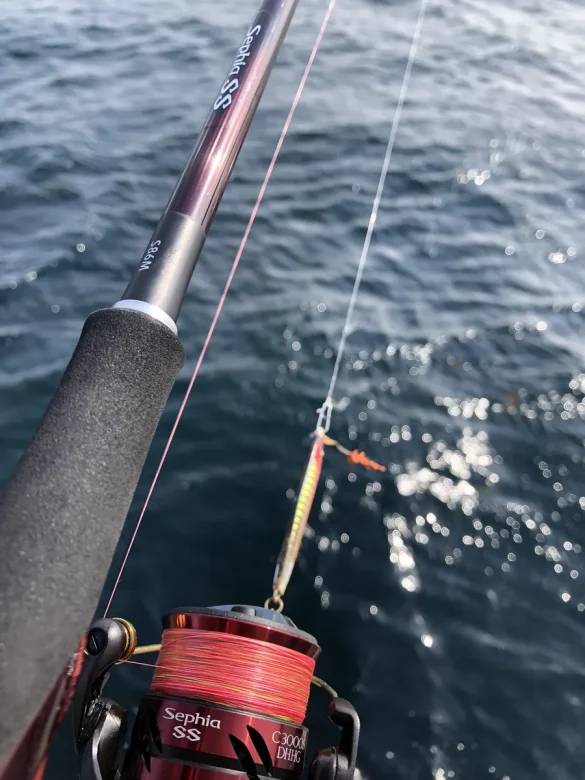
This is where the diameter-first logic pays off. A JDM reel lists capacity as a gou number times a length, like “PE 1.0 / 300m” or “PE 2 / 200m.” Because gou is a fixed diameter, that spec tells you precisely how much of a given line thickness the spool holds, regardless of brand. It’s the same reasoning behind the size codes on the reel itself, which we cover in the JDM reel size numbering guide.
Two practical notes. First, capacity is quoted for braid at that gou, so your fluorocarbon leader (thicker per gou in practice) doesn’t map one-to-one. Second, “shallow” or “SH” spools are built around thin PE on purpose, which is why a small tairaba or light-jigging reel can still carry plenty of 0.8–1.0号. If a US-market version of the same reel lists capacity only in yards of pound-test mono, that’s your sign the spec was translated for a different market.
Most serious Japanese braid brands, YGK, Varivas, Sunline, and Duel among them, are the reason JDM anglers obsess over line at all. Some of their lines reach Amazon.com; many stay domestic. If you want to browse what ships internationally, this search for Japanese PE braid on Amazon.com is a fair starting point, and you can price a fluorocarbon leader on Amazon Japan for the JDM-only spools. Ships internationally from Amazon Japan: check availability and shipping cost at checkout.
One buying tip that saves grief: note both the gou and the printed pound test before you order. Because the pound rating varies by brand, the number on the box is the only figure you can trust across the whole shelf. For the shipping, customs, and proxy details, see our full walkthrough on how to buy JDM tackle overseas.
For Japanese 8-strand braid, roughly 16 to 23 lb. PE 1.0 is a thickness class rather than a strength — makers publish it at about 0.17mm, and there is no official diameter standard for braid — so the pound test moves with the fiber, the strand count and the weave. Budget 4-strand lines sit lower, often nearer 10 to 16 lb. Always check the breaking strain on the box.
Multiply the gou number by about four. A 3号 leader is roughly 12 to 14 lb and a 5号 about 20 to 22 lb, depending on the maker. Unlike braid, leader gou is a published JAFTMA diameter standard, which is why the numbers stay close across brands.
Because gou fixes the nominal thickness class, not the strength — and for braid it isn’t a diameter standard at all. A tightly woven 8-strand line packs more working fiber into the same 1.5号 class than a cheaper 4-strand, so it breaks at a higher weight. That’s normal, and it’s why the label’s stated pound test matters more than the gou number when you’re picking line for a target fish.
Usually yes, or at least equal. The leader takes the abrasion near the lure and absorbs shock, so setting it at roughly the same pound rating as your braid’s real strength, or a touch above, protects the main line. A common tairaba setup is PE 0.8 braid with a 3号 (about 12 lb) fluoro leader.
Once you stop reading gou as a pound test and start reading it as a diameter, the whole Japanese system clicks. Braid gou tells you thickness and casts a wide net on strength; leader gou converts cleanly at about four times the number; and the two don’t have to match. Pick your line by the technique, trust the printed breaking strain over any chart, and pair a slightly stronger leader on top.
From here, the natural next steps are the gear guides that use these exact line ratings. Start with the English top page and pick the technique you’re rigging for, whether that’s tairaba, light jigging, or shore jigging.