Best JDM Rods for Snapper on Soft Plastics in Australia: Five Series by Model Number
ちゃんま
マイボ!

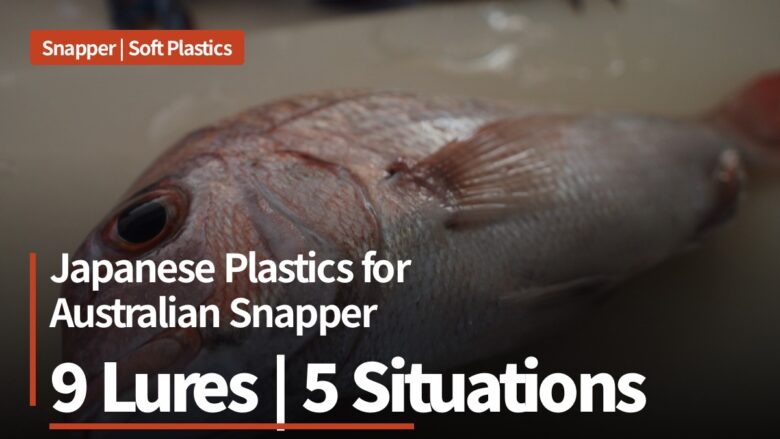
Every second boat on Australian snapper ground has a packet of plastics open on the deck. That part is settled. What isn’t settled is what to do when the fish are sitting in forty metres with three knots of tide running over them, or when the pinkies in the estuary keep mouthing a bait and dropping it. Those are different problems, and in Japan they get sold different lures.
Madai, the red sea bream (Pagrus major), is the fish the Japanese soft plastic industry has been aiming at for decades. Australian snapper (Chrysophrys auratus) is the same genus and behaves close enough that the gear crosses over without modification. The difference is how it’s catalogued. Japanese tackle walls are arranged by situation: this one for the fall, this one for current, this one for fish that won’t commit.
So that’s how this is laid out. Five situations you’ll recognise from your own water, and the Japanese plastic built for each. If you want the wider picture across lure categories, kabura heads and blades and micro jigs included, that’s covered in our guide to Japanese snapper lures. Everything below is soft plastic.
Four things on a Japanese packet are worth learning to read before you order anything:
Prices are maker list prices in JPY with approximate AUD conversion at A$1 = ¥110 (August 2026). Keitech and Bait Breath publish tax-included prices; Fish Arrow publishes tax-excluded; Marukyu does not publish list prices for Ecogear soft plastics at all, and those cells say so. JDM buy links point to Amazon Japan, which ships internationally: check availability and shipping cost at checkout, and orders over A$59 may qualify for free international delivery. Where a lure is also stocked in the US, the Amazon.com link is available with international shipping to Australia. Snapper size and bag limits differ by state, so check your local regulations before you go.
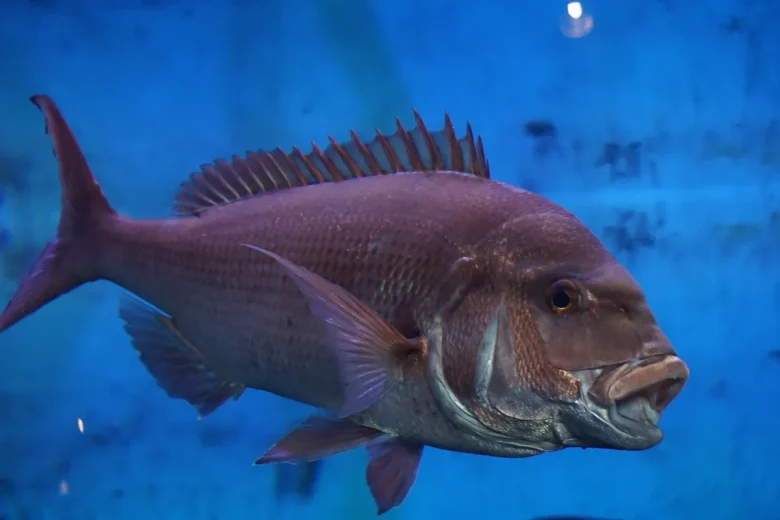
Spring fish in five to fifteen metres are the easiest snapper in the calendar and the most easily spooked. Big profiles get followed and refused. What works is a small shad on a light head, cast well ahead of the boat, left to sink on a slack line, then wound just fast enough to feel the tail.
Ecogear is Marukyu’s lure brand, and Marukyu is a bait company first. That heritage shows up in odd places, but the Grass Minnow isn’t one of them. It’s a plain shad tail that has outlasted three decades of fashion. Ecogear’s own description of it runs to one sentence about the wiggle and one about how many rigs it suits, which tells you how much explaining they think it needs.
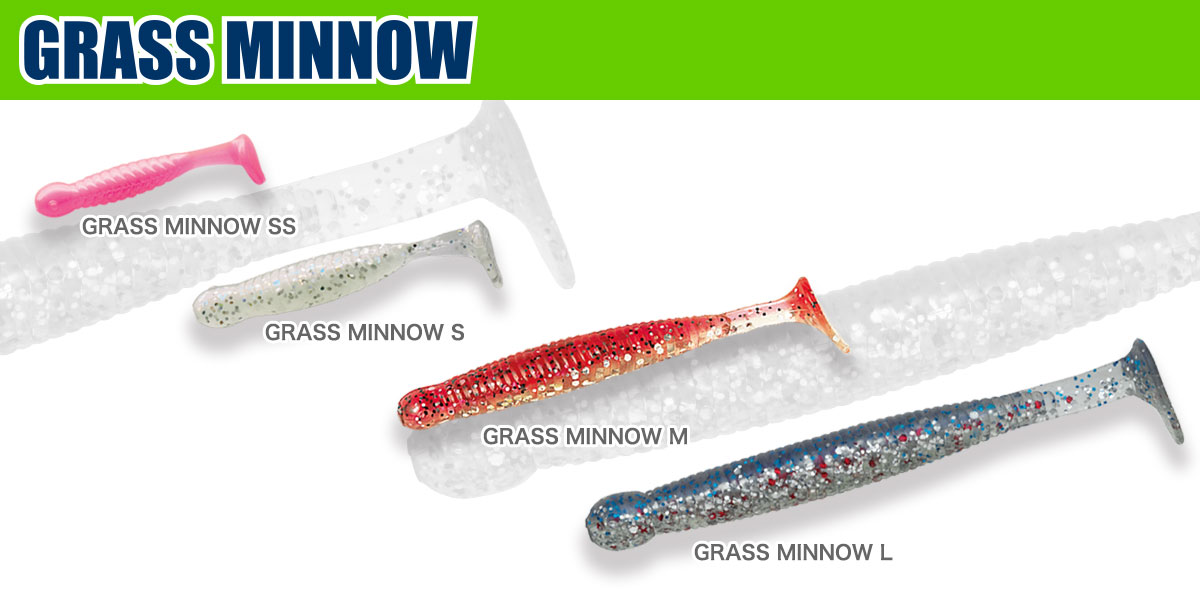
| Point | What Ecogear says |
|---|---|
| Action | Wiggly swimming action produced by the tail shape |
| Rigs | Jig head, split shot, drop shot or no-sinker |
| Scope | Salt and fresh water, wide range of species |
| Sizes | Four, from 28 mm to 85 mm |
| Size | Length | Pcs. per pack | List price |
|---|---|---|---|
| SS | 1-1/8″ / 28 mm | 15 | Not published |
| S | 1-3/4″ / 42 mm | 12 | Not published |
| M | 2-1/2″ / 64 mm | 10 | Not published |
| L | 3-1/4″ / 85 mm | 8 | Not published |
The L at 85 mm is the snapper size. Eight in a bag sounds thin until you notice it’s the same eight most people would get through in a morning of pinkie bites, and the material holds up to those better than a soft bass plastic does. Where it earns its place is on a light head in clear water, when a bulkier lure draws follows and nothing else.
Keitech built this one around two ideas that are easy to miss on the shelf. The body is asymmetric, with a deliberately low centre of gravity, and the mix has extra salt loaded into the belly side so the lure sits upright without a heavy head forcing it there. Then there’s a keel running down to the bottom edge of the tail, which Keitech added to stop the tail folding upward under water pressure. Wind it fast and the action doesn’t wash out. That’s the whole design brief.
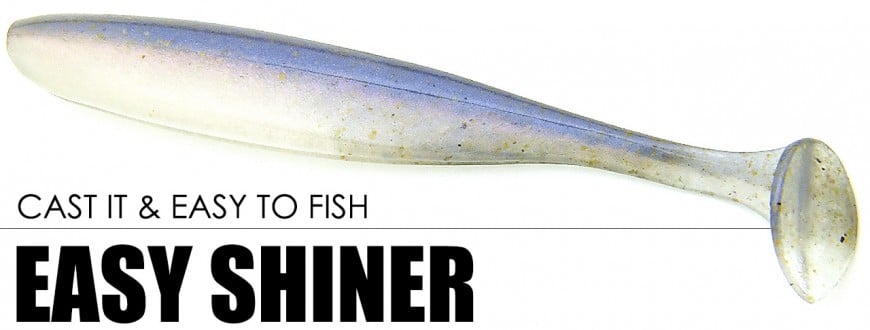
| Feature | Detail |
|---|---|
| Body | Vertically asymmetric, low centre of gravity, extra salt on the belly side |
| Tail | Thin, sharp profile with a keel to the lower edge so the tail won’t flip up at speed |
| Hook slits | Top and bottom, so an offset hook goes in straight and the point buries |
| Scent | Squid extract in the mix (Keitech’s ika formula) |
| Size | Weight each | Pcs. | Rec. offset hook | Price (incl. tax) | Approx. AUD |
|---|---|---|---|---|---|
| 3.5″ | 3.9 g | 7 | #1/0 to #2/0 | ¥814 | ~A$7.40 |
| 4″ | 5.5 g | 7 | #2/0 | ¥814 | ~A$7.40 |
| 4.5″ | 7.4 g | 6 | #3/0 or #4/0 | ¥814 | ~A$7.40 |
| 5″ | 10.4 g | 5 | #4/0 or #5/0 | ¥924 | ~A$8.40 |
Two things to keep in mind. Keitech is a bass company, and those hook recommendations assume a fish that doesn’t run. Snapper do. The #2/0 offset that suits a 4-inch body in a bass context is light in wire for a 6 kg red, so match the size but not the wire gauge. And the salt loading that makes the lure sit upright also makes it tear more readily at the nose than a tough elastomer would. You’ll get fewer fish per lure than you would from an Australian ElaZtech bait, and better action while it lasts.
Thirty to sixty metres with tide over the top, and the arithmetic changes completely. Now the lure’s job is to keep swimming while the head drags it down, and a plastic with a lazy tail simply hangs in the water column doing nothing. Two answers here, plus the head that makes either of them work.
The tail is cut as an inverted triangle and the plastic is noticeably firmer than the Grass Minnow. Ecogear calls the result a body sound, which is their way of saying the tail shoves the whole body into a wobble rather than flicking on its own. In deep water that translates into something you can actually feel through the rod, which matters more than it sounds when you’re trying to work out whether your lure is fishing or fouled.
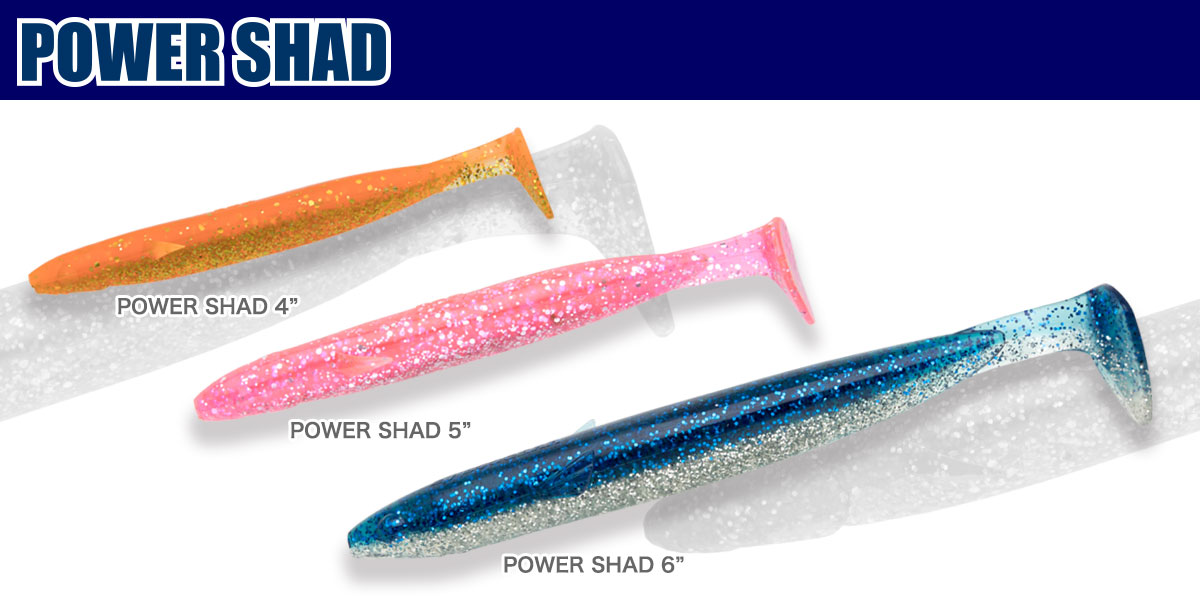
| Point | What Ecogear says |
|---|---|
| Body | Shaped for maximum vibration in the water |
| Rig range | No-sinker through to a heavy jig head |
| Surface work | Swims on a no-sinker rig for sight fishing |
| Size | Length | Pcs. per pack | List price |
|---|---|---|---|
| 4″ | 100 mm | 7 | Not published |
| 5″ | 115 mm | 6 | Not published |
| 6″ | 150 mm | 5 | Not published |
Ecogear also makes the head this range was designed to sit on. The Swimming Tenya runs 20, 25, 30, 40 and 50 g on #2/0 to #5/0 hooks, two to a pack, with a heavier-wire STRONG version from 30 g up. For Australian snapper the STRONG is the one to order, not the standard, and the 30 to 50 g range covers most of what you’ll fish over deep reef.

Where the Easy Shiner is subtle, this is the opposite argument. Keitech’s own list of features for the FAT opens with a wide, strong lateral tail swing and then goes to how well the tail bites water, and their point is about start-up: the action kicks in over a short distance rather than needing half a retrieve to load. Drop it down a fast drift and it’s working the moment the line comes tight.
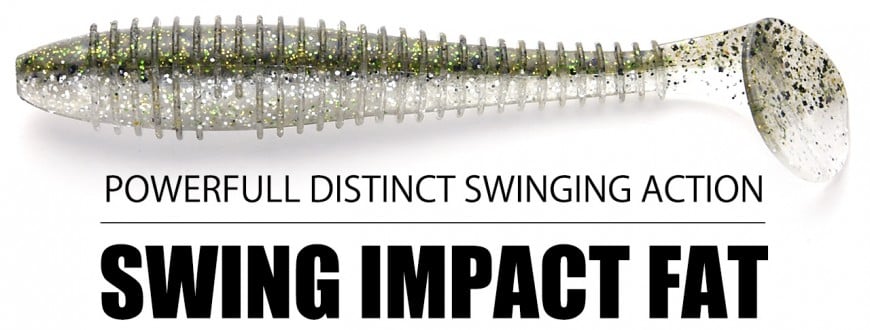
| Feature | Detail |
|---|---|
| Ring body | Blurs the outline, adds water resistance, and shields an offset hook point among the ribs |
| Belly holes | Two symmetrical holes for nail sinkers, to run deeper than a plain no-sinker rig |
| Centre line | Moulded under the head as a guide for setting the hook straight |
| Durability | Formulated to resist tearing off the hook under repeated full-power casts |
| Scent | Natural squid flavour through the body |
| Size | Weight each | Pcs. | Rec. offset hook | Price (incl. tax) | Approx. AUD |
|---|---|---|---|---|---|
| 3.8″ | 8.5 g | 6 | #2/0 | ¥814 | ~A$7.40 |
| 4.3″ | 10.3 g | 6 | #3/0 | ¥946 | ~A$8.60 |
| 4.8″ | 12.8 g | 5 | #4/0 | ¥946 | ~A$8.60 |
| 5.8″ | 22.8 g | 4 | #6/0 | ¥946 | ~A$8.60 |
At 12.8 g the 4.8-inch is heavy enough to cast on its own, which opens up the drift-and-cast approach in shallower water too. The trade is drag. That wide tail pushes hard enough to lift the lure in strong current, so you’ll be reaching for a heavier head than you expected, and at some point the sensible move is to drop back to the narrower Swing Impact instead.
Anyone who fishes bays and estuary channels knows the pattern. Something takes, you lean into it, and there’s nothing there. Small snapper mouth a lure and reject it fast, and no amount of rod-tip work fixes a fish that has already decided the thing in its mouth isn’t food.
Marukyu’s answer is not a lure in the usual sense. Ecogear Jukusei Aqua is a water-soluble polymer loaded with fermented natural material, sold sitting in a preservation liquid rather than dry in a bag. It’s marketed in Japan as a hybrid of lure and bait, and the argument is straightforward: get the fish to hold on for an extra second and the hook does the rest.

Ecogear designed it as a replacement for the live prawn used in hitotsu tenya (ひとつテンヤ), a Japanese method where a single weighted hook is dropped for madai. Drop the head, and the shape makes the shrimp slide sideways rather than plummet. That slide is the moment fish eat, which is why the flat antennae are cut the way they are: on a straight retrieve they trail and produce almost no vibration at all.
| Point | What Ecogear says |
|---|---|
| Purpose | Shrimp-type lure designed specifically for hitotsu tenya fishing |
| On the drop | Slides attractively through the water after the tenya falls |
| Material | Flavour in the body works on the hook-up, not just the bite |
| Certification | Carries the Japan Sport Fishing Association environmental mark |
| Size | Length | Pcs. per pack | List price |
|---|---|---|---|
| 3″ | 80 mm | 8 | Not published |
| 4″ | 96 mm | 6 | Not published |
Storage is the catch, and it’s a real one. These have to stay in their liquid, out of the sun, with used and unused lures kept apart, and Ecogear’s own instructions say to decant into a sealed container before you take them out. Leave a packet on a hot dashboard and you’ve wasted it. Ecogear sells a stocker tin for exactly this reason. Against that: it works on the fish that were beating you, and the same lure covers flathead and grunter in the same water.
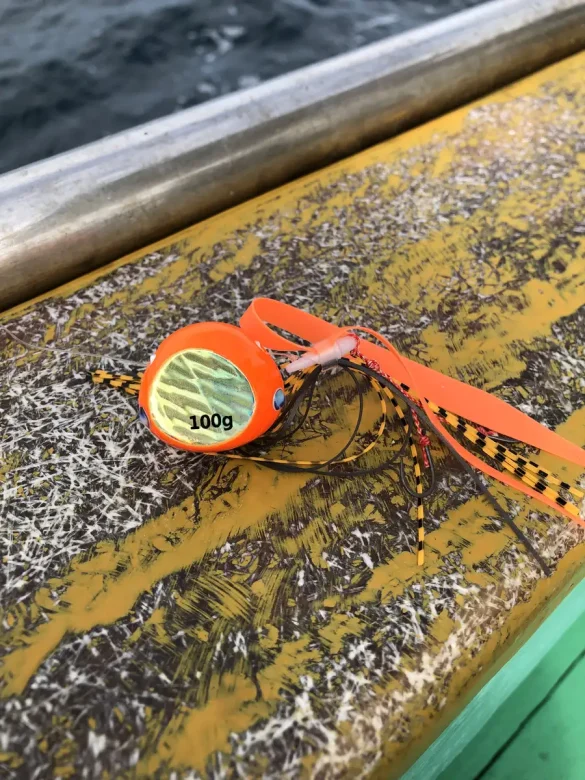
This one has no Australian equivalent at all, which is why it’s worth the space. A kabura, or tai rubber (鯛ラバ), catches fish on a silicone skirt and a thin rubber necktie. On a good day nothing needs changing. On a day when fish keep hitting the tail and coming off, you can take the rubber tie off and put soft plastic there instead, and the whole character of the lure changes. Two Japanese products are made specifically for that swap. If the method itself is new to you, start with tai rubber for snapper in Australia, and the gear side is in our tai rubber setup guide.
A curly tail, two and a half inches, sold in a colour range chosen for kabura work rather than for bass. Bait Breath’s pitch is that the tail keeps moving on its own in any water flow, so it stays alive during the very slow winds that tai rubber depends on, and that a natural umami compound in the mix makes fish hold on longer. Eight in a packet at ¥715 makes it the cheapest way to test the idea.
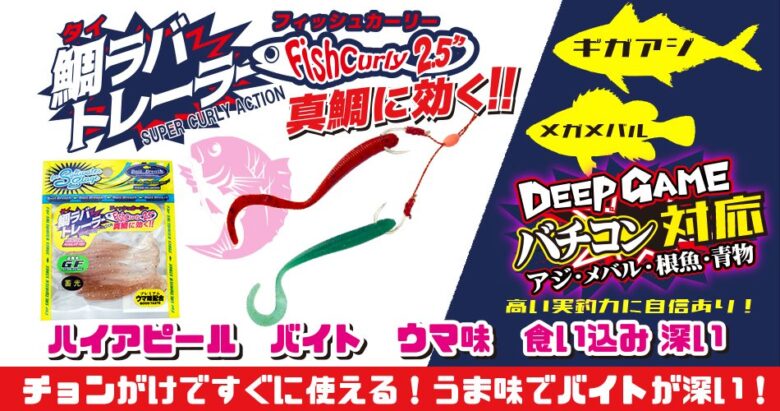
| Feature | Detail |
|---|---|
| Tail | Self-actuating curly tail that works on water flow alone, down to very slow retrieves |
| Formula | Umami compound from natural ingredients, blended for deeper bites |
| Colour tech | Standard green glow pigment, UV-reactive keimura, and point-glow flake versions |
| Also used for | Bachikon (deep light-tackle bream and jack fishing) and other deep jig head work |
| Model | Length | Pcs. | List price | Approx. AUD |
|---|---|---|---|---|
| Fish Curly 2.5″ for Tairaba | 2.5″ | 8 | ¥715 | ~A$6.50 |
Same bio-plastic material as the Swim Shrimp, cut as a 120 mm flap and sold twelve to a pack, and it goes on as the necktie rather than beside one. Ecogear’s line on the kuwase (食わせ, roughly “make them eat it”) series is that it’s deliberately compact with a muted action, aimed at fish that have gone off big, noisy neckties. Want more presence? Rig two or three together. Want less? Cut the body down and hang the tail section off the hook, which is a use Ecogear documents themselves.

| Point | What Ecogear says |
|---|---|
| Role | Used as the necktie itself in tai rubber fishing |
| Material | Fermented ingredients carrying flavour and scent, for more bites than a plain necktie |
| Shape | Flap profile chosen as the all-rounder when you don’t know what to put on |
| Rigging | Thread onto the hooks of the Aquraba Rig Kuwase, or hang it off a standard kabura hook |
| Model | Length | Pcs. | List price |
|---|---|---|---|
| Kuwase Flap Slim | 120 mm | 12 | Not published |
Twelve pieces is generous for a consumable that snapper and leatherjackets destroy, and this is the item on the list that has no substitute in an Australian tackle shop. It also needs the same liquid-storage discipline as everything else in the Jukusei Aqua range.
Some days you’re not trying to catch numbers. Bigger snapper hold tighter to structure and feed on bigger prey, and a lure aimed at them will be ignored by everything smaller. Two ways to go about it, and they’re not the same idea at all.
Fish Arrow’s whole Flash-J concept is a strip of aluminium foil moulded inside a translucent body. As the shad tail rolls the lure, that foil throws light the way a baitfish flank does, and no amount of printed holographic finish achieves the same thing. The SW version is the saltwater build, aimed at rockfish and flathead in Japan, with a real shad tail for stronger vibration than the original Flash-J profile.

| Feature | Detail |
|---|---|
| Flash | Aluminium foil laminated inside the body, flashing as the lure rolls |
| Tail | Realistic shad tail with a swinging action, for species that want strong vibration |
| Target | Rockfish and flatfish in Fish Arrow’s own description |
| Colours | Eleven, including keimura purple, glow pink and two gold-back finishes |
| Model | Pcs. | List price (excl. tax) | Approx. AUD |
|---|---|---|---|
| Flash-J Shad 4inch+ SW | 5 | ¥850 | ~A$7.70 |
Five to a bag at ¥850 puts this at the top of the per-lure cost on this page, and a foil insert is a weak point once a fish tears the body: a plastic you’d normally get three fish out of gives you one. Clear water in good light is where it pays for that, and it’s wasted in a dirty run-out.
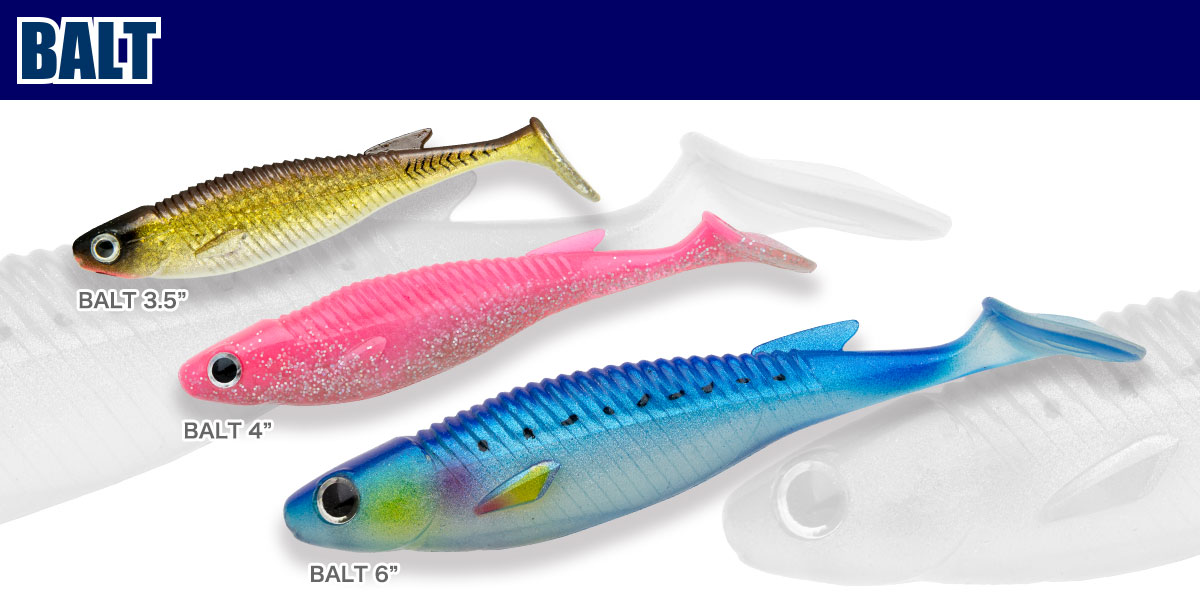
The other route is simply more lure. Ecogear’s Balt is a shad with a big tail on a flat-sided body, and the 6-inch runs 140 mm, four to a pack. Ecogear’s stated intent for that size is to pull fish in from a distance rather than to match anything in particular. It’s the one to have in the box on a day when you’ll accept three bites instead of twenty. List price isn’t published for this range either.
| Lure | Snapper size | Pcs. | List price | Where it belongs |
|---|---|---|---|---|
| Ecogear Grass Minnow L | 3-1/4″ / 85 mm | 8 | Not published | Clear shallow reef, light heads |
| Keitech Easy Shiner 4″ | 4″ / 5.5 g | 7 | ¥814 (~A$7.40) | All-round spring shallows |
| Ecogear Power Shad 5″ | 5″ / 115 mm | 6 | Not published | Deep reef on a heavy head |
| Keitech Swing Impact FAT 4.8″ | 4.8″ / 12.8 g | 5 | ¥946 (~A$8.60) | Fast drift, dirty water |
| Ecogear Jukusei Aqua Swim Shrimp 3″ | 3″ / 80 mm | 8 | Not published | Estuary pinkies, dropped bites |
| Bait Breath Fish Curly 2.5″ | 2.5″ | 8 | ¥715 (~A$6.50) | Kabura trailer, slow winds |
| Ecogear Kuwase Flap Slim | 120 mm | 12 | Not published | Necktie replacement on a kabura |
| Fish Arrow Flash-J Shad 4inch+ SW | 4″+ | 5 | ¥850 excl. (~A$7.70) | Clear water, big fish, bright light |
| Ecogear Balt 6″ | 6″ / 140 mm | 4 | Not published | Long-range appeal, fewer bites |
| Ecogear Swimming Tenya | 20 to 50 g | 2 | Not published | The head for the Ecogear shads |
Back to that first bullet about pack counts. Divide the list price by the number of lures in the bag and the ranking shifts, because the cheap-looking packet isn’t always the cheap one:
| Lure | Pack price | Pcs. | Per lure |
|---|---|---|---|
| Bait Breath Fish Curly 2.5″ | ¥715 | 8 | ¥89 (~A$0.81) |
| Keitech Easy Shiner 4″ | ¥814 | 7 | ¥116 (~A$1.06) |
| Fish Arrow Flash-J Shad 4inch+ SW | ¥850 excl. | 5 | ¥170 (~A$1.55) |
| Keitech Easy Shiner 5″ | ¥924 | 5 | ¥185 (~A$1.68) |
| Keitech Swing Impact FAT 4.8″ | ¥946 | 5 | ¥189 (~A$1.72) |
| Keitech Swing Impact FAT 5.8″ | ¥946 | 4 | ¥237 (~A$2.15) |
Three sensible stopping points, using only the prices the makers actually publish. Add international shipping on top, and note that a single Amazon Japan order covering all of them costs the same to ship as one packet.
| Budget | What to order | Total (list) |
|---|---|---|
| Around A$7 | Keitech Easy Shiner 4″ on heads you already own | ¥814 (~A$7.40) |
| Around A$23 | Add Swing Impact FAT 4.8″ for the deep drift and Fish Curly 2.5″ for the kabura | ¥2,475 (~A$22.50) |
| Around A$50 plus heads | Add Swim Shrimp 3″, Power Shad 5″ and Swimming Tenya STRONG heads | Ecogear prices not published; budget from retail |
If it has to be one packet, make it the Easy Shiner 4-inch. Seven lures, one price band, and a tail that holds its action across the whole range of retrieve speeds most people fish. The one that changes how you think, rather than how you fish, is the Kuwase Flap Slim: there’s no Australian product that does the same job, and a kabura with fermented bio-plastic hanging off it fishes nothing like one with a rubber tie.
Nothing above will out-fish a well-presented plastic you already trust. What the Japanese range gives you is a set of specialists, and specialists only make sense once you can name the problem you’re solving. Fish refusing a big profile in clear shallows is one problem. A lure that stops swimming in three knots of tide is another. Bites you can feel but never connect with is a third, and none of the three is fixed by the same lure.
One practical note on ordering. Ecogear and Keitech both have some international distribution, so you may find them without leaving Australia. The Jukusei Aqua range and the Bait Breath kabura trailer are effectively Japan-only, and those are the ones worth putting in the same Amazon Japan order. While you’re building that basket, the rigging side of Japanese light tackle is covered in our guide to JDM jig heads and worms, which uses the same brands at a smaller scale.
And the usual reminder: snapper regulations move. Check the current size and bag limits for your state before the boat leaves the ramp.
Decoy makes heads through this weight range, and they’re covered in our Japanese jig head guide for Australian plastics.
For the rod to throw them on, see the best JDM rods for snapper on soft plastics.