Japanese Soft Plastics for Snapper: JDM Picks for Australian Waters
ちゃんま
マイボ!

Tai rubber (鏃ラバ / tairaba) is a simple lure with a fussy setup. A sliding head, a rubber skirt, two small hooks, and a retrieve so plain that the tackle around it has to do the subtle work. That is why Japanese makers print lure ratings in vertical grams instead of casting weights, and put a depth counter on the side plate. The gear is the technique.
Australian snapper (Chrysophrys auratus) eat this lure happily, and the local answer so far has been to hang a kabura jig off whatever snapper spin combo is in the boat. That works, up to a point. What goes missing is bite detection through the drop-and-wind cycle, which is where most of the fish are won or lost.
This is the gear-side companion to our guide on tai rubber for snapper in Australia, which covers the retrieve itself and where it fits in the season. Here we are answering the buying questions: what head weight, what rod rating, whether the counter reel is worth it, and what to change because an Aussie snapper is not a Japanese madai.
A note on prices and links: this is Japanese-domestic (JDM) gear, so prices are maker RRP in Japanese yen, tax excluded, with an approximate AUD conversion at A$1 ≈ ¥100 at the time of writing. JDM items link to Amazon Japan. Ships internationally from Amazon Japan — check availability and shipping cost at checkout. Orders over A$59 may qualify for free international delivery. Some items are also listed on Amazon.com with international shipping to Australia.
You can catch snapper on a kabura with a 7 ft spin stick and 30 lb braid. What you can’t do with it is feel a fish mouth the skirt fifteen metres off the bottom, hold the retrieve dead even while it does, and let two size-S hooks find a hold without tearing out. A tai rubber rod is soft in the tip and firm from the belly down, which is the whole point of the category.
The other half of the question is the fish. Japanese tai rubber tackle is built around madai, and it shows in the ratings: most JDM tai rubber rods top out at PE 1.2 to 1.5, and the makers’ recommended leader for their own heads is fluorocarbon #4 to #5, roughly 16 to 20 lb. Australian snapper run heavier on average and often sit on rougher, sharper country. Taking the Japanese numbers literally is where people get burned, so the sensible move is to buy the JDM rod and reel, then fish the top of the rating rather than the middle.
| Element | Japanese madai standard | Australian snapper adjustment |
|---|---|---|
| Rod power | ML to M, vertical 30-150 g | M to MH, vertical 40-200 g for reef and drift |
| Main line | PE 0.8 | PE 1.0, PE 1.2 over foul ground |
| Leader | Fluoro #4-5 (16-20 lb), maker recommendation | Fluoro #5-6 (20-25 lb), longer if the reef is sharp |
| Head weight | 45-120 g typical | 60-150 g typical, 200 g plus on deep drifts |
| Drag | About 1 kg, set light on purpose | Still light, but check the reel has 5 kg available |
Start with the Japanese rule of about one gram per metre of depth, then add weight until you feel the head touch down without slack in the line. Australian snapper boats drift more than they anchor, and a drifting boat pays line out on an angle, which is exactly what heavy heads were designed for.
| Depth and conditions | Head weight | Why |
|---|---|---|
| Bays and inshore, under 25 m, gentle drift | 45-80 g | Slow fall keeps the skirt working in front of shallow fish |
| 25-45 m, moderate drift | 80-120 g | Reaches bottom on a near-vertical line and stays easy to wind |
| 45 m plus, wind or running tide | 120-200 g | More bottom contacts per drift, less belly in the line |
| Deep reef with the boat flying | 200-250 g | The only way to keep the head in the strike zone at all |

Daiwa’s head is worth understanding before you buy any tai rubber gear, because the design explains the method. It is a bare lead head with a wide resin pipe through the middle, and the hook unit is a separate part that slides on the leader. When a snapper takes, the head slides up the line and stops acting as a lever, which is the single biggest reason hook-ups improve over a fixed jighead.
Two details matter in the water. The pipe bore is large enough to swallow both the leader knot and the nose of the unit, so the head seats flush instead of hanging up on the knot. And the head is designed to fit either way round: nose forward for a stable fall, reversed for a wider wobble when the tide goes slack. Two actions from one head is a real advantage on a long drift, where the alternative is re-tying to change lures.
| Feature | Detail |
|---|---|
| Head type | Round type, lead, free-sliding (beta system compatible) |
| Pipe | New-shape resin pipe, wide bore to seat the knot and unit nose |
| Double action | Mount forward or reversed to change action with the tide |
| Finish | Adel holographic finish |
| Recommended hook | Kohga Hook (SaqSas) size S |
| Recommended leader | Fluorocarbon #4-5 (approx. 16-20 lb) |
| Model | Weight | Price (JPY, tax excl.) |
|---|---|---|
| Beta Head 45 | 45 g | ¥800 (~A$8) |
| Beta Head 80 | 80 g | ¥900 (~A$9) |
| Beta Head 100 | 100 g | ¥950 (~A$9.50) |
| Beta Head 150 | 150 g | ¥1,050 (~A$10.50) |
| Beta Head 250 | 250 g | ¥1,450 (~A$14.50) |
Who is it for? Anyone building a first proper tai rubber kit. Buy 80 g, 100 g and 150 g, add the matching Kohga hook units, and you have covered most snapper ground from sheltered bay water out to open coastal reef. Lead heads this size get chewed up fast on rubble bottom, and the skirt units are consumables too, so budget for spares rather than one of each.
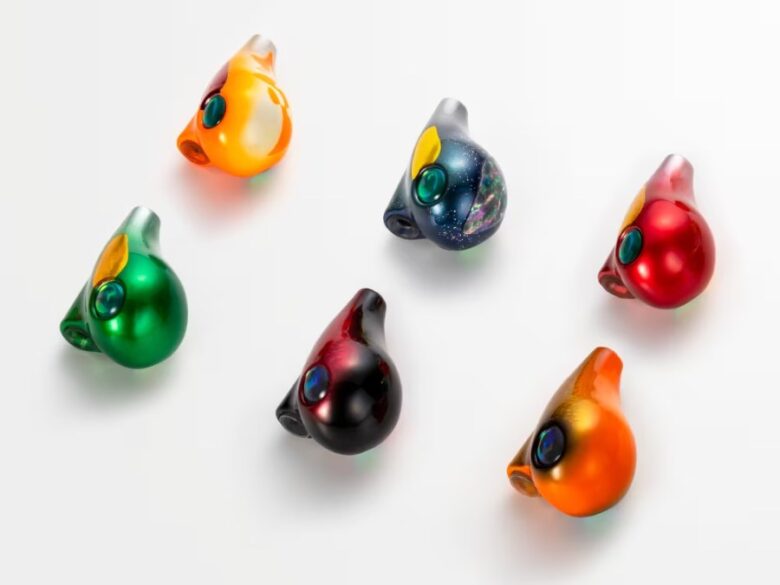
Shimano built this one for dotera nagashi, the Japanese style of letting the boat drift beam-on to the wind and fishing the line at an angle. Australians have been fishing snapper that way forever without a name for it, which makes this the most directly transferable tai rubber product on the market.
The engineering follows from the problem. Weight is biased to the rear like a bomb sinker so it drops fast, and Shimano puts the gain at 15 percent quicker sink than the same weight in its Tiger Bakubaku head. The nose is thinned to cut retrieve resistance, because the tiring part of deep drift fishing is not the fish, it is winding a big head back up an angled line thirty times a session. The lineup starts at 80 g and runs to 250 g, which tells you plainly what it is for.
| Feature | Detail |
|---|---|
| Design brief | Deep dotera (beam-on drift) fishing with repeated bottom contact |
| Shape | Rear-weighted bomb-sinker profile with a slim nose |
| Sink speed | 15% faster than the same weight in Tiger Bakubaku (Shimano figure) |
| Retrieve | Reduced drag through the water on deep, angled retrieves |
| Finish | ScaleBoost holographic on colours 009 and 010 |
| Model | Weight | Price (JPY, tax excl.) |
|---|---|---|
| JD-Q08T | 80 g | ¥1,050 (~A$10.50) |
| JD-Q10T | 100 g | ¥1,080 (~A$10.80) |
| JD-Q12T | 120 g | ¥1,180 (~A$11.80) |
| JD-Q15T | 150 g | ¥1,250 (~A$12.50) |
| JD-Q20T | 200 g | ¥1,350 (~A$13.50) |
| JD-Q25T | 250 g | ¥1,500 (~A$15) |
Should you buy it? If your snapper ground is 40 m or deeper and the boat drifts, this is the better head of the two. Under 30 m it sinks too quickly to be interesting, and in a bay the Daiwa in 45 g or 60 g does that job instead. Two brands, two jobs. Worth knowing as well: tungsten heads deliver the same sink rate in a smaller profile, at roughly triple the price per head.
Complete kabura jigs, head and skirt in one package, have been stocked by Australian tackle shops for years under names like tai kabura and slider jig. They are a fine way to try the method before committing to a Japanese order. The trade is flexibility: a one-piece package means replacing the whole lure when the skirt shreds, where the Japanese free-slide system lets you carry six heads and a dozen units in one small box.
A tai rubber reel needs three things: a low-profile body you can palm and wind one-handed for hours, a smooth start-up drag for the run a big snapper makes off a light setting, and enough line to fish 60 m of water. A counter is not one of the three. It is just hard to give up once you have used one, because snapper often sit at a repeatable height off the bottom, and a counter turns “somewhere up there” into “wind to 12 metres”.
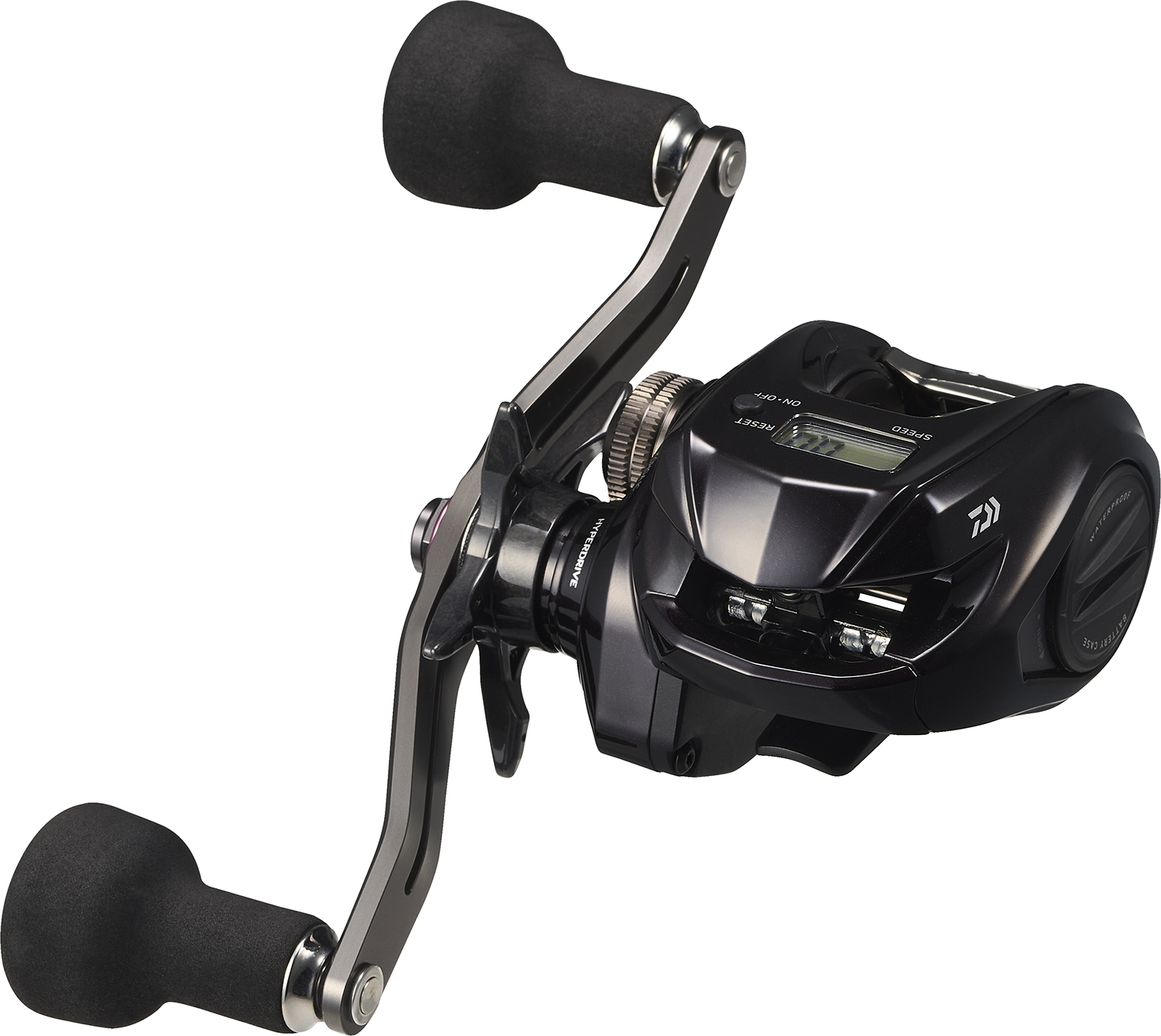
The counter reads in 10 cm steps, backlights on demand, alarms at a depth you set, and shows retrieve and fall speed. Fall speed is the useful one here: it tells you when the drift has picked up and your 100 g head has quietly stopped reaching bottom on a straight line.
Underneath the electronics it is a proper fishing reel: Hyperdrive Design gearing in high-strength brass, an aluminium frame, ATD drag and a 130 mm handle that gives you leverage for winding a heavy head up from 50 m. Line capacity is the quiet strength at PE 1 for 400 m. You can spool PE 1.2 and still hold well over 250 m, which is the sort of margin that matters when a big fish decides to leave. Daiwa quotes 5 kg of maximum drag, and the reel weighs 235 g.
| Technology | What it does |
|---|---|
| IC counter | Depth in 10 cm units, LED backlight, depth alarm, retrieve and fall speed display |
| Hyperdrive Design / Digigear | Wider gear teeth for smoother rotation under light and heavy load alike |
| ATD drag | Smooth start-up drag, the usual failure point on light tai rubber settings |
| Construction | Aluminium frame, high-strength brass gear |
| Brake | Centrifugal, so casting the head away from the boat is possible |
| Model | Gear ratio | Retrieve per turn | Weight | Max drag | PE capacity | Price (JPY, tax excl.) |
|---|---|---|---|---|---|---|
| 26 Kohga IC 150P | 4.8 | 54 cm | 235 g | 5 kg | PE1-400 m | ¥49,300 (~A$493) |
| 26 Kohga IC 150 | 6.3 | 70 cm | 235 g | 5 kg | PE1-400 m | ¥49,300 (~A$493) |
| 26 Kohga IC 150H | 7.1 | 80 cm | 235 g | 5 kg | PE1-400 m | ¥49,300 (~A$493) |
Best suited for: deeper reef work where knowing your exact depth changes the day. Take the P model at 4.8 if you fish slow and heavy, or the standard 6.3 as an all-rounder. At around A$493 this is a serious spend for a first tai rubber reel, and the 5 kg drag ceiling is a plain number worth checking against your local fish before you commit.
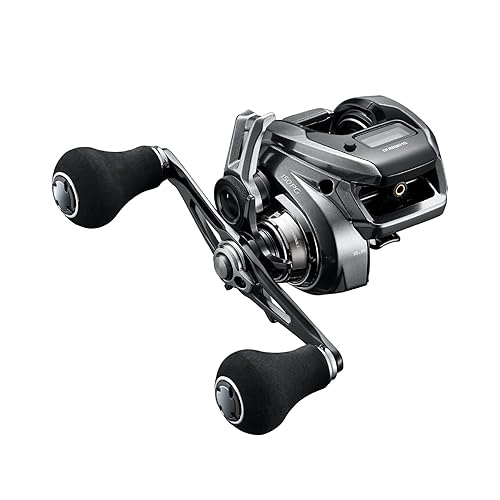
Put the two counter reels side by side and the Shimano wins on paper in most of the columns an Australian angler cares about. It is 15 g lighter at 220 g, matches or beats the Daiwa on drag — 6 kg on the power gear, 5 kg on the fast gear against the Kohga’s 5 kg — runs 8 ball bearings plus 2 rollers against the Daiwa’s 6 plus 1, and lists at ¥46,500 against ¥49,300. That is only about A$28 apart, so price is not what decides this one.
It also has the fall lever, which the Kohga does not. The lever brakes the spool by feel on the drop instead of thumbing it, so you can slow the head through the last few metres where snapper often intercept it. MicroModule gearing gives it the smoothest wind of the two, and on a lure whose only action is a constant retrieve, that is not a luxury. Where it gives ground is capacity: PE 0.8 for 400 m, so heavier line eats into the spool faster than on the Daiwa.
| Technology | What it does |
|---|---|
| Fall lever | Brakes the spool on the drop for a controlled, slower fall |
| MicroModule gear | Finer gear pitch for a smoother, quieter constant retrieve |
| X-SHIP | Holds gear mesh under load so winding a heavy head stays light |
| Counter | Depth plus speed display, LED backlight, retrieve alarm, replaceable battery |
| Drag | Carbon cross wash drag with exciting drag sound |
| Model | Gear ratio | Retrieve per turn | Weight | Max drag | PE capacity | Price (JPY, tax excl.) |
|---|---|---|---|---|---|---|
| Engetsu Premium 150PG | 5.8 | 58 cm | 220 g | 6 kg | PE0.8-400 m | ¥46,500 (~A$465) |
| Engetsu Premium 150HG | 7.4 | 74 cm | 220 g | 5 kg | PE0.8-400 m | ¥46,500 (~A$465) |
| Engetsu Premium 151HG (left) | 7.4 | 74 cm | 220 g | 5 kg | PE0.8-400 m | ¥46,500 (~A$465) |
The verdict: for most Australian snapper fishing this is the reel to buy, and the PG at 58 cm per turn suits the deliberate retrieve better than the fast HG. The fall lever adds a part that can fail, and JDM warranty service from Australia means posting it back to Japan. Buy it knowing that. For a wider look at the class, our guide to the best tairaba reels compares the full Japanese lineup.
Ignore rod names and read two numbers on the blank: the vertical lure rating in grams and the PE rating. The first tells you what head the tip is built to load with, which decides whether you feel a tap at 45 m. The second is the maker’s honest opinion of how much drag the blank will take. Pick the model whose lure rating sits mid-range for the heads you actually fish, then check the PE number is 1.2 or better on reef.
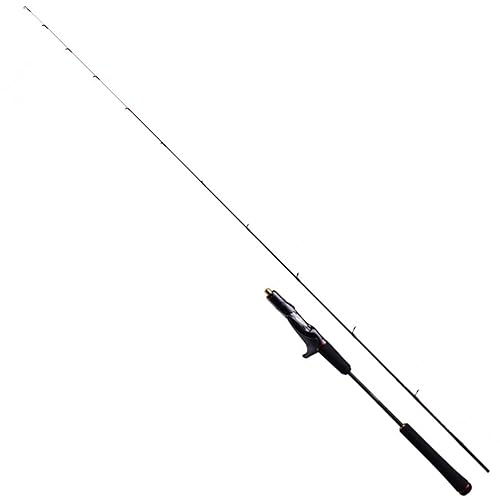
Most of the XR range is built around Japanese bay fishing: full-solid tips rated 30-100 g, PE max 1. Useful rods, but not the model an Australian should reach for first. The one to look at is the D-B611M+-T, the tubular-tip drift model, rated 50-250 g with PE max 1.5. That covers a 200 g head on a fast drift over deep reef, and it is the only model in the family with real capacity for a heavy fish over foul ground.
Blank construction is Spiral X Core with Hi-Power X, and the bait models run spiral guides with oversized rings, which keeps line clear of the blank when the boat swings side-on. The full-solid tips are the best bite detectors in this price bracket: they fold away under a pecking snapper and stay loaded instead of bouncing the head out of its mouth. For bay work under 30 m, the N-B66M-FS at 40-150 g is the better buy.
| Technology | What it does |
|---|---|
| Spiral X Core | Core carbon layer resisting blank crush and twist under load |
| Hi-Power X | Cross-wrap reinforcement against blank twist on the wind-up |
| Tafutec Infinity / Hi-Power X full solid | Solid tips that load on a soft bite instead of pushing back |
| Guides | Stainless / SiC, spiral layout with oversized rings on bait models |
| Reel seat | Xseat Versatile Gunclip on bait models, separate EVA grip |
| Model | Length | Weight | Vertical lure | PE max | Tip | Price (JPY, tax excl.) |
|---|---|---|---|---|---|---|
| D-B611M+-T | 2.11 m | 126 g | 50-250 g | 1.5 | Tubular | ¥48,000 (~A$480) |
| N-B66M-FS | 1.98 m | 136 g | 40-150 g | 1.2 | Full solid | ¥49,000 (~A$490) |
| N-B72M-S | 2.18 m | 128 g | 40-150 g | 1.2 | Tafutec Infinity solid | ¥48,500 (~A$485) |
| C-S68M-T (spin) | 2.03 m | 100 g | 20-100 g | 1.2 | Tubular | ¥44,500 (~A$445) |

Daiwa splits this range by how you want to hook the fish, which is more useful than it sounds. TYPE-N is the soft action that lets a snapper eat and hook itself. TYPE-K is the hook-set action for anglers who would rather strike on feel. TYPE-C is spinning, for casting the head up-drift. Work out which of those you are and there are only three or four models left to choose between.
Two options stand out for Australian conditions. The N69HB-METAL carries 45-200 g on a 2.06 m blank with a metal top, which is close to a perfect all-round snapper rating. The N68XHB-METAL takes that to 60-300 g for deep drifts, and Daiwa’s own description of the model is deep water and dotera work with heavy heads. Both handle PE up to 1.5. The metal tip is the cheapest genuine sensitivity upgrade in tai rubber, because it transmits the tap rather than absorbing it.
| Technology | What it does |
|---|---|
| Metal Top / Megatop | Metal or solid carbon tip section for bite transmission |
| HVF Nanoplus | High-density carbon with nano resin for a lighter, crisper blank |
| X45 | 45-degree bias wrap that cancels blank twist under load |
| Air Sensor Seat | Light reel seat that passes vibration to your palm on long retrieves |
| V-Joint | Joint design that keeps the bend continuous through the ferrule |
| Model | Length | Weight | Lure weight | PE | Price (JPY, tax excl.) |
|---|---|---|---|---|---|
| TYPE-N 69HB-METAL | 2.06 m | 92 g | 45-200 g | 0.6-1.5 | ¥40,000 (~A$400) |
| TYPE-N 68XHB-METAL | 2.03 m | 93 g | 60-300 g | 0.8-1.5 | ¥40,300 (~A$403) |
| TYPE-N 69MHB Thrill Game | 2.06 m | 107 g | 60-300 g | 0.5-1.5 | ¥41,200 (~A$412) |
| TYPE-K 65HB-METAL | 1.96 m | 92 g | 40-120 g | 0.8-1.5 | ¥40,000 (~A$400) |
| TYPE-C 62MHS-S (spin) | 1.88 m | 91 g | 20-65 g | 0.6-1.2 | ¥39,700 (~A$397) |
This is the range for anglers who want JDM tip feel without paying flagship money, and who already know whether they are a let-them-eat type or a striker. Metal tips are fragile in a car door and unforgiving of high-sticking a fish at the net. The Kohga X sits below this range at ¥16,500 if you would rather not risk a A$400 rod on a first outing, and our tairaba rod guide covers the tiers above.
Thin braid is the reason light heads work at all. PE 0.8 cuts current so cleanly that an 80 g head fishes almost vertically where 30 lb braid would need 120 g for the same angle. In Australia the sensible compromise is PE 1.0 as a default and PE 1.2 when the ground is sharp, joined with an FG knot to two rod lengths of fluorocarbon.
| Situation | Main line | Leader | Drag setting |
|---|---|---|---|
| Bay, clean bottom, under 30 m | PE 0.8 | Fluoro #4 (16 lb), 3-4 m | About 1 kg |
| Coastal reef, 30-50 m | PE 1.0 | Fluoro #5 (20 lb), 4 m | 1.0-1.5 kg |
| Sharp reef or deep drift | PE 1.2 | Fluoro #6 (25 lb), 4-5 m | 1.5-2 kg |
Then there are the hooks. Daiwa specifies size S for its heads, which looks alarmingly small next to a 6 kg snapper, and most anglers opening the packet reach for something bigger. Resist that for one trip: small, sharp, fine-wire hooks find purchase in the tough jaw and hinge of a sea bream where a heavy-gauge point skates off. What does deserve attention is quantity, since a snapper’s crushers flatten a point in one fish. Carry three or four spare units.
| Item | Type | Key spec | Best for | Price (JPY, tax excl.) |
|---|---|---|---|---|
| Shimano Engetsu XR | Rod | 40-150 g / 50-250 g, PE max 1.2-1.5 | Deep drifts and heavy heads | ¥44,500-49,000 (~A$445-490) |
| Daiwa Kohga MX | Rod | 45-200 g / 60-300 g, PE 0.6-1.5, metal top | All-round snapper, best tip feel per dollar | ¥39,700-42,000 (~A$397-420) |
| Daiwa Kohga X 69XHB-S | Rod | 2.06 m, 113 g, PE 0.8-1.5 | First tai rubber rod on a budget | ¥16,500 (~A$165) |
| Daiwa 26 Kohga IC 150 | Reel | 235 g, 5 kg drag, PE1-400 m, counter | Deep water and line capacity margin | ¥49,300 (~A$493) |
| Shimano Engetsu Premium 150 | Reel | 220 g, 5-6 kg drag, PE0.8-400 m, fall lever | Best all-round counter reel for snapper | ¥46,500 (~A$465) |
| Daiwa Kohga X IC | Reel | 240 g, 5 kg drag, PE0.8-300 m, counter | Counter function at entry price | ¥16,000 (~A$160) |
| Daiwa Kohga Bayrubber Free Beta Head | Head | 45-250 g, lead, free-slide, reversible | Bays through to open reef | ¥800-1,450 (~A$8-14.50) |
| Shimano Engetsu Dotera Bakubaku Head | Head | 80-250 g, rear-weighted, fast sink | Deep water and fast drifts | ¥1,050-1,500 (~A$10.50-15) |
Three ways to spend the money, depending on how sure you are that you will stick with the method.
🥇 No.1: Shimano Engetsu Premium 150PG
The most complete counter reel in the tai rubber class. It is lighter than the Daiwa, matches it on drag, has the fall lever for controlling the drop, and lands at a near-identical price — so you are choosing on features, not on cost. The 58 cm retrieve suits the slow constant wind that catches snapper. RRP ¥46,500 (~A$465).
🥈 No.2: Daiwa Kohga MX TYPE-N 69HB-METAL
The rating that fits Australian snapper fishing almost exactly: 45-200 g of head on a 2.06 m blank, PE to 1.5, and a metal tip that turns a tentative peck into something you can feel. It costs about A$400, which is real money, and it is the piece of this kit that moves your catch rate most. RRP ¥40,000 (~A$400).
🥉 No.3: Daiwa Kohga X rod plus Kohga X IC reel
The try-before-you-commit pairing. Around ¥32,500 (~A$325) buys both pieces: a 2.06 m blank rated PE 0.8-1.5 and a counter reel holding PE 0.8 for 300 m with 5 kg of drag. Neither is refined, and the reel winds at only 54 cm per turn, but the pair fishes the method properly for less than the Engetsu Premium costs on its own.
We fish tai rubber for madai in Japan, and the setup advice we were given on the boat had almost nothing to do with brands. Set the drag light, around a kilo, so a taking fish feels nothing. Keep the rod low and still. When the taps start, change nothing at all: same handle speed, same angle, until the blank is bent under real weight. Everything about the gear, the soft tip, the small hooks, the thin line, exists to make that restraint possible.
The hardest part to trust is the drag. A kilo feels absurd when you know a good fish is coming, and the instinct is to wind it up before the first drop. What we found is that a light setting plus a rod bent to the butt lands more fish than a tight one, because the tiny hooks hold as long as nothing jerks them. Australian snapper pull harder than the madai this gear was designed around, so start a touch firmer at a kilo and a half, then adjust on what you actually lose rather than on what you fear.
Southern snapper fishing peaks through spring and early summer, roughly October to January, which is when a tai rubber outfit earns its cost. That means ordering from Japan in late winter if you want the gear in hand for the run.
Rules vary sharply by state and have moved more than once in recent years. South Australia has kept snapper closed in the West Coast, Spencer Gulf and Gulf St Vincent / Kangaroo Island zones, with the South-East zone managed separately under mandatory catch reporting, so confirm the current status with PIRSA before planning anything. Victoria runs a minimum size and a bag limit with a cap on larger fish, published by the Victorian Fisheries Authority. Western Australia manages its west coast demersal species seasonally. Check your local regulations before every trip, since dates and limits are reviewed regularly.
Buy the head weights first, then the rod, then the reel. The method is cheap to try and expensive to perfect, and the fish will tell you soon enough whether the rest is worth ordering.