Best Slow Pitch Jigging Reels: JDM Models Worth Importing
ちゃんま
マイボ!

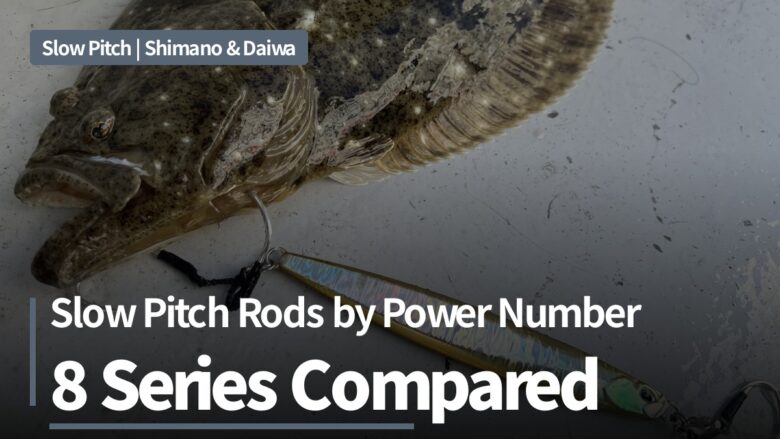
A Japanese slow pitch rod isn’t sold as medium or heavy. It’s sold with a number, 0 through 6, printed on the blank, and that number carries two things at once. One is jig weight, which everybody reads. The other is depth. Shimano prints it on its own product pages: a Game Type Slow J B66-3 is rated to 260 g of jig, a slow jerk down to roughly 250 m, and a fast jerk to roughly 110 m. Buy the number for the water you fish, not for the jig sitting in your box.
Shimano and Daiwa have eight slow pitch series in production between them as of September 2026, 55 models in total, from ¥21,000 to ¥84,000 before tax. Daiwa’s Saltiga SJ TG went on sale this month. And the two makers disagree about length in a way that matters more than the price gap does: Daiwa builds at 5’5″, 5’8″ and 6’1″, Shimano at 6’6″ and 6’10”.
All eight are Japan-market rods, so most buy links go to Amazon Japan, which ships internationally (check availability and shipping cost at checkout). The Ocea Jigger ∞ is also listed on Amazon.com, so its links go there. If the technique itself is new to you, read what slow pitch jigging actually is first.
Both makers use the same 0 to 6 power scale, with Daiwa adding a 00 at the light end. What they publish about it differs. Shimano gives a jig ceiling, a maximum drag in kilograms measured at a 45 degree rod angle, and two depth figures, one for a slow jerk and one for a fast one. Daiwa gives a jig range instead of a ceiling, which tells you where a blank starts working as well as where it stops.
| Power number | Shimano jig weight | Slow jerk, to about | Fast jerk, to about | Daiwa jig range |
|---|---|---|---|---|
| 00 | not offered | — | — | 80 to 150 g |
| 0 | Max 130 g | 80 m | 40 m | 100 to 180 g |
| 1 | Max 160 g | 120 m | 60 m | 120 to 210 g |
| 2 | Max 200 g | 180 m | 80 m | 150 to 250 g |
| 3 | Max 260 g | 250 m | 110 m | 180 to 330 g |
| 4 | Max 330 g | 320 m | 140 m | 200 to 350 g |
| 5 | Max 400 g | 400 m | 160 m | 230 to 500 g |
| 6 | Max 500 g | 450 m | 180 m | 250 to 800 g |
Length is the second decision, and it splits by brand. Shimano settled its two mid-price series at 6’6″ and put the Ocea Jigger Infinity Motive at 6’10”. Daiwa standardised the Saltiga SJ and Outrage SJ at 6’1″, and its full solid rods at 5’8″ and 5’5″. Longer moves the jig further per stroke and draws out the fall. Shorter puts the bending fulcrum nearer your hands and takes load off your forearm.
Then blank type. Most of these are tubular. Daiwa also builds full solid blanks, badged TG, where the whole rod is solid carbon rather than a tube: more bend, more hold on a fish, and traditionally a duller feel, which is the thing Daiwa has spent two generations attacking.
Daiwa’s model codes read left to right: 61 is 6 feet 1 inch, 610 is 6 feet 10 inches, B is baitcast, then the power number. The rest of the Japanese shorthand is in our rod spec decoder, and the reels that go on these rods are in slow pitch reels worth importing.

Nothing current from Daiwa reaches down here. Its cheapest slow pitch rod is the Outrage SJ at ¥40,700, so everything under ¥35,000 is Shimano, in two series that share a length and not much else.
Four models, powers 1 to 4, ¥21,000 to ¥22,500. All 6’6″, all two-piece at the grip joint, 117 to 135 g, with jig ratings of Max 160, 200, 260 and 330 g. Reinforcement is Hi-Power X on its own, the carbon X-wrap that keeps the blank from twisting under load, on a Fuji T-DPS seat with separate EVA grips. This is a slow pitch taper, not a light jigging blank with a new sticker.
What’s missing is both ends of the range. There is no 5 or 6 power, so 400 g and 500 g jigs are out, and the rings are Alconite with a SiC top rather than SiC throughout. For inshore water to about 150 m with jigs under 330 g, neither of those will come up.
| What it’s built from | What it does |
|---|---|
| Hi-Power X | Carbon tape wound in an X over the blank to stop it twisting, so a jerk arrives at the jig instead of being lost in the rod |
| Grip joint two-piece | The rod splits at the handle rather than mid-blank, which keeps the bending curve continuous and shortens the travel tube to 150 cm |
| Fuji T-DPS seat | Standard trigger seat rather than Shimano’s own Full Holding Seat, which is the main feel difference against the Grappler above it |
| Alconite rings, SiC top | Hard rings everywhere, with the harder SiC reserved for the tip guide where the line angle is worst |
| Model | Weight | Tip dia. | Jig | PE | Max drag | JDM RRP (excl. tax) |
|---|---|---|---|---|---|---|
| B66-1 | 117 g | 2.0 | Max 160 g | Max 1.5 | 3 kg | ¥21,000 (~$134) |
| B66-2 | 120 g | 2.2 | Max 200 g | Max 2 | 4 kg | ¥21,500 (~$137) |
| B66-3 | 125 g | 2.2 | Max 260 g | Max 2.5 | 5 kg | ¥22,000 (~$140) |
| B66-4 | 135 g | 2.2 | Max 330 g | Max 3 | 6 kg | ¥22,500 (~$143) |
Shimano rebuilt this in 2025 and cut it from 6’8″ to 6’6″, which is the change you notice in the first ten minutes. Six powers now, 1 through 6, ¥32,000 to ¥34,500, 120 to 158 g. Spiral X sits under the Hi-Power X wrap, and the seat is the CI4+ Full Holding Seat borrowed from the Ocea Jigger rods.
The lineup notes are the reason to pay the extra ¥11,000 over the BB. Shimano gives every model a depth and a reel size: B66-2 is a slow jerk to about 150 m on a 300 to 1500 size reel, B66-4 a slow jerk to about 250 m on a 1500 to 3000. That is the which-one-do-I-buy question answered in one line per model.
Against the Game Type Slow J it saves you ¥12,000 and costs you about 8 g per model, Spiral X instead of Spiral X Core, Alconite instead of SiC. The tip is deliberately harder than the Game’s: Shimano describes it as automatic, meaning you bend it and it throws the jig for you. Anglers who want to feel every input may find it does too much of the work.
| What it’s built from | What it does |
|---|---|
| Spiral X | Three-layer blank with carbon tape wound in opposite diagonals inside and out, for twist and crush resistance without added weight |
| Hi-Power X | An outer X-wrap on top of Spiral X, so the bend holds the direction you put it in |
| CI4+ Full Holding Seat | Shimano’s own seat in carbon-reinforced CI4+, waisted and flattened underneath so it works palmed, gripped or two to four fingers |
| Published depth and reel size | Every model carries a slow jerk depth, a fast jerk depth and a recommended reel size from 200 up to 4000 |
| Model | Weight | Tip dia. | Jig | PE | Max drag | Slow jerk | Fast jerk | JDM RRP (excl. tax) |
|---|---|---|---|---|---|---|---|---|
| B66-1 | 120 g | 2.0 | Max 160 g | Max 1.5 | 3 kg | 100 m | 60 m | ¥32,000 (~$204) |
| B66-2 | 130 g | 2.2 | Max 200 g | Max 2 | 4 kg | 150 m | 80 m | ¥32,500 (~$207) |
| B66-3 | 135 g | 2.2 | Max 260 g | Max 2.5 | 5 kg | 200 m | 100 m | ¥33,000 (~$210) |
| B66-4 | 138 g | 2.4 | Max 330 g | Max 3 | 6 kg | 250 m | 130 m | ¥33,500 (~$213) |
| B66-5 | 147 g | 2.4 | Max 400 g | Max 3 | 6 kg | 300 m | 160 m | ¥34,000 (~$217) |
| B66-6 | 158 g | 2.8 | Max 500 g | Max 4 | 8 kg | 350 m | 180 m | ¥34,500 (~$220) |
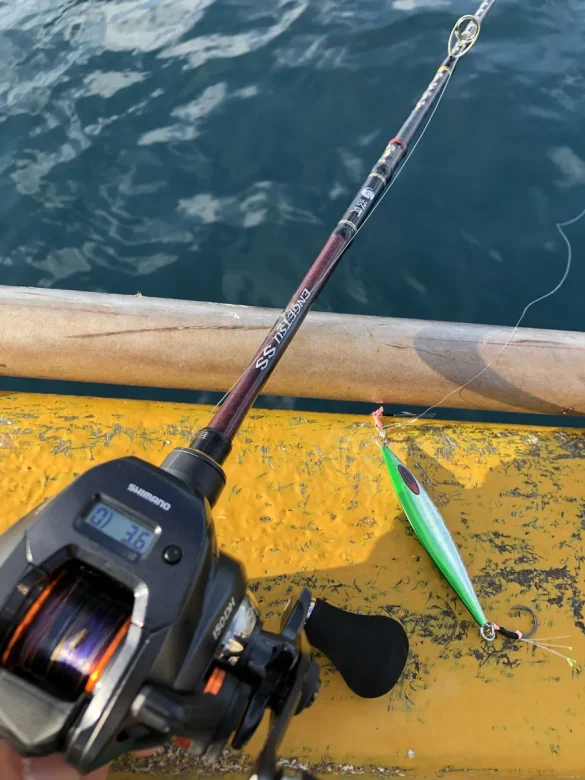
This is where most people end up: one rod, a middle power, and a day that refuses to stay at one depth. Both makers have a purpose-built answer, roughly ¥5,000 apart and built on opposite ideas about length.
Outrage is Daiwa’s second tier, and this series openly reuses the Saltiga SJ taper, set slightly stiffer so it’s easier to handle. Eleven models: eight tubular at 6’1″, powers 00 to 6, ¥40,700 to ¥42,800, plus three full solid at 5’5″, ¥49,500 to ¥50,500. Every one is a single piece.
The tubular blank is HVF Nanoplus inside X45 Full Shield, a 45 degree carbon bias cloth laid on the outermost layer against twist. The ZERO-SEAT reel seat is the strongest argument for this rod: it was shaped around a round baitcaster, over eight months of a tester carving prototypes and checking where his hand hurt after three hours of holding it.
Jig ratings are Daiwa’s, so you get both ends of the window. 61B-2 covers 150 to 250 g, 61B-3 covers 180 to 330 g, and 61B-6 reaches 250 to 800 g, which is more jig than any Grappler or Game Type will take.
The full solid 55B TG models cost ¥7,000 more than the tubulars and only come in powers 2, 3 and 4. At 5’5″ they are the shortest slow pitch rods either maker sells, built on Mega Top solid carbon with an X45X outer layer to fight the dullness full solid blanks are known for.
| What it’s built from | What it does |
|---|---|
| HVF Nanoplus | High-density carbon with less resin, combined with Toray nano-alloy resin technology, for strength at low weight. Tubular models only |
| Mega Top solid carbon | The full solid blank in the 55B TG models, with fibre and resin evenly dispersed so the blank bends the same in every direction |
| X45 Full Shield | Carbon bias cloth at 45 degrees on the outermost layer, tightening the whole blank against twist |
| ZERO-SEAT | The seat Daiwa developed for the Saltiga SJ, shaped for a round baitcaster and for hours of palming it |
| Model code | 61 = 6 ft 1 in, 610 = 6 ft 10 in; B = baitcast; then the power number |
| Model | Length | Weight | Tip / butt dia. | Jig | PE | JDM RRP (excl. tax) |
|---|---|---|---|---|---|---|
| 61B-00 | 6’1″ / 1.85 m | 105 g | 1.6/7.0 | 80 to 150 g | Max 1.2 | ¥40,700 (~$259) |
| 61B-0 | 6’1″ / 1.85 m | 107 g | 1.6/7.5 | 100 to 180 g | Max 1.5 | ¥41,000 (~$261) |
| 61B-1 | 6’1″ / 1.85 m | 109 g | 1.8/7.5 | 120 to 210 g | Max 1.5 | ¥41,300 (~$263) |
| 61B-2 | 6’1″ / 1.85 m | 112 g | 1.8/8.0 | 150 to 250 g | Max 2.0 | ¥41,600 (~$265) |
| 61B-3 | 6’1″ / 1.85 m | 114 g | 1.8/8.5 | 180 to 330 g | Max 3.0 | ¥41,900 (~$267) |
| 61B-4 | 6’1″ / 1.85 m | 118 g | 1.8/9.0 | 200 to 350 g | Max 3.0 | ¥42,200 (~$269) |
| 61B-5 | 6’1″ / 1.85 m | 127 g | 2.2/9.5 | 230 to 500 g | Max 4.0 | ¥42,500 (~$271) |
| 61B-6 | 6’1″ / 1.85 m | 135 g | 2.3/10.0 | 250 to 800 g | Max 4.0 | ¥42,800 (~$273) |
| 55B-2 TG | 5’5″ / 1.65 m | 127 g | 2.0/7.0 | 150 to 300 g | Max 2.0 | ¥49,500 (~$315) |
| 55B-3 TG | 5’5″ / 1.65 m | 137 g | 2.3/7.5 | 200 to 400 g | Max 3.0 | ¥50,000 (~$318) |
| 55B-4 TG | 5’5″ / 1.65 m | 140 g | 2.3/7.5 | 250 to 500 g | Max 3.0 | ¥50,500 (~$322) |
Seven models, 0 through 6, ¥44,200 to ¥47,000, and the thinnest blanks Shimano builds at this price: up to 6 percent slimmer than the previous version, with Spiral X Core underneath holding the crush strength. 122 to 157 g, all 6’6″, all two-piece at the grip.
Its depth chart is the broad one. B66-2 covers a slow jerk to about 180 m and a fast jerk to about 80 m; B66-3 reaches about 250 m and 110 m. One rod, two different jobs, and Shimano prints both numbers. You are paying roughly ¥12,000 over the Grappler for a structural upgrade and SiC rings, and Shimano’s own tester calls this action automatic too, so the difference in feel is narrower than the difference in price.
| What it’s built from | What it does |
|---|---|
| Spiral X Core | Spiral X rebuilt with nano-alloy high-strength resin tape. Shimano claims 1.4x the torsional strength and 2.5x the crush strength of a conventional blank |
| Slimmer blank | Up to 6 percent thinner than the previous generation, so the whole rod bends further and recovers harder |
| LKW guides | Stainless feet, SiC rings, sloped and short-framed to shed tangles without adding tip weight |
| CI4+ Full Holding Seat | The same seat as the Grappler, which suits the elbow-braced jerk slow pitch anglers use as well as the usual underarm stroke |
| Model | Weight | Tip dia. | Jig | PE | Max drag | Slow jerk | Fast jerk | JDM RRP (excl. tax) |
|---|---|---|---|---|---|---|---|---|
| B66-0 | 122 g | 1.8 | Max 130 g | Max 1.5 | 3 kg | 80 m | 40 m | ¥44,200 (~$282) |
| B66-1 | 122 g | 2.0 | Max 160 g | Max 1.5 | 3 kg | 120 m | 60 m | ¥44,200 (~$282) |
| B66-2 | 128 g | 2.0 | Max 200 g | Max 2 | 4 kg | 180 m | 80 m | ¥44,800 (~$285) |
| B66-3 | 132 g | 2.0 | Max 260 g | Max 2.5 | 5 kg | 250 m | 110 m | ¥45,400 (~$289) |
| B66-4 | 139 g | 2.0 | Max 330 g | Max 3 | 6 kg | 320 m | 140 m | ¥46,000 (~$293) |
| B66-5 | 146 g | 2.2 | Max 400 g | Max 3 | 6 kg | 400 m | 160 m | ¥46,500 (~$296) |
| B66-6 | 157 g | 2.4 | Max 500 g | Max 4 | 8 kg | 450 m | 180 m | ¥47,000 (~$299) |
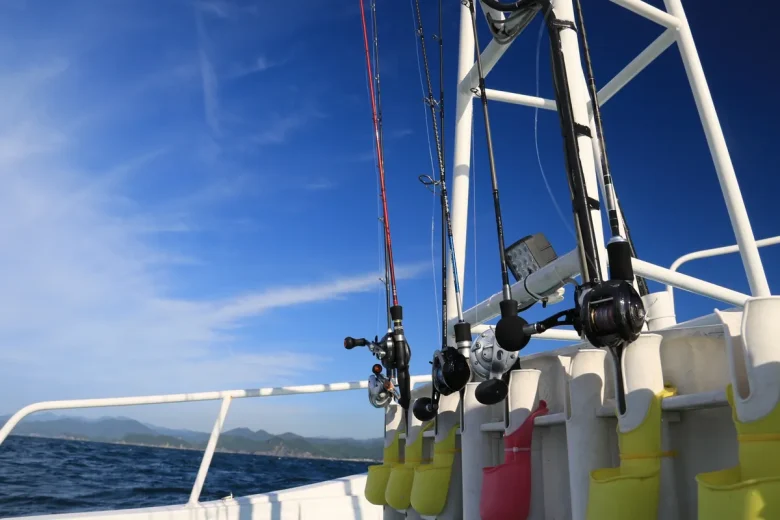
Offshore from my own boat, a 23 footer, the water is close. On a boat that size, which covers most privately owned boats, a shorter rod is easier to work: there’s less arc to swing and less distance between your hands and the surface. The exception is any fishing where you want the fish to take the bait properly rather than react to an action, mebaru sabiki and tai sabiki in my case, where a longer rod wins. Slow pitch is all action, so the short end of Daiwa’s range makes sense off a small boat in a way it wouldn’t from the high rail of a charter.
Eight models, every one 6’1″ and a single piece, 103 to 129 g, ¥60,500 to ¥64,000. Weight is the headline. The three lightest are all 103 g, which is 17 g under a Grappler at the same power and 19 g under a Game Type.
Daiwa gets there with AGS, carbon guide frames it rates at roughly three times the rigidity of titanium, over an SVF Nanoplus blank inside X45 Full Shield, at 99 percent carbon content across the series. Carbon frames at the tip are the part you actually feel, because that is where saved weight changes how fast the blank recovers.
Jig ranges run from 80 to 150 g on 61B-00 up to 250 to 800 g on 61B-6, the widest spread of any series here. One piece means a tube over 1.8 m long, which is the hard part of getting one out of Japan.
| What it’s built from | What it does |
|---|---|
| AGS, R frame | Carbon guide frames instead of titanium, about three times as rigid, and light where lightness counts most, out at the tip |
| SVF Nanoplus | Ultra-high-density carbon combined with Toray nano-alloy resin, for a thin blank that still holds power |
| X45 Full Shield | 45 degree carbon bias cloth on the outermost layer, so the blank resists twisting through a jerk and a fight |
| ZERO-SEAT Active Hold Trigger | A seat designed specifically for this series with tester Kazunari Shimizu, ground down to the strength limit so small hands can close around it |
| Length | Standardised at 6’1″, with the seat moved down the blank versus the previous generation to lengthen the working section |
| Model | Weight | Tip / butt dia. | Jig | PE | JDM RRP (excl. tax) |
|---|---|---|---|---|---|
| 61B-00 | 103 g | 1.5/7.0 | 80 to 150 g | Max 1.2 | ¥60,500 (~$385) |
| 61B-0 | 103 g | 1.5/7.5 | 100 to 180 g | Max 1.5 | ¥61,000 (~$389) |
| 61B-1 | 103 g | 1.6/7.5 | 120 to 210 g | Max 1.5 | ¥61,500 (~$392) |
| 61B-2 | 106 g | 1.6/8.0 | 150 to 250 g | Max 2.0 | ¥62,000 (~$395) |
| 61B-3 | 110 g | 1.7/8.5 | 180 to 330 g | Max 3.0 | ¥62,500 (~$398) |
| 61B-4 | 112 g | 1.9/9.0 | 200 to 350 g | Max 3.0 | ¥63,000 (~$401) |
| 61B-5 | 120 g | 2.2/9.5 | 230 to 500 g | Max 4.0 | ¥63,500 (~$404) |
| 61B-6 | 129 g | 2.5/10.0 | 250 to 800 g | Max 4.0 | ¥64,000 (~$408) |
Five models, 5’8″, one piece, ¥77,000 to ¥83,000, released September 2026. This is the full solid Thrill Game blank, and the new part is what’s wrapped around it: SVF Nanoplus with Toray M40X on the outer layer.
Daiwa’s case is straightforward. Full solid rods have always bent deep and held on to fish, and felt dull while doing it. M40X is there to put the response back. Its tester says a 4 power now handles like a 3, which is a claim you can only settle on the water.
Length went up rather than down. The previous generation was 5’5″; this one is 5’8″, specifically so the rod works on the fall as well as on the lift. AGS type R guides are fixed with CWS, woven carbon cloth instead of thread wrap, which is new to this series. Powers 5 and 6 are new as well, extending the range to 700 g for deep water and tuna.
It starts at power 2, so there is no light model, and ¥77,000 is the highest entry price of any series here. 126 to 157 g puts it above the tubular Saltiga SJ at every comparable power, as a solid blank will be.
| What it’s built from | What it does |
|---|---|
| Thrill Game full solid blank | Solid carbon end to end rather than a tube, for deep bending and drawn-out pressure on a big fish |
| Toray M40X outer layer | High-modulus carbon over SVF Nanoplus, added to restore the response a full solid blank normally gives away |
| AGS type R with CWS | Carbon guide frames bonded with woven carbon cloth instead of thread, a first on this series, for weight and sensitivity |
| Guide layout | Powers 2 to 4 mix single and double foot guides; powers 5 and 6 are all double foot |
| Length change | 5’5″ to 5’8″ versus the previous generation, to add fall control to the lift-only strength of the old rod |
| Model | Weight | Tip / butt dia. | Jig | PE | JDM RRP (excl. tax) |
|---|---|---|---|---|---|
| 58B-2 | 126 g | 1.9/6.5 | 150 to 300 g | Max 2.0 | ¥77,000 (~$490) |
| 58B-3 | 136 g | 2.1/7.0 | 200 to 400 g | Max 3.0 | ¥78,000 (~$497) |
| 58B-4 | 138 g | 2.1/7.0 | 250 to 500 g | Max 3.0 | ¥79,000 (~$503) |
| 58B-5 | 147 g | 2.4/7.5 | 280 to 600 g | Max 4.0 | ¥82,000 (~$522) |
| 58B-6 | 157 g | 2.5/8.0 | 300 to 700 g | Max 4.0 | ¥83,000 (~$529) |
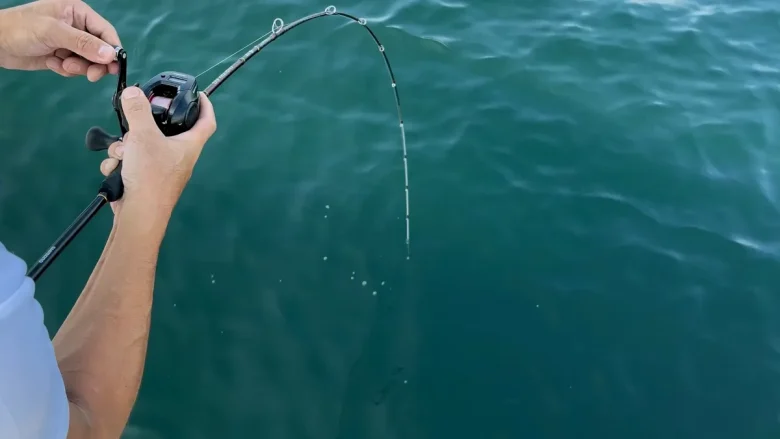
Deep water changes what you’re asking for. The fall is the feeding trigger, a longer blank gives the jig more room on the drop, and jig weights climb past anything the rods above will take. Both answers here are Shimano’s, and Daiwa has nothing that competes at the heavy end.
Seven models, powers 0 to 6, ¥64,000 to ¥69,000, 132 to 175 g, two-piece at the grip joint. Shimano took the previous Motive and slowed the taper, moving the bending fulcrum closer to your hands so a long rod stops being tiring to work.
The build is the top of Shimano’s rod catalogue: Spiral X Core, X-Guide 3D titanium frames cold forged in one piece, and a hollow carbon rear grip that carries vibration better than EVA. The X-Guides are on it because long rods tangle, and a wrap at 250 m costs you the whole drop.
At 6’10” it is still the most rod to handle in this group, which is the thing Shimano set out to reduce rather than something it claims to have removed. Worked off a small boat with a low gunwale, the extra length is working against you before you start.
| What it’s built from | What it does |
|---|---|
| Spiral X Core | Nano-alloy resin carbon tape in Shimano’s spiral structure, for a thin blank that doesn’t wobble under a heavy jig |
| X-Guide 3D titanium | One-piece cold-forged frames with no edges and short feet, so the blank bends cleanly and the line doesn’t wrap |
| Hollow carbon rear grip | Light, stiff and a better vibration path than EVA, which is how you feel the bottom at 300 m |
| Slow taper | The bending fulcrum sits closer to the hands than the previous version, which is what makes a 6 ft 10 in rod workable all day |
| Model | Weight | Tip dia. | Jig | PE | Max drag | Slow jerk | Fast jerk | JDM RRP (excl. tax) |
|---|---|---|---|---|---|---|---|---|
| B610-0 | 132 g | 2.1 | 40 to 130 g | Max 1.5 | 3 kg | 80 m | 40 m | ¥64,000 (~$408) |
| B610-1 | 139 g | 2.1 | 80 to 180 g | Max 1.5 | 3 kg | 110 m | 60 m | ¥64,000 (~$408) |
| B610-2 | 143 g | 2.3 | 100 to 230 g | Max 2 | 4 kg | 160 m | 80 m | ¥65,000 (~$414) |
| B610-3 | 150 g | 2.3 | 120 to 280 g | Max 2.5 | 5 kg | 230 m | 110 m | ¥66,000 (~$420) |
| B610-4 | 161 g | 2.2 | 140 to 350 g | Max 3 | 6 kg | 300 m | 140 m | ¥67,000 (~$427) |
| B610-5 | 168 g | 2.2 | 160 to 430 g | Max 3 | 6 kg | 350 m | 160 m | ¥68,000 (~$433) |
| B610-6 | 175 g | 2.4 | 180 to 500 g | Max 4 | 8 kg | 400 m | 180 m | ¥69,000 (~$439) |
Eleven models, ¥69,000 to ¥84,000, and the only one-piece Shimano here. Length steps down as power climbs: 6’5″ for powers 0 to 3, 6’3″ for 4 to 6, 6’1″ for 7 through 10.
Powers 7 to 10 exist nowhere else in this comparison. B61-10 takes jigs from 300 to 1,200 g on PE 5 with a 10 kg drag rating, which is deep dropping and tuna work. If your fishing has a 900 g jig in it, this is the only series on this page that covers it. One piece at 1.85 to 1.96 m is a freight question rather than a shipping one.
| What it’s built from | What it does |
|---|---|
| One-piece blank | No joint anywhere, so the bend is continuous and the blank is as strong as Shimano can make it. It also can’t be packed short |
| Spiral X Core | The same core structure as the Motive, carrying jig weights up to 1,200 g |
| Stepped lengths | 6 ft 5 in at the light end down to 6 ft 1 in at the heavy end, because a 900 g jig doesn’t want a long lever |
| Drag ratings to 10 kg | Powers 9 and 10 are rated at 10 kg of line tension at 45 degrees, double what the mid powers carry |
| Model | Length | Weight | Tip dia. | Jig | PE | Max drag | JDM RRP (excl. tax) |
|---|---|---|---|---|---|---|---|
| B65-0 | 6’5″ / 1.96 m | 127 g | 2.0 | 40 to 130 g | Max 1.5 | 3 kg | ¥69,000 (~$439) |
| B65-1 | 6’5″ / 1.96 m | 127 g | 2.0 | 80 to 180 g | Max 1.5 | 3 kg | ¥70,000 (~$446) |
| B65-2 | 6’5″ / 1.96 m | 137 g | 2.0 | 100 to 230 g | Max 2 | 4 kg | ¥71,000 (~$452) |
| B65-3 | 6’5″ / 1.96 m | 137 g | 2.2 | 120 to 280 g | Max 2.5 | 5 kg | ¥72,000 (~$459) |
| B63-4 | 6’3″ / 1.91 m | 145 g | 2.2 | 140 to 350 g | Max 3 | 6 kg | ¥73,000 (~$465) |
| B63-5 | 6’3″ / 1.91 m | 157 g | 2.5 | 160 to 430 g | Max 3 | 6 kg | ¥74,000 (~$471) |
| B63-6 | 6’3″ / 1.91 m | 167 g | 2.5 | 180 to 500 g | Max 4 | 8 kg | ¥76,000 (~$484) |
| B61-7 | 6’1″ / 1.85 m | 180 g | 2.8 | 200 to 600 g | Max 4 | 8 kg | ¥78,000 (~$497) |
| B61-8 | 6’1″ / 1.85 m | 188 g | 3.0 | 230 to 750 g | Max 4 | 8 kg | ¥80,000 (~$510) |
| B61-9 | 6’1″ / 1.85 m | 198 g | 3.1 | 260 to 900 g | Max 5 | 10 kg | ¥82,000 (~$522) |
| B61-10 | 6’1″ / 1.85 m | 203 g | 3.5 | 300 to 1,200 g | Max 5 | 10 kg | ¥84,000 (~$535) |
| Series | Length | Powers | Jig range across the series | Blank | JDM RRP (excl. tax) |
|---|---|---|---|---|---|
| Shimano Grappler BB Type Slow J | 6’6″ | 1 to 4 | 160 to 330 g | Tubular, two-piece | ¥21,000 (~$134) to ¥22,500 (~$143) |
| Shimano Grappler Type Slow J | 6’6″ | 1 to 6 | 160 to 500 g | Tubular, two-piece | ¥32,000 (~$204) to ¥34,500 (~$220) |
| Daiwa Outrage SJ | 6’1″ and 5’5″ | 00 to 6, plus 2 to 4 TG | 80 to 800 g | Tubular and full solid, one piece | ¥40,700 (~$259) to ¥50,500 (~$322) |
| Shimano Game Type Slow J | 6’6″ | 0 to 6 | 130 to 500 g | Tubular, two-piece | ¥44,200 (~$282) to ¥47,000 (~$299) |
| Daiwa Saltiga SJ | 6’1″ | 00 to 6 | 80 to 800 g | Tubular, one piece | ¥60,500 (~$385) to ¥64,000 (~$408) |
| Shimano Ocea Jigger Infinity Motive | 6’10” | 0 to 6 | 40 to 500 g | Tubular, two-piece | ¥64,000 (~$408) to ¥69,000 (~$439) |
| Shimano Ocea Jigger Infinity | 6’5″ to 6’1″ | 0 to 10 | 40 to 1,200 g | Tubular, one piece | ¥69,000 (~$439) to ¥84,000 (~$535) |
| Daiwa Saltiga SJ TG | 5’8″ | 2 to 6 | 150 to 700 g | Full solid, one piece | ¥77,000 (~$490) to ¥83,000 (~$529) |
Best all-round buy: Shimano Grappler Type Slow J B66-3
¥33,000 (~$210). Jigs to 260 g, a slow jerk to about 200 m, a fast jerk to about 100 m, and a reel size printed on the page (300 to 2000). It is the cheapest rod here that covers a normal inshore season without a second rod in the rack.
For a small boat: Daiwa Outrage SJ 61B-3
¥41,900 (~$267). Six foot one instead of six foot six, one piece, 114 g, and a 180 to 330 g jig window that tells you where the blank starts working rather than only where it stops. The reel seat is the Saltiga part you get to keep.
Cheapest honest way in: Shimano Grappler BB Type Slow J B66-2
¥21,500 (~$137). Max 200 g of jig on PE 2, 120 g, and a taper built for slow pitch rather than borrowed from a light jigging rod. Two trips will tell you whether you want to spend the other ¥20,000.
Work through it in order: the deepest water you realistically fish, then the jig weight that water demands, then how high your hands sit above the surface, then price. The first three narrow it to two or three models. Brand comes last, and it comes down to feel.
On feel I’ll give you my bias rather than pretend I don’t have one. Fishing Shimano and Daiwa rods of the same lure rating alongside each other in light shore jigging and seabass, Shimano feels firmer from the butt, with more to push against on the cast and on the jerk. Daiwa feels softer overall. That is a personal, sensory thing and entirely down to preference. I’ve bought Shimano on that feeling for years. Which is the reason a Daiwa slow pitch blank is the next rod I want in my hands.
If your water is under 100 m and your jigs under 150 g, a light jigging rod covers much of the same ground, and the Yamaga Galahad and Tenryu Horizon numbers for that job are in best JDM light jigging rods. What you hang off the end is in JDM jigs for slow pitch jigging.
For Daiwa’s LJ, SLJ and J rods at the same four price levels, see how the Saltiga, Outrage, Outrage BR and Outrage XV jigging rod tiers compare.