What Is Slow Pitch Jigging? The Japanese Method Explained
ちゃんま
マイボ!

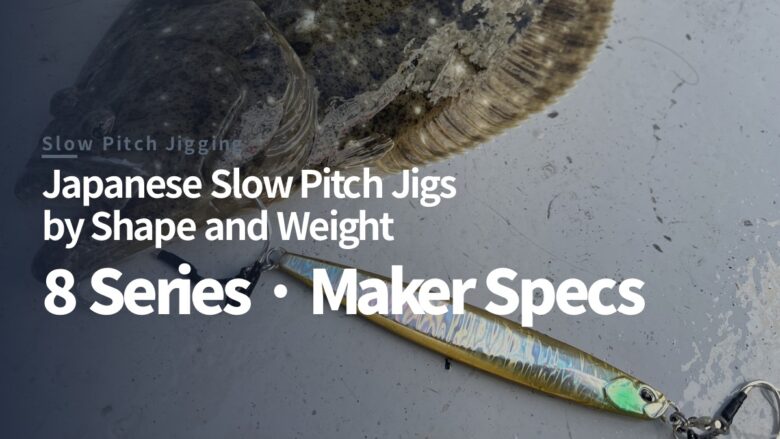
A slow pitch jig doesn’t look like a jig. It looks like a flattened spoon somebody bent slightly and hung a split ring off both ends. That shape is the entire point. The thing is built to fall sideways, flutter, and stay in front of a fish that has no intention of chasing anything.
Most of the jigs that made the method work are still Japanese, and most never reach a US tackle shop wall. Below are eight series you can actually get hold of, what their makers publish, and where each one earns its slot. Vocabulary first, because almost none of it is labeled in English: slow pitch jerk (スローピッチジャーク), shortened to SPJ or simply “slow jigging” in Japan, is the method. The lures are sold as metal jigs (メタルジグ), tagged with a shape word: short, semi-long, or long.
Pricing note: JDM figures are the makers’ published prices in JPY excluding Japanese consumption tax, with rough USD conversions at about ¥157 to the dollar in August 2026. Amazon Japan ships internationally; check availability and shipping cost at checkout. If the method is new to you, what slow pitch jigging is covers the mechanics first.
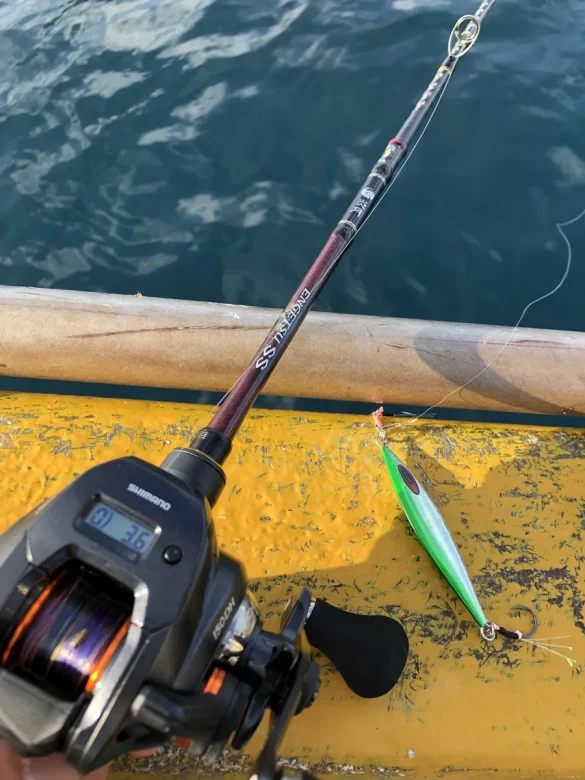
Three things, and none of them is the word printed on the packet.
The rod does the stroke, not your arm. You lift a short distance, let the jig go slack, and the shape does the rest while the line is loose. Nearly every bite happens then. This is also why a jig with a great fall action is worthless if you can’t feel when the fall ends, which is a rod and reel problem more than a jig problem. The companion piece on slow pitch jigging reels deals with that side.
Grams first, shape second. Everything else is downstream of getting the jig down on a reasonably vertical line. The Japanese rule of thumb is blunt: take the depth in meters, start there in grams, then add for current.
| Depth | Light current | Hard current or drift | Shape that usually works |
|---|---|---|---|
| 30-60 m (100-200 ft) | 60-120 g | 130-180 g | Short / leaf |
| 60-100 m (200-330 ft) | 130-200 g | 210-300 g | Short or semi-long |
| 100-150 m (330-490 ft) | 200-300 g | 330-450 g | Semi-long |
| 150-250 m (490-820 ft) | 300-500 g | 500-800 g | Semi-long, low-drag nose |
| 250 m+ (820 ft+) | 500 g+ | 800 g+ | Deep-specific only |
Two things surprise first-time importers. How far the ladders go, for one: several series below run past 900 g, because Japanese mid-deep bottom fishing happens in 200 to 400 m of water. And how small the steps are. A range that goes 200, 220, 250, 270, 300 exists because on a slow rod, a 30 g jump changes the stroke you have to use. If you buy jigs in 2 oz increments, that granularity is the JDM advantage nobody advertises.
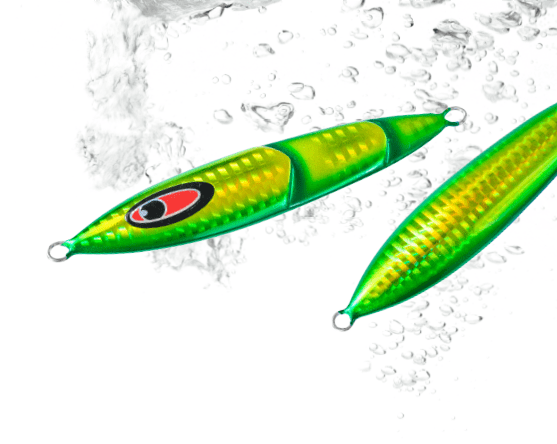
Short and leaf-shaped. It’s the forgiving end of the category, and Seafloor Control says so on the product page rather than making you work it out: the Cranky is listed under the heading “first choice for beginner.”
The Kochi workshop has been building slow pitch jigs since before the method had a name outside Japan, and the Cranky is the one it points beginners toward. It falls on its own. The maker’s phrasing: it “makes automatic action while falling” and “acts irregular falling action every drop,” a translated way of saying no two drops look the same. Two machined edges down the front face cut water resistance on the lift, so it comes up light in the hand even at 300 g. That combination, dead easy to lift and self-animating on the drop, is why it forgives sloppy timing.
| Feature | What it does |
|---|---|
| Short-type body | Compact silhouette that starts its fall action immediately after the jig goes slack, with no input from you |
| Twin front edges | Two machined edges on the front face reduce water resistance on the lift, so the jig feels light through the stroke |
| Irregular fall | Seafloor Control’s stated aim is a different fall path on every drop rather than a repeatable one |
| Quick response to small input | A short jerk is enough to make it slide; designed around minimal rod travel |
| Tested water | Maker lists Shizuoka, Kochi, Wakayama and Okinawa, from shallow to deep, on nodoguro (blackthroat seaperch) and amberjack-type species |
| Series | Weight ladder (g) | Colors | List price |
|---|---|---|---|
| Seafloor Control Cranky | 90 / 120 / 140 / 170 / 200 / 230 / 260 / 290 / 320 / 350 / 400 / 450 / 500 / 600 / 700 / 800 / 900 | 25 | Not published by the maker |
Length buys you glide and costs you lift. A semi-long jig slides further on each stroke, covers more water horizontally, and pushes more water on the way up. In deep water that last part stops being an abstraction and starts being your shoulder.
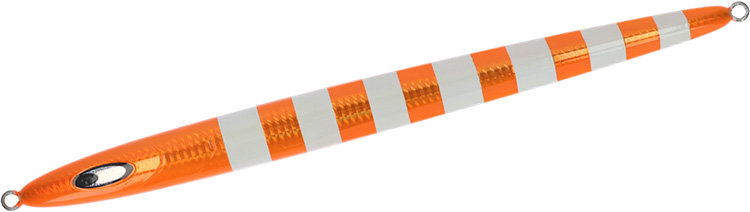
Daiwa’s answer is the Saltiga SL Jig SD, and the design note is unusual enough to read twice. The nose is hemispherical, and Daiwa credits bulbous bow theory: the bulge under a container ship’s bow that cancels part of the wave the hull makes. Applied to a 500 g lump of lead at 200 m, the claim is a measurable drop in pull. The point isn’t extra action, it’s letting you keep jerking after hour three. The paint is Daiwa’s Super Glow, the high-luminance grade, because at those depths glow is not decoration.
Its limit is where it starts. The lightest SL Jig SD is 230 g, so for anything shallower than about 100 m this is the wrong tool from the outset.
| Feature | What it does |
|---|---|
| Bulbous bow nose | Hemispherical front end borrowed from ship hull design; Daiwa’s stated goal is to remove wave-making resistance so the jig pulls straight and light |
| Semi-long profile | Longer body for glide and a stable jerk-and-fall cycle under heavy water pressure |
| Super Glow finish | Daiwa’s high-luminance glow paint, specified for mid-deep water where ambient light is effectively zero |
| Lead body, no hooks | Sold bare, as almost all JDM jigs are; you choose and fit your own assists |
| Model | Length (mm) | Weight (g) | Price, excl. tax |
|---|---|---|---|
| SL Jig SD 230 g | 193 | 230 | ¥1,550 (~$10) |
| SL Jig SD 260 g | 200 | 260 | ¥1,800 (~$11) |
| SL Jig SD 290 g | 205 | 290 | ¥2,050 (~$13) |
| SL Jig SD 330 g | 223 | 330 | ¥2,300 (~$15) |
| SL Jig SD 400 g | 228 | 400 | ¥2,650 (~$17) |
| SL Jig SD 500 g | 245 | 500 | ¥3,200 (~$20) |
| SL Jig SD 800 g | 318 | 800 | ¥4,550 (~$29) |
It changes it more than color does, more than length does, and more than most anglers expect. Here are two jigs that sit at opposite ends of that axis and were designed by companies with nothing else in common.
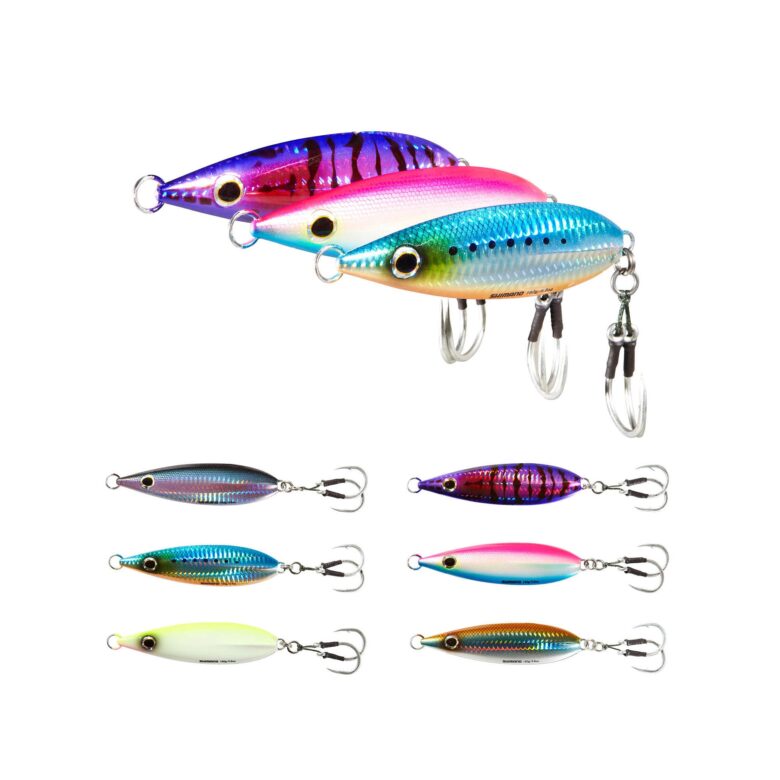
This is the one you can buy this afternoon without a proxy service, and for a lot of American anglers it is the whole introduction to the category. Shimano’s US arm sells it at $15 to $27 depending on size, in eight weights from 80 g to 350 g, and the design brief is stated plainly: the jig is center-balanced, so it falls horizontally with a wobble and stays in the strike zone longer than the rest of the Butterfly range.
It’s also the least specialized jig here. Shimano’s own instructions describe free-spooling it through a depth band and cranking back up, closer to a vertical drop-and-flutter than to slow pitch jerking. Fish it on a fast rod with a heavy hand and it just falls; the horizontal attitude that makes it work depends on a genuinely slack line.
| Feature | What it does |
|---|---|
| Center balance | Mass at the middle of the body, so the jig sits flat and wobbles on the way down instead of pointing nose-first |
| Horizontal fall attitude | Shimano’s stated benefit is longer time in the strike zone per drop |
| Sinking type across the range | Every SKU in the lineup is listed as sinking; no float or suspend variants to sort through |
| US distribution | The only jig on this page with a published US retail price and normal domestic shipping |
| Model | Length (in) | Weight (g) | Weight (oz) |
|---|---|---|---|
| Flat-Fall 80 g | 3.74 | 80 | 2.82 |
| Flat-Fall 100 g | 4.06 | 100 | 3.53 |
| Flat-Fall 130 g | 4.37 | 130 | 4.59 |
| Flat-Fall 160 g | 4.65 | 160 | 5.64 |
| Flat-Fall 200 g | 5.08 | 200 | 7.05 |
| Flat-Fall 250 g | 5.31 | 250 | 8.82 |
| Flat-Fall 300 g | 5.20 | 300 | 10.58 |
| Flat-Fall 350 g | 5.51 | 350 | 12.35 |
Shimano lists the whole range at $15 to $27 depending on size. The 300 and 350 g come in three colors; everything below that in eight.
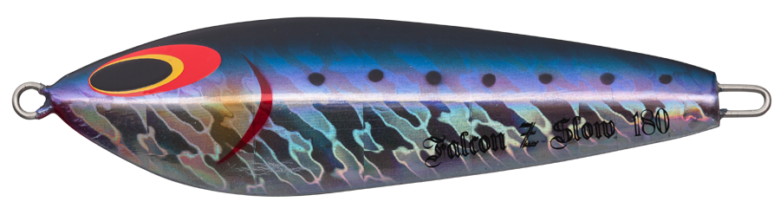
Now the opposite. Sea Falcon is the lure brand of Bluing Hearts, a Hamamatsu workshop that has been handcrafting lures since it was founded in 1998, and the Z Slow is one of its longest-running items. Front balance, with a V-shaped keel down one flank. Drop it off the gunwale and it turns in a slow circle on the way down, which is the “horizontal spiral fall” the maker’s own English copy claims.
What makes it interesting for anyone starting out is how little you have to give it. Sea Falcon describes controlling the jig with a third or a quarter turn of the reel handle and a very light rod input, aimed at pulling a bottom-hugging fish up into the water column. The company also notes that each jig is painted in-house. The 70 g size is the lightest genuine slow pitch jig on this page, which matters if your water is 40 m rather than 240 m.
| Feature | What it does |
|---|---|
| Asymmetrical body | Sea Falcon’s original approach to producing a horizontal spiral fall rather than a straight drop |
| V-keel on one flank | Sets the roll axis; the maker cites it as the reason beginners can handle the jig |
| Front balance | Fast dart on the jerk, then a slide, rather than the flat pancake of a center-balanced jig |
| Slow current specification | Listed by the maker as a slow-current standard model, multi-species |
| Hand-finished in Hamamatsu | Each jig painted in the company’s own craft center rather than outsourced |
| Series | Weight ladder (g) | Balance | List price |
|---|---|---|---|
| Sea Falcon Z Slow | 70 / 90 / 120 / 150 / 180 / 220 / 280 / 350 / 400 | Front, V-keel one side | Not published by the maker |
Japanese anglers call it nimai-shio (二枚潮), literally “two-layer tide”: a surface flow running one way and a deeper flow running another, with your braid bellied out between them. It’s the condition that ruins slow pitch, because the jig stops answering the rod. Two very different answers exist.
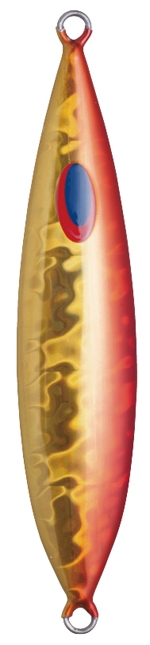
The weight list tells you who Deepliner builds for: 30 g at one end and 1,500 g at the other, through thirty-one steps. No other series here comes close. The Kochi company is one of the makers usually credited with setting the template for the category, and the Slow Skip VB is its baseline model.
The published actions are quick dart, stop-and-go fall, and vibration. Deepliner is specific about the rest: the jig holds a horizontal attitude with very little stroke, answers slow jerks from a full reel turn down to an eighth of one, and refuses to drop vertically after the jerk, so the fall reads like a baitfish that has just been stunned. Within the Slow Skip family it leans hardest on the stop. One caveat the maker states outright: VB is the model for relatively slack water with little two-layer current. For genuine nimai-shio Deepliner points you at the Slow Skip FB, which it lists as the light-action model that handles stacked flow.
| Feature | What it does |
|---|---|
| Asymmetric slow-style body | Holds the jig horizontal with minimal rod travel, which is the core of the Slow Skip concept |
| Stop-and-go fall | Prevents the vertical free-fall after a jerk; the maker’s stated image is a baitfish losing consciousness |
| 1/1 to 1/8 jerk range | Designed to answer everything from a full reel turn to an eighth of a turn, which is unusually wide |
| Quick dart and vibration | The two other published actions, used to reset the jig after a long pause |
| Thirty-one weights | 30 g to 1,500 g, the widest ladder of any series on this page |
| Series | Weight ladder (g) | Best water | List price |
|---|---|---|---|
| Deepliner Slow Skip VB | 30, 60, 80, 100, 130, 150, 180, 200, 220, 250, 270, 300, 330, 350, 380, 400, 430, 450, 480, 500, 550, 600, 650, 700, 750, 800, 850, 900, 950, 1000, 1500 | Slack to moderate current, minimal two-layer flow | Not published by the maker |
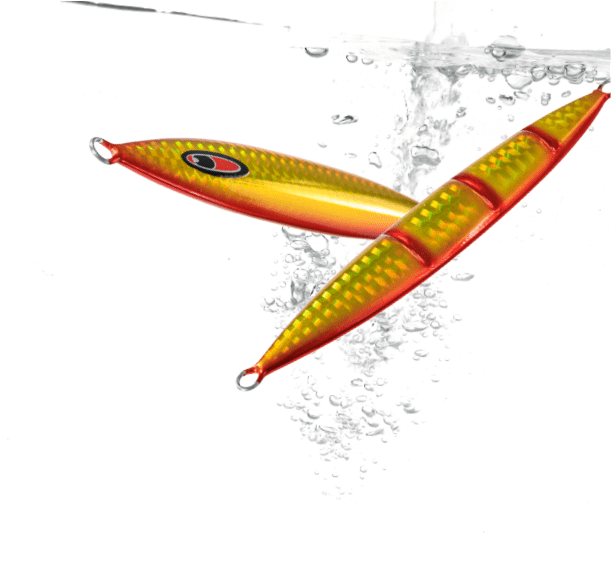
The Spunky is the Cranky’s mirror image, from the same workshop. Where the Cranky is tuned around the fall, the Spunky is tuned around the lift: a short jig with a slimmed silhouette and multiple horizontal edges machined across the surface, all aimed at cutting resistance on the way up. Seafloor Control’s English copy is unusually direct about the target condition, promising you “will not be bothered by tough current condition anymore,” plus a fast, accurate fall in dual or multiple current layers.
Read the two together and you have a working pair: Cranky when the fish want a long, uncertain drop, Spunky when the water is stacked and you simply need to reach bottom and stay in touch. It runs 60 g to 900 g, and unlike the Cranky it starts light enough for shallower ground.
| Feature | What it does |
|---|---|
| Slimmed short body | Less frontal area than the Cranky, so the jig climbs through stacked current instead of planing sideways |
| Multiple horizontal edges | Machined across the surface to cut water resistance on the lift; the maker’s phrase is “feather lightness up-lifting feeling” |
| Fast, accurate fall | Reaches bottom on a truer line in dual or multiple current layers |
| Species range | Maker lists everything from fast-swimming pelagics to bottom fish, worked on both the lift and the drop |
| Series | Weight ladder (g) | Bias | List price |
|---|---|---|---|
| Seafloor Control Spunky | 60 / 80 / 100 / 130 / 150 / 180 / 210 / 240 / 270 / 300 / 330 / 360 / 390 / 420 / 450 / 500 / 600 / 700 / 800 / 900 | Up-lift priority | Not published by the maker |
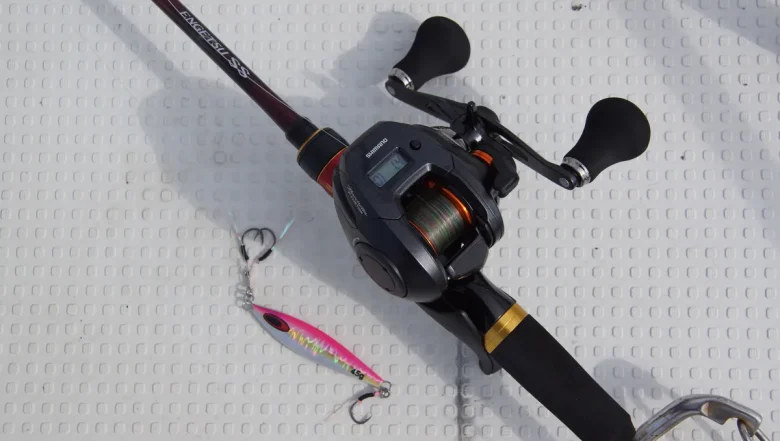
Some days the lift does nothing and every hit lands in the slack. That’s a real pattern, not bad luck, and Japan has a whole sub-category built around it: jigs that are frankly poor at anything except falling well.
Xesta calls the Slippy a fall-dedicated shape, with cut-outs on both flanks that shed drag when you jerk it. By the company’s own account that produces the most aggressive flat fall in the Slow Emotion family, with the appeal turned up hardest in deep water. It runs 120 g to 500 g, and at ¥1,600 for the 120 g, roughly ten dollars, it is the cheapest purpose-built fall jig on this page.
Buy it as a specialist. A jig this committed to the drop is not the one to reach for when fish are chasing.

| Feature | What it does |
|---|---|
| Fall-dedicated shape | Built around the drop rather than the lift; the fall is the presentation, not the reset |
| Twin side cut-outs | Machined recesses on both flanks that shed water and lighten the pull on the jerk |
| Flat-fall action | The most pronounced flat fall in the Slow Emotion range, per Xesta |
| Deep water bias | Xesta states the appeal is strongest at depth, across a wide species list |
| Model | Weight (g) | Price, excl. tax | Approx. USD |
|---|---|---|---|
| Slow Emotion Slippy 120 | 120 | ¥1,600 | ~$10 |
| Slow Emotion Slippy 150 | 150 | ¥1,800 | ~$11 |
| Slow Emotion Slippy 180 | 180 | ¥2,000 | ~$13 |
| Slow Emotion Slippy 200 | 200 | ¥2,200 | ~$14 |
| Slow Emotion Slippy 250 | 250 | ¥2,700 | ~$17 |
| Slow Emotion Slippy 300 | 300 | ¥3,000 | ~$19 |
| Slow Emotion Slippy 400 | 400 | ¥3,500 | ~$22 |
| Slow Emotion Slippy 500 | 500 | ¥3,800 | ~$24 |
FK stands for Fall Killer, and Daiwa’s design note is one sentence of genuine engineering rather than marketing: they went looking for the exact sink rate of an injured baitfish dropping out of a bait ball, then built an asymmetric body that flashes at that speed. Not faster, not slower.
Strictly speaking Daiwa positions this for one-pitch jerking rather than slow pitch, and the five weights stop at 250 g. It earns its place here anyway, because a 130 g jig at ¥1,900 costs less than half a hand-finished jig of the same weight and answers the same question: are your fish eating on the drop?

| Feature | What it does |
|---|---|
| Fall Killer profile | Daiwa’s type designation for the whole range; tuned to a specific fall speed rather than a specific action |
| Asymmetric body | Produces flashing on the drop instead of a dead vertical sink |
| Bait-matched sink rate | Set to the speed of a damaged baitfish falling away from a bait ball, neither fast nor slow |
| Lead body, no hooks | Supplied bare like the rest; budget for assists separately |
| Model | Length (mm) | Weight (g) | Price, excl. tax |
|---|---|---|---|
| Saltiga FK Jig 130 g | 135 | 130 | ¥1,900 (~$12) |
| Saltiga FK Jig 150 g | 145 | 150 | ¥2,000 (~$13) |
| Saltiga FK Jig 180 g | 155 | 180 | ¥2,250 (~$14) |
| Saltiga FK Jig 210 g | 162 | 210 | ¥2,500 (~$16) |
| Saltiga FK Jig 250 g | 170 | 250 | ¥2,800 (~$18) |
Because they don’t have one, in the sense a US shopper expects. Seafloor Control, Deepliner and Sea Falcon all publish weights, actions and color charts on their sites and publish no prices at all. This isn’t an oversight. These are small workshops selling through a dealer network, and the shop sets the number.
Two consequences when you import. Prices for the same jig differ between Japanese retailers, so the search links above are worth comparing rather than clicking blind. And the handmade brands cost roughly double a Daiwa or Xesta jig of the same weight, before shipping. That gap is the real decision on this page, not the shape chart. The walkthrough on buying JDM tackle from overseas covers proxies and freight.
You can drop them. You won’t be slow pitch jigging.
A conventional jigging rod resists load, recovers fast, and drags the jig up in a straight line. A slow pitch rod loads and unloads: you push the blank down, it springs back, and that spring throws the jig sideways into its glide. Fish a Flat-Fall on a stiff rod and you get a fluttering drop and nothing else, which is exactly how Shimano tells US anglers to use it. Fish a Cranky or a Slow Skip that way and you’re wasting the shape.
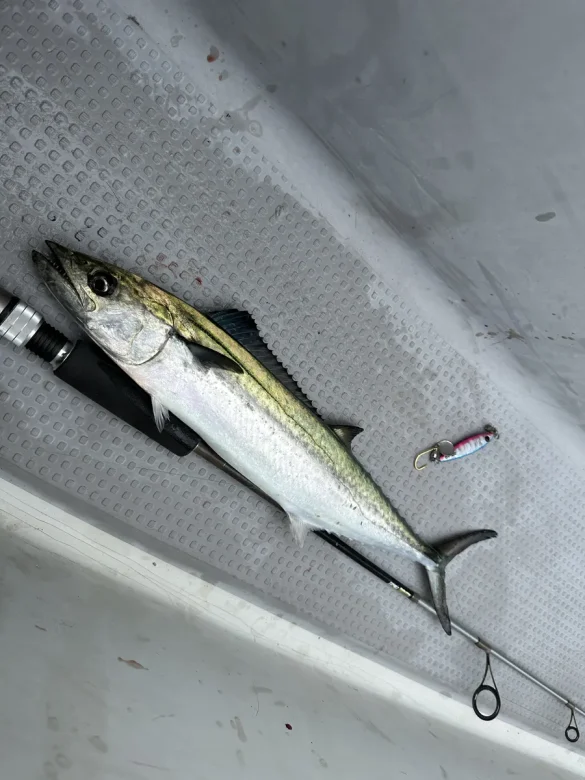
Line matters as much. Thin braid, PE 1.5 to 2.5 for most of this, keeps things vertical enough for the jig to answer the rod; the numbering is unpacked in the line and assist hook guide. Every jig here except the Shimano ships bare, so budget two assists per jig, top and bottom.
A few things about the Japanese side of this that don’t survive translation into a product listing, from fishing and buying here rather than from a catalog.
Jigs are sold bare and nobody finds that strange. A Japanese tackle shop wall has jigs on one side and assist hooks on the other, and the assumption is that you rig your own, matching hook size to jig length rather than to fish size. Boutique jigs are not stocked deep, either: a shop carrying Seafloor Control might have four weights in two colors, and the rest is special order. That’s the same constraint an overseas buyer hits, which is why the search links above return a scatter of sizes rather than a clean lineup.
On the boat, the captain calls the depth and often the jig weight, and everyone changes together. Less individualistic than US offshore fishing, and it exists for a reason: with six anglers drifting over structure, a mismatched jig is a tangle waiting to happen. If you take one habit from Japanese slow pitch, take that one: match the weight to the boat, not to your preference. The broader picture of how jig choice fits the rest of the kit is in the metal jig selection guide.
| Series | Maker | Shape | Balance / bias | Weight range | List price, excl. tax |
|---|---|---|---|---|---|
| Cranky | Seafloor Control | Short / leaf | Fall priority | 90-900 g | Not published |
| Spunky | Seafloor Control | Short / slim | Lift priority | 60-900 g | Not published |
| Slow Skip VB | Deepliner | Asymmetric mid | Stop emphasis | 30-1,500 g | Not published |
| Z Slow | Sea Falcon | Asymmetric, V-keel | Front balance | 70-400 g | Not published |
| Butterfly Flat-Fall | Shimano | Flat, wide | Center balance | 80-350 g | $15-$27 US retail |
| Saltiga SL Jig SD | Daiwa | Semi-long | Low-drag nose | 230-800 g | ¥1,550-¥4,550 |
| Saltiga FK Jig | Daiwa | Asymmetric short | Fall speed matched | 130-250 g | ¥1,900-¥2,800 |
| Slow Emotion Slippy | Xesta | Fall-dedicated | Flat fall | 120-500 g | ¥1,600-¥3,800 |
All figures are maker-published. JPY prices exclude Japanese consumption tax; USD conversions elsewhere on this page are rough, at about ¥157 to the dollar.
A Xesta Slow Emotion Slippy in 150 g and 250 g (¥1,800 and ¥2,700), plus a Daiwa Saltiga FK Jig in 180 g (¥2,250). Three jigs, two different fall characters, enough range for 60 to 120 m. None of them needs a specialist rod to behave itself, which is the point at this price.
Put a Seafloor Control Cranky around 200 g and a Sea Falcon Z Slow in 120 g alongside them. This is the tier where the workshop jigs start earning their premium: self-animating falls that keep producing on the afternoon when the cheaper jigs go flat. Neither maker publishes a price, so compare Japanese sellers before you commit.
Three weights of Deepliner Slow Skip VB, spaced 20 to 30 g apart, plus a Daiwa Saltiga SL Jig SD in 400 g (¥2,650) for deep drops. Matching current in small steps within one brand is the actual reason experienced Japanese anglers end up loyal to a single maker, and the VB ladder is the widest there is.
Buying exactly one jig to find out whether the method suits you? Make it the Shimano Butterfly Flat-Fall in 130 g. Domestically stocked, under thirty dollars, and it fails gracefully on tackle you already own.
Work backwards from your water. Under 100 m with moderate current, a short jig in 130 to 200 g does almost everything, and the Cranky, the Z Slow and the Slippy all live in that band at very different prices. Past 150 m, shape stops being a preference and becomes physics: semi-long body, low-drag nose. That’s a short list, and the Saltiga SL Jig SD is on it.
The honest summary: the boutique jigs are better, and you probably shouldn’t start there. Buy two cheap fall-focused jigs, learn to feel the moment the line goes slack, and only then find out whether a hand-painted Deepliner does something a ¥2,000 Daiwa doesn’t. Go the other way and you tend to end up with an expensive box and the same three drops.