Best JDM Light Jigging Reels Under $300
ちゃんま
マイボ!

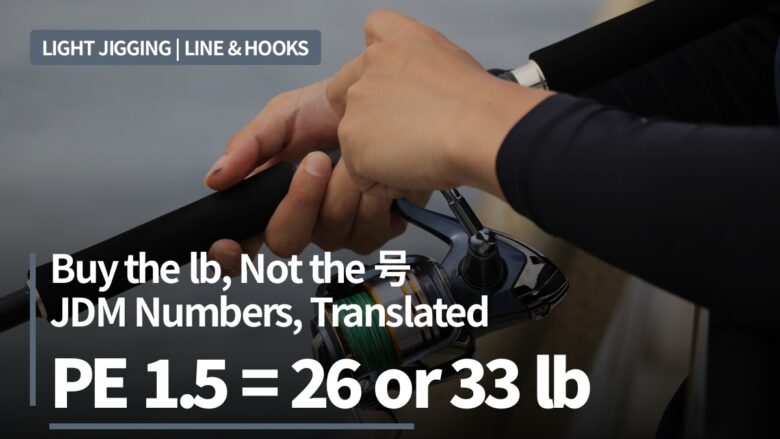
You can buy a Japanese light jigging rod and a small counter baitcaster on a US site in about four minutes. The line and the hooks are where it stops being easy. The spool says 1.5, the leader says 8, the assist hook packet says #1/0 and 200lb, and none of those numbers line up with anything printed on the tackle you already own.
So this is a translation job as much as a gear list. Below, four rungs: the braid, the leader, the ready-tied assist hooks, and the parts if you’d rather build your own. Every number comes off the maker’s own spec page, because the same 号 (gou) size can differ by seven pounds between two Japanese brands, and that gap is the whole reason this article exists.
Light jigging (ライトジギング) in Japan means 60 to 150 g jigs on PE 1 to 2, worked from a boat over 30 to 100 m of water for amberjack, sea bass, madai and whatever else is sitting on the bait. If you’re new to the style, start with our complete guide to light jigging from a boat. Prices for JDM products are shown in JPY excluding tax, with approximate USD at about ¥157 to the dollar in August 2026.
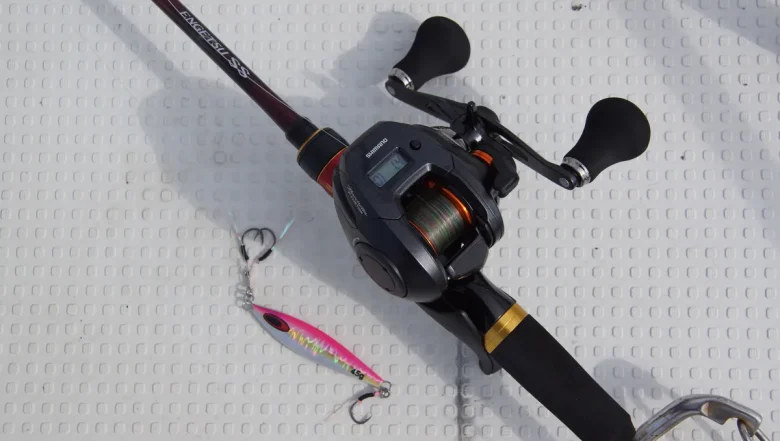
Five decisions, and only two of them are about money.
1. The braid size is a diameter, not a breaking strain. 号 is a thickness scale. Sunline publishes the industry standard on its own product pages: 1号 equals 200 denier, and every other size scales from there. Two 8-carrier braids at 1.5号 are the same thickness and can still be rated seven pounds apart, because the rating describes the fiber and the build, not the number on the box. Here are two current jigging braids side by side, both from the makers’ official spec tables.
| PE size (号) | Daiwa UVF Saltiga Dura Sensor ×8+Si2 | Sunline Saltimate Amazer X8 | Gap |
|---|---|---|---|
| 0.8 | 15 lb / 6.8 kg | 19 lb / 8.6 kg | +4 lb |
| 1 | 18 lb / 8 kg | 22 lb / 10 kg | +4 lb |
| 1.2 | 21 lb / 9.6 kg | 27 lb / 12.3 kg | +6 lb |
| 1.5 | 26 lb / 12 kg | 33 lb / 15 kg | +7 lb |
| 2 | 35 lb / 16 kg | 40 lb / 18.2 kg | +5 lb |
| 2.5 | 42 lb / 19 kg | 47 lb / 21.4 kg | +5 lb |
| 3 | 49 lb / 22 kg | 54 lb / 24.5 kg | +5 lb |
2. The leader number is a different scale again. Fluorocarbon and nylon use their own 号 table, which has nothing to do with the PE one. Sunline prints both the lb and the reference 号 on its shock leader pages, and also publishes the diameter in millimeters, so you can cross-check against an American spool of leader you already trust.
| Leader (lb) | Reference 号 | Diameter (mm) | Where it fits in light jigging |
|---|---|---|---|
| 20 lb | 5号 | 0.370 | Small jigs, clean bottom, shy fish |
| 25 lb | 7号 | 0.435 | The all-round default with PE 1 to 1.2 |
| 30 lb | 8号 | 0.470 | PE 1.5, reef edges, better class of amberjack |
| 35 lb | 10号 | 0.520 | Toothy bycatch, deeper drops |
| 40 lb | 12号 | 0.570 | PE 2, structure, the top of light tackle |
3. Leader length is measured in arm spans. A hiro (ヒロ) is one span of outstretched arms, near enough to 1.5 m. Light jigging runs shorter than tairaba: two hiro, so about 3 m, is the common answer, and plenty of anglers fish half of that when they’re dropping straight down on a clean bottom. The leader exists to survive teeth and a rod tip, not to hide from the fish.
4. Assist cord length is set by where the jig’s weight sits. A center-balanced jig flutters sideways on the fall and a long front assist can swing round and foul the line. Japanese anglers call that ebi (エビ), shrimping, because of the shape the rig ends up in. A rear-weighted jig drops nose-up and fast, so it tolerates a longer cord. Decoy sells this distinction as separate products rather than as advice: the standard Twin Pike, and a Shorter version the company says was developed for small tungsten jigs and is short enough to mount at the rear without shrimping.
5. Twin or single is a bycatch question. Twin front assists hold better on a headshaking fish. A short single at the rear picks up the followers that nip at the tail, and it snags the bottom far less than a treble. Running a long twin front and a long twin rear at the same time is the fastest way to spend your day untangling.
This is the braid you’ll see on more Japanese light jigging decks than any other, and the reason is boring: it costs ¥3,100 for 200 m and it lasts. Daiwa built it on a new base fiber it calls TOUGH PE, then coated it with its EvoSilicone² treatment, and claims over 300% the abrasion resistance of its previous line. The 0.6 and 0.8 in 300 m were added specifically for super light jigging, which tells you where the range starts.

| Technology | What Daiwa says it does |
|---|---|
| TOUGH PE | A base fiber that is thicker and rounder per strand than the previous one, braided into 4, 8 or 12 carriers for strength, abrasion resistance and durability |
| EvoSilicone² (+Si2) | Daiwa’s silicone treatment for abrasion resistance, slickness and spool life. Combined with TOUGH PE, Daiwa rates abrasion resistance at over 300% of its own previous line |
| Marking system | 10 m × 5 colors (lime green, orange, purple, pink, Saltiga blue), plus 1 m marks in yellow and black and a long yellow mark at 5 m |
| Specific gravity 0.98 | Published by Daiwa for the TOUGH PE fiber. Slightly buoyant, which is why the line bows in current before the jig does |
| Size | Strength | Spool lengths | RRP excl. tax |
|---|---|---|---|
| 0.8号 | 15 lb / 6.8 kg | 200 m, 300 m | ¥3,100 / ¥4,150 (about $20 / $26) |
| 1号 | 18 lb / 8 kg | 200 m, 300 m | ¥3,100 / ¥4,150 |
| 1.2号 | 21 lb / 9.6 kg | 200 m, 300 m | ¥3,100 / ¥4,150 |
| 1.5号 | 26 lb / 12 kg | 200 m, 300 m | ¥3,100 / ¥4,150 |
| 2号 | 35 lb / 16 kg | 200 m, 300 m | ¥3,100 / ¥4,150 |
| 3号 | 49 lb / 22 kg | 200 m, 300 m, 400 m | ¥3,100 / ¥4,150 / ¥5,400 |
Buy 1.2号 in 300 m and you have covered 60 to 120 g jigs down to about 80 m with change left over. The one thing that catches people out is the rating basis: Daiwa quotes averages, so treat 21 lb as a working number rather than a ceiling.
Sunline aims this one squarely at jigging for amberjack and yellowtail, and it is refreshingly blunt about why: fish that run for structure have to be stopped, and a jigging line has to take full drag pressure right to the end. It’s built on the company’s ULT-PE fiber with Smooth Surface Processing, which Sunline describes as finishing the braid closer to a true circle so the fuzz stays down.

| Size | MAX strength | Spool options |
|---|---|---|
| #0.8 | 19 lb / 8.6 kg | 200 m, 300 m |
| #1 | 22 lb / 10 kg | 200 m, 300 m |
| #1.2 | 27 lb / 12.3 kg | 200 m, 300 m |
| #1.5 | 33 lb / 15 kg | 200 m, 300 m, 100 m connected spools |
| #2 | 40 lb / 18.2 kg | 200 m, 300 m, 100 m connected spools |
| #3 | 54 lb / 24.5 kg | 200 m, 300 m, 100 m connected spools |
| Technology | What Sunline says it does |
|---|---|
| ULT-PE fiber | Sunline’s ultimate PE material, the base for its jigging range |
| Smooth Surface Processing (SSP) | Special surface finishing. The line is smoother, fiber fuzz is suppressed, and the cross-section ends up close to a perfect circle |
| Multicolor with EMCS marking | Color changes for reading depth, the point of which on a light jigging boat is matching everyone else’s count when someone finds the fish |
| Connected spool format | 100 m spools sold in connected multiples, so a deep-water reel can be filled without buying a length you’ll never use |
The practical read: if you want 30 lb of braid and you also want it thin, Sunline’s #1.5 at 33 lb gets you there a full size thinner than Daiwa’s 2号 at 35 lb. Thinner braid means less bow in current, which means the jig stays under the boat. On a windy drift that matters more than the seven pounds does.
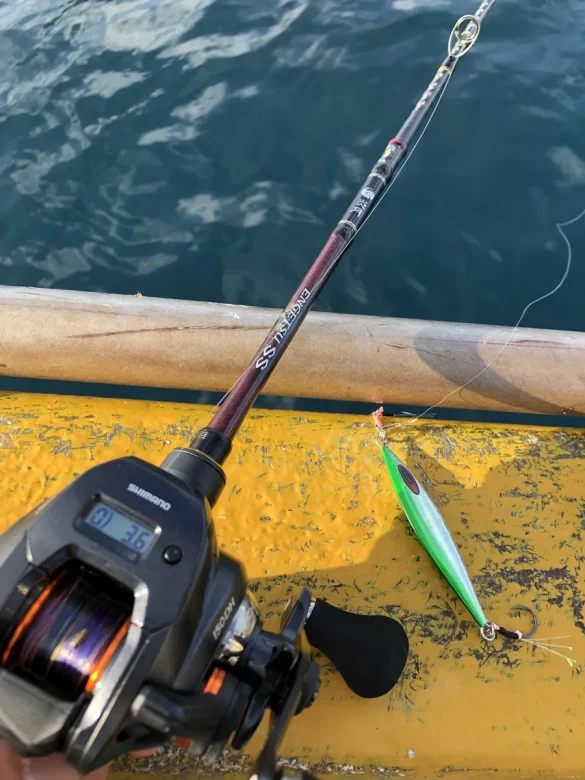
Leader gets about four sentences of thought from most anglers and then causes about half the lost fish. This one is a plain abrasion-resistant fluorocarbon with a low initial stretch, wound parallel on the spool so it comes off without memory, and it is stocked in the sizes light jigging actually uses. The 50 m spool covers 12 to 50 lb, and the 30 m spool picks up the heavy end.

| Spool | Sizes available | Reference 号 |
|---|---|---|
| 50 m single spool | 12, 16, 20, 25, 30, 35, 40, 50 lb | 3, 4, 5, 7, 8, 10, 12, 14号 |
| 30 m single spool | 60, 70, 80, 100 lb | 18, 20, 22, 30号 |
| Feature | Detail from Sunline |
|---|---|
| Triple Resin Processing (TRP) | A three-layer coating upgraded from the single-layer SRP, with resin baked between the molecules for water resistance, slickness and abrasion resistance at the same time |
| Abrasion resistance | Built to resist damage from sharp teeth, reef and the pressure of a long fight |
| Low initial stretch | So jig action and hookset power actually reach the far end |
| Parallel winding | Level winding on the spool to cut line memory and surface unevenness |
Two hiro of 30 lb, tied to PE 1.2 or 1.5 with an FG knot, and you have a system that survives a decent amberjack and still passes through a small guide train without ticking.
If you asked a Japanese tackle shop for a light jigging assist and gave no other information, this is what would land on the counter. Katsuichi calls it the monument of the category, which is marketing, but the ubiquity is real. The hook itself is the Pike AS-03: thin wire, wide gape, long taper, with a patented process Katsuichi calls CF that strengthens the bend. It’s tied on an elastic braided cord the company makes for the purpose, and the whole point of that stiffness is that the cord doesn’t collapse and wrap the jig on the fall.

| Size | RRP excl. tax | Typical jig weight |
|---|---|---|
| #2 | ¥600 (about $3.8) | Micro and super light jigging, added to the range in 2019 |
| #1 | ¥600 | 40 to 80 g |
| #1/0 | ¥600 | 60 to 120 g, the size most people buy first |
| #2/0 | ¥600 | 100 to 150 g |
| #3/0 | ¥600 | 150 g and up |
| #4/0 | ¥700 (about $4.5) | The top of the range |
| Model | Type | Sizes | Katsuichi’s stated purpose |
|---|---|---|---|
| DJ-88 Twin Pike | Twin, standard cord | #2 to #4/0 | General light tackle jigging, shore or offshore, sea bass and madai first |
| DJ-80 Twin Pike Shorter | Twin, short cord | #1/0 to #3/0 | Small jigs including tungsten. Short enough to mount at the rear without fouling, and designed to be paired with a standard Twin Pike at the front |
| DJ-77 Short Pike | Single, very short | #2 to #3/0 | Solves the rear-hook problem for people who don’t want a treble. Free-swinging eye, front or rear |
| DJ-98 Twin Pike Hyper | Twin, heavy wire | #1/0 to #3/0 | Two wire ranks thicker and about 30% stronger, on 40号 (200 lb) assist cord, for high-drag work on big fish |
Note what Katsuichi did there, because it’s the useful part. The company sells cord length as a product decision rather than leaving it to you, which is why a Japanese angler’s box has three near-identical packets in it. Standard twin at the front. Shorter twin when the jig is compact and dense. Short single at the back when fish are following and biting short.
Danzuke (段差) means step, or offset. Instead of two hooks sitting level, one rides slightly lower than the other. Owner’s argument is that the first hook goes in with the penetration of a single, and the second then holds like a double. It’s tied with the Jigger Light Hayagake hook, which Owner describes as its strongest ultra-thin-wire jigging point, ground slightly wide with a straight tip so it stands up instantly rather than rolling.
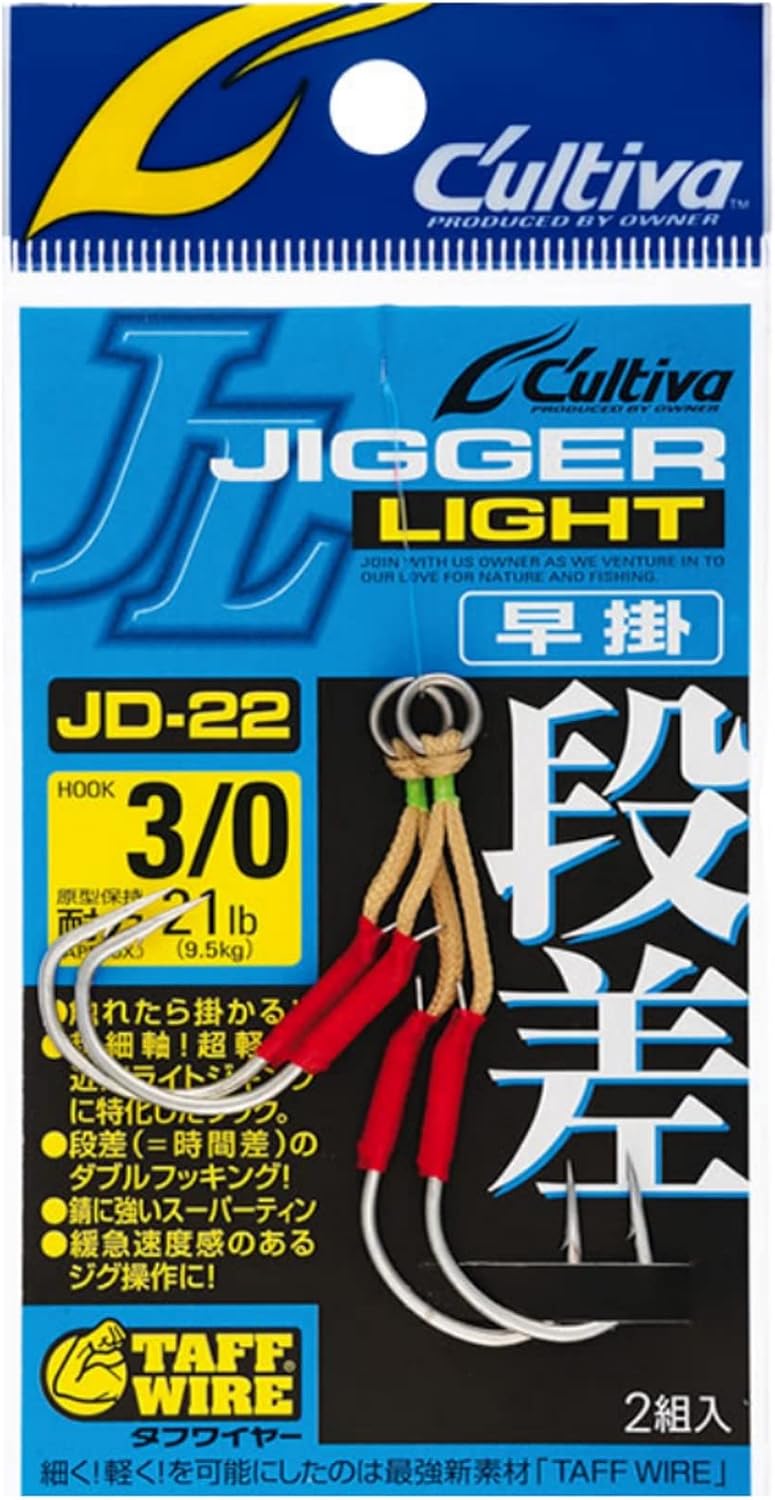
| Size | RRP excl. tax | USD approx. |
|---|---|---|
| 1/0 | ¥650 | $4.1 |
| 2/0 | ¥680 | $4.3 |
| 3/0 | ¥700 | $4.5 |
| 4/0 | ¥750 | $4.8 |
| 5/0 | ¥800 | $5.1 |
| Design point | Owner’s explanation |
|---|---|
| Danzuke (staggered) layout | A slight offset between the two hooks improves hookup rate. Penetration of a single on the strike, holding power of a double afterwards |
| Jigger Light Hayagake point | Slightly wide-angle, straight point on Owner’s strongest ultra-thin wire. Built so tricky jerks with sudden slowdowns and accelerations don’t throw the fish |
Where this one earns its place is on fast, erratic retrieves. The trade-off is the same as any staggered rig: two hooks at different heights find the line more easily than two level ones, so keep the cord short and don’t pair it with a rear hook unless you have a reason to.
Ready-tied assists cost about four dollars a pair, so nobody ties their own to save money. People do it because a shop-tied assist is one length and one hook size, and because a light jigging box empties fast when the bottom is rough. The reason to point US anglers at this is different again: Owner publishes a strength rating per hook size, which is the single most useful number in this whole article and one you almost never see in English.

| JF-22 size | Rated strength | RRP excl. tax |
|---|---|---|
| #4 | 7.7 lb / 3.5 kg | ¥550 |
| #2 | 10.8 lb / 4.9 kg | ¥550 |
| #1 | 14 lb / 6.4 kg | ¥550 |
| #1/0 | 15 lb / 6.7 kg | ¥550 |
| #2/0 | 17 lb / 7.6 kg | ¥550 |
| #3/0 | 21 lb / 9.5 kg | ¥550 |
| #4/0 | 25 lb / 11.5 kg | ¥550 |
| #5/0 | 32 lb / 14.4 kg | ¥550 |
Read that against your drag setting and the arithmetic gets uncomfortable. A #1/0 thin-wire hook is rated at 15 lb. If you’re fishing PE 1.5 at 33 lb and running eight pounds of drag with a bent rod on top, the hook is the softest part of the system, and it’s supposed to be. Thin wire is what gets a hook into a fish that has only half-committed. Going up two sizes for the extra strength gives you a hook that bounces off.

| PFP-03 rating | Fluorocarbon core | RRP excl. tax |
|---|---|---|
| 55 lb | 1.5号 | ¥600 |
| 105 lb | 2号 | ¥600 |
| 155 lb | 3号 | ¥600 |
| 215 lb | 5号 | ¥600 |
| 300 lb | 5号 | ¥600 |
For light jigging, 55 lb or 105 lb is the range. The heavier grades are there for hooks two categories above anything you’d tie for a 100 g jig.
| Product | Type | Light jigging sizes | Price excl. tax | Best for |
|---|---|---|---|---|
| Daiwa UVF Saltiga Dura Sensor ×8+Si2 | PE braid, 8-carrier | 0.8 to 2号, 200 to 400 m | ¥3,100 to ¥5,400 | One spool, most days, at a fixed low price |
| Sunline Saltimate Amazer X8 | PE braid, 8-carrier | #0.8 to #2, 200 to 300 m | Open price | Highest strength per thickness, connected spools |
| Sunline Saltimate System Shock Leader FC | Fluorocarbon leader | 20 to 40 lb (5 to 12号), 50 m | Open price | The whole light jigging leader range on one spool type |
| Decoy DJ-88 Twin Pike | Twin front assist | #2 to #4/0 | ¥600 to ¥700 | The default. Buy #1/0 if you buy one |
| Owner Cultiva JD-22 Jigger Light Danzuke Hayagake | Staggered twin assist | 1/0 to 5/0 | ¥650 to ¥800 | Fast, erratic retrieves and short-biting fish |
| Owner Cultiva JF-22 Jigger Light Hayagake | Bare jigging hooks | #4 to #7/0 | ¥550 | Tying your own, and knowing the hook’s rating |
| Owner PFP-03 PE Assist Line | Fluoro-cored assist cord | 55 lb and 105 lb | ¥600 | The cord that goes with those hooks |
Daiwa’s 1.2号 at 21 lb on 300 m, 25 lb fluorocarbon leader at two hiro, and a Decoy DJ-88 in #1/0 at the front with nothing at the back. Total outlay on the terminal end is under ten dollars, and this is the rig that covers most US fall inshore water where you’re dropping on structure in 60 to 150 feet. Check the Saltiga Dura Sensor price on Amazon Japan.
When the tide is running and you want the drag without the diameter, the Amazer X8 at #1.5 gives 33 lb on the same thickness Daiwa rates 26. Pair it with 30 lb leader and a #2/0 twin. This is also the rig to run if your local fish include anything with teeth that reaches the leader. Check the Amazer X8 price on Amazon Japan.
Small dense jigs fall fast and nose-down, which is exactly the situation where a standard-length front assist wraps. A Twin Pike Shorter at the front and a Short Pike single at the back is Katsuichi’s own answer to that, and it’s cheap enough to test on one trip. Keep the leader at 25 lb so the small jig still swims.
The US market covers this setup, if not with the same marking systems. Look for a 15 to 30 lb 8-carrier braid, a 25 to 30 lb fluorocarbon leader, and a twin assist in roughly a 1/0. Owner’s hooks are widely distributed in the States under the same names, so the JF-22 and its relatives turn up without an import at all.
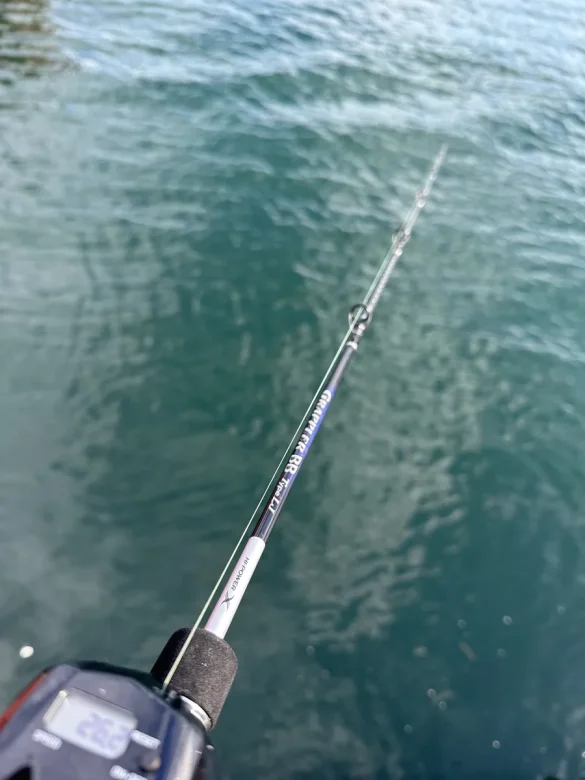
I fish light jigging from a small boat in Japan, and the rig I leave the dock with almost never changes. PE 1.2 or 1.5, two hiro of 30 lb fluorocarbon, one twin assist at the front. What changes during the day is the hook, not the line, because swapping a spool at sea is a bad idea and swapping an assist takes fifteen seconds with a split ring plier.
The order I work through it: if fish are hitting and not sticking, the front assist goes down a size before anything else does. If the jig keeps coming up with the cord wrapped around the leader, the cord is too long for that jig’s balance and I go to a shorter one. If I’m getting knocks near the bottom that never turn into a hookup, that’s when the rear single goes on, and that’s the only situation I’ll run two assists on one jig. Rough bottom is the exception, since a rear hook down there is a jig you’re going to leave behind.
Leader length I treat as almost fixed. Two hiro, checked with a thumbnail after every decent fish, cut back and retied when it feels rough rather than when it looks bad. Fluorocarbon that has been sawed across a gill plate doesn’t look like anything at all.
One number to take away: PE 1.2 to 1.5 with a 25 to 30 lb fluorocarbon leader and a #1/0 twin assist covers the great majority of light jigging, and the Japanese numbering only matters until you’ve matched it once. After that it’s a size on a box.
The part worth being fussy about isn’t the braid at all. It’s the assist hook, because that’s the component with a published rating in single digits of kilograms sitting at the end of a system rated four times higher, and it’s the one you can change on the water in the time it takes the boat to reposition.