Best JDM Light Jigging Rods
ちゃんま
マイボ!

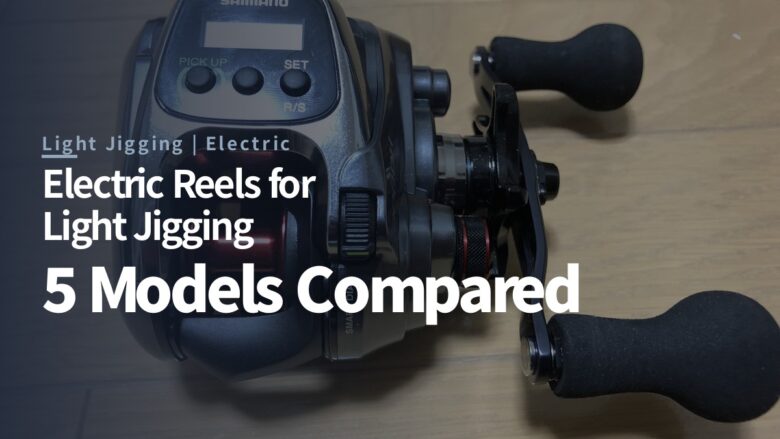
Light jigging is a rod technique. You lift, you drop, the jig does most of the talking, and the reel is there to pick up slack and hold on when something eats. Handing that retrieve to a motor sounds like it misses the point.
Japanese makers disagree, and they’ve put money behind the disagreement. Shimano ships a mode called EJ (電動ジギング, dendou jigging, electric jigging) with three sub-modes and adjustable jerk strength. Daiwa’s counterpart runs three preset jerk patterns off the reel’s menu. These are documented functions in the makers’ own product material, not accessories bolted on by the marketing department. Whether they belong on your boat is the question this article is actually about.
Pricing note: JDM products are shown at maker suggested prices in JPY excluding tax, with an approximate USD conversion at about ¥157 to the dollar in August 2026. All links point to Amazon Japan, which ships internationally; check availability and shipping cost at checkout. If you’re here about slow winding a kabura head rather than working a jig, our separate piece on electric reels for tairaba covers that method, which asks completely different things of a motor. For the technique itself, start with the light jigging guide.
For most light jigging, no. For a specific slice of it, yes, and that slice is wider than it looks from the US, where “electric reel” still mostly means swordfish.
Fishing 60 to 150 g jigs in 40 to 80 m, with tackle you chose because it’s light? A motor takes away more than it hands back. You’re adding 150 to 300 g to a rod you work several hundred times a day, and paying two to four times what a strong conventional counter reel costs. Our roundup of JDM light jigging reels covers that route, and for most people it’s the right one.
The calculation flips in three places. Past about 100 m, where every drop costs you a minute of winding you didn’t want to spend. On days built around repeated deep drops, when the arm that’s tired at 11 a.m. is the arm you need at 2 p.m. And when the auto-jerk programs are the reason you’re buying: a machine holds a one-pitch rhythm for an hour without drifting, which no forearm does.
If you buy one, buy one of these
Shimano ForceMaster 300 / 301, ¥95,200 (~$606). At 405 g it’s the only reel here that doesn’t fight the rod. Fall lever, Touch Drive, and Shimano lists it as electric-jigging capable. Check price on Amazon Japan
Shimano 26 Beastmaster 1000, ¥149,500 (~$952). Buy this one if EJ mode is the reason you’re buying at all, not if you just want a motor. Check price on Amazon Japan
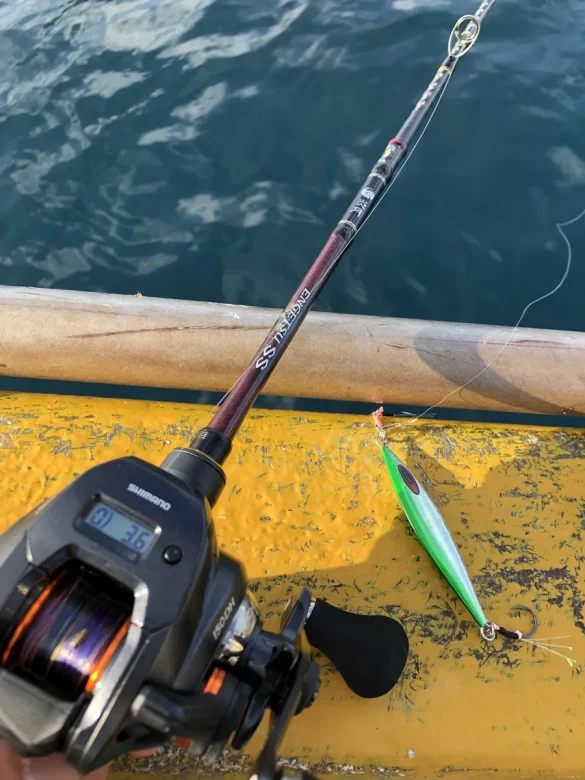
Weight decides this category, and 405 g is the number to beat. Everything else with a motor and a useful line capacity sits between 540 and 690 g, which is where a light jigging rod starts loading wrong and the tip stops telling you things. The 300 is the only reel in this article you could mount on a PE 1.5 outfit without rethinking the whole setup.
Capacity is the reason it beats its own smaller brother, the 200. PE 1.5 to 200 m or PE 2 to 150 m is a real light jigging spool, not a tairaba spool with ambitions. It runs a fall lever, so the drop is controlled by a dial rather than a thumb you’re also using for something else, and Shimano’s spec sheet marks it as electric-jigging capable. The 7.4:1 gear picks up 65 cm a turn, quick enough that hand-cranking between drops doesn’t feel like a punishment.
Where it runs out: 5 kg of drag and 3.0 kg of winding power. Hook a 10 kg amberjack over structure and the reel is a passenger. That isn’t a design flaw, it’s what a 405 g electric costs, and it’s the honest boundary of the “light” in light jigging.

| Feature | What it does |
|---|---|
| Touch Drive | Winding speed set from a pressure switch on top of the body, so the hand that would be cranking stays on the rod |
| フォールレバー (fall lever) | Dial control of spool rotation on the drop, instead of thumbing the spool |
| Speed Clutch | Clutch on and off from the lever alone, with a finger still on the spool |
| Motor and clutch interlock | Motor cuts when the clutch drops, so the jig falls with no motor noise or drag, then restarts on clutch-on |
| 一定速巻上げ (fixed speed mode) | Holds the set speed regardless of load, which is what makes a mechanical retrieve repeatable |
| MUTEKI MOTOR+ | Shimano’s uprated brush motor grade for the compact electric class |
| 探見丸 (Tankenmaru) screen | Mirrors the sonar repeater fitted at each seat on Japanese charter boats. Nothing to talk to elsewhere |
| CI4+ body | Carbon-reinforced resin: most of the reason this reel is 405 g and not 550 |
| Model | Weight | Gear ratio | Line per turn | Handle arm | Price (excl. tax) |
|---|---|---|---|---|---|
| ForceMaster 300 (right) | 405 g | 7.4:1 | 65 cm | 65 mm | ¥95,200 (~$606) |
| ForceMaster 301 (left) | 405 g | 7.4:1 | 65 cm | 65 mm | ¥95,200 (~$606) |
| ForceMaster 300DH | 400 g | 7.4:1 | 65 cm | 60 mm | ¥95,200 (~$606) |
| ForceMaster 301DH | 400 g | 7.4:1 | 65 cm | 60 mm | ¥95,200 (~$606) |
All four take PE 0.8-400 m / 1-300 m / 1.5-200 m / 2-150 m, run a 5 kg drag and 9/2 bearings, and are rated by Shimano at 3.0 kg of winding power with a 215 m/min maximum. DH is the double handle version. Source: Shimano product data.
If you want an electric reel that still lets you fish light jigging the way you already fish it, this is the one, and there isn’t a close second on weight. Buy it for depth relief and fall control. Don’t buy it expecting to muscle a big fish out of a wreck.
Everything else here has a motor that helps you fish. This one has a motor that fishes. Shimano’s NEW EJ mode runs three ways, and the maker documents all three in English on its own product pages.
The detail that earns its keep is smaller than any of that. All three modes show a one-pitch distance readout: how far the line moved per jerk. A pattern that produced a bite becomes a number you can write down, repeat after lunch, and hand to the guy next to you. Hand jigging gives you a feeling. This gives you a setting.
Touch Drive Speed Lock adds a two-stage intermediate speed, jig speed and fight speed, so one hard press starts the jig moving off the bottom and a second press steps up when a fish is on. The new fall lever carries a one-way roller bearing inside, which means you can hold tension on the falling spool without that tension fighting the wind-up. Nine and a half kilos of winding power and a 15 kg drag put it in different water from the ForceMaster 300 entirely.

| Feature | What it does |
|---|---|
| NEW EJ MODE | Manual jerk, auto jerk and advance modes, with H/M/L jerk strength and a one-pitch distance display |
| GIGA MAX MOTOR | Brushless motor, Beastmaster only. High torque and speed, and it holds up under heat |
| Touch Drive Speed Lock | 31 speed steps plus two preset intermediate speeds (jig speed, fight speed) reached by pressing harder |
| NEW FALL LEVER | One-way roller bearing inside, so braking the fall doesn’t add resistance to the following wind |
| Thermo Adjust Drag | Cuts motor speed automatically when the drag starts slipping, to stop heat building in the washers |
| NEW SPEED CLUTCH | Clutch lever sits lower when disengaged, leaving room to thumb the spool |
| Colour LCD Tankenmaru screen | Displays the Japanese charter-boat sonar repeater feed. Dead weight outside Japan |
| Language switching | Japanese, English, Korean, Chinese |
| Spec | 26 Beastmaster 1000 |
|---|---|
| Model | 26 Beastmaster 1000 |
| Weight | 685 g |
| Gear ratio / line per turn | 5.3:1 / 70 cm |
| PE capacity | 3-400 m / 4-300 m / 5-230 m |
| Max drag | 15 kg |
| Winding power (Shimano standard) | 9.5 kg |
| Speed at 1 / 3 / 5 kg load | 178 / 164 / 150 m per min |
| Bearings | 11/2 |
| Price (excl. tax) | ¥149,500 (~$952) |
Two things to weigh against all of that. It’s 685 g and ¥149,500, which is a heavy reel and a serious amount of money for a style of fishing whose whole appeal is being light and cheap to run. And the PE 3 minimum spooling means you’re fishing heavier line than most light jigging calls for. This is the reel for people who have decided electric jigging is a technique they want to learn, rather than a convenience they want to buy.
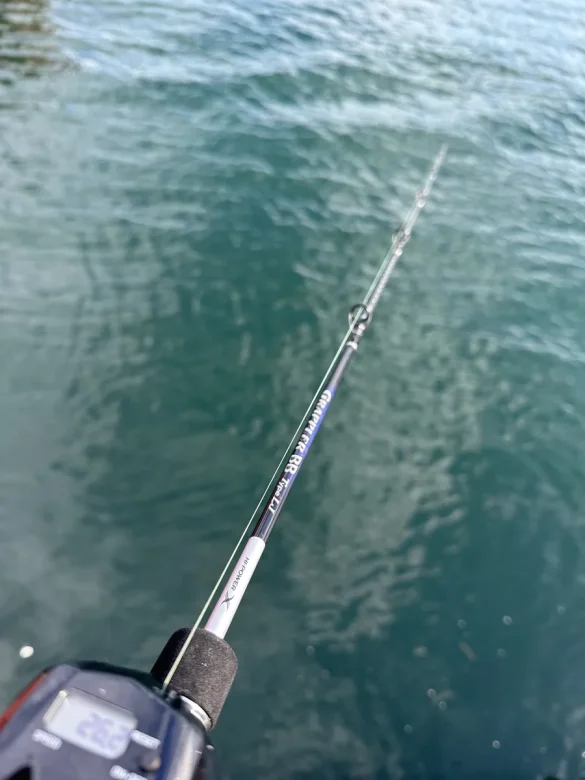
Start with three numbers, because they tell the story faster than prose does: 570 g, 87 cm of line per handle turn, 18 bearings. That retrieve figure is the longest in this article by 17 cm, and Daiwa is explicit about why, saying the hand-crank response is meant to match a dedicated jigging reel. HYPERDRIVE DIGIGEAR backs it up on the cranking side. You can fish this reel manually all day and only reach for the motor when you want it, which is not true of the Beastmaster.
Daiwa’s jigging mode is narrower than Shimano’s EJ and easier to live with: three auto-jerk patterns, chosen from the counter menu. One-pitch jerk repeats an orthodox single lift. One-pitch pause adds a stay between lifts. Combi jerk alternates a straight retrieve with a jerk. There’s no acceleration curve to program and no jerk-strength selector, and for most people that’s plenty.
One practical edge nobody mentions: the counter switches between nine languages, against Shimano’s Japanese and English. If you’re buying JDM from overseas and the menu is where these reels usually defeat people, that matters more than a spec sheet suggests.
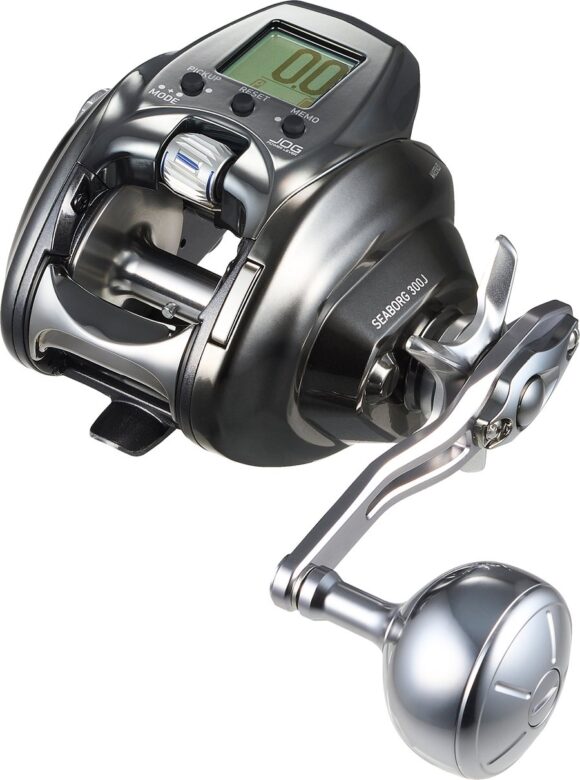
| Spec | 26 Seaborg 300J / 300JL |
|---|---|
| Model | 26 Seaborg 300J (right) / 300JL (left) |
| Weight | 570 g |
| Gear ratio / line per turn | 6.3:1 / 87 cm |
| PE capacity | 3-400 m / 4-300 m / 5-230 m |
| Max drag (ATD) | 16 kg |
| Winding power (JAFS standard) | 14 kg |
| Speed, 1 kg load | 157 m per min (174 on Super Lithium) |
| Bearings | 18/1 |
| Price (excl. tax) | ¥112,000 (~$713) |
| Feature | What it does |
|---|---|
| ジギングモード (jigging mode) | Three preset auto-jerk patterns: one-pitch jerk, one-pitch pause, combi jerk |
| JOG POWER LEVER | Thumb dial in the middle of the body handling wind-up and clutch, freeing the other hand entirely for the rod |
| MAGMAX-G MOTOR | Slide-brush motor with neodymium magnets, rated by Daiwa at four times the durability of the previous MAGMAX, warranted three years or 300 km |
| HYPERDRIVE DIGIGEAR | Drive and pinion gear set that keeps hand-cranking smooth under load |
| Fall brake dial | Thumb dial covering spool-free to full brake across 180 degrees, for reading bites on the drop |
| Motor / clutch interlock | Clutch off pauses the motor mid-wind, clutch on restarts it. Works below 9 m of depth only |
| MAGSEALED ball bearing | Magnetic fluid seal on the spool shaft bearing, the one that usually dies first from salt |
| Nine-language counter | Menu display switches between nine languages, metres or feet |
Best all-rounder of the group if you can carry 570 g. It jigs by hand better than the Shimanos, it has enough drag to argue with a serious fish, and the three-year motor warranty is worth real money on a reel crossing an ocean. It’s still 165 g heavier than the ForceMaster 300 and ¥17,000 dearer, so the light-tackle purist will keep walking.
At ¥83,100 this is the entry point, and Daiwa gets there by removing the clever parts, not the sturdy ones. Aluminium body, JOG power lever, ATD drag, electric slow wind for dead-slow retrieves under load. No jigging mode, no Magsealed bearing, no HYPERDRIVE gearing, and a one-year motor warranty against the Seaborg’s three.
Read the two winding-power figures carefully, because they disagree on purpose. The Leobritz posts a higher maximum than the Seaborg 300J, 59 kg against 56, which is a stall figure. On the JAFS standard, the one meant for comparing reels, it’s 11 kg against 14. The bigger number is the one that means less.

| Feature | What it does |
|---|---|
| JOG POWER LEVER | Same thumb-dial control system as the Seaborg |
| 電動スロー巻き (electric slow wind) | Holds motor torque at the lowest lever settings, so dead slow stays dead slow with weight on |
| ATD drag | Daiwa’s auto-tuned drag, smooth on the initial run |
| One-push ON clutch | Clutch engaged and released by pressing the lever |
| Aluminium body | Rigid frame, and part of why it holds 540 g despite the cost cutting |
| Spec | 23 Leobritz 300J / 300JL |
|---|---|
| Model | 23 Leobritz 300J (right) / 300JL (left) |
| Weight | 540 g |
| Gear ratio / line per turn | 5.1:1 / 70 cm |
| PE capacity | 3-400 m / 4-300 m |
| Max drag | 13 kg |
| Winding power (JAFS standard) | 11 kg |
| Speed, 1 kg load | 145 m per min (161 on Super Lithium) |
| Price (excl. tax) | ¥83,100 (~$529) |
Some of what gets called light jigging in Japan is 150 to 200 g jigs in 120 m of water, chasing fish that don’t care what you’ve named the technique. The ForceMaster 1000 is built for that end of it, and at ¥95,400 it’s the cheapest way into 15 kg of drag and PE 3 to 400 m capacity.
It’s the Beastmaster’s older, plainer relative: electric jigging capable, but without EJ mode’s programmed jerks, without a fall lever, without the Tankenmaru screen. You’re buying 8.5 kg of winding power for ¥54,100 less than the Beastmaster, and giving up the reason most people wanted the Beastmaster.

| Feature | What it does |
|---|---|
| Touch Drive | Speed from the top-mounted switch, rod held in both hands |
| Enhanced gear system | Bearing-supported reduction gears, for heavy loads and long winds |
| 楽楽モード (rakuraku mode) | Winds at constant tension rather than constant speed, useful on thin line or a fish swimming up |
| 一定速巻上げ (fixed speed mode) | Constant speed regardless of load |
| MUTEKI MOTOR+ | Uprated brush motor |
| Japanese / English menu | Counter and settings switch to English |
| Spec | ForceMaster 1000 |
|---|---|
| Model | ForceMaster 1000 |
| Weight | 680 g |
| Gear ratio / line per turn | 5.3:1 / 70 cm |
| PE capacity | 2-600 m / 3-400 m / 4-300 m / 5-230 m |
| Max drag | 15 kg |
| Winding power (Shimano standard) | 8.5 kg |
| Price (excl. tax) | ¥95,400 (~$608) |
Five things, in the order they’ll actually affect your day.
One structural problem worth naming. Shimano’s US channels list the 9000-size ForceMaster, a deep-drop and kite reel. Every reel in this article is a Japanese-market product with no US-market equivalent in the size you need, so importing isn’t a preference here, it’s the only route. Our guide to buying JDM tackle from overseas covers the mechanics, and if the model numbers look arbitrary, JDM reel size numbering explains what 300 and 1000 are counting.
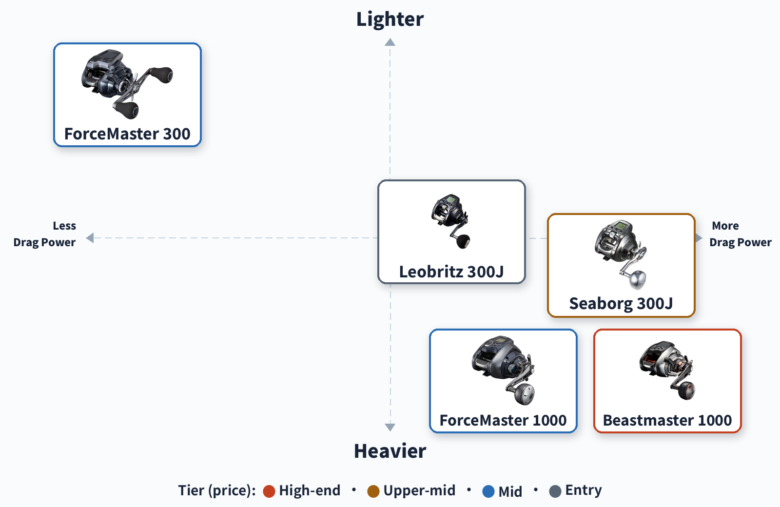
| Model | Weight | PE capacity | Max drag | Auto-jerk | Fall control | Price (excl. tax) |
|---|---|---|---|---|---|---|
| Shimano ForceMaster 300 | 400-405 g | 1.5-200 m | 5 kg | No (EJ capable) | Fall lever | ¥95,200 (~$606) |
| Shimano 26 Beastmaster 1000 | 685 g | 3-400 m | 15 kg | NEW EJ mode, 3 modes | New fall lever | ¥149,500 (~$952) |
| Daiwa 26 Seaborg 300J | 570 g | 3-400 m | 16 kg | Jigging mode, 3 patterns | Fall brake dial | ¥112,000 (~$713) |
| Daiwa 23 Leobritz 300J | 540 g | 3-400 m | 13 kg | No | Fall brake dial | ¥83,100 (~$529) |
| Shimano ForceMaster 1000 | 680 g | 3-400 m | 15 kg | No (EJ capable) | None | ¥95,400 (~$608) |
Specs from Shimano and Daiwa published product data (source tier: official). Prices are maker suggested, excluding tax.
You need 12 V at the rail, and on a Japanese charter boat that’s standard fitting because whole categories of fishing here assume it. On a US boat, plan on carrying your own. Shimano recommends a high-capacity battery, around 10 Ah, for full performance on its compact electrics. Daiwa’s own Super Lithium packs buy back speed and power, and the spec sheets list separate figures for them: the Seaborg 300J goes from 157 to 174 m/min at a 1 kg load.
Sometimes not, and this is worth ten minutes before you spend $600. Some US fisheries restrict or ban electric and powered reels for particular species or in particular waters, and rules differ by state and between state and federal waters. Check your local regulations, and check them for the species you’re targeting rather than the gear category.
Mechanically, yes. Practically, it depends on the number. The ForceMaster 300 at 405 g sits close enough to a heavy conventional reel that most PE 1.5 rods cope. Anything from 570 g up wants a rod with a stiffer butt and a reel seat that isn’t asking your fingers to do the holding, and a lot of dedicated JDM electric rods exist precisely because of that.
Nobody on a Japanese boat treats it that way, and nobody treats it as the default either. Hand jigging is still what most people do, because it’s the fun part. Auto-jerk earns its place in deep water on long days, and as a way of pinning down a rhythm you can then copy by hand. Plenty of anglers use the reel to find the pattern and their arms to fish it.
You ship it to Japan. None of these are covered by a US warranty network, and the motor warranties differ enough to matter: Daiwa states three years or 300 km on the MAGMAX-G motor in the Seaborg 300J, and one year on the Leobritz. Salt water and a sealed motor housing are not natural friends, so rinse behaviour matters more on these than on a conventional reel.
So: worth it, if your light jigging has drifted deep, or if the programmed jerk is a tool you actually want. Not worth it if you fish 60 g jigs in 50 m and love how light the outfit feels, because that feeling is the first thing a motor takes. Buy the ForceMaster 300 if you want the fishing unchanged, the Seaborg 300J if you want one reel that does both jobs well, and the Beastmaster 1000 only if electric jigging is the point rather than the excuse.