Shimano vs Daiwa Light Jigging Reels
ちゃんま
マイボ!

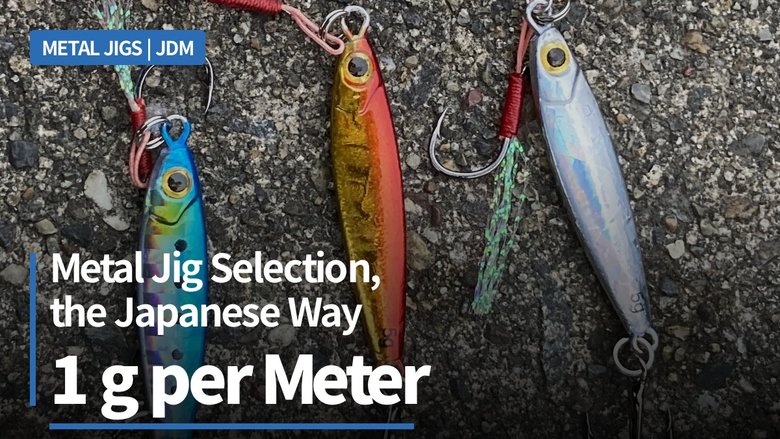
A metal jig wall in a US shop is organized by brand. A metal jig wall in a Japanese shop is organized by weight, in neat 20 gram steps, and the shape and color decisions come after you’ve committed to a number. That ordering isn’t an accident. It’s the selection system, and once you have it, a wall of two hundred jigs collapses into about four questions.
This article answers those questions the way they get answered on a Japanese boat: how many grams, which shape first, whether color is real, and why your jig showed up in the mail with no hooks on it. The weight question has an actual formula, and it converts to ounces, which is the part that never survives translation on English-language tackle sites.
If you’re new to Japanese-style boat jigging, our complete guide to light jigging from a boat covers the rod, reel and technique side. Every product number below comes from the maker’s official spec page. Prices for JDM products are shown in JPY excluding tax, with approximate USD at about ¥157 to the dollar in August 2026.
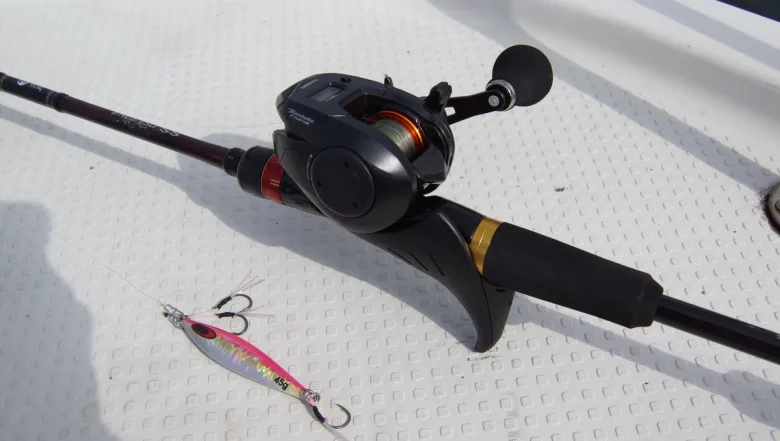
The Japanese baseline is one gram per meter of water. Fishing 60 m, start around 60 g. It’s a floor, not a target: when the tide runs or the boat drifts fast, you go up, to somewhere around 1.5 times the depth, because the jig you can feel ticking bottom is the right jig, and the one you can’t is scenery. Nobody in Japan sizes a jig to the fish. They size it to the water, and let the hook handle the fish.
| Depth | Calm day starting point | Running tide / fast drift | In ounces |
|---|---|---|---|
| 30 m / 100 ft | 40 to 60 g | 60 to 80 g | 1.4 to 2.8 oz |
| 50 m / 165 ft | 60 to 80 g | 80 to 120 g | 2.1 to 4.2 oz |
| 70 m / 230 ft | 80 to 100 g | 120 to 150 g | 2.8 to 5.3 oz |
| 100 m / 330 ft | 100 to 120 g | 150 to 180 g | 3.5 to 6.3 oz |
For most US fall inshore work, 60 to 150 feet of water, that lands you at 60 to 100 g, which is 2.1 to 3.5 oz. Buy the same jig in two weights before you buy two jigs in one weight. The second weight gets fished. The fifth shape mostly doesn’t.
Short, center-mass jigs are the default in Japan for a boring reason: they do everything at a passing grade. Major Craft’s Jigpara Vertical Short is the one you’ll see most on party boats, and it costs so little that losing one to the rocks doesn’t change anyone’s mood. Major Craft describes it as a universal silhouette and action that grips the water without sliding out too wide, and rates it for everything from fast cranking to one-pitch jerking. The company beefed the paint up to a 6-layer multi-layered coating precisely because the price invites people to fish it in nasty rocky bottom.

| Lineup | Weights | In ounces | Price |
|---|---|---|---|
| Jigpara Vertical Short | 80, 100, 120, 150, 180 g | 2.8 to 6.3 oz | Open price (street price is low) |
| Over 200 series | 200, 250, 300 g | 7.1 to 10.6 oz | Open price |
| Feature | What Major Craft says it does |
|---|---|
| Universal silhouette & action | Grips the water without excessive slide, appeals strongly, and handles everything from fast retrieve (jaka-maki) to one-pitch jerk |
| 6-layer multi-layered coating | One layer more than the casting model. Built so paint damage and lure loss stop being a reason to avoid rough, snaggy ground |
| Live Bait colors (keimura) | A UV-reactive baitfish pattern hidden in the body that appears underwater where sunlight thins out; damage-scale versions add reflective torn-scale holo |
| Tachiuo color group | Five purple-based patterns for cutlassfish jigging, with the multi-layer coating resisting tooth damage |
If you take one product from this article, take this one in 100 g. Its weakness is the flip side of the price: the finish is tough for the money, but this is still a lead jig with no exotic tricks, and on days when fish want a tiny profile or a dead-slow fall it will get out-fished by the two jigs at the bottom of this page.
The second shape Japanese anglers add is usually longer and flatter. A semi-long body planes sideways when you jerk it, and that horizontal dart, the slide, is what triggers yellowtail-family fish that follow a compact jig without committing. Slide width comes from body design, not from how hard you work the rod, which is why makers engineer for it specifically.
Sea Falcon, a lure-maker brand from Hamamatsu run by Bluing Hearts, is blunt about the mechanism on its Long Slider: a double-drain structure on the body surface and rear sides that the company says produces an amazing slide width while cutting pulling resistance. Less resistance matters more than it sounds. On the fifth hour of a jigging day, the jig you can still jerk properly is the one that catches.

| Feature | Sea Falcon’s explanation |
|---|---|
| Double-drain structure | Drain channels on the body surface and rear sides produce a wide slide and reduce pulling resistance through the water |
| Color range | Six patterns: blue back, pink back, red gold, blue pink, and two keimura (UV) silvers, wave and plane |
| Weight | In ounces | Where it fits |
|---|---|---|
| 85 g | 3.0 oz | Shallow marks, light tackle |
| 115 g | 4.1 oz | The all-round light jigging size |
| 145 g | 5.1 oz | Deeper water, harder tide |
| 175 g / 210 g | 6.2 / 7.4 oz | Beyond light tackle |
A semi-long is a second jig, not a first one. It earns its spot on the days fish chase and turn away, and that’s a pattern you only recognize after the short jig has told you it’s happening.
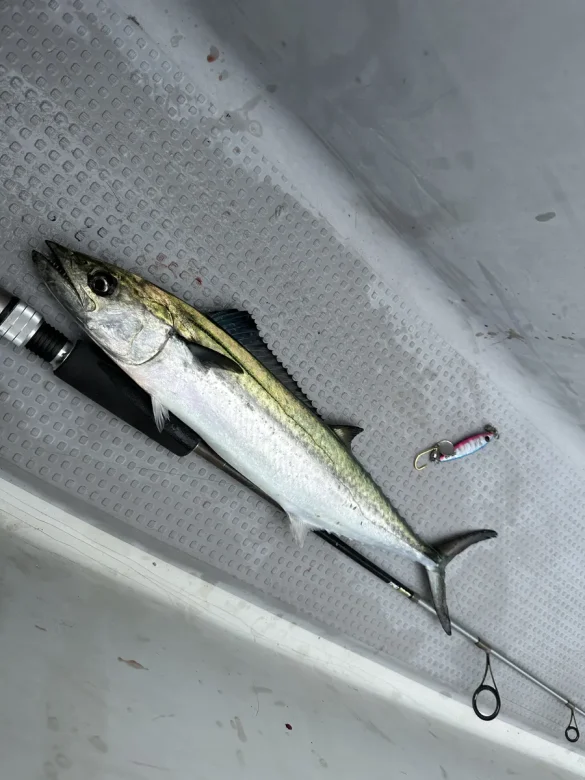
Fall. That’s the whole answer. A slow-type jig is wide and flat so it fights its own descent, hanging and rocking on the drop instead of knifing down, and most of the bites come while the line is slack and the jig is doing nothing you can feel.

Xesta calls its Slow Emotion Flap QR the basic form of the slow jigging jig, rated for slow work, jerking and even fast retrieve. QR stands for quick and response: the current version keeps the original Flap’s body but carves the nose sharper so the jig answers rod input faster with less pulling resistance, and sharpens the edges to crispen the action, extend hang time, and put a clear pause, a pose, between movements. Xesta’s testing credits it with rockfish, bottom fish and pelagics, which matches how mixed-bag these drops tend to be.
| Weight | In ounces | RRP excl. tax | USD approx. |
|---|---|---|---|
| 120 g | 4.2 oz | ¥1,800 | $11 |
| 150 g | 5.3 oz | ¥2,000 | $13 |
| 180 g | 6.3 oz | ¥2,200 | $14 |
| 220 g | 7.8 oz | ¥2,500 | $16 |
| 260 g / 300 g | 9.2 / 10.6 oz | ¥2,800 / ¥3,100 | $18 / $20 |
| Feature | What Xesta says it does |
|---|---|
| QR (Quick & Response) nose | The nose is carved sharper than the original Flap, raising the jig’s responsiveness to rod action and reducing pulling resistance |
| Sharpened edges | Crisper action, longer hang time on the fall, and a defined posing action between movements |
| All-tempo rating | Xesta positions it for slow pitch, jerking and fast retrieve on one body, its baseline slow jigging shape |
One honest limit: the range starts at 120 g, so there’s no true light option for shallow water. If your marks sit in 60 feet, this jig doesn’t belong there.
A Daiwa TG Bait costs about four times what a Jigpara costs at the same weight, and there are days it’s the only jig on the boat getting bit. The reason is density, not magic. Daiwa states tungsten runs about 1.7 times the specific gravity of lead, so the same grams pack into a much smaller body. When gamefish are gorging on tiny anchovies, sand eels or shrimp-sized bait, a standard 100 g lead jig is a sandwich pitched to someone eating peanuts.

| Feature | What Daiwa says it does |
|---|---|
| Tungsten body | About 1.7 times the specific gravity of lead: real weight in a small silhouette, and stress-free long casts when fish boil out of range of small lead jigs |
| Asymmetric design | A realistic sardine shape with different left and right faces, so the dense body still swims on the retrieve |
| Near-horizontal slide fall | On the drop it slides in a posture close to horizontal, playing a weakened baitfish |
| No hooks included | Daiwa’s spec table lists standard hooks as none, on every size (see the next question) |
| Weight | Length | In ounces | RRP excl. tax | USD approx. |
|---|---|---|---|---|
| 30 g | 55 mm / 2.2 in | 1.1 oz | ¥1,800 | $11 |
| 45 g | 64 mm / 2.5 in | 1.6 oz | ¥2,200 | $14 |
| 60 g | 68 mm / 2.7 in | 2.1 oz | ¥2,700 | $17 |
| 80 g | 80 mm / 3.1 in | 2.8 oz | ¥3,600 | $23 |
| 100 g | 87 mm / 3.4 in | 3.5 oz | ¥4,300 | $27 |
| 120 g | 92 mm / 3.6 in | 4.2 oz | ¥5,100 | $32 |
| 150 g | 99 mm / 3.9 in | 5.3 oz | ¥5,900 | $38 |
Read the length column against the depth table at the top. A TG Bait 100 g is 87 mm, about the length of a lead jig half its weight, so you keep bottom contact at depth while showing the fish a bait-sized profile. That combination is the entire value proposition, and on anchovy-ball days it’s worth every yen. The rest of the season, the cheap short jig does the job and losing a ¥4,300 jig to a snag stings for an hour.
Less than the racks suggest, more than zero. The honest Japanese answer is that weight and contact beat color every single time, but that color decides confidence, and confident anglers fish better. What’s genuinely useful is that Japanese color logic compresses to four slots, and every maker in this article stocks all four, which tells you the demand is real.
| Slot | Japanese shorthand | When it comes out of the box |
|---|---|---|
| Silver | Gin (ギン) | Clear water, high sun, fish keyed on sardines or other flashy bait. The natural default |
| Red gold | Akakin (アカキン) | Dawn, dusk, stained or green water. The classic low-light appeal color across all JDM jigging |
| Pink | Pinku (ピンク) | The confidence color: visible to the angler, proven on everything, first out when nothing is obvious |
| Zebra glow | Zebura guro (ゼブラグロー) | Deep water, overcast, dawn drops and squid-eating fish. Glow stripes rather than full glow, so it adds contrast without nuking the profile |
Buy silver, akakin and zebra glow in your main weight and you’ve covered the logic. The trap is buying six colors in one weight: five of them are the same jig to the fish, and none of them fix a jig that’s too light for the tide.
Nothing is missing and nothing is broken. Daiwa’s spec table lists standard hooks as none for every TG Bait size, and bare or minimally-hooked jigs are normal across JDM brands, because Japanese anglers treat the hook as a separate tackle decision: front assist size matched to the jig, rear hook added or removed by conditions. US-market jigs arrive wearing trebles; JDM jigs arrive expecting you to have opinions. Our light jigging line and assist hook setup guide walks through exactly which assist hooks to buy and when a rear hook earns its keep, with the same official-spec approach as this article.
| Jig | Shape / role | Weights | JDM price excl. tax | Best for |
|---|---|---|---|---|
| Major Craft Jigpara Vertical Short | Short all-rounder | 80 to 180 g (plus 200 to 300 g) | Open price | First jig, rough bottom, every technique |
| Sea Falcon Long Slider | Semi-long slider | 85 to 210 g | Open price | Followers that won’t commit; wide slide on the jerk |
| Xesta Slow Emotion Flap QR | Slow-type, all tempo | 120 to 300 g | ¥1,800 to ¥3,100 | Fall bites, mixed bags of bottom fish and pelagics |
| Daiwa TG Bait | Tungsten compact | 30 to 250 g | ¥1,800 to ¥8,800 | Tiny-bait days, small profile at real depth |
One in 80 g, one in 100 g, one heavier for the tide, in silver, akakin and zebra glow. Street prices are low enough that the whole set costs less than one tungsten jig, and this box fishes 60 to 200 feet of US inshore water without excuses. Check Jigpara Vertical Short prices on Amazon Japan.
The 60 g at 68 mm (¥2,700, about $17) is the classic size for fish gorging on small anchovies; go 100 g when the same pattern happens in deeper water. Buy it the day you watch fish boil and refuse everything, because that day repeats. Check TG Bait prices on Amazon Japan.
When the fast stuff dies midday, a slow-type jig keeps the rod bent, and at ¥1,800 to ¥2,000 (about $11 to $13) Xesta’s pricing undercuts most of the slow jigging category. It needs 100-plus feet of water to make sense. Check Flap QR prices on Amazon Japan.
I fish light jigging from a small boat in Japan, and the selection habit that gets drilled into you here has a fixed order: weight first, color second, shape last. If the jig isn’t reaching bottom cleanly, nothing else gets discussed. Go up 20 or 30 g, re-establish contact, and only then start asking why the bites aren’t coming.
Color is the cheap experiment, so it comes next: silver to glow, glow to akakin, thirty seconds per change. Shape is the expensive experiment, a different retrieve rhythm and sometimes a different rod feel, so it waits until two colors have failed. The general Japanese thinking is that a shape change is really a presentation change, and you don’t change presentations while the weight is still wrong. It’s not glamorous. It fills the box with fewer, better jigs, and it means the day’s decisions are mostly made before the first drop.
One gram per meter, up to 1.5 times in current. A cheap short jig in two weights and three colors. Add a semi-long when fish follow without eating, a slow-type when bites come on the fall, and tungsten when the bait is tiny. That’s the entire Japanese system, and it fits in a box the size of a hardcover book.