Light Jigging Line and Assist Hook Setup: The JDM Numbers Explained
ちゃんま
マイボ!

Shimano or Daiwa? Ask that in any Japanese tackle shop and you’ll get a shrug and a “depends how you fish.” For light jigging it’s a real fork in the road, because the two brands don’t just build different reels. They start from different beliefs. Daiwa builds a line counter into every model, right down to its cheapest one. Shimano makes you climb the range to reach a counter, and spends its money instead on feel, gearing, and a fall lever you meter with your thumb.
Quick definition first. Light jigging (ライトジギング) is the Japanese style of working a 40 to 150 g metal jig on thin braid in roughly 30 to 100 meters of water, usually for aomono (青物, the jacks and amberjacks) plus whatever else is holding near the bottom. It leans on small low-profile baitcasters, not the big conventional reels you’d use for deep jigging. I fish this style off a small boat here in Japan, and I’ve run both brands enough to have a clear read on where each one earns its keep.
A note on pricing and links: these are JDM (Japan Domestic Market) reels, so most buy links point to Amazon Japan, which ships internationally. Prices are shown as Japanese RRP with an approximate USD conversion at the time of writing (about ¥160 = $1, mid-2026). Daiwa lists prices tax excluded; Shimano lists tax included, and each table notes which. If you just want the cheapest reels that clear the job, our best JDM light jigging reels under $300 roundup is the pure budget list. This one is about the brand split.
Don’t want to read the whole thing? Here’s where most people land. If the counter matters to you and money is tight, Daiwa wins on value. If you want the nicest reel to actually fish and don’t mind paying for it, Shimano’s counter model is the one to hold. Two picks cover the great majority of buyers.
The value + counter pick: Daiwa Light Game X IC 150
A real depth counter for around $105. Nothing from Shimano gets close on price with a counter fitted, because Shimano doesn’t sell one this cheap. The gear is on the slow, torquey side and the body is plain, but for a first light jigging reel that tells you exactly how deep your jig is, this is the smart money. ¥16,800 (~$105, tax excl.).
The premium-feel pick: Shimano Grappler CT 150XG
The reel I’d hand most people who want one they’ll enjoy for years. You get the digital counter, a fall lever, a fast 8.1:1 gear for quick lifts, and Shimano’s dialed-in Grappler feel. It even shows up on Amazon US, so you can often skip the import. It costs more than the Daiwa, and it’s worth it if feel is what you’re buying. ¥34,800 (~$218, tax incl.).
Daiwa’s whole pitch is the counter. Its Light Game IC (ライトゲーム IC) family carries the Intelligent Counter (IC) from the cheapest model up, so even the entry reel reads out your exact depth and retrieve speed and beeps as the jig passes a set mark. For a technique where getting back to the right depth is half the battle, that’s a huge head start at a low price. The family splits into two you’d actually cross-shop: the budget Light Game X IC, and the smoother standard Light Game IC.

The standout is the counter, but the standard IC also brings Daiwa’s HyperDrive Design gearing, which is the reason it winds smoothly and keeps doing so.
| Technology | What it does |
|---|---|
| IC counter | Intelligent Counter showing depth, retrieve speed, a timer, and a depth alarm, fitted from the entry model up |
| HyperDrive Design | Durable gear and shaft system that holds its smoothness over time (standard Light Game IC) |
| HD DigiGear | Precision-machined gear for power and a quiet wind |
| ATD drag | Automatic Tournament Drag, smooth enough to protect thin PE leaders under a sudden run |
| Body | Aluminium frame, low-profile shape; no fall lever on either model |
Both are low-gear reels around 6.3:1. That’s the one trade to note: they wind with more torque than speed, so they shine on tairaba and steady jigging more than fast, high-pitch work.
| Model | Tier | Gear ratio | Weight | Max drag | Retrieve/crank | Counter | Price (excl. tax) |
|---|---|---|---|---|---|---|---|
| Light Game X IC 150 | Budget | 6.3 | 230 g | 5 kg | 69 cm | Yes (IC) | ¥16,800 (~$105) |
| Light Game IC 150 | Value | 6.3 | 215 g | 5 kg | 70 cm | Yes (IC) | ¥35,000 (~$219) |
Get the Light Game X IC if a counter on a tight budget is the goal. A depth readout for about $105 is remarkable value, full stop. Step up to the standard Light Game IC if you want that same counter in a lighter 215 g body with smoother, longer-lasting HyperDrive gearing, and you don’t mind mid-range money. Both suit anglers who value the readout and a relaxed, torquey wind over raw retrieve speed.
Shimano goes the other way. Its Grappler (グラップラー) is a ladder built for light jigging and tairaba, and the counter only shows up once you climb to the CT. What you’re paying for lower down is the reel itself: a rigid body, a fast gear, and a wind that just feels good in the hand. The build quality stays honest all the way down the range, which is the Shimano argument in a nutshell.

The CT and Premium add the fall lever, Shimano’s best trick here, which lets you brake the drop with your thumb so a hesitant fish still eats on the way down.
| Technology | What it does |
|---|---|
| Counter + Fall Lever | Digital depth counter with speed display, plus a thumb lever to meter the jig’s drop (CT and Premium) |
| MicroModule Gear | Fine-pitch gearing for a smooth, quiet retrieve (Premium) |
| X-Ship | Supported pinion gear for efficient, stable winding under load |
| Drag | Carbon cross-washer with Exciting Drag Sound, up to 7 kg on the Premium |
| Body | Rigid aluminium frame with a PE-only spool |
Note the gear ratios. Both counter Grapplers run a fast 8:1-ish gear, so they pick up line quicker than the Daiwas on the lift. The entry BB skips the counter to hit its price.
| Model | Tier | Gear ratio | Weight | Max drag | Retrieve/crank | Counter | Price (incl. tax) |
|---|---|---|---|---|---|---|---|
| Grappler BB 150HG | Budget | 7.2 | 210 g | 5 kg | 72 cm | No | ¥17,500 (~$109) |
| Grappler CT 150XG | Value | 8.1 | 240 g | 5 kg | 81 cm | Yes + fall lever | ¥34,800 (~$218) |
| Grappler Premium 150XG | High-end | 8.1 | 240 g | 5 kg | 81 cm | Yes + fall lever | ¥46,500 (~$291) |
Pick the BB if you want a proven Shimano body for the lowest spend and you’re happy tracking depth by line marks. Pick the CT if you want the counter and fall lever without going premium, which is where most Shimano buyers should land. Pick the Premium if a glass-smooth MicroModule wind and a 7 kg drag matter to you, and you fish often enough to feel the difference. Every one of them stays under $300.
Most of these reels you’ll be importing, and Amazon Japan ships internationally, so it’s rarely a hassle. Two shortcuts are worth knowing. The Shimano Grappler CT turns up on Amazon US fairly often, so you can sometimes skip the import entirely. And if you like the Daiwa counter idea but want it from a US warehouse, Daiwa sells the closely related Light Game RX IC 150 on Amazon US. It’s the same IC counter concept with slightly different gearing and a touch more line capacity (Japanese RRP around ¥24,600, ~$154), and it lands without the wait. That’s the whole brand split in one line: Daiwa hands you the readout, Shimano hands you the feel.
Here’s the part the spec sheets miss. On the water, the counter earns its money when the sounder shows fish stacked at a set depth. With a Daiwa IC reel I’ll drop, watch the number climb, stop dead on the mark, and start working the jig in the zone every single time. No guessing. It’s the fastest way I know to turn a good screen into bites, and it’s why I reach for a counter reel when the bite is depth-specific.
The Shimano case shows up on a slow day. When fish want the jig fluttering down rather than ripping up, that fall lever lets me feather the drop and hold the jig in front of them a beat longer. The wind feels tighter too, which sounds like a small thing until you’ve cranked a light jig for six hours. My honest take after seasons of both: I keep a Daiwa counter reel for depth-fussy days and a Grappler for everything else. Neither brand is wrong. They just solve different halves of the same problem.
Strip away the badge and five things decide whether a reel suits you. Get these right and the rest is preference.
For the rod side of the setup, our best JDM light jigging rods guide pairs with these reels, and the wider light jigging from a boat guide covers the whole technique. If you’re weighing the same brand question for the related bottom method, our Shimano vs Daiwa tairaba reels comparison runs the same playbook for tairaba.
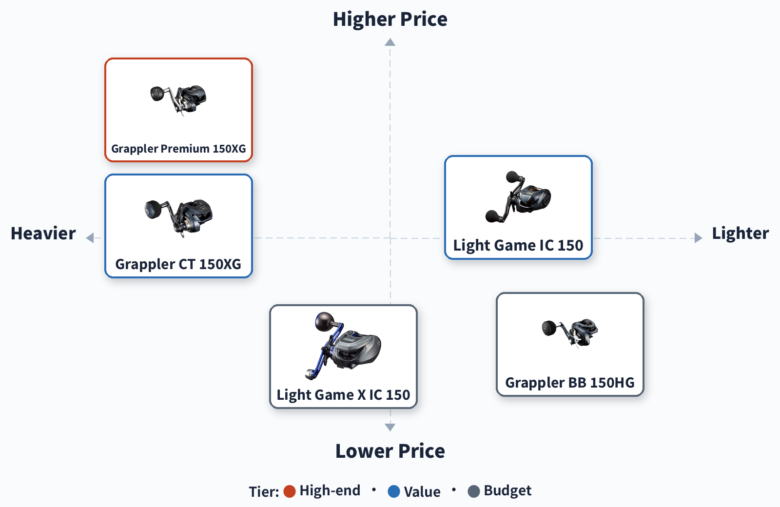
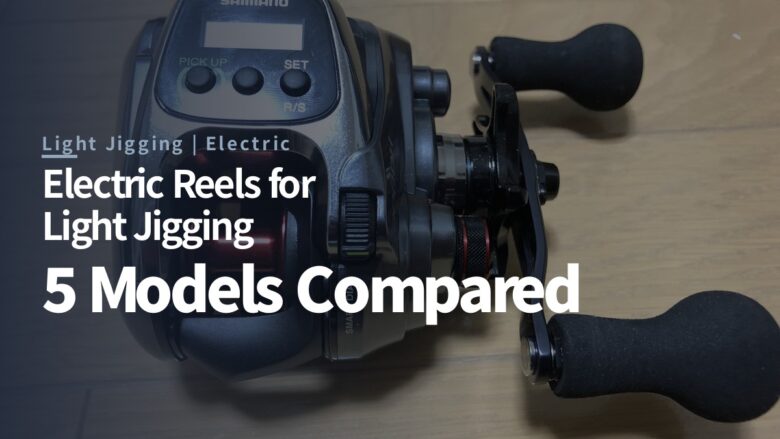
All five reels in one place, grouped by brand and sorted by price. Every one stays under $300.
| Reel | Brand | Tier | Gear ratio | Weight | Max drag | Counter | Price (~USD) |
|---|---|---|---|---|---|---|---|
| Light Game X IC 150 | Daiwa | Budget | 6.3 | 230 g | 5 kg | Yes | ~$105 |
| Grappler BB 150HG | Shimano | Budget | 7.2 | 210 g | 5 kg | No | ~$109 |
| Light Game IC 150 | Daiwa | Value | 6.3 | 215 g | 5 kg | Yes | ~$219 |
| Grappler CT 150XG | Shimano | Value | 8.1 | 240 g | 5 kg | Yes + fall lever | ~$218 |
| Grappler Premium 150XG | Shimano | High-end | 8.1 | 240 g | 5 kg | Yes + fall lever | ~$291 |
The pattern jumps out fast. At the budget end, the two reels do opposite things for nearly the same money: the Daiwa hands you a counter, the Shimano hands you a faster gear and skips it. In the value tier it’s lighter-and-counter (Light Game IC) against faster-with-a-fall-lever (Grappler CT). Daiwa never makes you pay extra for the readout. Shimano never stops charging for feel.
Do I really need a line counter for light jigging? No, but it helps a lot, especially early on. When fish sit at a set depth, a counter gets you back there on every drop instead of counting line marks and hoping. If your budget is tight, a Daiwa Light Game X IC gives you one for about $105, which is why I’d take it over a fancier counter-less reel most days.
Which brand is smoother? Shimano, at the top of the range. The Grappler Premium’s MicroModule Gear gives the nicest wind here. Daiwa’s HyperDrive gearing on the standard Light Game IC is close and very durable, but the plush, quiet feel goes to the Premium.
HG or XG, which gear should I pick? For fast, active jigging, go XG or HG for quick line pickup, like the Grappler CT’s 8.1:1. For heavier jigs, current, or tairaba-style steady winding, the Daiwa 6.3:1 gives more torque and less fatigue. Many anglers keep one of each.
Can I use these reels for tairaba too? Yes, and most people do. All five double as tairaba reels, and the low-gear Daiwas are especially at home there. Our budget light jigging reel roundup shows how much of this gear crosses over between the two methods.
Are these hard to buy outside Japan? Not really. Amazon Japan ships most of them internationally, the Grappler CT often appears on Amazon US, and Daiwa’s Light Game RX IC 150 is sold on Amazon US as a no-import option. Whichever you choose, rinse it with fresh water after every saltwater trip and it’ll last for years.
All specifications were taken from the Shimano (fish.shimano.com) and Daiwa (daiwa.com) official catalogues. Product images are from Amazon product pages. Affiliate links are provided for reels available via Amazon US and Amazon Japan (international shipping); we may earn a commission at no extra cost to you. Check your local regulations and bag limits before fishing.