Shimano vs Daiwa Light Jigging Reels
ちゃんま
マイボ!

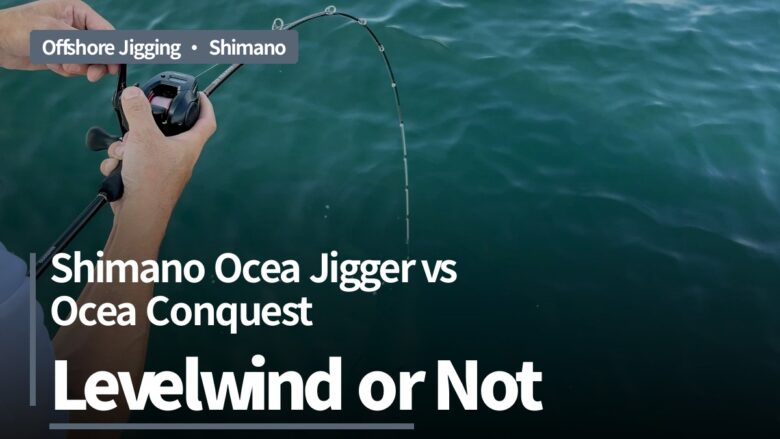
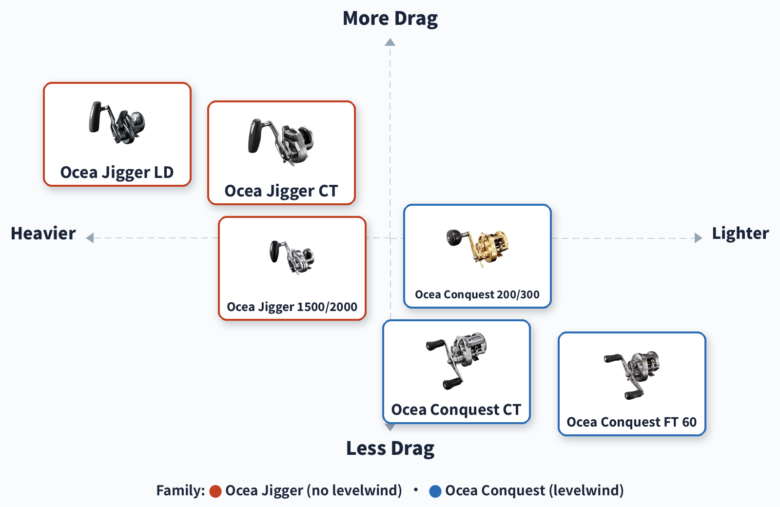
Two round Shimano baitcasters end up on the gunwale of the same boat all the time. Same aluminium, same gold-and-black look, prices within a few thousand yen of each other. One has a levelwind walking the line back and forth across the spool. The other doesn’t, and you thumb the line yourself. That single difference decides more about which one belongs in your hand than any spec sheet does.
The levelwind branch is the Ocea Conquest (オシアコンクエスト). The free-spool branch is the Ocea Jigger (オシアジガー). Both sit at the top of Shimano’s Japanese offshore range, both are sold as PE-only reels, and both have grown into families with counter versions, lever-drag versions and finesse versions bolted on. Eight product lines between them as of this writing.
I fish tai rubber and light jigging off a small boat in the Seto Inland Sea and Osaka Bay, and I’ve had both shapes of reel in rotation. Below I’ve sorted the whole range by the kind of day you’re actually having, rather than by price. For a deeper look at one family on its own, there’s a full Ocea Conquest series guide and a dedicated piece on the new Ocea Jigger CT.
Pricing note: these are JDM (Japan Domestic Market) reels. Prices are Shimano’s Japanese list price, tax excluded, with an approximate USD figure at roughly ¥160 = $1 as of August 2026. Amazon Japan ships internationally, so check availability and shipping cost at checkout. A handful of models also turn up on Amazon.com through import sellers.
Four things separate these families. Get them straight and the rest of this article is just filling in numbers.
The levelwind. Every Conquest has one, and it tracks with the spool. It lays line evenly at the crawling speeds tai rubber runs at, and it means you never have to think about line stacking on one side. No Jigger has a levelwind at all. On a reel that gets jerked hard several thousand times a day, one less part for PE to rub against is the whole argument.
Drag class. This is where people guess wrong. Conquest bodies run 5 to 8 kg of max drag. The standard Jigger 1500 sits at 6 to 7.5 kg, the same neighbourhood, and only the 2000NR sizes push to 10 kg. The heavy numbers live in the specialist Jiggers: 12 to 13 kg on the CT, 18 kg on the 4000, 20 kg on the lever-drag LD. So “Jigger means more drag” is only true once you leave the 1500.
Spool diameter. A Conquest 200 runs a 38 mm spool, the 300 a 43 mm. Jiggers start at 49 mm and go to 60 mm and 73 mm. Bigger spool means more line recovered per handle turn at the same gear ratio, and it means your retrieve rate collapses less when you’re 150 m down and the spool is half empty. That’s a real difference in deep water, not a brochure difference.
Counter and money. Both families have a counter option. Adding one costs roughly ¥11,000 on the Conquest side and considerably more on the Jigger side. Whether that’s worth it depends entirely on how much of your fishing happens in a narrow depth band, which I’ll come back to.
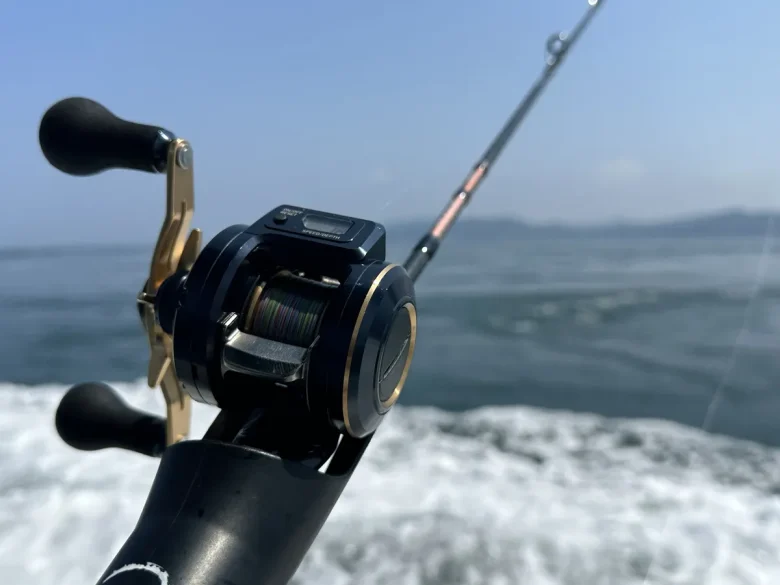
The neat split of “Jigger for jerking, Conquest for winding” is useful, but it isn’t a law. In LSJ (light shore jigging) I do something most people around me don’t: I take a lure everyone agrees is meant to be worked with rod action, and I just wind it straight instead. It catches fish more often than you’d expect. If you’re that kind of angler, the case for a levelwind reel is stronger than your target species suggests, because a lot of your rod time is spent cranking rather than pitching.
This is the reel the Conquest name was built around. Tai rubber (鯛ラバ / タイラバ) is a Japanese bottom method for madai, red sea bream, and it’s almost entirely a winding game: drop the head, close the clutch, crank at one honest speed until something eats. A reel that lays line perfectly at 30 cm per second and never asks anything of your thumb is exactly right for that.
The 200 is the light body, on a 38 mm spool, built around PE 1.0 to 2.0. The 300 steps up to 43 mm and PE 1.5 to 3.0, which is where deeper tai rubber, light jigging and inshore slow pitch start to overlap. Both carry InfinityDrive, which changes how the pinion gear is supported so the handle stays light when the drag is loaded, plus the redesigned fall lever for metering the drop.

| Feature | What it does |
|---|---|
| InfinityDrive | Supports the pinion gear on the spool shaft instead of a friction-heavy bearing, so winding stays light under drag pressure |
| Fall lever (フォールレバー) with one-way roller bearing | Thumb lever that meters the drop; the roller bearing means the wind doesn’t get heavy while lever tension is still applied |
| Spool-linked levelwind | Line guide that moves with the spool, laying braid evenly even at a crawling retrieve speed |
| MicroModule Gear | More, smaller teeth in mesh at once, for a quieter and smoother wind |
| HAGANE Body | Rigid metal frame that stops the body flexing when a fish loads it up |
| S-Compact Body | Palming plate made smaller than the handle side so the reel sits lower in your hand |
| X-Protect | Water-repellent coating plus a labyrinth channel to keep salt water out of the drive bearing |
| PE-only spool | Rated for braid only, so don’t fill it with mono or fluorocarbon |
| Model | Gear ratio | Max drag | Weight | PE capacity | Per crank | Handle | Price (excl. tax) |
|---|---|---|---|---|---|---|---|
| 200PG | 4.8 | 8 kg | 285 g | 1.0-400 m | 57 cm | 51 mm | ¥60,900 (~$381) |
| 200HG | 6.5 | 7 kg | 295 g | 1.0-400 m | 78 cm | 65 mm | ¥60,900 (~$381) |
| 300PG | 4.8 | 8 kg | 350 g | 1.5-500 m | 65 cm | 75 mm | ¥61,300 (~$383) |
| 300HG | 6.2 | 7.5 kg | 355 g | 1.5-500 m | 84 cm | 75 mm | ¥61,300 (~$383) |
| 300XG | 7.5 | 7 kg | 355 g | 1.5-500 m | 101 cm | 75 mm | ¥61,300 (~$383) |
Left-hand versions exist for every one of these, numbered 201 and 301. They’re usually listed as separate items on Amazon Japan, so check the handle side before you order.
Most tai rubber advice tells you to pick the slow gear and wind at a constant speed forever. That’s decent advice for a first season. Here’s what I’ve found on my own water, though: from summer into autumn, when iwashi (sardines) are the bait, breaking that constant speed is what gets bites. Not with the rod, because a tai rubber blank is far too soft for rod-driven action to reach the head. With the reel. You lift the crank speed a little, drop it back, lift it again. Nothing dramatic, just enough that the head stops behaving like a metronome.
That’s a tai rubber observation, and I’d expect the same logic to hold anywhere a slow straight retrieve is the default presentation. It changes the gear-ratio question too. If retrieve speed is itself the action, faster gearing gives you more room to vary it, and slower gearing gives you more torque to hold a head steady in current. Neither is an obvious default, and I’d rather people chose on how they actually fish than on a rule of thumb.
Same reel, same bodies, same fall lever, with a digital line counter sitting on top and a wider viewing angle than the outgoing version. Everything above still applies. What you’re buying is repeatability: when a fish eats 8 m off the bottom, you can put the head back in that window on the next drop instead of guessing.
The counter also carries a winding-distance alarm that beeps once you’ve cranked a set height off the bottom. More useful than it sounds on a drift where the depth keeps changing under you. The battery is owner-replaceable, and there’s an LED backlight for dawn starts.

Only the counter-related parts are listed here. The drivetrain is the one from the table above.
| Feature | What it does |
|---|---|
| Digital line counter | Reads depth in metres straight off the spool, with a wider viewing angle than the outgoing model |
| Winding-distance alarm | Beeps once you’ve wound a set height off the bottom, so a productive lift is repeatable |
| LED backlight | Readable display at first light and after dark |
| Replaceable battery | Coin cell you swap yourself rather than sending the reel in |
| New fall lever | Revised design that doesn’t make the wind heavy when you apply tension |
| Model | Gear ratio | Max drag | Weight | PE capacity | Per crank | Handle | Price (excl. tax) |
|---|---|---|---|---|---|---|---|
| CT 200PG | 4.8 | 8 kg | 300 g | 1.0-400 m | 57 cm | 51 mm | ¥72,000 (~$450) |
| CT 200MG | 5.5 | 7.5 kg | 300 g | 1.0-400 m | 66 cm | 55 mm | ¥72,000 (~$450) |
| CT 200HG | 6.5 | 7 kg | 315 g | 1.0-400 m | 78 cm | 65 mm | ¥72,000 (~$450) |
| CT 300MG | 5.5 | 8 kg | 385 g | 1.5-500 m | 74 cm | 70 mm | ¥73,000 (~$456) |
| CT 300HG | 6.2 | 7.5 kg | 395 g | 1.5-500 m | 84 cm | 75 mm | ¥73,000 (~$456) |
| CT 300XG | 7.5 | 7 kg | 395 g | 1.5-500 m | 101 cm | 75 mm | ¥73,000 (~$456) |
If you fish a sounder-marked band, yes, and it isn’t close. If you fish bottom-up in 40 m of water and count cranks, probably not. The counter versions carry 15 to 45 g of extra weight depending on size, and they add a battery to the list of things that can die on a Saturday. Worth knowing before you pay for the screen.
Now the other side. Take the levelwind off and you get a reel you can rip on all day without line ever tracking across a guide under load. The current Ocea Jigger is built around that, and its headline feature is choice of speed: seven gear ratios across two body sizes, from 5.1 up to 7.0.
The 1500 runs a 49 mm spool and holds PE 2 for 500 m, at 405 to 410 g. Drag tops out between 6 and 7.5 kg, which surprises people who assume a jigging reel must out-muscle a tai rubber reel. At this size it doesn’t. What it does give you is a much bigger spool at a much lower weight, which is why it holds its retrieve rate better as line goes out.
The 2000NR is the narrow-frame 60 mm spool: 580 to 595 g, PE 3 for 400 m, a flat 10 kg of drag across all four ratios. The fastest one pulls 132 cm per handle turn, roughly what a big saltwater spinning reel does. That’s the tool for sliding long jigs sideways, and for firing off a speed change when nothing has touched the lure in an hour.

| Feature | What it does |
|---|---|
| Seven gear ratios | Three speeds in the 1500 and four in the 2000NR, so jerk rhythm can be matched to current, jig shape and rod |
| InfinityDrive | Cuts rotational resistance by up to about 60% against Shimano’s earlier structure, measured in-house |
| Revised drag sound mechanism | The clicker spring was removed, so the drag sound adds no rubbing resistance while you’re winding |
| Cold-forged long crank handle | Around twice the rigidity of the previous handle, which is what makes the direct feel possible |
| Treated pinion gear | Surface treatment for salt resistance, aimed at clutch durability |
| Thumbing space | Deliberate gap ahead of the clutch bar so you can control the spool without moving your grip |
| Model | Gear ratio | Max drag | Weight | PE capacity | Per crank | Price (excl. tax) |
|---|---|---|---|---|---|---|
| 1500PG | 5.1 | 7.5 kg | 405 g | 2-500 m | 78 cm | ¥56,700 (~$354) |
| 1500HG | 6.4 | 7 kg | 405 g | 2-500 m | 97 cm | ¥56,700 (~$354) |
| 1500XG | 7.3 | 6 kg | 410 g | 2-500 m | 112 cm | ¥56,700 (~$354) |
| 2000NRPG | 5.1 | 10 kg | 595 g | 3-400 m | 96 cm | ¥62,000 (~$388) |
| 2000NRMG | 5.7 | 10 kg | 580 g | 3-400 m | 107 cm | ¥62,000 (~$388) |
| 2000NRHG | 6.2 | 10 kg | 595 g | 3-400 m | 117 cm | ¥62,000 (~$388) |
| 2000NRXG | 7.0 | 10 kg | 580 g | 3-400 m | 132 cm | ¥62,000 (~$388) |
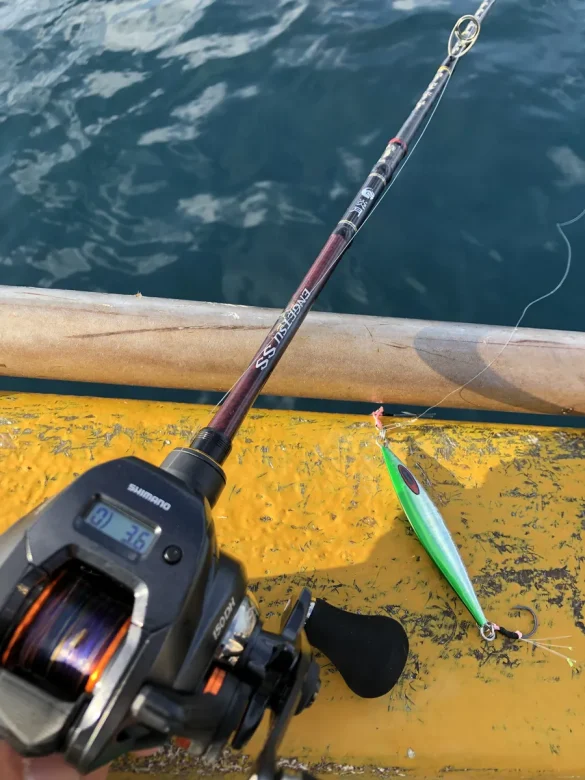
The LD swaps the star drag for a lever, and the numbers change character completely. Max drag is 20 kg. The spool is 60 mm across and 33 mm wide, swallowing PE 4 for 500 m or PE 3 for 670 m. It weighs 690 g, which you’ll feel by mid-afternoon, and that’s the trade for being able to run genuinely heavy pressure on a lever you can find without looking down.
Shimano ships a spare drag cam in the box that also suits lighter line, so the lever curve still makes sense when you drop a class or two below tuna gear. That matters if you bought it for deep slow pitch. It’s the natural pick past 150 m, when current is doubling your line up, or when you’re dropping on fish that will simply leave with a 7 kg drag setting. Our roundup of the best slow pitch jigging reels puts it against the alternatives from Daiwa and the smaller specialists.

| Feature | What it does |
|---|---|
| Lever drag | Sets pressure on a sliding lever rather than a star, so you can find a setting by feel mid-fight |
| Included drag cam for lighter line | Spare cam that reshapes the lever curve so light line still gets a usable range of settings |
| InfinityDrive | Shimano rates handle rotation about 30% lighter at high drag against the previous structure |
| 105 mm cold-forged handle | Long crank with a large T-knob, aimed at cranking heavy iron up from depth |
| Thumb-friendly frame | Frame profiled so the spool is easy to thumb during the drop |
| Model | Gear ratio | Max drag | Weight | PE capacity | Per crank | Price (excl. tax) |
|---|---|---|---|---|---|---|
| LD 2500MG | 5.7 | 20 kg | 690 g | 4-500 m | 107 cm | ¥72,000 (~$450) |
| LD 2500HG | 6.2 | 20 kg | 690 g | 4-500 m | 117 cm | ¥72,000 (~$450) |
If the lever isn’t what you want but the metered drop is, there’s a middle option, and it gets its own section below.
This one answers a narrow question. What if you want a metered drop, but not a lever drag and not a levelwind? The F Custom takes the standard Jigger bodies, leaves the line guide off, and puts a fall lever on the palming plate. Thumb pressure you don’t have to hold yourself through 150 m of water is the entire pitch, and by the last drift of a deep day it stops being a luxury.
The lever is shaped for jigging rather than lifted off the tai rubber side of the catalogue: there’s a dimple on the top face and another on the flank, so either thumb reaches it, the one palming the reel or the one on the handle. Two bodies, and a single gear ratio in each. If the standard Jigger appealed to you because of its seven speeds, that’s what you’re handing back.

| Feature | What it does |
|---|---|
| Jigging-shaped fall lever | Recessed on the top face and the side so either thumb can work it, and it holds spool tension for you through the whole drop |
| New lightweight T-knob | Mid-size knob fitted across the range, chosen for the loads mid-deep work puts through your fingers |
| Cold-forged long crank handle | Shimano rates it at roughly twice the rigidity of the handle it replaced |
| InfinityDrive | Pinion carried on the spool shaft instead of a resistance-heavy bearing, so the wind stays light with drag on |
| HAGANE Body with S-Compact Body | Cold-forged frame, palming side made smaller in diameter than the handle side |
| X-Protect | Repellent grease plus a labyrinth wall guarding the drive gear bearing |
| PE-only spool | Braid only across every size, same as the rest of the Jigger family |
| Model | Gear ratio | Max drag | Weight | PE capacity | Per crank | Handle | Price (excl. tax) |
|---|---|---|---|---|---|---|---|
| 1500HG | 6.4 | 7 kg | 430 g | 2-500 m | 98 cm | 73/85 mm | ¥62,900 (~$393) |
| 2000NRHG | 6.2 | 10 kg | 605 g | 3-400 m | 117 cm | 80/92 mm | ¥68,500 (~$428) |
Left-hand versions are catalogued as 1501HG and 2001NRHG at the same money.
Shimano aims the 1500 at madai, tachiuo (hairtail), rockfish and mid-deep jigging, and the 2000NR at amberjack and near-shore tuna. That reads about right to me. The reel earns its price once the drop itself is part of the presentation. If your day is short drops and hard jerking, the plain Jigger is cheaper and hands you the ratio choice instead.
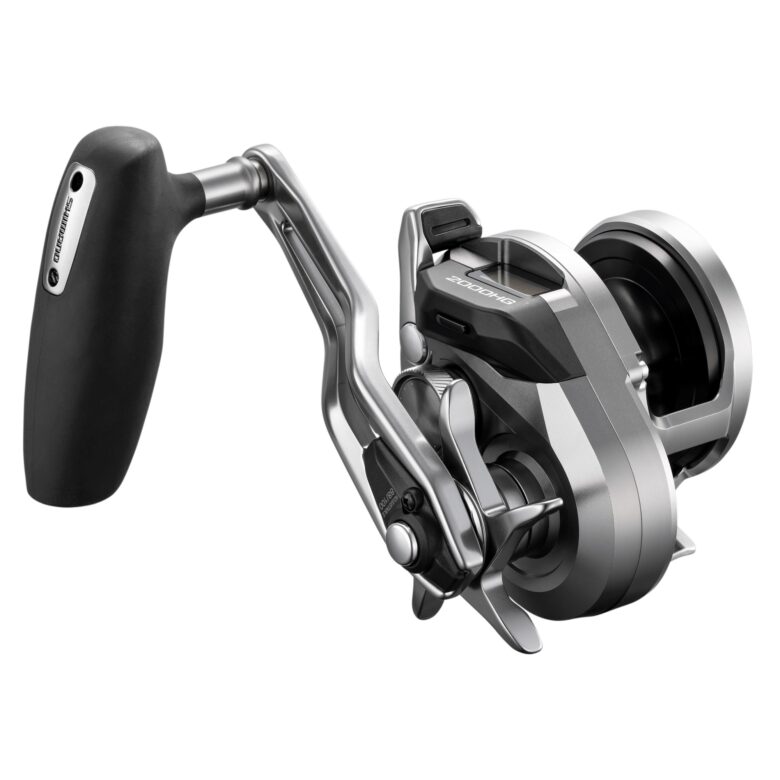
The newest thing in either family, and the first Ocea Jigger ever fitted with a counter. It’s due in Japan from November 2026, with left-hand versions following in December, and it’s priced well above everything else here at ¥96,000 to ¥98,000.
What it adds over the Conquest CT is a fall-speed readout rather than only a depth number, plus a HAGANE body, 12 to 13 kg of drag and a 60 mm spool. What it gives up is the levelwind and the fall lever, because neither belongs on a reel you jerk. Shimano lists Silent Drive and X-Protect on this one too, and says a Bluetooth link with the next-generation Tankenmaru sounder is in development. I’ve written it up properly in the Ocea Jigger CT explainer.
| Feature | What it does |
|---|---|
| Counter with fall-speed display | Shows depth and how fast the jig is sinking, the number the Conquest CT doesn’t give you |
| Winding-distance alarm | Beeps at a set height off the bottom so a good lift sequence can be repeated |
| Silent Drive | Removes play between rotating parts for a quieter, tighter feel |
| New star drag | 4 mm larger in diameter and thicker, for finer adjustment with wet hands |
| CR1632 battery | Small coin cell, rated by Shimano at roughly ten trips, user-replaceable |
| Model | Gear ratio | Max drag | Weight | PE capacity | Per crank | Price (excl. tax) |
|---|---|---|---|---|---|---|
| CT 2000HG | 6.2 | 12 kg | 590 g | 3-500 m | 117 cm | ¥96,000 (~$600) |
| CT 2500MG | 5.7 | 13 kg | 605 g | 4-500 m | 107 cm | ¥98,000 (~$613) |
| CT 2500HG | 6.2 | 12 kg | 605 g | 4-500 m | 117 cm | ¥98,000 (~$613) |
The big-capacity end of the line, and a reel with an unapologetically narrow brief. A 73 mm spool swallows PE 3 for 1,200 m, drag runs to 18 kg, and there are two gear ratios: 4.4 and 5.1. Both slow, deliberately. Past 300 m you aren’t out-cranking anything, you’re lifting weight, and the spool is already doing the work a fast ratio would normally do. Japanese anglers run it for amberjack and for the deep-water species that live below where most jigging tackle stops.
Bring a rod that can hold it. 785 to 790 g before you spool it is a lot of reel to have hanging off a foregrip, and the frame is wide enough that palming isn’t really the intention.

| Feature | What it does |
|---|---|
| Large-diameter brass drive gear | Oversized high-strength brass gear, specified for the loads deep drops put through the drivetrain |
| Spool lock | Locks the spool solid against reverse rotation, which is what you want the moment you’re snagged in 300 m |
| Roller clutch | Shimano puts anti-reverse strength at eleven times the old 03 Ocea Jigger 4000, with a seal added on the drive gear shaft |
| Auto-return clutch | Re-engages with the first turn of the handle, so there’s no pause between bottom contact and winding |
| Cold-forged clutch lever | Reshaped and stiffer than the one it replaced, for cold hands and wet gloves |
| Large drag star | Wide enough in diameter to adjust without letting go of the handle knob |
| Treated pinion gear | Surface treatment for salt resistance, aimed at clutch life |
| F Custom fall lever compatible | Takes the fall lever assembly from the F Custom 2000 if you want a metered drop |
| Model | Gear ratio | Max drag | Weight | PE capacity | Per crank | Handle | Price (excl. tax) |
|---|---|---|---|---|---|---|---|
| 4000 | 4.4 | 18 kg | 785 g | 3-1,200 m | 101 cm | 110/98 mm | ¥72,000 (~$450) |
| 4000HG | 5.1 | 18 kg | 790 g | 3-1,200 m | 117 cm | 110/98 mm | ¥72,000 (~$450) |
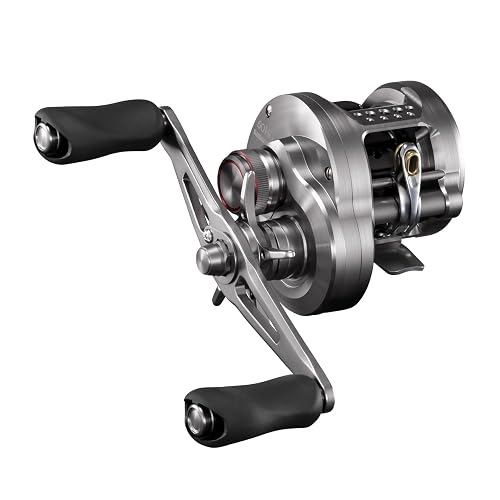
New for 2026, and the odd one out on this page by some distance. 225 g, a 31 mm spool carrying PE 0.6 for 200 m, and an FTB magnetic brake with the brake unit taken off the spool altogether and moved to an external dial. Shimano built it for finesse tai rubber, where the head is light, the braid is thin, and you read the landing off the spool rather than off the rod tip.
Getting there meant giving up the family’s signature. On the FT the levelwind no longer tracks the spool, and that’s precisely what lets a small, thin-walled spool spin fast and then stop dead the instant the head touches. Shimano’s own line is that a small spool turns more times per metre of line leaving it, so the moment it stops is easier to see.
| Feature | What it does |
|---|---|
| FTB (Finesse Tune Brake) | Magnets act on the spool from outside, so no brake hardware rides on the spool itself; adjusted on an external dial, including mid-drop |
| Super Free Spool | With the clutch out the spool is carried on two bearings and nothing else |
| Unlinked levelwind | The line guide no longer moves with the spool, which is where the free-running feel comes from |
| Thin-wall PE-only spool | Sized so PE 0.6 for 200 m or 0.8 for 150 m fills it without any backing underneath |
| Brass MicroModule Gear | The Conquest drivetrain in miniature: brass gears, small teeth, plenty of them in mesh |
| X-SHIP | Larger drive gear and a pinion supported at two points, to keep winding light when the drag is loaded |
| Silent Tune and S3D spool | Light preload on the spool bearings plus a re-cut spool, to damp vibration on the cast |
| 55 mm double handle | Paddle knobs on a long crank, so the MG ratio can still pull a 100 g head |
| Model | Gear ratio | Max drag | Weight | PE capacity | Per crank | Handle | Price (excl. tax) |
|---|---|---|---|---|---|---|---|
| 60MG | 6.2 | 5 kg | 225 g | 0.6-200 m | 60 cm | 55 mm | ¥61,000 (~$381) |
| 60HG | 7.4 | 5 kg | 225 g | 0.6-200 m | 72 cm | 55 mm | ¥61,000 (~$381) |
Only if finesse tai rubber is a real part of your season. Shimano’s own product page quotes Yasuhiro Akazawa saying that once his average depth gets past 100 m he goes back to a 200 or a 300 for the power. Inside that range, in shallow water and messy current with a light head, the FT does something the others can’t. Outside it you’ve paid Conquest 300 money for 5 kg of drag and a PE 0.8 ceiling. It’s a lovely thing. It replaces nothing else in this comparison.
All eight current lines, ordered from lightest to heaviest body.
| Series | Levelwind | Counter | Weight | Max drag | Price (excl. tax) | Built for |
|---|---|---|---|---|---|---|
| Ocea Conquest FT 60 | Yes | No | 225 g | 5 kg | ¥61,000 | Casting light metals, super-light jigging |
| Ocea Conquest 200 / 300 | Yes | No | 285-355 g | 7-8 kg | ¥60,900-61,300 | Tai rubber, light jigging |
| Ocea Conquest CT 200 / 300 | Yes | Yes | 300-395 g | 7-8 kg | ¥72,000-73,000 | The same jobs, with depth control |
| Ocea Jigger 1500 / 2000NR | No | No | 405-595 g | 6-10 kg | ¥56,700-62,000 | One-pitch jigging, seven speeds |
| Ocea Jigger F Custom | No | No | 430-605 g | 7-10 kg | ¥62,900-68,500 | Jigging where the fall matters |
| Ocea Jigger CT | No | Yes | 590-605 g | 12-13 kg | ¥96,000-98,000 | Jigging a marked depth band |
| Ocea Jigger LD | No | No | 690 g | 20 kg | ¥72,000 | Deep slow pitch, heavy drag settings |
| Ocea Jigger 4000 | No | No | 785-790 g | 18 kg | ¥72,000 | Deep water, very high line capacity |
Three honest starting points, depending on what your boat day looks like.
🥇 Mostly winding: Shimano Ocea Conquest 300HG
If tai rubber, inchiku and slow light jigging make up most of your season, this is the one that never feels like a compromise. PE 3 capacity, a 75 mm handle with real leverage, 84 cm per crank, and no battery to worry about. It carries you from deep tai rubber drifts into your first slow pitch sessions without swapping reels. ¥61,300 (~$383).
🥈 Mostly jerking: Shimano Ocea Jigger 1500HG
The cheapest reel on this page, and the one I’d hand a first-time offshore jigger. 405 g, a 49 mm spool that keeps its retrieve rate deep in the drop, 97 cm per turn, and nothing on the frame for braid to catch on when you’re pitching. Go up to the 1500XG if you fish long jigs, or to the 2000NR sizes if PE 3 is your normal line. ¥56,700 (~$354).
🥉 Depth is the puzzle: Shimano Ocea Conquest CT 200HG
For anglers who fish a sounder-marked band and want to reproduce a bite depth exactly. The counter, the winding alarm, the fall lever and the InfinityDrive wind in a 315 g body, and it handles tai rubber and PE 1.5 light jigging without a weak spot. It’s the least expensive way into a counter reel at this level. ¥72,000 (~$450).
Forget the tier ladder. These aren’t a good reel and a better reel, they’re two answers to two different questions. Ask what your hands do for most of a trip. If they turn a handle at a steady rate and your thumb only touches the spool on the drop, buy a Conquest and enjoy never thinking about line lay again. If they lift a rod and drop it, over and over, buy a Jigger and learn to thumb.
The middle ground is real, though. A Conquest 300 will jig, and plenty of Japanese anglers use one for light jigging all season. A Jigger 1500 will grind out a day of tai rubber if you’re willing to watch your line lay. Neither is being used wrong. You’re just paying a small tax in convenience or in feel, depending on which way you cross over. If you’re still working out where your fishing sits, the light jigging guide covers the technique side that all of this hardware is serving.