Metal Jig Selection: Weight, Shape & Color the Japanese Way
ちゃんま
マイボ!

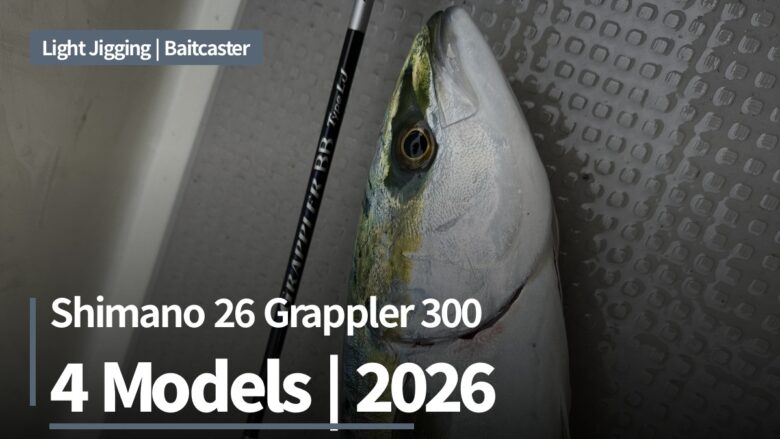
Shimano put a 300-size reel in the Grappler family in April 2026, and the question it creates is an awkward one. The Grappler 150 has been the default light jigging baitcaster in Japan for years. The new 300 costs ¥8,200 more, holds a lot more line, and nearly doubles the drag. It also weighs 135 g more and drops the fall lever that a lot of 150 owners bought the reel for.
So this isn’t a straight upgrade. It’s a trade, and whether it’s a good one depends entirely on what you’re dropping down the water column. I fish a 23 ft boat in western Japan, mostly light jigging and tairaba (鯛ラバ, the Japanese sliding-head technique for madai), which is exactly the water both of these reels were built for.
If you fish PE 1.5 or heavier, jigs from 100 g up, or anywhere the bottom sits past about 500 feet, buy the 26 Grappler 300HG. The 7.5 kg drag and the 500 m spool are the whole point, and at ¥41,000 (~$258) it undercuts every other Shimano reel that can do that job.
If your fishing lives at PE 1 with 60 to 100 g jigs and you care about the drop, stay on the Grappler 150. It’s ¥8,200 cheaper, it’s 135 g lighter in the hand all day, and it has a fall lever the 300 doesn’t. Buying the 300 for tairaba would be a downgrade, which is not a sentence you expect to write about a bigger reel.
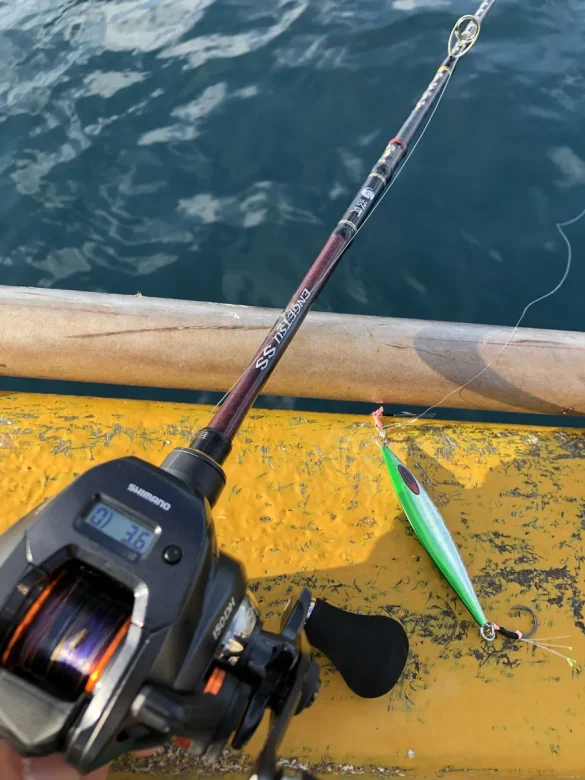
The 300 is a low-profile reel with a levelwind, not a round jigging reel, so it sits in the palm the same way the 150 does. What changed is everything underneath. The spool takes PE 1.5 to 500 m (547 yd), PE 2 to 380 m, or PE 3 to 250 m. Max drag is 7.5 kg on the HG models, nearly double the 150’s 4 kg and level with what a full Ocea Jigger 1500 gives you. The handle grew to 75 mm (3.0 in) from the 150’s 51 mm, and you feel that immediately when a fish is pulling.
The body is Shimano’s Core Solid aluminum construction with X-Ship and MicroModule gearing, and the drag is the usual Cross Carbon stack with the Exciting Drag Sound clicker. One genuinely odd inclusion for a jigging reel: it carries an SVS Infinity centrifugal brake, the system Shimano puts in casting reels. The 150 has no brake at all. That makes the 300 the rare offshore baitcaster you can actually throw, which matters if you cast tairaba or work bait around structure.
Bearing count drops to 5+1 from the 150’s 8+1. There’s no fall lever, so you can’t meter the sink rate with your thumb on a lever. The levelwind is the safety type, not the synchronized type that tracks the line on the drop. And at 340 g it’s two thirds heavier than the 150. Shimano built this as a small jigging reel, not a big tairaba reel, and the spec sheet says so in every line.

| Feature | What it does |
|---|---|
| Core Solid body | Rigid aluminum frame that resists flex under drag load, so the gears stay in mesh when a fish digs |
| SVS Infinity | Centrifugal casting brake adjusted from outside the sideplate; unusual on an offshore reel and the reason this one casts |
| MicroModule Gear + X-Ship | Fine-pitch gear teeth and a supported pinion for a smooth, quiet wind under load |
| Cross Carbon drag | Carbon washer stack rated to 7.5 kg (HG) or 7.0 kg (XG), with the Exciting Drag Sound clicker |
| Safety levelwind | Levelwind with a guard against pinching a finger on the drop; not the synchronized type used on the Grappler 150 |
| PE-dedicated spool | Spool designed for braid only, so you don’t need backing to fill it |
| Model | Hand | Gear ratio | Per crank | Weight | Max drag | PE capacity | JDM RRP (excl. tax) |
|---|---|---|---|---|---|---|---|
| 26 Grappler 300HG | Right | 6.3 | 85 cm (33 in) | 340 g (12.0 oz) | 7.5 kg (16.5 lb) | 1.5-500, 2-380, 3-250 m | ¥41,000 (~$258) |
| 26 Grappler 301HG | Left | 6.3 | 85 cm (33 in) | 340 g (12.0 oz) | 7.5 kg (16.5 lb) | 1.5-500, 2-380, 3-250 m | ¥41,000 (~$258) |
| 26 Grappler 300XG | Right | 7.6 | 103 cm (41 in) | 345 g (12.2 oz) | 7.0 kg (15.4 lb) | 1.5-500, 2-380, 3-250 m | ¥41,000 (~$258) |
| 26 Grappler 301XG | Left | 7.6 | 103 cm (41 in) | 345 g (12.2 oz) | 7.0 kg (15.4 lb) | 1.5-500, 2-380, 3-250 m | ¥41,000 (~$258) |
Two decisions, and Shimano charges the same ¥41,000 whichever way you go. Hand first: 300 is right-hand, 301 is left-hand. Japanese boat anglers overwhelmingly run left-hand retrieve on baitcasters so the rod stays in the stronger hand, so if you’re coming from US conventional gear the 300 will feel more familiar.
I’d take HG. At this size the reel’s job is lifting, and the extra drag is worth more than the extra speed.
Shimano’s 150-size Grapplers are a four-reel family, and every one of them beats the 300 at something. The Grappler 150HG at ¥32,800 (~$206) is 205 g, runs 8+1 bearings against the 300’s 5+1, and has both a fall lever and a synchronized levelwind. For tairaba, and for any fishing where the bite comes on the drop, that fall lever isn’t a luxury. The Grappler BB 150HG at ¥17,500 (~$110) is the cheapest way into the family.
Then there are the counter models. The Grappler CT 150XG (¥34,800) and Grappler Premium 150XG (¥46,500) both put a digital depth readout on top, and the 300 has none. If you fish a bait zone the captain calls out in feet off the bottom, that omission will annoy you every trip. We’ve broken the 150 family down in the guide to JDM light jigging reels under $300, and the counter models specifically in JDM counter reels.
The 300 answers none of that. It answers one thing: line and drag.
Push past the 300 and you’re into Shimano’s proper jigging flagship. The Ocea Jigger 1500HG is a round reel, 405 g, 6.4:1, 97 cm per crank, 7 kg drag, and it holds PE 2 to 500 m. The Grappler 300HG matches it on drag, beats it on weight by 65 g, and costs ¥41,000 against ¥56,700 (~$357).
What the Jigger buys you is InfinityDrive winding under heavy load, a no-levelwind design that thick PE prefers, and a build meant for a lifetime of amberjack abuse. That’s a real gap, but it’s a gap that only opens at PE 3 and above. Below that, the Grappler 300 does the same work for 28% less money. For the full picture on the flagship line, we compared it against the Ocea Conquest in Ocea Jigger vs Ocea Conquest.
Here’s the thing that took me a few seasons to stop getting wrong. The name of the technique tells you nothing about how big a reel you need. “Light jigging” covers 60 g jigs over 150 feet of water and 150 g jigs over 500 feet, and those two days want completely different tackle. What sets the size is how big the fish run and how heavy the lure is. Nothing else. Once I started sizing reels off those two numbers instead of off the category printed on the rod tube, the choices got a lot simpler.

This reel isn’t sold in the United States. Shimano North America lists Grappler rods, the Type J and Type LJ, but no Grappler reel. A US shop can’t order you one, and the warranty is a Japanese warranty, serviced in Japan. Amazon.com listings, where they appear at all, are third-party sellers rather than Shimano stock, so check who’s actually shipping before you click.
Walk into a US tackle shop looking for a reel that does this job and you’ll be pointed at a round star-drag conventional: a Shimano Torium, a Penn Fathom, something in that family. Those are honest tools and they’re on the shelf today. The Grappler 300 is a different shape of answer, a compact low-profile with a levelwind and a casting brake, a body style US conventional reels mostly don’t offer in this class. That’s the actual reason to import one, more than the spec sheet is.
On cost, ¥41,000 before tax is the sticker; what lands on your card is that plus international shipping and import fees, which Amazon Japan totals at checkout. Street prices in Japan usually sit under RRP. We walk through proxy services, shipping tiers and customs in how to buy JDM tackle overseas.
| Model | Gear ratio | Per crank | Weight | Max drag | Bearings | Counter | Fall lever | JDM RRP (excl. tax) |
|---|---|---|---|---|---|---|---|---|
| 26 Grappler 300HG | 6.3 | 85 cm | 340 g | 7.5 kg | 5+1 | No | No | ¥41,000 (~$258) |
| 26 Grappler 300XG | 7.6 | 103 cm | 345 g | 7.0 kg | 5+1 | No | No | ¥41,000 (~$258) |
| Grappler 150HG | 7.8 | 78 cm | 205 g | 4.0 kg | 8+1 | No | Yes | ¥32,800 (~$206) |
| Grappler BB 150HG | 7.2 | 72 cm | 210 g | 5.0 kg | 4+1 | No | No | ¥17,500 (~$110) |
| Grappler CT 150XG | 8.1 | 81 cm | 240 g | 5.0 kg | 5+2 | Yes | Yes | ¥34,800 (~$219) |
| Grappler Premium 150XG | 8.1 | 81 cm | 240 g | 5.0 kg | 8+2 | Yes | Yes | ¥46,500 (~$292) |
| Ocea Jigger 1500HG | 6.4 | 97 cm | 405 g | 7.0 kg | 8+1 | No | No | ¥56,700 (~$357) |
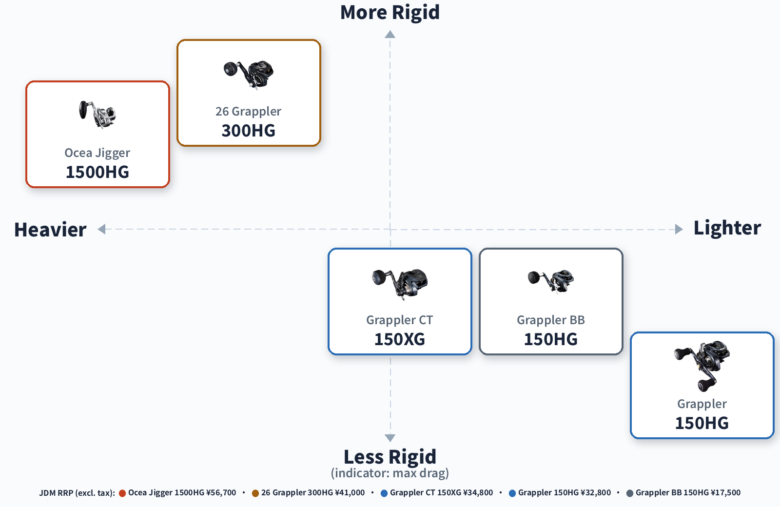
On a party boat, more or less yes. On my own 23 ft boat, no. That’s one of the quiet advantages of running your own boat: there’s no deck etiquette about rod space and nothing stopping you bringing the lot, so I load tackle for the whole day and swap when the depth changes. Bring as much as you want, no problem at all! If you’re in the same position, these two reels aren’t competitors. They’re the light day and the heavy day.
You can, and I wouldn’t. 340 g is heavy for a technique where you hold the rod and wind at a constant speed for eight hours, and losing the fall lever costs you control over the one moment tairaba fish care about. Look at the 150-size reels instead, or at a dedicated tairaba reel.
The SVS Infinity brake says yes, and that’s a deliberate choice by Shimano rather than a leftover part. It opens up casting tairaba, pitching at structure, and throwing at surface activity on the way home, which nothing else in this class does. Just don’t expect bass-reel manners from a 340 g offshore body.
PE 1.5 if you want the full 500 m, PE 2 at 380 m for heavier work. The spool is braid-only, so no backing needed. For what those numbers mean in pound test, see our PE and leader ratings guide.
The 26 Grappler 300 fills a hole Shimano had left open for years: a compact, castable, ¥41,000 reel that holds PE 1.5 and pulls 7.5 kg. Against the Ocea Jigger 1500 it’s lighter, cheaper, and gives up very little below PE 3. Against the Grappler 150 it isn’t an upgrade at all, just a bigger tool for a heavier job, and if your heavier job doesn’t exist yet, neither does your reason to buy it. Pair it with a rod matched to the jig weight you’re actually throwing; our JDM light jigging rod picks are a reasonable place to start.