Shimano Ocea Jigger vs Ocea Conquest: Which One Fits Your Fishing?
ちゃんま
マイボ!


Watch a tairaba angler work and you notice how little seems to happen. The head goes down, the clutch flips, and a slow, even retrieve does the rest. Almost everything that matters in that quiet half-minute, the drop, the depth, the wind back up, runs through the reel. So when you decide to fish tairaba (鯛ラバ) seriously, the real question is the one Japanese boat anglers have argued about for years: Shimano or Daiwa?
Both brands build purpose-made tairaba baitcasters for the Japan Domestic Market (JDM), and they take genuinely different routes to the same fish. Daiwa builds its whole tairaba lineup around the Kohga brand and puts a depth counter on almost every model, including its cheapest. Shimano spreads a wider ladder from a bargain entry reel up to a flagship with the smoothest winding feel on the water, but it makes you climb a tier or two before the counter appears. Neither approach is better in the abstract, so instead of walking each catalogue top to bottom, this comparison starts from the situations that actually decide the choice. Find the one that sounds like your fishing, and the right brand tends to fall out of it.
This guide lays both lineups side by side with specs pulled straight from each maker’s official catalogue. If you’re new to the technique, start with our complete guide to tairaba fishing. For a ranked shortlist across both brands, see best tairaba reels, and for the rod side of the setup, best tairaba rods.
A note on links and pricing: these are JDM reels, so most buy links point to Amazon Japan, which ships internationally (check availability and cost at checkout). Prices are shown in JPY (tax excluded) with an approximate USD conversion at the time of writing (~¥160 = $1, June 2026). Always check live pricing before you buy.
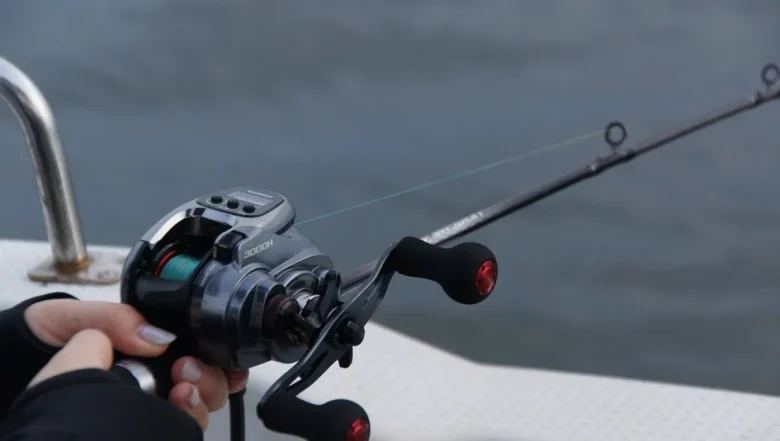
For a lot of anglers the decision starts and ends here. You marked fish in a tight band off the bottom, you want to drop back to that exact depth every time, and you don’t want to pay flagship money for the privilege.
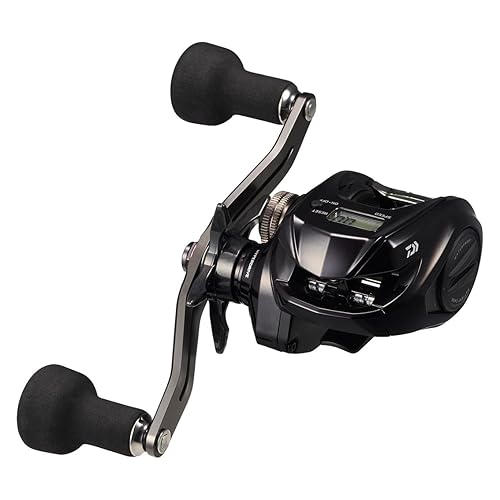
Daiwa treats tairaba as its own discipline. The Kohga (紅牙) name is a dedicated brand, not a sub-line borrowed from jigging, and the giveaway is the counter. Daiwa’s Intelligent Counter (IC) shows up on the entry model, the value model, and everything above. That matters because a counter, knowing your exact depth so you can return to a productive zone, is the single most useful feature on a tairaba reel. With Daiwa you don’t have to spend up to get one.
The lineup follows through on that promise from the very bottom rung. The entry Kohga X IC includes the Intelligent Counter for about $100, which is the cheapest way anywhere to get a counter-equipped tairaba reel. From there the ladder climbs through the value RX IC, a no-counter base Kohga, a light 2026 Kohga IC, and the premium Kohga IC 150-C. The gearing runs on Daiwa’s HyperDrive Design, aimed at holding that new-reel smoothness for longer, and the ATD drag starts up smoothly to protect thin leaders. The one thing Daiwa leaves out is a Shimano-style fall lever.
| Feature | What it does |
|---|---|
| HyperDrive Design | Durable gear and shaft system that holds smoothness over time |
| HD DigiGear | Precision-machined gear for power and a quiet wind |
| ATD drag | Automatic Tournament Drag: smooth, progressive start-up |
| IC counter | Intelligent Counter with electric drag sound, fitted from the entry model up |
| HT Clutch | Hyper Tough Clutch for reliable engagement under load |
| Body | Rigid construction with a PE-tuned spool; no fall lever |
| Model | Tier | Gear ratio | Weight | Max drag | Counter | Price (excl. tax) |
|---|---|---|---|---|---|---|
| Kohga X IC | Budget | 4.9 | 240 g | 5 kg | Yes | ¥16,000 (~$100) |
| Kohga RX IC 150P | Value | 5.5 | 235 g | 6 kg | Yes | ¥25,900 (~$162) |
| Kohga 100 | Mid (no counter) | 6.3 | 205 g | 5.5 kg | No | ¥31,400 (~$196) |
| Kohga IC 150 (2026) | High-end | 6.3 | 235 g | 5 kg | Yes | ¥49,300 (~$308) |
| Kohga IC 150-C | Premium | 6.3 | 275 g | 7 kg | Yes | ¥53,900 (~$337) |
Notice what the Kohga ladder does that Shimano’s doesn’t: four of these five reels carry a counter, and the one that doesn’t (the base Kohga) is the lightest and most traditional of the set. If a built-in depth counter is non-negotiable for you and the budget is tight, Daiwa simply gives you more options. The premium IC 150-C is the priciest reel in this whole comparison, and it earns it with a 7 kg drag and a tairaba-dedicated feel.
The counter is Daiwa’s clearest win. It lets you drop back to the exact depth fish are sitting at, over and over, and Daiwa fits one from the ¥16,000 entry reel upward. Shimano makes you reach the Engetsu CT before the counter appears, roughly double the price of the cheapest Engetsu. If a counter is your priority and you don’t want to spend up, Daiwa’s the easy answer, and the RX IC in the middle of the ladder is where the value peaks.
Now the other road. Maybe you already track depth by the marks on your PE line, or you simply care more about what the reel feels like through a six-hour tide than about a digital readout. This is the case Shimano builds.
Shimano plays it differently. Its tairaba-focused Engetsu (炎月) series starts cheaper than anything Daiwa offers, but the entry reel has no counter: you track depth by line marks instead. Climb to the CT tier and you get the counter plus a fall lever, and at the top the flagship Ocea Conquest CT brings Shimano’s best gearing for a winding feel Daiwa struggles to match. The trade is clear. Shimano rewards you at the top and at the rock bottom; Daiwa rewards you in the middle and makes the counter standard.
That ladder is the broadest in the game. It runs from the Engetsu BB, a genuinely good sub-$120 entry reel, up through the counter-equipped Engetsu CT and Engetsu Premium, to the flagship Ocea Conquest CT. The flagship is the headline act: Infinity Drive lightens the wind under load, and MicroModule Gear gives that glass-smooth retrieve, exactly the feel you want on a slow tairaba pull. The honest catch is that the counter is a step-up feature, so the cheapest Engetsu BB goes without one.

| Feature | What it does |
|---|---|
| Infinity Drive | Low-friction pinion support: lighter winding under load (flagship only) |
| MicroModule Gear | Fine-pitch gearing for a smooth, silent retrieve |
| X-Ship | Supported pinion gear for efficient, stable winding |
| Counter + Fall Lever | Digital depth counter with fall and retrieve speed display, plus a thumb lever to meter the drop (CT tier and up) |
| Drag | Carbon cross-washer with Exciting Drag Sound, up to 8 kg on the flagship |
| Body | Rigid aluminium HAGANE construction, PE-only spool |
| Model | Tier | Gear ratio | Weight | Max drag | Counter | Price (excl. tax) |
|---|---|---|---|---|---|---|
| Engetsu BB 100PG | Budget | 5.5 | 200 g | 6 kg | No | ¥17,500 (~$109) |
| Engetsu CT 150PG | Value | 5.8 | 230 g | 6 kg | Yes + fall lever | ¥34,800 (~$218) |
| Engetsu Premium 150PG | High-end | 5.8 | 220 g | 6 kg | Yes + fall lever | ¥46,500 (~$291) |
| Ocea Conquest CT 200HG | Flagship | 6.5 | 315 g | 7 kg | Yes + fall lever | ¥72,000 (~$450) |
The pattern is easy to read. Spend the least and you get a sound body without a counter (Engetsu BB). Spend in the middle and the counter and fall lever arrive (Engetsu CT and Premium, which sit close in price and feature set). Spend the most and you buy refinement: Infinity Drive smoothness and up to 8 kg of drag in the Ocea Conquest CT, which doubles happily as a light jigging reel.
The strongest single reason is the fall lever. A fall lever lets you meter the drop speed of the head with your thumb, which can be a real edge on pressured or fussy fish. Shimano fits it from the Engetsu CT up. Daiwa’s Kohga reels don’t have an equivalent lever, so you control the fall with thumb pressure on the spool the traditional way. Plenty of anglers never miss it, but if you like to feather the drop, it’s a point for Shimano, and together with the flagship’s winding feel it defines who this ladder is for.
Spec ladders only tell you so much. On the water, a handful of real differences decide which brand suits you. Here’s where they actually diverge.
Both drags are very good, and they have slightly different characters. Daiwa’s ATD is known for a smooth, progressive start-up that’s kind to thin tairaba leaders when a red sea bream shakes its head. Shimano’s carbon cross-washer drag tops out higher (8 kg on the flagship) and adds the Exciting Drag Sound that a lot of anglers love. For madai-class fish, either is more than enough. If you fish very light leaders, Daiwa’s smooth start is the safer feel.
Here the two brands chase different goals. Daiwa’s HyperDrive Design is built around longevity, holding the new-reel smoothness across many seasons. Shimano’s MicroModule Gear and, at the flagship, Infinity Drive chase the smoothest possible wind right now, and the Ocea Conquest CT is the smoothest-winding reel in this comparison by a small margin. Daiwa aims for durable smoothness; Shimano aims for peak smoothness. Both will outlast careless owners if you rinse them after every trip.
The lightest reels here come from both camps: the Engetsu BB at 200 g and the base Kohga at 205 g. Counter reels carry a little more, and Daiwa’s 2026 Kohga IC is impressively light for a counter model at 235 g, undercutting the 315 g Ocea Conquest CT by a full 80 g. If all-day, palm-the-reel comfort is what you’re after, Daiwa’s lighter counter reels have a small edge over Shimano’s heavier flagship.
Put those small differences side by side and a pattern shows up: each brand wins exactly where it chooses to compete.
| What you value | Edge |
|---|---|
| Counter on a tight budget | Daiwa (counter from the entry model) |
| Metering the fall | Shimano (fall lever from CT up) |
| Smooth drag start on light leaders | Daiwa (ATD) |
| Highest drag and the smoothest wind | Shimano (Ocea Conquest CT) |
| Lightest counter reel | Daiwa (2026 Kohga IC, 235 g) |
| Widest range of price points | Shimano (Engetsu BB to Ocea Conquest CT) |
Here are the two brands matched tier for tier, using a representative model from each.
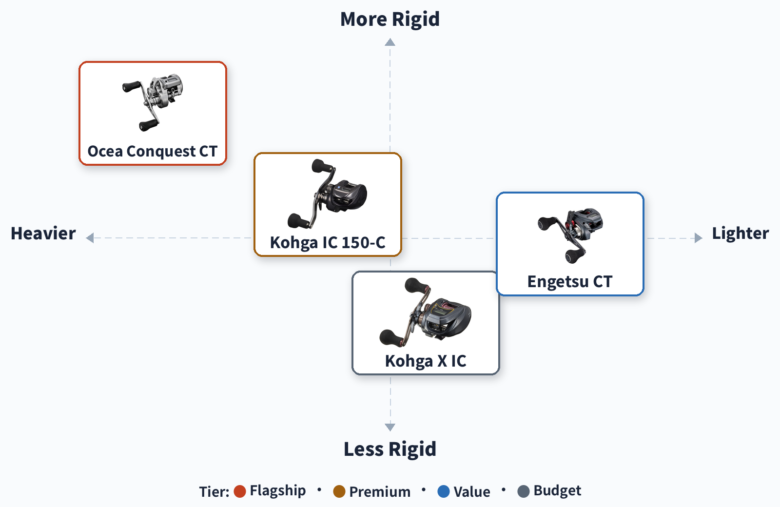
| Tier | Shimano | Daiwa |
|---|---|---|
| Flagship / Premium | Ocea Conquest CT 200HG 315 g, 7 kg, counter + fall lever ¥72,000 (~$450) | Kohga IC 150-C 275 g, 7 kg, counter ¥53,900 (~$337) |
| High-end counter | Engetsu CT 150PG 230 g, 6 kg, counter + fall lever ¥34,800 (~$218) | Kohga IC 150 (2026) 235 g, 5 kg, counter ¥49,300 (~$308) |
| Budget entry | Engetsu BB 100PG 200 g, 6 kg, no counter ¥17,500 (~$109) | Kohga X IC 240 g, 5 kg, counter ¥16,000 (~$100) |
The budget row is the most telling. For almost the same money, Shimano gives you a counter-less reel and Daiwa gives you a counter. At the top, Shimano’s flagship costs less than Daiwa’s premium and adds the fall lever and a higher drag, so the smart-money flagship pick leans Shimano.
If you skipped straight here, these two reels cover most readers, with one alternative for the fall-lever camp.
Our Top Pick: Daiwa Kohga RX IC
The value sweet spot of this whole comparison. A counter, the smooth ATD drag, and a light 235 g body for around $160, which is less than Shimano’s cheapest counter reel costs. For the angler who wants a depth counter without flagship spending, this is the one to beat. ¥25,900 (~$162).
Budget Pick: Daiwa Kohga X IC
The cheapest counter reel anywhere. For about $100 you get a built-in depth counter and Daiwa’s tairaba tuning, which is remarkable at the price. The trade is a simpler body and a lower drag, but as a first tairaba reel that reads your depth, nothing else gets close. ¥16,000 (~$100).
Both picks are Daiwa, and that is no accident: at these prices the counter drives the value equation. There is one swap worth making, though. If the fall lever earned its keep while you were reading the Shimano section, the reel to buy is the Engetsu CT.
Shimano’s value benchmark, and the answer if you want the fall lever. You get the counter, the fall lever, and the Exciting Drag Sound in a light 230 g reel for a sensible price, with room left for a good rod. The most complete sub-$250 tairaba reel Shimano makes. ¥34,800 (~$218).
The catalogues make this look harder than it is. Go Daiwa if you want a depth counter without spending up: the Kohga ladder fits one from the entry model, and the RX IC is the best-value counter reel here. Go Shimano if you want the fall lever, the highest drag, or the smoothest possible wind: the Ocea Conquest CT is the flagship to own, and it doubles as a light jigging reel.
On the tightest budget it’s close. The counter-less Engetsu BB is a rock-solid body, while Daiwa’s entry Kohga gets you a counter for similar money. And for the tairaba purist who fishes nothing else, Daiwa’s premium Kohga IC is the dedicated, no-compromise tool, at the highest price in this comparison. Whichever way you lean, both brands will catch fish for years if you look after them.
One last thing worth repeating: tairaba rewards a slow, even retrieve above all else, so a smooth reel you enjoy winding matters more than any single spec. If you think you’ll use the same reel for other styles, our light jigging guide covers the crossover, and the flagship Ocea Conquest CT is the most natural fit for both jobs.
All specifications were taken from the Shimano (fish.shimano.com) and Daiwa (daiwa.com) official catalogues. Product images are from Amazon product pages. Affiliate links are provided for reels available via Amazon Japan with international shipping; we may earn a commission at no extra cost to you.