Shimano vs Daiwa Tairaba Reels Comparison
ちゃんま
マイボ!

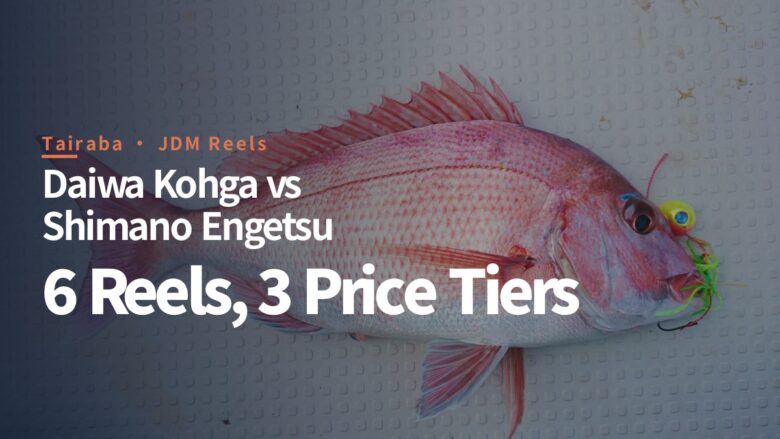
Two red boxes turn up on Japanese tairaba boats more than any others. Daiwa’s is Kohga (紅牙, “red fang”). Shimano’s is Engetsu (炎月, “flame moon”). Ask which brand is better and most Japanese anglers will shrug, because that isn’t the question anyone is really answering on the water. The question is which reel to buy at the money you have.
Tairaba (鯛ラバ / タイラバ) is the Japanese bottom method where you drop a skirted head jig, close the clutch, and wind it back at one steady speed for madai, red sea bream. No jerking, no hookset. The reel does nearly all of the work, which is why both makers build reels that do nothing else.
So this isn’t a brand argument. I’ve lined the ranges up at three price points and settled each pair on published numbers: grams, centimetres of line per handle turn, kilos of drag, and how many versions you can actually order. Six reels, three fights. Two go to Shimano, one to Daiwa.
If the technique itself is new to you, start with the complete guide to tairaba fishing. For a shortlist that also takes in Shimano’s round Ocea Conquest bodies, see best tairaba reels, and if you want one brand mapped end to end including rods, there’s the Daiwa Kohga series guide.
Pricing note: these are JDM (Japan Domestic Market) reels. Prices are each maker’s Japanese list price, tax excluded, converted at ¥159.75 = $1 as of 1 September 2026. Amazon Japan ships internationally, so check availability and shipping cost at checkout.
Buy one reel and it’s the Engetsu CT. Buy the cheapest reel that still tells you your depth and it’s the Kohga X IC. Different brands, which is the point of pairing them off by price instead of by badge.
A digital counter, a fall lever, both gear ratios and both handle sides, in a 230 g body. Nothing else on this page gives you all four for the money. The power version keeps 6 kg of drag; the high-gear version pulls 73 cm of line a turn. ¥34,800 (~$218).
The least expensive reel here, and it still carries a counter with fall speed, retrieve speed and a depth alarm. Shimano’s reel at the same money, the Engetsu BB, has no counter at all. The cost of that: one configuration only, right hand, 4.9 gearing. ¥16,000 (~$100).
The top of the two ranges is closer than the sticker price suggests. Daiwa’s 26 Kohga IC 150 is ¥49,300 and Shimano’s Engetsu Premium is ¥46,500, and the Shimano is 15 g lighter with 1 kg more drag. Daiwa answers with a third gear ratio and 80 cm of line per turn, which Shimano doesn’t sell at any price in this part of its range.
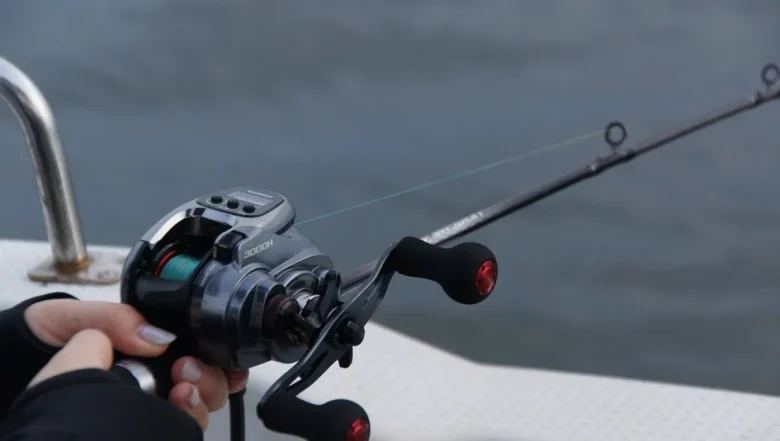
The 2025 CT is the reel most Japanese anglers land on once they stop borrowing tackle from the boat. It’s the cheapest Shimano tairaba reel with a counter on it, at 230 g.
For ¥34,800 (~$218) you get a counter that shows fall speed as well as retrieve speed, a fall lever for metering the drop, and a winding alarm that beeps at a distance you set. The 55 mm double handle is long for a reel this size, which you notice around hour four against tide. Four versions, two gear ratios, both hands, all at the same price.

| Feature | What it does |
|---|---|
| Digital counter with fall and retrieve speed | Shows depth, plus how fast the head is dropping and how fast you’re winding, as numbers rather than a feel |
| Winding alarm | Beeps at a distance you set, so you can come back to a bite depth without watching the display |
| Fall lever (フォールレバー) | Thumb lever that brakes the spool on the way down, so you control how fast the head falls |
| X-SHIP | Supports the pinion gear at both ends to hold the gear mesh in line under load |
| HAGANE Body | Aluminium frame that resists flex when a fish loads the reel up |
| X-Protect | Water-repellent coating and a labyrinth channel to keep salt out of the drive bearing |
| Spool-linked levelwind | Line guide that moves with the spool, so braid lies evenly even at a crawling retrieve speed |
| 55 mm double handle | Long crank arms for leverage with heavy heads |
| Model | Gear ratio | Per crank | Max drag | Weight | PE capacity | Price (excl. tax) |
|---|---|---|---|---|---|---|
| 150PG | 5.8 | 58 cm | 6.0 kg | 230 g | 0.8-400 / 1.0-330 / 1.5-200 m | ¥34,800 (~$218) |
| 151PG | 5.8 | 58 cm | 6.0 kg | 230 g | 0.8-400 / 1.0-330 / 1.5-200 m | ¥34,800 (~$218) |
| 150HG | 7.3 | 73 cm | 5.0 kg | 230 g | 0.8-400 / 1.0-330 / 1.5-200 m | ¥34,800 (~$218) |
| 151HG | 7.3 | 73 cm | 5.0 kg | 230 g | 0.8-400 / 1.0-330 / 1.5-200 m | ¥34,800 (~$218) |
Numbers ending in 1 are the left-hand versions.
Watch the drag column. The high-gear version gives up a kilo, 5 kg against 6 kg for the power gear. Shimano does the same thing on the BB. Daiwa doesn’t do it at all and rates every version of a given Kohga identically. If you fish thin leader and want the ceiling, take the power gear and accept 58 cm a turn.
This is Daiwa’s direct answer to the CT, and it undercuts it by ¥8,900 (~$56). You still get a depth counter, an alarm every 10 m, a user-replaceable battery and an aluminium housing, at 235 g, which is 5 g heavier than the Shimano. On paper that looks like free money.
The bill comes due in the order form. There are exactly two versions, right hand and left hand, both power gear at 5.5. No fast option, no fall lever. What Daiwa throws in is the Economizer: spacers that sit in the spool so light braid fills it without backing, which is a small thing until you’re spooling PE 0.8 onto a reel rated for 400 m of it.

| Feature | What it does |
|---|---|
| IC counter with depth alarm | Digital depth readout that beeps every 10 m, so you can follow the drop without staring at the display |
| Economizer (H and L spacers) | Supplied spool spacers with three fitting states, none, H or L, so light braid fills the spool without backing |
| HYPER ARMED HOUSING (aluminium) | Aluminium housing that holds the frame square when the reel is loaded |
| 110 mm handle arm | A longer crank than this price class usually gets |
| Drag click | Audible click when a fish pulls line off the spool |
| Self battery replacement | You change the counter battery yourself instead of sending the reel in |
| 36 mm spool | The barrel the line winds onto. Diameter, not gearing, is why 5.5 still recovers 62 cm a turn |
| Model | Gear ratio | Per crank | Max drag | Weight | PE capacity | Price (excl. tax) |
|---|---|---|---|---|---|---|
| 150P | 5.5 | 62 cm | 6.0 kg | 235 g | 1.0-400 / 2.0-200 m | ¥25,900 (~$162) |
| 150PL | 5.5 | 62 cm | 6.0 kg | 235 g | 1.0-400 / 2.0-200 m | ¥25,900 (~$162) |
Here’s the detail that decides this pair. Daiwa’s power gear is 5.5 and pulls 62 cm a turn. Shimano’s power gear is a higher 5.8 and pulls 58 cm. The lower ratio is the faster reel, because Daiwa is winding line onto a 36 mm spool. If a slow, heavy retrieve is what you came for, the Shimano is actually the slower of the two. Then Shimano hands you a 7.3 option and Daiwa hands you nothing, and that’s the ¥8,900.
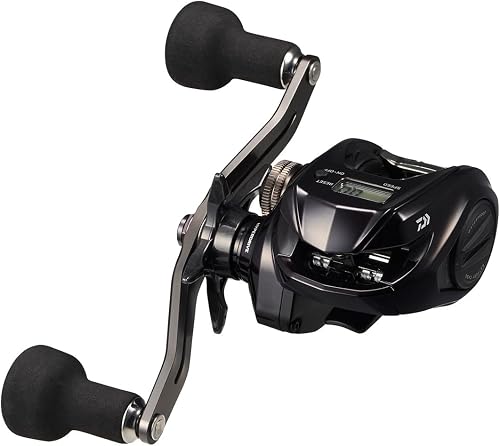
Daiwa’s 2026 counter reel is where the range gets serious. ¥49,300 (~$309), 235 g, and a sheet built around choice: three gear ratios, six orderable versions, and a centrifugal brake for a light under-cast when there’s no wind and no tide to spread the drift.
The counter reads retrieve speed, fall speed and depth, with an alarm. Daiwa also widened the tooth face on the drive gear for this generation. But the number that matters is 80 cm: no Engetsu recovers line that fast.
| Feature | What it does |
|---|---|
| IC counter | Depth, retrieve speed and fall speed on one display, with a depth alarm |
| Centrifugal brake | Lets you make a light under-cast to fan the head away from the hull on a flat, slack day |
| HYPERDRIVE DIGIGEAR | Machined drive gear, given a wider tooth face on this generation for better rotation |
| HYPERDRIVE DESIGN | Daiwa’s name for the gear, support and clutch package meant to keep the wind feeling new for longer |
| ATD (Automatic Tournament Drag) | Drag tuned to start smoothly rather than grab when a fish first pulls |
| HYPER TOUGH CLUTCH | Clutch built to hold its engagement feel over long use |
| Aluminium frame | The housing material Daiwa lists for this model |
| Three gear ratios | 4.8, 6.3 and 7.1, all at the same 235 g and the same 5 kg drag rating |
| Bearings: 6 ball, 1 roller | Two balls and one roller fewer than the Shimano it’s priced against |
| Model | Gear ratio | Per crank | Max drag | Weight | PE capacity | Price (excl. tax) |
|---|---|---|---|---|---|---|
| 150P | 4.8 | 54 cm | 5.0 kg | 235 g | 1.0-400 / 2.0-200 m | ¥49,300 (~$309) |
| 150PL | 4.8 | 54 cm | 5.0 kg | 235 g | 1.0-400 / 2.0-200 m | ¥49,300 (~$309) |
| 150 (right) | 6.3 | 70 cm | 5.0 kg | 235 g | 1.0-400 / 2.0-200 m | ¥49,300 (~$309) |
| 150L | 6.3 | 70 cm | 5.0 kg | 235 g | 1.0-400 / 2.0-200 m | ¥49,300 (~$309) |
| 150H | 7.1 | 80 cm | 5.0 kg | 235 g | 1.0-400 / 2.0-200 m | ¥49,300 (~$309) |
| 150HL | 7.1 | 80 cm | 5.0 kg | 235 g | 1.0-400 / 2.0-200 m | ¥49,300 (~$309) |
Most people buying a first tairaba reel treat gear ratio as a footnote and pick on weight or brand. That’s backwards for a method where retrieve speed is the presentation. Daiwa gives you 54, 70 and 80 cm a turn at one price. Shimano’s premium reel gives 58 and 74. Both ends belong to Daiwa.
Against that, the drag ceiling here is 5 kg, a full kilo under the Shimano, and Daiwa charges ¥2,800 more for a reel that’s 15 g heavier with fewer bearings. You’re buying the ratio spread and the centrifugal brake, nothing else.
Shimano’s top tairaba reel is the lightest thing in this comparison at 220 g, and it holds 6 kg of drag in every version, high gear included. The side plate is CI4+ rather than metal, which is where most of the weight went. Eight ball bearings and two rollers, against Daiwa’s six and one.

| Feature | What it does |
|---|---|
| Fall lever with one-way roller bearing | The wind stays light in the retrieve direction even while lever tension is still applied |
| Digital counter with fall and retrieve speed | Depth and both speeds as numbers, on a display Shimano widened the viewing angle of |
| Winding alarm | Sounds up to three times at multiples of a distance you set, so you find a depth band by ear |
| CI4+ side plate | Carbon-reinforced plate that takes weight out of the body without giving up the rigid feel |
| MicroModule Gear | More, smaller teeth in mesh at once, for a quieter and smoother wind |
| X-SHIP | Holds the pinion and drive gear aligned when the reel is under load |
| Exciting Drag Sound | Audible drag click when a fish takes line |
| LED backlight | Selectable: five seconds, on spool rotation, or always on |
| Bearings: 8 ball, 2 roller | The highest count on this page, and two roller bearings where the Daiwa has one |
| Model | Gear ratio | Per crank | Max drag | Weight | PE capacity | Price (excl. tax) |
|---|---|---|---|---|---|---|
| 150PG | 5.8 | 58 cm | 6.0 kg | 220 g | 0.8-400 m | ¥46,500 (~$291) |
| 151PG | 5.8 | 58 cm | 6.0 kg | 220 g | 0.8-400 m | ¥46,500 (~$291) |
| 150HG | 7.4 | 74 cm | 6.0 kg | 220 g | 0.8-400 m | ¥46,500 (~$291) |
| 151HG | 7.4 | 74 cm | 6.0 kg | 220 g | 0.8-400 m | ¥46,500 (~$291) |
Note what the ratios do here. Shimano’s 7.4 is numerically higher than Daiwa’s 7.1 and still recovers 6 cm less per turn. Centimetres per crank is the only figure that compares across two brands.
Where the Premium loses is choice. Two ratios, and the capacity is quoted for PE 0.8 only, so if PE 1.5 is your normal line the Daiwa’s 1.0 to 400 m and 2.0 to 200 m rating is the safer buy. There’s no low gear anywhere near 54 cm in Shimano’s tairaba range either.
This is the reel that makes the entry-level fight lopsided. ¥16,000 (~$100) buys a counter reading in 10 cm increments, with retrieve speed, fall speed and a depth alarm you can set to one, three or five beeps or switch off. The spool is shallow, set up for PE 1.0 to 200 m with no backing, and the counter ships pre-set for that fill, which removes the one setup step people get wrong.

| Feature | What it does |
|---|---|
| IC counter | Depth in 10 cm increments, plus retrieve speed and fall speed |
| Depth alarm | Beeps every 10 m, selectable at one, three or five beeps, or off |
| Super Metal Frame | Metal frame that doesn’t flex under a loaded wind |
| Shallow spool | Takes PE 1.0 to 200 m with no backing; the counter is pre-set for that fill out of the box |
| 100 mm double handle | Large EVA knobs that stay grippy with wet hands |
| Spec | Value |
|---|---|
| Gear ratio | 4.9 |
| Per crank | 54 cm |
| Max drag | 5.0 kg |
| Weight | 240 g |
| PE capacity | 0.8 to 300 m, 1.0 to 200 m |
| Handle | 100 mm |
| Bearings | 5 ball, 1 roller |
| Price (excl. tax) | ¥16,000 (~$100) |
There is no left-hand version. It’s the only reel on this page you can’t get for either hand, and it’s the only one with a single configuration full stop. At 54 cm a turn it’s also the slowest thing here, which is fine for tairaba and awkward if you ever want to pick up line in a hurry. For ¥16,000 you’re getting information no Shimano gives you until ¥34,800, and that trade is worth making for most people starting out.
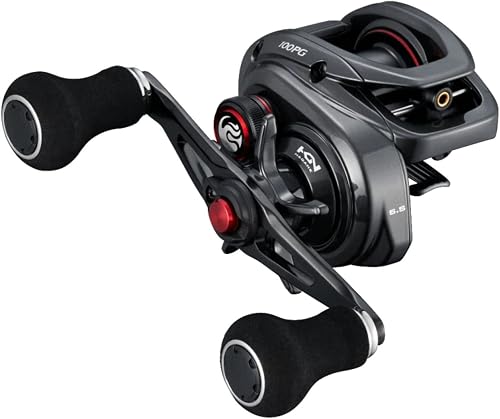
Shimano’s entry reel costs ¥1,500 more than the Kohga X IC and takes the opposite approach. No counter at all. What it does instead is be the lightest reel in this whole comparison at 200 g, 40 g under the Daiwa, and give you four versions: two gear ratios, both hands. Shimano also dropped the body profile by 1.6 mm over the previous version, which you feel in your palm rather than on a spec sheet.
| Feature | What it does |
|---|---|
| HAGANE Body | Aluminium frame; the profile also came down 1.6 mm from the previous version, so the reel sits lower in the palm |
| Counterbalanced double handle | The two arms balance each other, so the handle stops where you let go instead of spinning back |
| Spool-linked levelwind | Line pays out more smoothly on the fall and when the drag slips |
| Safety levelwind | Guarded line guide, so fingers stay out of it under load |
| S A-RB bearings | Stainless anti-rust ball bearings |
| Carbon cross drag washers | Drag stack sized for the 5 to 6 kg range this reel works in |
| PE-only spool | Rated for braid, not for mono or fluorocarbon |
| Model | Gear ratio | Per crank | Max drag | Weight | PE capacity | Price (excl. tax) |
|---|---|---|---|---|---|---|
| 100PG | 5.5 | 55 cm | 6.0 kg | 200 g | 0.8-250 m | ¥17,500 (~$110) |
| 101PG | 5.5 | 55 cm | 6.0 kg | 200 g | 0.8-250 m | ¥17,500 (~$110) |
| 100HG | 7.2 | 72 cm | 5.0 kg | 200 g | 0.8-250 m | ¥17,500 (~$110) |
| 101HG | 7.2 | 72 cm | 5.0 kg | 200 g | 0.8-250 m | ¥17,500 (~$110) |
Capacity is the real limit: 250 m of PE 0.8, against 300 m on the Daiwa and 400 m on everything above. Deep ground will run this spool thin. Inside 60 or 70 m it’s a lot of reel for the money, and it’s the one I’d reach for when I can read depth off the sounder instead of the reel.
Four things decide this, and the first one isn’t really about the reel at all.
When I started boat fishing I came at tairaba from the shore, and for a while I left the head sitting on the bottom without knowing it. Off a jetty a lure sinks, stops, and your thumb tells you so. Drifting, it doesn’t work like that. The boat keeps moving away from the head, line keeps leaving the spool after it has landed, and your hand still says you’re falling. Miss the landing and nothing you do afterwards matters.
That much I know first-hand. The rest is my own inference: I think a counter is what fixes it, because a number on the display doesn’t care what the line is doing. Sounder says 45 m, counter says 45, you wind. That’s a conclusion I’ve drawn, not something the mistake itself proved.
Compare the two brands on ratio and you’ll get it backwards. Shimano’s 7.4 recovers 74 cm. Daiwa’s lower 7.1 recovers 80 cm. Shimano’s 5.8 recovers 58 cm while Daiwa’s 5.5 recovers 62 cm. Spool diameter is why, and every maker publishes the per-crank figure, so use it. Across the six reels the span runs 54 cm to 80 cm, and both ends are Daiwa.
There’s a habit of picking tackle by the name of the technique, as if “tairaba reel” were itself a strength rating. It isn’t. What loads a reel is how big the fish get on your ground and how heavy a head you’re winding, and those vary more between anglers than the brands do. Read them first, then read the drag column. The ceilings here are 5 kg or 6 kg, and Shimano is the one that drops to 5 kg on the fast gear — on the Premium, the CT and the BB alike. Every Shimano here trades a kilo of drag for speed.
Version count is a spec, and importers feel it more than Japanese buyers do: you can’t walk into a shop and swap. Six versions on the Kohga IC 150, four on each Shimano, two on the RX IC, one on the X IC, which has no left-hand model at all. Check the handle side before you click.
One row you won’t find in my comparison table: handle length. Shimano quotes 55 mm for the CT’s double handle, Daiwa 110 mm for the RX IC’s handle arm. They aren’t measured the same way.
All six, cheapest first. Prices are Japanese list, tax excluded.
| Reel | Counter | Weight | Per crank | Max drag | Versions | Price |
|---|---|---|---|---|---|---|
| Daiwa Kohga X IC | Yes | 240 g | 54 cm | 5.0 kg | 1 (right only) | ¥16,000 (~$100) |
| Shimano Engetsu BB | No | 200 g | 55 / 72 cm | 5.0-6.0 kg | 4 | ¥17,500 (~$110) |
| Daiwa Kohga RX IC 150 | Yes | 235 g | 62 cm | 6.0 kg | 2 | ¥25,900 (~$162) |
| Shimano Engetsu CT | Yes | 230 g | 58 / 73 cm | 5.0-6.0 kg | 4 | ¥34,800 (~$218) |
| Shimano Engetsu Premium | Yes | 220 g | 58 / 74 cm | 6.0 kg | 4 | ¥46,500 (~$291) |
| Daiwa 26 Kohga IC 150 | Yes | 235 g | 54 / 70 / 80 cm | 5.0 kg | 6 | ¥49,300 (~$309) |
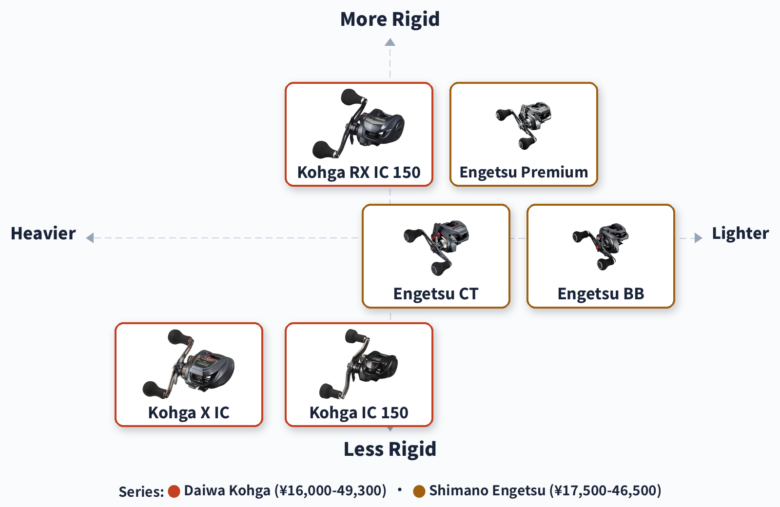
Same three tiers as above, read the other way round: not which reel won, but who each one is actually for.
This is the Kohga X IC, and the profile it fits is narrow: you crank right-handed, tairaba is new to you, and your ground is inside about 60 m. Spool it with PE 1.0 and the counter arrives already set for that fill. If you crank left-handed you can’t order it at all, so take the Engetsu BB and count line another way. ¥16,000 (~$100).
The Engetsu CT is the pick if this is the only tairaba reel you’ll own, or if you fish other people’s boats and need the hand you’re used to. Heavy heads and thin leader, order a PG for 6 kg of drag. Shallow ground and a lot of dropping, order an HG for 73 cm a turn. It’s also the one here that will follow you into light jigging. ¥34,800 (~$218).
The Engetsu Premium suits people who are on the water often enough that 220 g and 6 kg of drag in every version matter more than the order form does. Go to Daiwa’s 26 Kohga IC 150 instead only if 80 cm a turn or a 4.8 low gear is worth ¥2,800 and 15 extra grams to you. ¥46,500 (~$291).
Split the decision by price and it stops being a brand question. Under $120 Daiwa wins, because it puts a counter in a reel Shimano sells without one. Around $220 Shimano wins, because the CT is the only reel offering gearing and handedness together at that money. Above $280 the two sit within ¥2,800, and it comes down to whether 80 cm a turn is worth 15 extra grams and a kilo less drag.
The rod side of the setup follows the same pattern, and the best tairaba rods guide covers it. If you want the argument at brand level rather than model level, that’s the Shimano vs Daiwa tairaba reels piece.
Not if you fish shallow off your own boat with a sounder in front of you. You need one the moment you’re on a charter, drifting in current, and trying to put the head back where a fish ate three drops ago. Five of the six reels here have one. Daiwa just starts offering it ¥18,800 earlier than Shimano.
Whichever one you can get in the hand you want. Handedness is the constraint people forget when importing, and Daiwa’s cheapest reel is right-hand only. If you’re left-handed and on a tight budget, the choice is made for you: Shimano.
Shimano tags all three Engetsu reels for light jigging as well as tairaba. Daiwa tags the Kohga reels for tairaba only. That difference shows up in the capacity ratings, where the Engetsu CT carries PE 1.5 to 200 m and the entry Kohga tops out at PE 1.0. If you want one reel for two jobs, Shimano is built for it and Daiwa isn’t pretending to be.
Because Shimano’s tairaba range stops at the Engetsu Premium and Daiwa’s doesn’t. Daiwa runs two more rungs above the reel compared here, a 350 g deep-water body and a premium 150 size, both well past ¥60,000, and neither has an Engetsu counterpart. That’s why they’re not here. The Kohga series guide covers those two.