Light Shore Jigging (LSJ): The Japanese Approach for Australian Waters
ちゃんま
マイボ!

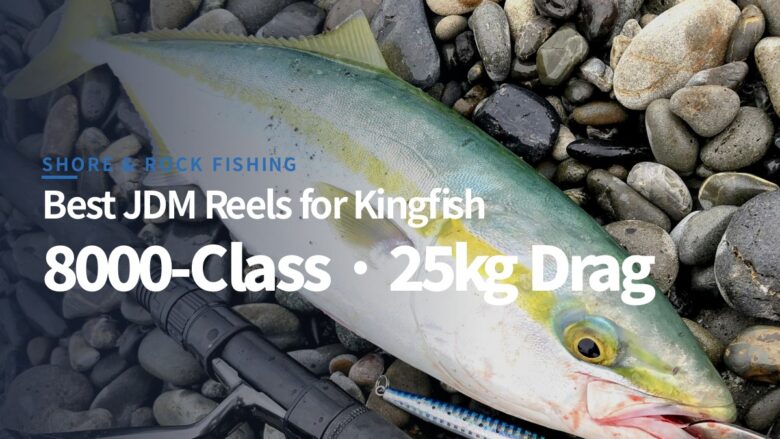
Hook a decent Yellowtail Kingfish (Seriola lalandi) off the stones and every question you had about your reel gets answered in about four seconds. Kings don’t tear off across open water like a salmon or a bonito. They turn, put their head down and drive straight back into the reef, and the fight is usually won or lost in the first ten metres. A reel that flexes, stutters or lets salt into its gears simply doesn’t survive this game for long.
So this page is built around the questions Australian anglers ask before they hand over the money. What size? How much drag? Does a flagship earn its price? Can a cheap reel do the job at all? We’ve already mapped the whole JDM (Japan Domestic Market) reel field, tier by tier, in our guide to the best JDM spinning reels for shore jigging. Here the field narrows to the big saltwater (SW) bodies, 6000 up to 8000, where drag systems, sealing and gear support are built for exactly this kind of dirty, short-range brawl.
Five JDM series answer those questions between them, from a ~A$233 workhorse to the A$1,650 benchmark, with specs pulled from Daiwa’s and Shimano’s official catalogues. If you’re still learning the basics of casting metal from the rocks, start with our shore jigging beginners guide and come back when the kings start following your jig in.
A note on links and pricing: the reels here are global or near-global models, so the buy links point to Amazon.com (available with international shipping to Australia). Prices are JDM RRP in JPY (tax excluded) with an approximate AUD conversion at the time of writing (~A$1 = ¥100, mid-2026). Always check live pricing, and check your local state regulations on kingfish size and bag limits before you head out.
This is the question that separates a kingfish reel from a general shore jigging reel, so it goes first. For salmon and tailor a 4000–5000 is plenty; for kings it usually isn’t. The 8000 class is the standard land-based kingfish size in Japan and it translates directly to Australian rock ledges. The 6000 class earns its keep around wharves, jetties and calmer washes where the fish run smaller and casting all day matters more than outright drag.
| Size class | Braid class | Where it fits |
|---|---|---|
| 6000 | PE2–3 (20–40 lb) | Jetties, wharves and calm washes; smaller school kings; all-day casting comfort |
| 8000 | PE3–5 (40–65 lb) | The standard rock-ledge kingfish size; jigs, stickbaits and live baits |
| 10000–14000 | PE5–8 (65–100 lb) | Heavy land-based game where big kings and tuna overlap; specialist territory |
Put numbers on it and the choice gets easier. An 8000 holds 300 m or more of PE3–5 (40–65 lb) braid behind a drag rated in the 20–25 kg range, which is the combination that buys you time when a fish puts its head down. A 6000 on PE2–3 is the jetty and wharf answer, and it stays comfortable through a long session of casting. Sizes of 10000 and up belong to heavy land-based game, where big kings and tuna overlap and the tackle gets specialised in a hurry.
Whatever size you land on, match it to a rod with the backbone to lift a stubborn fish; our guide to the best JDM shore jigging rods covers the heavy end of that spectrum.
Size answers half of it. The rest is what’s inside, because the fight profile is unlike anything else you cast metal at: shorter, more violent, and always angled toward structure. Five things matter most.
Less than the number on the box, applied better. The common rule of thumb is to set the drag at around a third of your line’s breaking strain, which on PE4 (~60 lb) works out to roughly 8–9 kg of pressure. Nobody fishes a 25 kg reel locked at 25 kg.
So why pay for the bigger number? Because a drag washer stack running at half its capacity stays smooth and consistent deep into a fight, while one working near its ceiling heats up and starts to grab. That gap between the pressure you actually fish and the pressure the reel is rated for is the most useful single figure to compare across the reels below.
For most Australian ledges, no. It’s still worth knowing what the money buys, because the two flagships here attack the same problem from opposite ends: Shimano refines, Daiwa armours.
Every conversation about stopping big fish on a spinning reel ends up at the Stella SW, and the 2025 redesign strengthened its case. For kingfish work the headline is the drag: a heat-sink system that sheds the warmth a long, locked-up fight generates, sitting on Shimano’s Rigid Support structure so it keeps starting smoothly deep into the fight. Infinity Drive keeps the handle turning under load that stalls lesser reels.

| Technology | Detail |
|---|---|
| Body | Aluminium HAGANE body |
| Rotor | Aluminium |
| Drive gear | HAGANE gear (extra-super duralumin), Infinity Cross tooth contact |
| Drag | Rigid Support Drag with heat-sink (X-Tough / XX-Tough) |
| Waterproofing | X-Shield + X-Protect |
| Other signature tech | Infinity Drive, Infinity Loop, Anti-Twist Fin, Silent Drive, DLC line roller |
| Model | Gear ratio | Weight | Max drag | PE capacity | Retrieve/turn | Price (excl. tax) |
|---|---|---|---|---|---|---|
| Stella SW 6000HG | 5.7 | 445 g | 13 kg | PE2-450, 4-230 | 103 cm | ¥140,000 (~A$1,400) |
| Stella SW 8000HG | 5.6 | 620 g | 25 kg | PE3-500, 5-300 | 110 cm | ¥165,000 (~A$1,650) |
| Stella SW 8000PG | 4.9 | 620 g | 25 kg | PE3-500, 5-300 | 96 cm | ¥165,000 (~A$1,650) |
Should you buy it? Only if you’ve decided land-based kings are your fish and you want to buy once. The 8000HG is the classic all-rounder for jigs and stickbaits; the PG suits live baiters. The honest downside is simple: at ~A$1,650 it costs more than many anglers’ entire rock outfit, and the reels further down this page get you most of the way there for far less.
If the Stella SW wins on refinement, the Saltiga’s pitch is brute security. The 2025 Saltiga in 8000-up sizes pairs an oversized G1 duralumin Power Digigear with the ATD TOUGH drag backed by Daiwa’s DRD dual-drag structure and full Magsealed protection, ball bearings included. Locked up on a king that’s boring for the bottom, it has that trademark solid, nothing-moves-but-the-fish feel. The 2023-generation 4000–6000 sizes carry the same DNA in a lighter casting package.

| Technology | Detail |
|---|---|
| Body | Aluminium Monocoque (MQ) |
| Rotor | Aluminium |
| Drive gear | G1 duralumin machine-cut Tough Digigear (oversized Power Digigear on 8000-up) |
| Drag | ATD TOUGH (DRD dual drag on 8000-up) |
| Waterproofing | Magsealed body, line roller and ball bearings |
| Other signature tech | Air Drive bail (4000–6000), Crank Power bail and 14 ball bearings (8000-up) |
| Model | Gear ratio | Weight | Max drag | PE capacity | Retrieve/turn | Price (excl. tax) |
|---|---|---|---|---|---|---|
| Saltiga 6000-H (2023) | 5.7 | 400 g | 15 kg | PE3-300 | 101 cm | ¥115,000 (~A$1,150) |
| Saltiga 8000-H (2025) | 5.6 | 680 g | 25 kg | PE3-460 | 110 cm | ¥155,000 (~A$1,550) |
| Saltiga 8000-P (2025) | 4.8 | 670 g | 25 kg | PE3-460 | 94 cm | ¥155,000 (~A$1,550) |
This is the drag-first answer. If your local ledge holds genuinely big kings and your nightmare is a drag fading mid-fight, the Saltiga 8000 is the tool for it. One ownership note before you commit: Magsealed units need specialised servicing rather than a home strip-down.
Between the flagships and the cheap seats sits the bracket most kingfish anglers should be shopping in, and 2026 made it a lot more interesting than it was a year ago.
Here’s the news of the year for land-based kingfish anglers on a sane budget. The new 2026 Certate SW extends the series into 8000–20000 sizes, and the 8000 brings the oversized Power Digigear, Crank Power bail and a 25 kg ATD TOUGH drag, most of the Saltiga’s stopping hardware, at ¥93,100 (~A$931). A ZAION carbon rotor keeps the rotation feel lively, and the Magseal covers both body and line roller. The 2024-generation 4000–6000 sizes round out the lighter end.

| Technology | Detail |
|---|---|
| Body | Aluminium Monocoque (MQ) |
| Rotor | ZAION carbon |
| Drive gear | G1 duralumin Tough Digigear (4000–6000) / oversized Power Digigear (8000-up) |
| Drag | ATD TOUGH |
| Waterproofing | Magsealed body (8000-up adds Magsealed line roller) |
| Other signature tech | Air Drive bail (4000–6000), Crank Power bail (8000-up) |
| Model | Gear ratio | Weight | Max drag | PE capacity | Retrieve/turn | Price (excl. tax) |
|---|---|---|---|---|---|---|
| Certate SW 6000-H (2024) | 5.7 | 375 g | 15 kg | PE3-300 | 101 cm | ¥72,700 (~A$727) |
| Certate SW 8000-H (2026) | 5.6 | 665 g | 25 kg | PE3-460 | 110 cm | ¥93,100 (~A$931) |
| Certate SW 10000-H (2026) | 5.6 | 670 g | 25 kg | PE4-380 | 117 cm | ¥93,100 (~A$931) |
It suits most serious Australian kingfish anglers, honestly. You give up the Saltiga’s DRD dual drag, its Magsealed ball bearings and five of its fourteen bearings, and you keep the 25 kg drag, the MQ body and the oversized gear. That’s flagship-grade stopping power for under A$1,000, and it’s the reel we’d point most readers of this page toward.
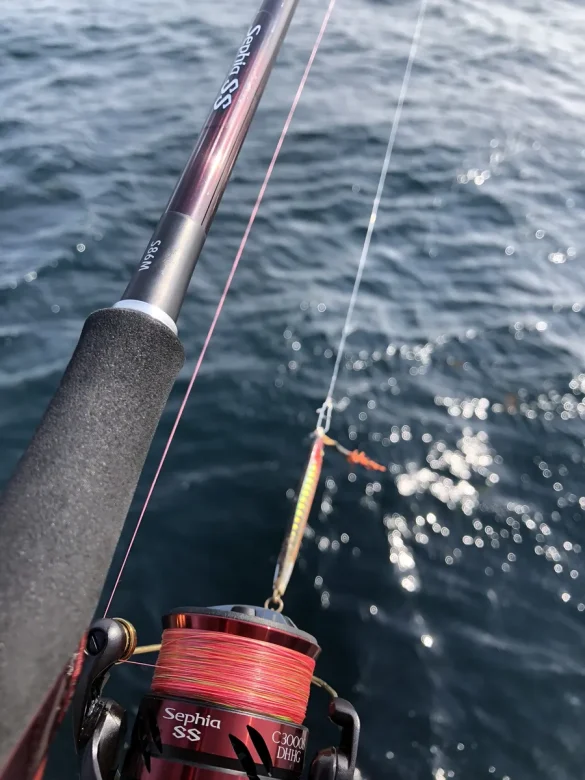
Ask around any serious land-based game community, in Japan or here, and the Twin Power SW keeps coming up. It sits one rung under the Stella SW with the same HAGANE aluminium body and the same style of heat-sink drag on a Rigid Support structure, plus Infinity Drive for cranking under load. The 2025 update keeps it comparatively simple inside, which is exactly why rock regulars trust it: it shrugs off abuse and it’s straightforward to service.
| Technology | Detail |
|---|---|
| Body | Aluminium HAGANE body |
| Rotor | Aluminium |
| Drive gear | HAGANE gear (extra-super duralumin) |
| Drag | Rigid Support Drag with heat-sink (X-Tough) |
| Waterproofing | X-Shield + X-Protect |
| Other signature tech | Infinity Drive, Silent Drive, one-piece bail |
| Model | Gear ratio | Weight | Max drag | PE capacity | Retrieve/turn | Price (excl. tax) |
|---|---|---|---|---|---|---|
| Twin Power SW 6000HG | 5.7 | 430 g | 13 kg | PE2-440, 4-220 | 102 cm | ¥68,400 (~A$684) |
| Twin Power SW 8000HG | 5.6 | 545 g | 20 kg | PE3-400, 5-240 | 108 cm | ¥78,600 (~A$786) |
| Twin Power SW 8000PG | 4.9 | 545 g | 20 kg | PE3-400, 5-240 | 95 cm | ¥78,600 (~A$786) |
Reliability over refinement is the trade here, and plenty of rock regulars make it happily. At 545 g the 8000HG is noticeably lighter than the Daiwa 8000s, and the 20 kg drag covers everything short of the biggest kings. If you like Shimano’s feel but the Stella SW price makes your eyes water, this is the sensible landing spot.
Yes, within limits worth knowing about. Not everyone wants four figures hanging off their rod over barnacle-covered rock, and these two open the door for a fraction of the price. Both offer genuine 8000 sizes rather than scaled-up small reels. The Stradic SW gives you a 20 kg drag, HAGANE body and Infinity Drive for ¥48,000 (~A$480); the BG SW is the toughest reel you’ll find anywhere near ~A$233.


| Technology | Shimano Stradic SW | Daiwa BG SW |
|---|---|---|
| Body | Aluminium HAGANE body | Aluminium |
| Rotor | High-rigidity resin | DS4 composite |
| Drive gear | HAGANE gear (extra-super duralumin), X-Ship | Tough Digigear |
| Drag | X-Tough Drag | ATD |
| Waterproofing | X-Shield (partial) + X-Protect | No Magseal (rinse with care) |
| Other signature tech | Infinity Drive | Aluminium spool |
| Model | Gear ratio | Weight | Max drag | PE capacity | Retrieve/turn | Price (excl. tax) |
|---|---|---|---|---|---|---|
| Stradic SW 6000XG | 6.2 | 455 g | 13 kg | PE2-440, 4-220 | 111 cm | ¥41,500 (~A$415) |
| Stradic SW 8000HG | 5.6 | 570 g | 20 kg | PE3-400, 5-240 | 108 cm | ¥48,000 (~A$480) |
| BG SW 8000-H | 5.7 | 605 g | 15 kg | PE3-400 | 110 cm | ¥23,300 (~A$233) |
The Stradic SW 8000HG is the pick if it’s your only kingfish reel: the drag numbers are real and the sealing is solid for the money. Know its limits though; it runs six bearings and skips the Rigid Support Drag and heat-sink of its bigger brothers, so a long, locked-up fight is asking more of it. The BG SW is for the angler starting out or wanting a spare: tough gears, honest 15 kg drag, no Magseal, so a freshwater rinse after every session isn’t optional.
Because they were built for the same fish. Australia’s Yellowtail Kingfish and Japan’s hiramasa (ヒラマサ) are the same Seriola lalandi lineage, and Japan’s rock-ledge casting scene has spent decades building tackle specifically to stop them before the reef does. That scene is exactly who the big SW reels above are designed for. A few of its habits translate directly: Japanese rock anglers size up rather than down, with the 8000 class as the default and bigger where fish or terrain demand it; they set drag to roughly a third of the line’s breaking strain and judge a reel by how smoothly it gives line late in a fight, not by the max figure on the box; and they treat the freshwater rinse after every salt session as part of the fishing, not an optional extra. Pair any reel on this page with a proper Japanese metal jig and you’re fishing a system that was refined on this exact fish.
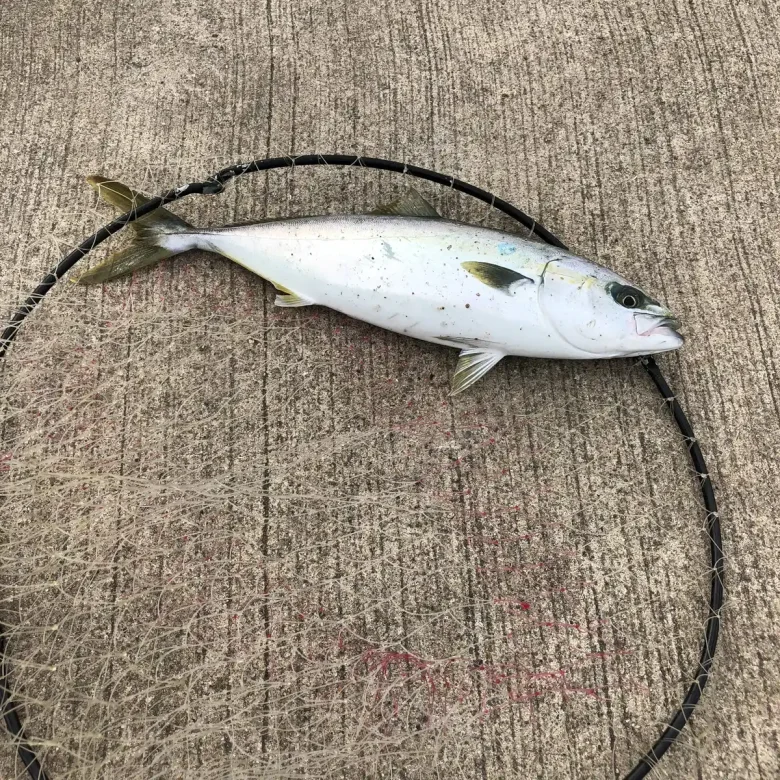
Usually, yes. The reels in this guide are global or near-global models, so Amazon.com listings ship to Australia, and JDM pricing is often sharper than local RRP, especially when the yen is weak. The trade-offs are warranty handling, since an imported reel may need to go back overseas for service, and the wait for shipping. For hard-to-find sizes, like the new 2026 Certate SW 8000-up models, importing is often the only way to get one early.
Here’s the field at a glance, using the representative kingfish size from each series.
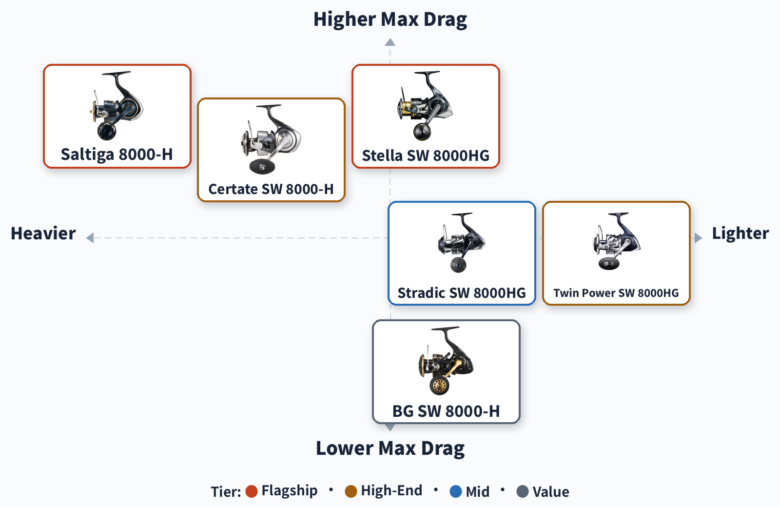
| Reel (rep. model) | Tier | Weight | Max drag | Sealing | Price (excl. tax) |
|---|---|---|---|---|---|
| Shimano Stella SW 8000HG | Flagship | 620 g | 25 kg | X-Shield + X-Protect | ¥165,000 (~A$1,650) |
| Daiwa Saltiga 8000-H | Flagship | 680 g | 25 kg | Magsealed (full, incl. bearings) | ¥155,000 (~A$1,550) |
| Daiwa Certate SW 8000-H | High-end | 665 g | 25 kg | Magsealed (body + line roller) | ¥93,100 (~A$931) |
| Shimano Twin Power SW 8000HG | High-end | 545 g | 20 kg | X-Shield + X-Protect | ¥78,600 (~A$786) |
| Shimano Stradic SW 8000HG | Mid | 570 g | 20 kg | X-Shield (partial) + X-Protect | ¥48,000 (~A$480) |
| Daiwa BG SW 8000-H | Value | 605 g | 15 kg | Unsealed body | ¥23,300 (~A$233) |
If you’d rather skip the shopping and take an answer, these three give you the most fish-stopping hardware per dollar on this page.
Top pick: Daiwa Certate SW 8000-H
The new 2026 model is the value shock of the big-reel market: a 25 kg ATD TOUGH drag, oversized Power Digigear, aluminium Monocoque body and Magsealed body plus line roller, at roughly 60% of the Saltiga’s price. For stopping rock kings, nothing under A$1,000 matches this spec sheet. ¥93,100 (~A$931).
The Shimano alternative: Shimano Twin Power SW 8000HG
The rock regular’s reel. HAGANE body, heat-sink drag on a Rigid Support structure and Infinity Drive, in the lightest 8000 here at 545 g. It gives up 5 kg of max drag to the Certate SW and gives you back easier servicing and all-day comfort. ¥78,600 (~A$786).
Best value: Shimano Stradic SW 8000HG
The cheapest reel here we’d genuinely trust on a kingfish ledge. A 20 kg drag, HAGANE body and gear, Infinity Drive and X-Protect sealing for under A$500 embarrasses reels at twice the price. Start here, upgrade only if the fish tell you to. ¥48,000 (~A$480).
Brand-wise, the pattern is the same one we unpacked in our Daiwa vs Shimano shore jigging comparison: Daiwa’s big SW reels lead on drag muscle and Magsealed waterproofing, Shimano’s on retrieve smoothness, lighter 8000 bodies and easier servicing. For kingfish specifically, here’s where we’d put our own money:
Whichever you choose, spool it with braid the reel can actually use, set the drag before you cast rather than mid-fight, and rinse it in fresh water every single session. Kings will find every weakness in your gear; the reels on this page just have fewer weaknesses to find.
For the rest of the system, see our full JDM shore jigging reel guide for the lighter sizes, our pick of the best JDM shore jigging rods to match these reels, and the shore jigging beginners guide if you’re just getting started.
All specifications were taken from the Daiwa (daiwa.com) and Shimano (fish.shimano.com) official product catalogues and product pages. Product images are from Amazon product pages and are representative of each series. Affiliate links are provided for reels available via Amazon.com with international shipping to Australia; we may earn a commission at no extra cost to you. Kingfish size and bag limits differ between states, so always check your local fishing regulations before you fish.