Tailor & Bonito on Metal Jigs: Light Jig Tactics for AU Pelagics
ちゃんま
マイボ!

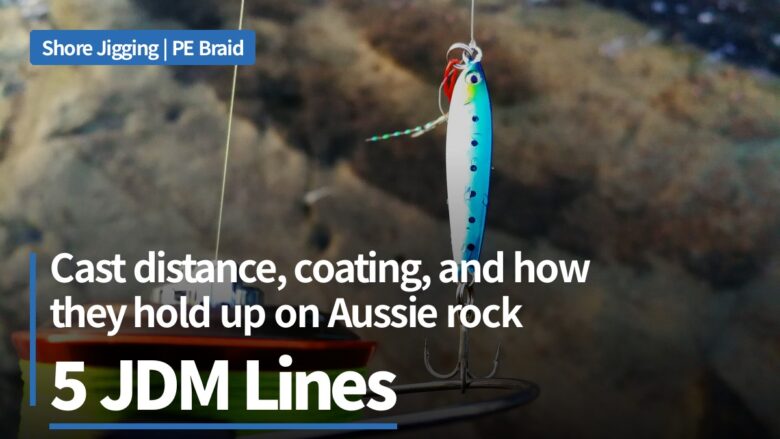
A shore jigging session is mostly casting. You work a headland for two hours, put a hundred casts through the guides, and the line spends every one of them scraping out over the tip, across barnacle, and back through wet sand. The braid is the part of the outfit doing the most work per hour, and it’s the part most of us replace by habit rather than by choice.
We bought a boat a few years back and thought we’d stop fishing from the bank once it arrived. That didn’t happen. What the bank has, and the boat doesn’t, is that you can swing the rod as hard as you like, full swing, every cast. The other thing is that the spots you can reach are limited, and it’s the limits that make it a game: from the boat the range is so wide it’s hard to narrow anything down. That’s all Seto Inland Sea and Osaka Bay water, not Australian rock, but it’s why the first thing we look at on a shore braid is what the maker did to the surface.
Japanese domestic braid is usually sold on open pricing, so the RRP column below is mostly empty by the maker’s own choice. Where a price is published it’s the Japanese RRP in JPY, tax excluded, with an approximate AUD conversion at A$1 ≈ ¥110.4, September 2026. Every line here links to Amazon Japan, which ships internationally: check availability and shipping cost at checkout, and orders over A$59 may qualify for free international delivery.
Most of the braid on an Australian shelf is already Japanese. Shimano’s Kairiki 8 is made in Japan and sold into export markets under a metric spec sheet; Daiwa’s J-Braid X8 is a global line built on Japanese fibre; Dangan, Braid X Cross 8 and Pandora sit in the same bracket. The Shimano and the Daiwa both link to Amazon.com with international shipping to Australia, and both will be on your spool this weekend rather than in three weeks.
What the local shelf doesn’t carry is the shore-specific build. Japanese makers split their braid by where you’re standing: a casting line, a jigging line, an eging line, each with a different coating and a different marking scheme. You’re not importing better fibre, you’re importing a version that was designed for casting rather than for dropping. That’s worth freight if you fish the rocks every weekend, and probably isn’t if you fish four times a summer.
Line choice also depends on what the rod will let you throw. If you’re still settling the outfit, our guide to JDM shore jigging rods covers the casting weights these braids get paired with, and the shore jigging beginner’s guide covers the rest of the setup.
The braid doesn’t add distance on its own. What changes your distance is how cleanly the line leaves the spool and clears the guides, which comes down to the surface treatment and how tightly the eight strands are packed. Two of the five lines here are built around that specifically, and both makers say so on the product page rather than leaving you to guess.
This is Varivas’s shore casting line, and it’s a different product from the Avani Jigging 10×10 that offshore anglers know. Varivas built it around three things: reaching a bust-up that’s forming out past your usual range, surviving repeated full casts, and holding together when something unexpected turns up. The fibre is their MAX-PE yarn, which Varivas rates at 1.3 to 1.5 times the tensile strength of ordinary PE, so a given breaking strain arrives on a thinner line.

The coating is the part that matters for range. SP-V is a fluorine-free water-repellent film over the braid, and Varivas credits it with both reduced water absorption over the line’s life and less drag through the guides. The line colour is solid white with no markings at all, chosen so you can track the lure’s path against any sky.
| What’s in it | What Varivas claims it does |
|---|---|
| MAX-PE yarn | 1.3 to 1.5× the tensile strength of standard PE yarn, so the same strength sits on a thinner line |
| SP-V coating | Fluorine-free repellent film: holds off water absorption, adds abrasion resistance, and improves casting distance |
| Eight strands under the SP-V film | A surface Varivas describes as silk-smooth, cutting the resistance the line meets in the guides |
| Solid white colour | Traceable in most light without depth marks interrupting it |
Varivas now sells a nine-strand Shore Master alongside the X8, and the two are easy to mix up in a search result. The X9 uses a different build: a high-strength core wrapped in MAX-PE yarn, a vertical braid that Varivas puts at stretch in the 3% range, and an SP-TⅡ resin coating instead of SP-V. The X9 isn’t simply the stronger line at every size. At 0.6 it’s rated a touch below the X8; from 0.8 up it’s rated above. Both come in 200m spools only, both are solid white, and both are open-priced.
| PE size | X8 Shore Master max lb | X9 Shore Master max lb |
|---|---|---|
| 0.6 | 14.5 | 14 |
| 0.8 | 16.7 | 18 |
| 1 | 20.2 | 23 |
| 1.2 | 24.1 | 25 |
| 1.5 | 28.6 | 33 |
| 2 | 33 | 39 |
Toray spins the fibre before anyone braids it, and the Super Strong PE X8 is what the fibre maker sells under its own name. Toray’s pitch for it is surface finish rather than coating chemistry: a dense, smooth outer face that slides through the guides, which they connect directly to casting distance and to how the lure handles at range. It’s the one line here Toray publishes an average breaking strain for rather than a maximum, which is a more conservative number to shop against.

| What’s in it | What Toray claims it does |
|---|---|
| Eight-strand balanced build | Strength and sensitivity held up without losing the suppleness that makes it easy to handle |
| High-density smooth surface | Better guide slip: more distance on the cast, better control of the lure |
| Five-colour marking | Purple, red, green, pink and blue, changing every 10m |
| PE size | Average lb | Average kg | Spools |
|---|---|---|---|
| 0.6 | 11 | 5.2 | 200m, 100m×12 joined |
| 0.8 | 13 | 6.1 | 150m, 200m, 100m×12 joined |
| 1 | 17 | 8.1 | 150m, 200m, 100m×12 joined |
| 1.5 | 21 | 9.6 | 150m, 200m, 100m×12 joined |
| 2 | 30 | 13.6 | 150m, 200m, 100m×12 joined |
| 3 | 44 | 20 | 150m, 200m, 100m×12 joined |
| 4 | 50 | 22.8 | 200m, 100m×12 joined |
Abrasion is where shore fishing differs from every other use of braid. A jig fished from a boat meets water; a jig fished off a ledge meets the ledge, and so does the last ten metres of your main line every time you lead a fish in. Two makers here treat that as the design problem rather than a side effect, and both publish what they did about it.
Hard Bull is the stiff one. Shimano braids it from Honeywell’s Spectra fibre, which uses a thicker individual filament than most PE yarn, then finishes it with what they call MX2: a hardened, high-crystallinity outer layer with a silicone coating over the top. In Shimano’s own underwater abrasion test, run until the line parts, Hard Bull lasted around three times as long as a general PE line. They make the point that line wears out underwater rather than in the air, which is why the test was run wet.

The stiffness is the other half of it, and it cuts both ways. Line that holds its shape doesn’t lift off the spool in a breeze and doesn’t loop itself around a guide on a windy headland, which on an exposed rock platform is worth as much as the abrasion figure. It also feels less supple on the retrieve than anything else in this list, and if you fish very light jigs on a soft tip you’ll notice it. Shimano is also the only maker of the five to publish a price.
| What’s in it | What Shimano claims it does |
|---|---|
| Honeywell Spectra fibre | Thicker individual filaments than standard PE yarn, which Shimano ties directly to abrasion life and stiffness |
| MX2 construction | Forms a high-crystallinity layer on the outer filaments: harder surface, lower stretch |
| Silicone surface coating | Sheds water and improves line handling |
| Stiffness by design | Fewer guide tangles, less spool lift, fewer wind knots |
| PE size | Max lb | Max kg | Spools and JDM RRP (tax excl.) |
|---|---|---|---|
| 0.6 | 13.8 | 6.3 | 100m ¥1,950 (~A$18) / 150m ¥2,950 (~A$27) / 200m ¥3,600 (~A$33) / 300m ¥5,100 (~A$46) |
| 0.8 | 19.5 | 8.9 | Same four spool sizes and prices |
| 1 | 20.6 | 9.3 | Same four spool sizes and prices |
| 1.2 | 23.4 | 10.6 | Same four spool sizes and prices |
| 1.5 | 28.7 | 13 | Same four spool sizes and prices |
| 2 | 46.9 | 21.3 | Same four spool sizes and prices |
| 3 | 62.7 | 28.5 | 100m / 150m / 200m / 300m |
| 4 | 82.6 | 37.4 | 100m / 150m / 200m / 300m |
| 5 | 99 | 44.9 | 100m / 150m / 200m |
| 6 | 103.4 | 46.9 | 100m / 150m / 200m |
YGK set out the trade-off on the product page rather than leaving it implied. Pack the braid tightly and you gain abrasion resistance and lose straight-line strength; braid it loosely and you gain straight-line strength and lose abrasion resistance. Upgrade X8 is YGK’s attempt to hold both ends at once, using a high-density pitch, their WX8 weave, and two finishing treatments they label GP and HST.

It’s also the one line here with a marking scheme fine enough to be useful from the shore. The line is green with a 15cm white mark every single metre, so you can count how far a cast went, or how much line a fish has taken, without waiting for a colour to change. YGK added a 100m spool to the range in March 2026, which suits anyone topping up a shallow spool rather than filling a 4000 from bare.
| What’s in it | What YGK claims it does |
|---|---|
| High-density pitch braiding | Raises abrasion resistance, which normally costs straight-line strength |
| WX8 weave | Holds the straight-line strength that dense braiding usually gives away |
| GP and HST treatments | YGK’s finishing processes, credited with the balance between the two above |
| Specific gravity 0.98 | Floats, in line with conventional PE |
| PE size | lb | Available in |
|---|---|---|
| 0.6 | 14 | 100m, 150m, 200m |
| 0.8 | 16 | 100m, 150m, 200m |
| 1 | 22 | 100m, 150m, 200m |
| 1.2 | 25 | 150m, 200m |
| 1.5 | 30 | 100m, 150m, 200m |
| 2 | 40 | 100m, 200m |
| 2.5 | 45 | 200m |
| 3 | 50 | 100m, 200m |
| 4 to 6 | 65 to 93 | 100m only |
If you’re fishing the lighter end of this, where 0.6 and 0.8 do the work and an abrasion figure matters more than a breaking strain, our super light shore jigging piece covers where those sizes sit, and the light shore jigging guide covers the step up from there.
From a boat, colour changes every 10m tell you how deep the jig is. From the shore they tell you how far it went, which is a slower, coarser piece of information: a 60m cast and a 69m cast look identical. That’s why YGK’s metre marks are the more useful scheme for casting, and why a solid white line like the Varivas is a defensible choice too, since it lets you watch the lure’s path instead of counting.
Duel builds the Hardcore X8 on what they call Micro Pitch braiding: ultra PE packed tighter than a four-strand, finished soft rather than stiff, which Duel links to knot strength when you’re tying an FG on a wet rock. The 150m spools come in a single colour, silver or milky blue; the 200m and 300m spools carry the 10m five-colour marking, and Duel’s own target list for those marked spools includes shore-based kingfish and other pelagics.

Duel is the only one of these five makers to publish a standard diameter in millimetres for every size. If you’ve been running 20lb braid bought in Australia and want to land on the same thickness in a Japanese PE number, this is the only one of the five that lets you check rather than assume. Duel also publishes a standard strength alongside the maximum, so you get both the conservative and the optimistic figure on one page.
| What’s in it | What Duel claims it does |
|---|---|
| Micro Pitch 8 Braided | Ultra PE packed tighter than a four-strand: strong and still supple |
| Silky Power | Precise braiding for consistent strength, and a smooth surface that makes knots easier to seat |
| Specific gravity 0.97 | Floats slightly higher than the YGK at 0.98 |
| Marking by spool length | 150m single colour; 200m and 300m in 10m × 5 colours |
| PE size | Standard diameter (mm) | Standard strength (kg) | Max straight-line (lb / kg) | Spools |
|---|---|---|---|---|
| 0.6 | 0.132 | 4.5 | 13 / 5.8 | 150m, 200m |
| 0.8 | 0.153 | 6 | 16 / 7 | 150m, 200m, 300m |
| 1 | 0.171 | 7.5 | 20 / 9 | 150m, 200m, 300m |
| 1.2 | 0.191 | 8.8 | 27 / 12 | 150m, 200m, 300m |
| 1.5 | 0.209 | 10 | 30 / 13.5 | 150m, 200m, 300m |
| 2 | 0.242 | 13.5 | 35 / 16 | 150m, 200m, 300m |
| 2.5 | 0.27 | 17 | 45 / 20 | 300m |
| 3 | 0.296 | 20 | 50 / 23 | 300m |
| 4 | 0.342 | 26 | 60 / 27 | 300m |
Which PE number you actually want depends on what’s swimming past your rocks. Our breakdown of shore jigging target species in Australia sets out the sizes fourteen common species call for.
| Line | Surface treatment | Marking | Spool lengths | JDM RRP (tax excl.) |
|---|---|---|---|---|
| Varivas Avani Casting PE Max Power X8 Shore Master | SP-V, fluorine-free repellent film | None, solid white | 200m | Open price |
| Varivas Avani Casting PE Max Power X9 Shore Master | SP-TⅡ resin film, nine strands | None, solid white | 200m | Open price |
| Toray Super Strong PE X8 | High-density smooth surface | 5 colours every 10m | 150m, 200m, 100m×12 joined | Open price |
| Shimano Hard Bull 8+ | MX2 hardened layer plus silicone | Solid, or 5 colours every 10m | 100m, 150m, 200m, 300m | ¥1,950 to ¥5,100 (~A$18 to A$46) |
| YGK X-Braid Upgrade X8 | High-density pitch, GP and HST | 15cm white mark every 1m | 100m, 150m, 200m | Open price |
| Duel Hardcore X8 | Micro Pitch braiding, soft finish | Solid at 150m, 5 colours every 10m at 200m and 300m | 150m, 200m, 300m | Open price |
The only line here with a mark every metre, which is the piece of information a shore angler actually uses. YGK’s whole argument for the line is the abrasion-versus-strength trade-off that shore fishing forces on you, and they publish the reasoning rather than the slogan. The 100m spool added in 2026 makes it the cheapest of these to try without committing to a full respool.
The only line in this group with a price you can plan a purchase around, freight aside. The three-times abrasion figure comes from a published underwater test rather than a marketing line, and the stiffness that costs it some feel on the retrieve is exactly what keeps loops out of the guides on an exposed platform in wind.
If you want distance above everything, the Varivas Shore Master is the line built for that job and nothing else, in either the X8 or the X9. If you want to know how far the cast went, the YGK. If you want a number in millimetres to check against the braid already on your reel, the Duel. If you fish a wind-blown platform and hate picking out wind knots, the Shimano. The Toray sits in the middle of all of it, from a company that makes the fibre everyone else buys.
Whatever ends up on the spool, the braid is only the first half of the rig. The knot, the leader and what’s tied on the end decide the rest, and our guide to JDM assist hooks and terminal tackle picks up from there.
For what goes on the end of the braid, see the fluorocarbon shock leaders that go on the end.