Best JDM Reels for Kingfish: Shore & Rock Fishing
ちゃんま
マイボ!

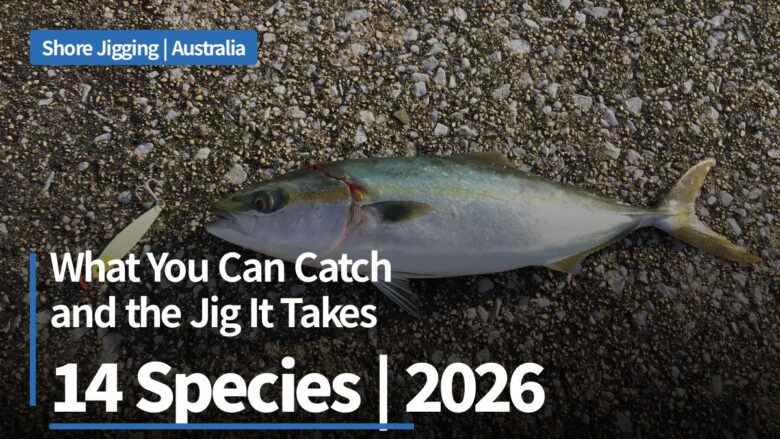
Every shore jigging guide gets around to a species list sooner or later, and they all read about the same: kingfish, salmon, tailor, bonito, snapper, mulloway. Useful up to a point. What the list never tells you is which of those fish the outfit already in your garage can actually land, and which one is going to empty a spool while you stand there watching.
Shore jigging in Australia spans a far wider weight range than most people realise. At the fine end sits super light shore jigging (SLSJ), the Japanese term for casting metal jigs under 20 grams. In the middle is light shore jigging (LSJ), the 20 to 60 gram band that does most of the work on this coast. Above that are the 60 gram and heavier metals people throw off deep ledges at kingfish. The fish decides which of the three you’re fishing, not your preference.
If you’re new to the style, our shore jigging beginner’s guide for Australia covers the outfit and the casting, and the month-by-month shore jigging calendar covers when each of these fish turns up. Size limits, bag limits and seasonal closures differ between states and change from year to year, so check your local fisheries rules before you keep anything.
Australian salmon, tailor, bonito and yellowtail kingfish. Between them they cover most of the coastline and most of the calendar, they all eat a fast metal, and three of the four sit comfortably inside a single 20 to 60 gram outfit. Kingfish are the exception. A kingfish is the only common shore jigging target that genuinely punishes light gear, because it heads for structure the instant it’s hooked and it doesn’t stop to negotiate.
Everything else is either a regional specialty, a fish you meet on the fall rather than the retrieve, or a real step up in class.
Australian salmon come in two species, and the difference matters more than most guides admit. The eastern fish (Arripis trutta) has a common length of 47 cm and a maximum published weight of 9.4 kg (FishBase). The western fish (Arripis truttaceus) is the bigger animal, common length closer to 65 cm and a maximum published weight above 10 kg (FishBase). Both feed in schools you can often see: working birds, a dark nervous patch in a gutter, bait showering out of the water. Both eat a 20 to 40 gram slim jig wound flat and steady.
Tailor (Pomatomus saltatrix) live in much the same water and hit the same jigs, but the business end of your rig changes completely. They have teeth that cut fluorocarbon like cotton, and a session that starts with three bite-offs in ten casts is a session where the trace needed sorting before you left home. Our tailor and bonito jig guide works through the wire versus heavy fluoro trade-off, and the JDM assist hook and terminal tackle guide deals with the hardware between jig and leader.
On the salmon side, our comparison of metal jigs for Australian salmon splits the options by whether you’re covering a distant beach gutter or working close wash off the rocks. These two fish are why a 30 to 40 gram jig lives permanently on most Australian shore rods. PE 1.0 to 1.5 braid with a 20 to 30 lb leader handles both without leaving you undergunned.
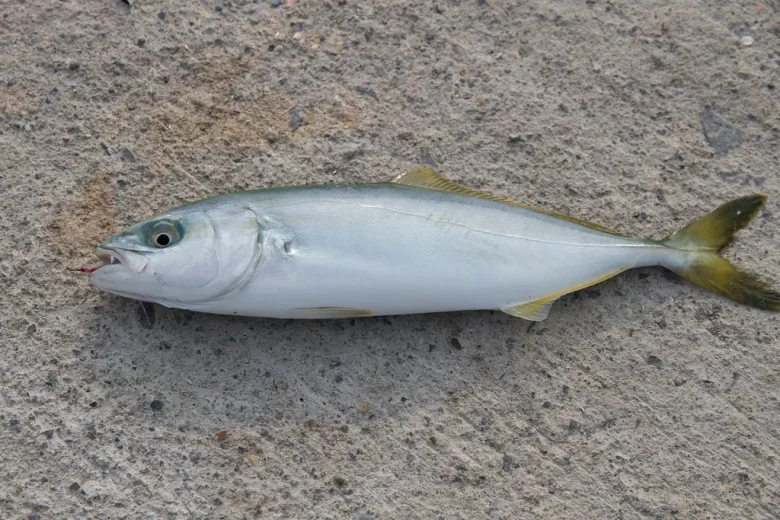
Yellowtail kingfish (Seriola lalandi) hold around deep rock ledges, breakwalls and harbour structure, which is exactly the problem. Hook one and its first run goes straight back to the kelp or the pylon it came out of, and there’s no second chance to tighten a drag you set too soft. From the shore you’ll meet far more small fish than large ones, and the gear still has to be built around the large ones.
The practical band is 40 to 80 gram jigs on PE 2 to 4 braid, a 40 to 60 lb leader, and a reel with a sealed drag you trust under sustained load. Our comparison of JDM reels for kingfish goes through the drag numbers that matter, the kingfish jig comparison puts eight Japanese metals side by side with their official weights and lengths, and the JDM shore jigging rod guide covers the blanks built for rock ledge work.
The ledges that produce kingfish are also the ledges that get people killed. Wear a life jacket, watch the sets for twenty minutes before you commit, and treat a landing net or a fishing partner as part of the kit rather than an optional extra.
Australian bonito (Sarda australis) crash bait against east coast rocks and breakwalls, and they’ll take a jig wound as fast as you can physically turn the handle. Mackerel tuna (Euthynnus affinis) grow to about 100 cm and 13 kg (FishBase), though the ones that turn up inside casting range are usually a good deal smaller, and they arrive in the same water with a nastier turn of pace. Neither wants a heavy jig. They want a slim profile moving quickly, which usually means a 30 to 60 gram metal chosen for how it casts rather than how it sinks.
Longtail tuna (Thunnus tonggol) are where some honesty is required. NSW Fisheries puts the species at 1.5 m and 32 kg at the top end, with the majority of angler-caught fish under 15 kg. Even a 12 kg fish on a 4000 reel and PE 1.5 is a long argument you usually lose, and losing it means a fish swimming off with a jig in its face. If longtails are genuinely on your list, that’s a PE 3 to 4 outfit with real line capacity, not a salmon rod with optimism attached.
With all three, the upgrade is about the fish’s weight and endurance, never about the jig. How heavy to go for the depth and current in front of you is a separate call, and our guide to metal jig weight and colour for Australian conditions sets out the rules for it.
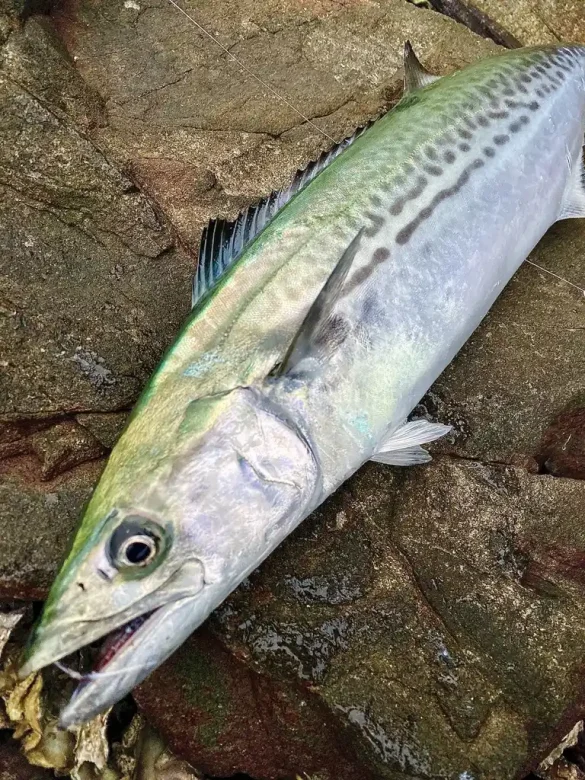
North of roughly the mid-NSW coast, two mackerel enter the picture. Spotted mackerel (Scomberomorus munroi) are the smaller and more approachable of the pair, feeding on small bait and often taking a 20 to 40 gram jig on standard light shore jigging gear. Spanish mackerel (Scomberomorus commerson) are the serious version: bigger, faster, and equipped with the kind of dentistry that removes a jig and half a metre of leader in one pass.
Both put you back in front of the trace question. Run wire and you keep more jigs; run heavy fluorocarbon and you get more bites but pay for some of them. Plenty of anglers start on fluoro and switch after the first bite-off. Spanish mackerel carry rules that have changed repeatedly in recent years across several states, so check the current limits and any closure before you plan a trip around them.
Giant trevally (Caranx ignobilis), GTs to most people, sit at the top of the land-based weight class in the tropics, patrolling headlands and reef edges where a hooked fish has somewhere unpleasant to go. GTs don’t break line so much as straighten hardware. Split rings, assist hooks and the ring on the jig’s nose fail first.
Silver trevally (Pseudocaranx georgianus) are the same family at the other extreme. They hold in southern bays, around breakwalls and under jetties right through the cold months, and they eat micro jigs of 5 to 20 grams on gear light enough to feel a bite on the drop. That’s SLSJ territory, and it overlaps almost exactly with Japanese light game tackle. Our super light shore jigging guide takes the sub-20 gram technique apart, and the LRF setup for bream and trevally gets into the rod, reel and line that fish it.
The pelagics above eat on the retrieve. This group eats on the fall, and that one difference changes how you fish a metal. Snapper (Chrysophrys auratus) come within range off deep breakwalls and ledges over broken bottom, mostly at first and last light, and they want a jig worked slowly with bottom contact rather than ripped through the middle of the column. Our guide to Japanese snapper lures for Australian water weighs kabura heads against micro jigs together, since the two overlap more than people expect.
Mulloway (Argyrosomus japonicus) turn up on metals around river mouths, breakwalls and night tides, though plastics and vibes account for far more of them. If mulloway are the target rather than a bonus, the tackle question is a different one, and our JDM rods and reels for mulloway guide sets out four outfits for four kinds of water.
Dusky flathead (Platycephalus fuscus) and yellowfin bream (Acanthopagrus australis) round out the light end. Flathead sit on sand near drop-offs and channel edges and take a micro jig hopped off the bottom. Bream hold tight to rock walls and jetty pylons and want something smaller still, down around 3 to 10 grams. Neither is a traditional jigging target in Australia, which is precisely why they’re worth knowing about. A micro jig turns a blown-out pelagic session into a fishable one instead of a drive home. Lure options for each are in our JDM flathead lure guide and JDM bream lure guide.
Four things settle it, and none of them is the fish’s reputation.
That last one deserves a word from home water. Back in Japan my autumn goes on hairtail from the shore, tenya rigs off the breakwall, roughly September through November, and the catch rate is usually pretty dependable. Once word goes round that they’ve started, they generally keep coming for a while. Something’s sitting there, I assume. The other dependable thing is the switch: they come on the moment it goes dark, and if you fish through to dawn they stop the instant the sky starts to lighten.
The transferable part isn’t the hairtail. It’s that arriving after the reports beats trying to beat them. A run that’s been announced usually has some time left in it, while guessing at one that hasn’t started yet mostly buys you a long drive and an empty session.
Weights are what most anglers settle on at average shore depths. Go heavier when current or wind is beating you, lighter when the bait is small.
| Species | Where it holds within casting range | Jig weight | Tackle class | What the retrieve wants |
|---|---|---|---|---|
| Australian salmon (Arripis trutta / A. truttaceus) | Surf gutters, washy rock, breakwalls | 20 to 40 g | LSJ, PE 1.0 to 1.5 | Fast, steady wind |
| Tailor (Pomatomus saltatrix) | Salmon water plus estuary mouths | 20 to 40 g | LSJ, PE 1.0 to 1.5, bite-proof trace | Fast wind with sharp jerks |
| Australian bonito (Sarda australis) | East coast rock ledges and breakwalls | 30 to 60 g, slim | LSJ, PE 1.5 | Flat out, no pauses |
| Mackerel tuna (Euthynnus affinis) | Headlands and deep walls, north and central | 30 to 60 g, slim | LSJ to heavy, PE 2 | Flat out, small profile |
| Longtail tuna (Thunnus tonggol) | Northern headlands and deep platforms | 40 to 80 g | Heavy, PE 3 to 4 | Cast at the school, wind fast |
| Yellowtail kingfish (Seriola lalandi) | Deep ledges, breakwalls, harbour structure | 40 to 80 g | Heavy, PE 2 to 4 | Fast lift and wind near structure |
| Spanish mackerel (Scomberomorus commerson) | Northern headlands and deep jetties | 40 to 60 g | Heavy, PE 3 plus, wire or heavy trace | Fast, high in the column |
| Spotted mackerel (Scomberomorus munroi) | Northern headlands on small bait | 20 to 40 g | LSJ, PE 1.5, light trace | Fast, small profile |
| Giant trevally (Caranx ignobilis) | Tropical headlands and reef edges | 60 to 100 g | Heavy, PE 4 plus, upgraded hardware | Fast, and expect the hit at your feet |
| Silver trevally (Pseudocaranx georgianus) | Southern bays, breakwalls, jetties | 5 to 20 g | SLSJ, PE 0.4 to 0.8 | Short hops and a long fall |
| Snapper (Chrysophrys auratus) | Deep breakwalls and ledges over broken bottom | 20 to 40 g | LSJ, PE 1.0 to 1.5 | Slow lift with bottom contact |
| Mulloway (Argyrosomus japonicus) | River mouths, breakwalls, night tides | 20 to 40 g | LSJ, PE 1.5 to 2 | Slow and close to the bottom |
| Dusky flathead (Platycephalus fuscus) | Sand near drop-offs and channel edges | 5 to 20 g | SLSJ, PE 0.4 to 0.8 | Hop off the bottom, then let it fall |
| Yellowfin bream (Acanthopagrus australis) | Rock walls, jetty pylons, estuary edges | 3 to 10 g | SLSJ, PE 0.4 to 0.6 | Tiny hops, and watch the fall |
Distribution and peak timing shift by state and by year. Treat the table as a starting framework and let local reports and water temperature adjust it.
Same spot I always fish, same place along the wall, same lure, same tackle, same retrieve I’ve caught on a hundred times. Nothing. Not a touch. Depending on how the tide is running and which day of the month it happens to be, there are days when nothing works, and swapping jigs doesn’t fix it.
My excuse is always that the fish weren’t there. Look, nobody else was catching either, so I’m sticking with it. Whether the anglers around you are catching is the most useful information available on the whole trip: if the entire wall is blank, it’s the day, and if two blokes along from you keep hooking up, it’s you.
Small ones, regularly. Rat kings around breakwalls and harbour structure sit well inside a PE 1.5 outfit as long as you’re not fishing tight to something. It’s the better fish, hooked beside the structure it lives in, that ends the conversation early. Fishing kingfish water on salmon gear means losing the occasional good one, which is fine if it’s a decision rather than a surprise.
No. Weight, profile and speed do almost all the work, and all three answer to the water and the bait rather than the fish’s name. A box of 20, 30, 40 and 60 gram jigs in a slim and a compact shape covers ten of the fourteen species here. The gaps are the sub-20 gram end for bream, flathead and silver trevally, and the 60 gram plus end for GT.
Longtail tuna and giant trevally, for opposite reasons. Longtails demand the right headland in the right month with a school inside casting range, and that window is narrow. GTs are less about finding the fish than surviving the fight once you have. Neither is a fair first target.
One outfit covers most of it. A 9 to 10 foot rod rated 20 to 60 grams, a 4000 size reel and PE 1.5 to 2 will handle salmon, tailor, bonito, spotted mackerel, snapper, mulloway and modest kingfish. A second, lighter rod for the SLSJ species costs less than upgrading that one, and opens up more days than it closes. The LSJ guide sets out where the middle band starts and stops.
Pick the species that suits the depth in front of you, then let the jig weight and tackle class follow. Most people work the other way round, buying gear for the fish they want and then hunting for water that suits it.
Fourteen species is a long list, and no single stretch of coast holds all of them. What every stretch of Australian shoreline does hold is two or three, in some month of the year, that will eat a metal jig thrown from dry land.