Australian Salmon on Metal Jigs: Light Jig Selection
ちゃんま
マイボ!

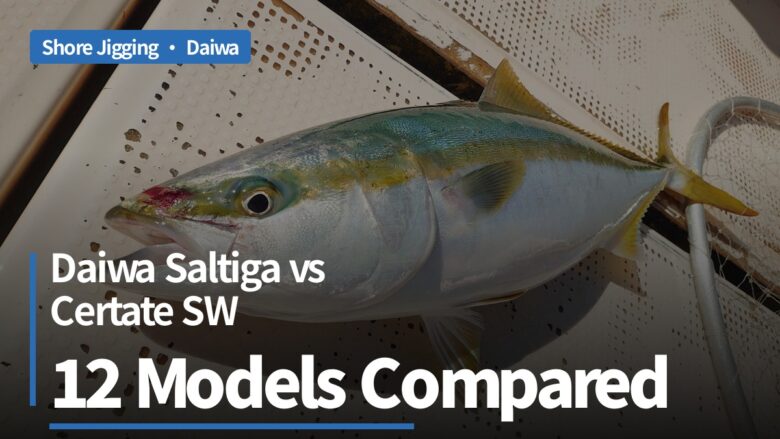
Daiwa Australia runs a public question page, and twice now an Australian angler has walked up to it and asked the same thing: Saltiga or Certate SW, same size, which one? The first question, in November 2024, came from someone fishing jigs inshore and off the rocks. It’s still sitting there unanswered. The second, in December 2025, got a reply about a year later suggesting the buyer go with personal preference and budget.
That’s a perfectly reasonable thing for a brand to say. It’s also no help at all when the two reels sit somewhere between A$460 and A$500 apart, depending on the size, and the spec sheets look almost identical. So here’s the version with numbers in it.
One warning before the tables. “Certate” isn’t one reel, it’s three, and only one of them is built for swinging metal off a headland. Get that wrong and the rest of the comparison doesn’t matter.
A word on the prices. JDM (Japan Domestic Market) means the model as Daiwa sells it at home, so the JDM figures below are the Japanese RRP in JPY (tax excluded) with an approximate AUD conversion at A$1 ≈ ¥114.6, September 2026, shown alongside the Australian RRP from Daiwa Australia. Available on Amazon.com with international shipping to Australia. The Certate HD links go to Amazon Japan, which ships internationally, so check availability and shipping cost at checkout. Orders over A$59 may qualify for free international delivery.
Three separate series carry the name in Japan right now, and they don’t overlap much. LT in the model codes is Daiwa’s “Light & Tough” chassis, used across its lighter lure reels. SW means saltwater. HD is the heavy-duty version of the LT chassis, new for 2026.
| Series | Sizes | JDM RRP (tax excl.) | What Daiwa built it for |
|---|---|---|---|
| 24 Certate (LT) | LT2500 to LT5000D | ¥55,600 to ¥61,600 | Light lure fishing. ATD TYPE-L drag, ZAION rotor, 200 to 290 g |
| 26 Certate HD | LT3000 to LT5000D | ¥79,500 to ¥88,000 | Boat light jigging and tai rubber. Aluminium rotor, ATD TOUGH |
| 24 / 26 Certate SW | 4000 to 20000 | ¥67,000 to ¥104,500 | Saltwater casting and jigging. The one that lines up against Saltiga |
The plain LT Certate is out of this discussion. It’s a lovely reel and it will handle salt, but its drag stack and its build are aimed at finesse work, not at eighty-gram jigs and fish that go straight for the barnacles. We won’t cover it again below. That leaves the Certate SW as the genuine Saltiga rival, and the Certate HD as an edge case worth twenty seconds of your time before you dismiss it.
Daiwa Australia’s own product copy answers this more honestly than most reviews do. It describes the 24 Certate SW as built on the 23 Saltiga’s foundations, with the ZAION carbon composite rotor as the thing that separates them. In other words: same body, cheaper rotor material, most of the same parts list.

The range comes in two generations. The 24 covers 4000 to 6000 and is the shore jigging half. The 26 covers 8000 up and is the first non-Saltiga reel to get Daiwa’s POWERDRIVE gear train, with a larger, thicker drive gear and a roller-supported oscillation that Daiwa rates at 20% better winding efficiency.
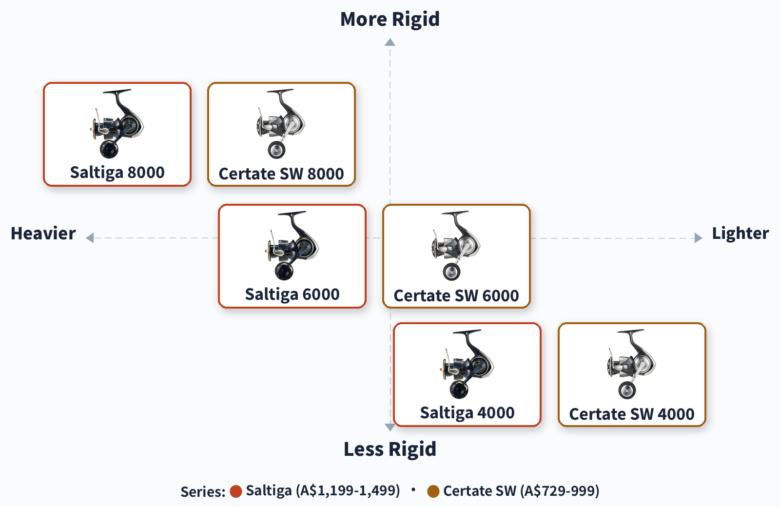
Two things stand out once you line the spec sheets up. Max drag is identical to the Saltiga at every size the two series share: 12 kg at 4000, 15 kg at 5000 and 6000, 25 kg from 8000 to 14000. And the Certate SW is the lighter reel in every one of those sizes, by 10 to 25 g. Through the 24 sizes that gap widens as you climb, to 375 g against 400 g at the 6000, which you notice by mid-afternoon.
Key technologies
| Body | One-piece aluminium MONOCOQUE (MQ) body, no side plate or screws |
| Rotor | ZAION AIRDRIVE ROTOR on the 24 (4000 to 6000); ZAION rotor on the 26 (8000 up). ZAION is Daiwa’s carbon composite |
| Gearing | 24: TOUGH DIGIGEAR in G1 Duralumin. 26: oversized POWERDRIVE DIGIGEAR |
| Drag | ATD TOUGH |
| Sealing | MAGSEALED body and main shaft (magnetic oil seal); MAGSEALED line roller on the 26 sizes only |
| Bail | AIRDRIVE BAIL on the 24; CRANK POWER BAIL on the 26 |
| Bearings | 10 ball + 1 roller on the 24; 9 ball + 1 roller on the 26 |
Key specs (JDM RRP tax excluded, plus Daiwa Australia RRP)
| Model | Gear Ratio | Max Drag | Weight | PE Capacity | Retrieve | JDM Price | AU RRP |
|---|---|---|---|---|---|---|---|
| 4000-H | 5.7 | 12 kg | 335 g | PE 2-300 | 90 cm | ¥67,000 (~A$585) | A$729 |
| 5000-H | 5.7 | 15 kg | 345 g | PE 2.5-300 | 96 cm | ¥70,400 (~A$614) | A$729 |
| 6000-H | 5.7 | 15 kg | 375 g | PE 3-300 | 101 cm | ¥72,700 (~A$634) | A$789 |
| 8000-H | 5.6 | 25 kg | 665 g | PE 3-460 | 110 cm | ¥93,100 (~A$812) | A$999 |
| 10000-H | 5.6 | 25 kg | 670 g | PE 4-380 | 117 cm | ¥93,100 (~A$812) | A$999 |
| 14000-XH | 6.2 | 25 kg | 675 g | PE 5-340 | 133 cm | ¥93,100 (~A$812) | A$999 |
Read the sealing line in the table again, because it’s the one real gap. Daiwa lists MAGSEALED on the body and main shaft across the whole Certate SW range, but the line roller only gets it on the 26 sizes, from 8000 up. If you fish white water off the stones, the line roller is the bearing that dies first. The Saltiga seals it in every size. That’s worth more than the bearing count on the box.
Not stopping power. Not line capacity, not retrieve per turn, not gear ratios. Every one of those numbers matches the Certate SW size for size. What you’re buying is metal where the Certate has composite, more bearings, and a sealing package that’s complete rather than nearly complete.

The rotor is the headline. Daiwa uses aluminium here rather than ZAION, and under a hard load an alloy rotor flexes less. Whether you can feel that with a 40 g jig and a 3 kg salmon on the end is another question. Probably not. It starts to matter when a kingfish is trying to reef you and you’ve got the drag wound most of the way up.
The quieter upgrade is sealing. Along with the MAGSEALED body, main shaft and line roller, the Saltiga runs MAGSEALED ball bearings either side of the drive gear, the bit you never see and never think about until a reel starts sounding like a coffee grinder three seasons in. Bearing counts go up as well, to 12 plus 1 on the 23 and 14 plus 1 on the 25.
Key technologies
| Body | One-piece aluminium MONOCOQUE (MQ) body |
| Rotor | Aluminium. AIRDRIVE ROTOR on the 23 (4000 to 6000); POWERDRIVE ROTOR on the 25 (8000 up) |
| Gearing | 23: MC TOUGH DIGIGEAR, machine-cut G1 Duralumin. 25: oversized POWERDRIVE DIGIGEAR |
| Drag | ATD TOUGH |
| Sealing | MAGSEALED body, main shaft and line roller, plus MAGSEALED ball bearings at the drive gear |
| Bail | AIRDRIVE BAIL on the 23; CRANK POWER BAIL on the 25 |
| Bearings | 12 ball + 1 roller on the 23; 14 ball + 1 roller on the 25 |
Key specs (JDM RRP tax excluded, plus Daiwa Australia RRP)
| Model | Gear Ratio | Max Drag | Weight | PE Capacity | Retrieve | JDM Price | AU RRP |
|---|---|---|---|---|---|---|---|
| 4000-H | 5.7 | 12 kg | 345 g | PE 2-300 | 90 cm | ¥105,000 (~A$916) | A$1,199 |
| 5000-H | 5.7 | 15 kg | 365 g | PE 2.5-300 | 96 cm | ¥113,000 (~A$986) | A$1,229 |
| 6000-H | 5.7 | 15 kg | 400 g | PE 3-300 | 101 cm | ¥115,000 (~A$1,003) | A$1,249 |
| 8000-H | 5.6 | 25 kg | 680 g | PE 3-460 | 110 cm | ¥155,000 (~A$1,353) | A$1,499 |
| 10000-H | 5.6 | 25 kg | 685 g | PE 4-380 | 117 cm | ¥155,000 (~A$1,353) | A$1,499 |
| 14000-XH | 6.2 | 25 kg | 690 g | PE 5-340 | 133 cm | ¥155,000 (~A$1,353) | A$1,499 |
People who fish a lot, in bad water, and who keep reels for a decade. The Saltiga’s case is longevity and rigidity, not performance you’ll measure on a Saturday. Against that, it’s the heaviest choice in every shared size, and at the 6000 it’s asking A$460 more than a Certate SW with the same 15 kg drag rating. That’s a rod. A good one. Our Daiwa Certate vs Shimano Stella comparison runs the same argument across the brand line if you’re weighing both camps.
Short answer: mostly no, but look at the weight column before you move on.

The HD takes the light LT chassis and hardens it: aluminium rotor instead of ZAION, machine-cut MC TOUGH DIGIGEAR with a surface treatment, ATD TOUGH drag, MAGSEALED body and line roller, 12 bearings plus a roller. Daiwa aims it at boat light jigging and tai rubber (鏃ラバ), the Japanese slow-drop technique for snapper. Daiwa Australia lists it from A$719.
Here’s the part that makes it worth a look. You get 12 kg of drag at 255 g, against 335 g for the lightest Certate SW with the same rating. If your shore fishing is 20 to 40 g jigs on PE 1.5 for salmon and tailor, that 80 g is a real difference over a four-hour session.
Key technologies
| Body | Aluminium MONOCOQUE (MQ) body |
| Rotor | Aluminium |
| Gearing | MC TOUGH DIGIGEAR with a special surface treatment |
| Drag | ATD TOUGH |
| Sealing | MAGSEALED body and MAGSEALED line roller |
| Bail | AIRDRIVE BAIL, cranked |
| Line management | TWIST BUSTER III line roller |
| Bearings | 12 ball + 1 roller |
Key specs (JDM RRP tax excluded, plus Daiwa Australia RRP)
| Model | Gear Ratio | Max Drag | Weight | PE Capacity | Retrieve | JDM Price | AU RRP |
|---|---|---|---|---|---|---|---|
| LT4000-C | 5.2 | 12 kg | 255 g | PE 1.5-200 | 82 cm | ¥83,000 (~A$724) | A$739 |
| LT4000-CXH | 6.2 | 12 kg | 255 g | PE 1.5-200 | 99 cm | ¥83,000 (~A$724) | A$739 |
| LT5000D-CXH | 6.2 | 12 kg | 260 g | PE 2.5-300 | 105 cm | ¥86,500 (~A$755) | A$779 |
Buy it for the boat, borrow it for the beach. The ceiling is the spool: PE 2.5 for 300 m is all the biggest size holds, and 12 kg is the top of its drag range. Fine for salmon, tailor and small bonito. It isn’t a kingfish-off-the-rocks reel, and no amount of aluminium rotor changes that. If your fishing genuinely lives at the light end, our light shore jigging guide covers where the line sits.
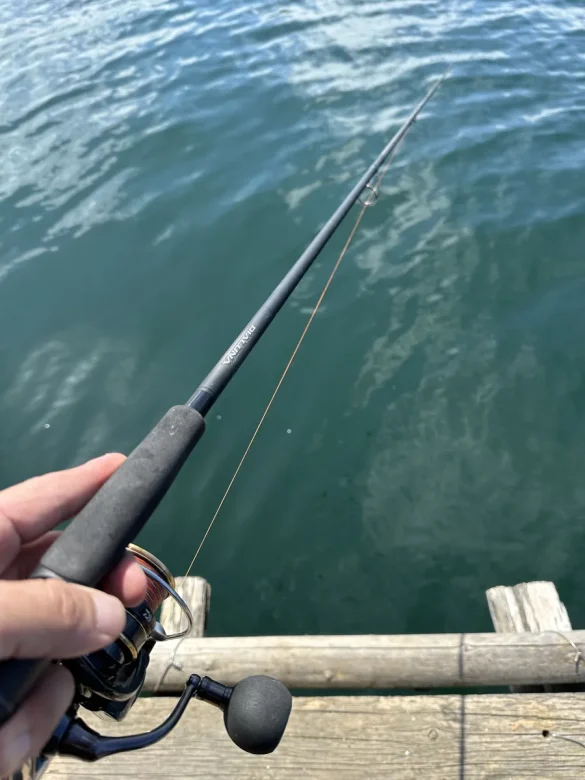
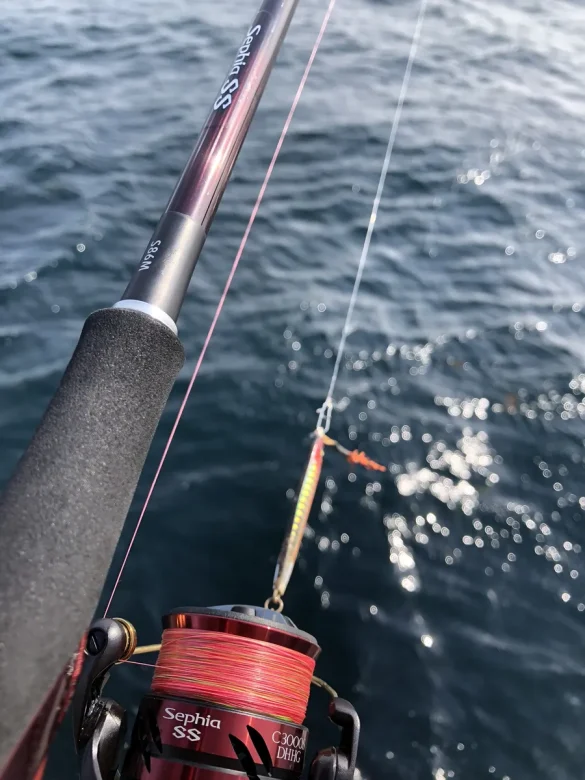
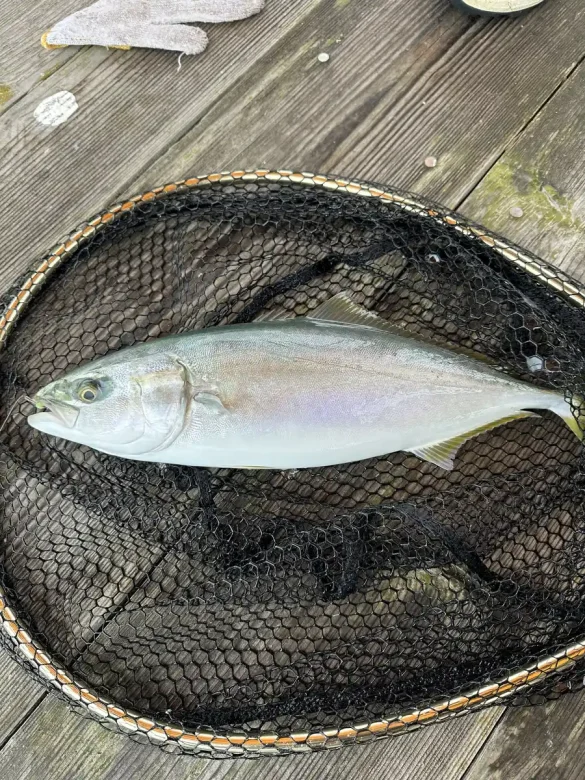
We fish shore jigging in Japan rather than Australia, so take the species names as yours and the tackle as ours. Ours isn’t on this page. It’s a Shimano 23 Dialuna rod and a Daiwa 22 Caldia SW, a reel several rungs below either of the two above, bought in February 2023 as one outfit for both seabass and light shore jigging (LSJ, in the Japanese shorthand). The reason was unglamorous: the Dialuna it replaced was a model more than ten years old, and we wanted to see how far things had moved. Three and a half years later that pair is still the first setup out of the car, which feels worth saying on a page about A$1,500 reels. It does have edges, and we know where they sit. Jigs over 40 g, or under 20 g, and it starts to feel like the wrong tool for the job. Every setup has a range it works in.
If you’re still sorting out rod and line before the reel, start with our shore jigging beginners guide. The reel becomes an easy call once you know what you’re throwing.
| Size | Certate SW | Saltiga | Max Drag | Weight (CSW / Saltiga) | AU RRP (CSW / Saltiga) |
|---|---|---|---|---|---|
| 4000 | 24 Certate SW 4000-H | 23 Saltiga 4000-H | 12 kg both | 335 g / 345 g | A$729 / A$1,199 |
| 5000 | 24 Certate SW 5000-H | 23 Saltiga 5000-H | 15 kg both | 345 g / 365 g | A$729 / A$1,229 |
| 6000 | 24 Certate SW 6000-H | 23 Saltiga 6000-H | 15 kg both | 375 g / 400 g | A$789 / A$1,249 |
| 8000 | 26 Certate SW 8000-H | 25 Saltiga 8000-H | 25 kg both | 665 g / 680 g | A$999 / A$1,499 |
| 10000 | 26 Certate SW 10000-H | 25 Saltiga 10000-H | 25 kg both | 670 g / 685 g | A$999 / A$1,499 |
| 14000 | 26 Certate SW 14000-XH | 25 Saltiga 14000-XH | 25 kg both | 675 g / 690 g | A$999 / A$1,499 |
| 26 Certate HD: the light-tackle outlier. LT chassis, capped at 12 kg, and there is no Saltiga twin, so the paired columns below carry HD figures only. | |||||
| LT4000 | 26 Certate HD LT4000-C | none | 12 kg | 255 g | A$739 |
| LT4000 | 26 Certate HD LT4000-CXH | none | 12 kg | 255 g | A$739 |
| LT5000D | 26 Certate HD LT5000D-CXH | none | 12 kg | 260 g | A$779 |
The Certate SW to Saltiga gap runs from A$460 at the 6000 to A$500 at the 5000 and everything above it. For that you get an aluminium rotor, sealed drive-gear bearings, two to five more bearings, and 10 to 25 g of extra weight to carry. Shimano’s side of the fence plays out the same way, which we ran through in our Stella SW vs Twin Power SW comparison.
The JDM price is lower on both of the series in question, and by more than most people expect once you convert at a real rate.
The two series move in opposite directions here, which isn’t what you’d guess. The Saltiga’s import saving shrinks as the reels get bigger, from about A$285 at the 4000 to about A$145 at the 8000, while the Certate SW’s runs the other way: about A$145 at the 4000, about A$185 at the 8000. So there’s no one answer to “import or buy here”. At the small end it’s the Saltiga that rewards shipping and the Certate SW you may as well buy locally. At the 8000 and up they trade places, and the Australian Saltiga price stops looking like much of a penalty at all.
Then the deductions. Ten per cent GST lands on an imported reel either way, and what changes above A$1,000 is who collects it: a consignment over that figure is assessed at the border, with any duty and a processing charge, instead of quietly at checkout. On the Japanese prices in the tables above, that line runs through the middle of the Saltiga range. The 6000 at about A$1,003 and everything from the 8000 up clear it; the 4000 and 5000 don’t, and every Certate SW and Certate HD on this page sits well under. Freight and a two-week wait come off the top as well. Against all of that sits an Australian warranty and a local service centre you can post a reel to without an export label.
One thing the conversion tables never tell you. Daiwa Australia only stocks the H and XH ratios of the 24 Certate SW, badged Certate SW (G). Japan also lists the 5000 and 6000 in P, the slow, high-torque version. If you want a power ratio in that size band, importing isn’t about saving money, it’s the only way to get one.
Not by Daiwa’s own drag ratings, which are identical at every shared size. The Saltiga’s aluminium rotor resists flex better than the Certate SW’s ZAION rotor when you’re leaning on a big fish, and its drive-gear bearings are sealed. Those are durability and rigidity gains rather than extra stopping power.
A 4000 covers beach work on salmon and tailor with PE 1.5 to 2. The 5000 and 6000 handle breakwall sessions on bonito and school kingfish. Step up to the 8000 when you’re throwing 60 g and more at kingfish off the rocks. Our JDM reels for kingfish guide goes further into that end.
Daiwa updates the size bands separately. The 24 covers 4000 to 6000 and runs the AIRDRIVE package; the 26, new for 2026, covers 8000 to 20000 and brought POWERDRIVE gearing down from the Saltiga. Both are current, and the 4000 to 6000 sizes have not been superseded.
Daiwa Australia’s service centre handles repairs and stocks spare parts, but the Australian warranty follows the Australian purchase. Budget for paid servicing on an imported reel and subtract it from the price gap before you decide, especially on the Certate SW where the gap is only about A$145 to A$185.
Fifteen kilos of drag, 345 g, an aluminium MQ body and 96 cm per turn, for ¥70,400 (~A$614) from Japan or A$729 here. It matches the same-size Saltiga on every performance number on the sheet and leaves you A$500 for a rod that deserves it.
The rock-fishing pick. Twenty-five kilos of drag at 665 g, PE 3 for 460 m, the POWERDRIVE gear train and, at this size, the MAGSEALED line roller the smaller Certate SW goes without. ¥93,100 (~A$812) from Japan, or A$999 on the Australian RRP.
Same drag, same capacity, same retrieve as the Certate SW above it, plus an aluminium POWERDRIVE rotor, 14 bearings and MAGSEALED bearings at the drive gear. ¥155,000 (~A$1,353) from Japan against A$1,499 here. Buy this if you fish hard water often and expect the reel to outlast the rod, and buy it locally: the import saving is only about A$145, which an Australian warranty is worth on its own.
A last word for anyone buying their first serious reel. Don’t start at the bottom. Buy something well regarded at a fair price, because it works properly from day one and because a known model holds its value if you decide the whole thing isn’t for you. In Japan the second-hand market for reels like these is strong enough that we’ve watched people get most of their money back. Your local market may differ, but the logic doesn’t. Buy once, buy something known, and you keep the option to change your mind.