Daiwa vs Shimano for Shore Jigging: Which Brand Suits You?
ちゃんま
マイボ!

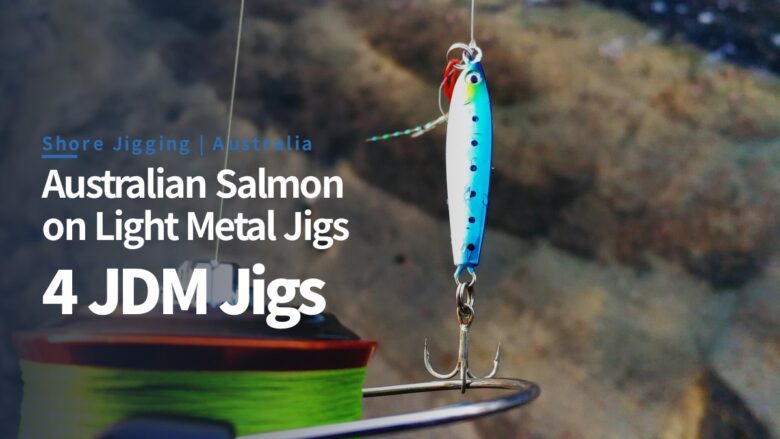
You see the birds first. Then the water goes dark and nervous a hundred metres down the beach, and suddenly a whole gutter is boiling with Australian salmon carving through a ball of whitebait. You have maybe twenty minutes before the school slides out of range, and the jig you happen to have tied on will decide how that twenty minutes goes.
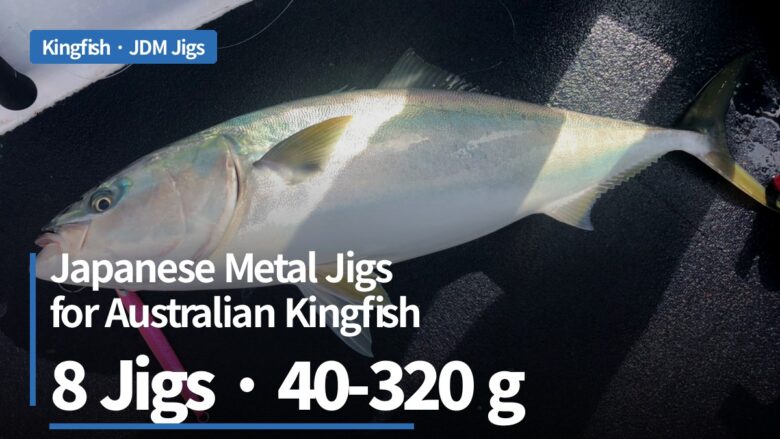
Australian salmon (Arripis trutta in the east, Arripis truttaceus in the west) aren’t actually salmon at all, but nobody who has hooked one on light gear cares about the taxonomy. They pull like fish twice their size, they school up within casting range of beaches, rocks and breakwalls, and they feed heavily on small baitfish. That last part is the key to this whole article: salmon are a small-jig fish, and the 20 to 40 g class is where Japanese metal jigs shine brightest.
This is a species-specific guide, a companion to our shore jigging beginner’s guide for Australia. If you want the full five-jig comparison across all weights and targets, that lives in our best Japanese metal jigs for shore jigging round-up. Here we go narrower and deeper: which light JDM (Japan Domestic Market) jig to tie on for salmon, scene by scene.
A note on links and pricing: the Daiwa and Shimano models below are JDM catalogue items, so their buy links point to Amazon Japan, which ships internationally (check availability and shipping cost at checkout; orders over A$59 may qualify for free international delivery). The Major Craft Jigpara links point to Amazon.com, available with international shipping to Australia. Prices are shown in JPY (tax excluded) with an approximate AUD conversion at the time of writing (~A$1 = ¥100, July 2026). Always check your local state regulations for current size and bag limits before you fish.
Plenty of Aussie anglers throw 60 g of metal at salmon because that’s what was in the rock-fishing box. It works when the fish are hungry. When they’re locked onto whitebait the size of your little finger, it doesn’t, and the angler with a 28 g jig keeps hooking up while everyone else changes colours.
Four things matter most when you’re picking a salmon jig.
Season and location vary hugely: the cooler months tend to produce the big beach schools in many regions, but every state runs on its own calendar, so treat local reports as gospel and this guide as the gear half of the equation. Now, the scenes.
Beach salmon are a distance game. The school works a gutter 80 metres out, the sea breeze is in your face, and every metre of cast counts. This is exactly the problem Daiwa rebuilt the Samurai Jig R to solve: the belly is slimmed down and the centre of gravity nudged slightly rearward, so the jig holds a stable, tumble-free flight path even into a headwind or crosswind.
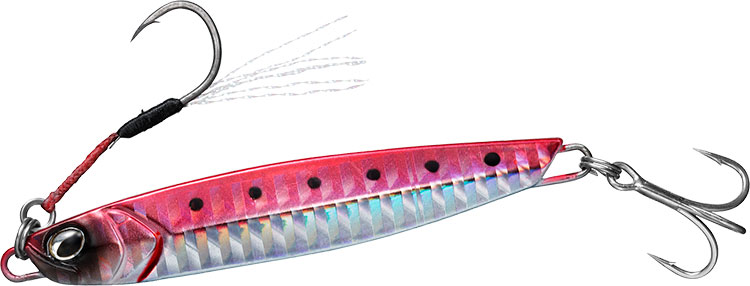
Distance is only half the story. The thinned-out head cuts water cleanly, so the jig responds instantly to rod work, and the redesign also reduced tailing (the line-over-hook tangle Japanese anglers call ebiri) that wastes casts. Up front sits a SaqSas assist hook: Daiwa’s fluorine-coated, tinsel-dressed single that pins short-striking fish, backed by a heavy-gauge rear treble.
| Feature | Detail |
|---|---|
| Type | Casting metal jig (lead body) |
| Balance | Slightly rear-weighted, slimmed belly |
| Flight | Stable trajectory in head and cross winds |
| Front hook | SaqSas fluorine-coated assist with tinsel |
| Rear hook | Thick-gauge treble |
| Retrieve | Jerks and plain straight retrieve both work |
The lineup runs 20 to 60 g. For beach salmon the 30 and 40 g sizes do most of the work: heavy enough to reach the far gutter, still small enough in profile that fish feeding on whitebait will eat them.
| Size | Length | Hooks (standard) | Price (JPY, tax excl.) |
|---|---|---|---|
| 20 g | 75 mm | Iseama #11 + treble #8 | ¥700 (~A$7) |
| 30 g | 83 mm | Iseama #13 + treble #6 | ¥750 (~A$7.50) |
| 40 g | 92 mm | Iseama #13 + treble #5 | ¥800 (~A$8) |
If your salmon fishing happens off open surf beaches, start here. The extra metres of cast turn schools you can see but not reach into schools you’re fishing, and the tinsel assist is genuinely sticky on fish that slash at the jig without committing. One caution: it’s a lead jig with a fine finish, so bouncing it across rock platforms will chew the paint; save it for the sand and keep a spare in the box.
Rock ledges and breakwalls are where salmon fishing gets messy. Fish bury themselves in the wash at your feet, thrash on the surface, and lever themselves off trebles against the white water. Shimano built the Coltsniper Aomono Catcher around exactly that end-game problem: instead of a rear treble it carries twin assist hooks up front, shaped to hold a thrashing fish at the waterline, which is precisely where salmon come unbuttoned.
Aomono means bluefish or pelagics in Japanese, and this is one of the standard light shore jigging (LSJ) jigs on Japanese breakwalls for exactly the kind of mid-size, hard-running fish that salmon are.
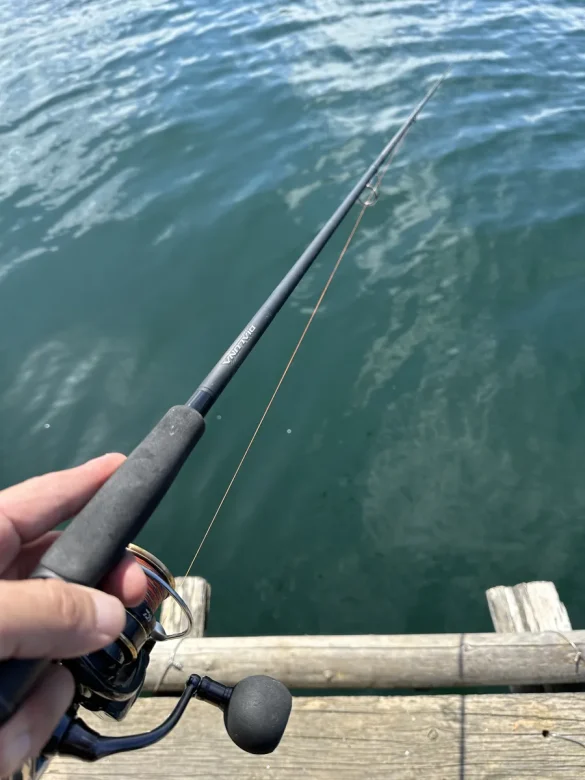
The body is the proven Coltsniper shape: symmetrical, slightly flattened, centre-to-rear balanced. Those flat faces grip the water, so the jig swims with a tail-kick on a plain retrieve, slides sharply on a light jerk, and vibrates steadily on the fall. Shimano’s Scale Boost holograms add a realistic scale flash that holds up well to toothy fish and rough ground.
| Feature | Detail |
|---|---|
| Type | Casting metal jig for light shore jigging |
| Balance | Symmetrical body, centre-rear weighted |
| Hooks | Original twin assist (front), hold-focused shape |
| Action | Tail-swing on straight retrieve, quick slide on jerks, stable fall vibration |
| Finish | Scale Boost hologram (realistic scale flash) |
| Best for | Rocks, breakwalls, high platforms |
Weights run 28 to 60 g. The 28 and 35 g sizes cover most salmon work; Shimano’s own testers describe the 42 g as flying beyond its weight class thanks to the smaller shape, which makes it the windy-day option.
| Size | Length | Hooks (standard) | Price (JPY, tax excl.) |
|---|---|---|---|
| 28 g (JW-228S) | 71 mm | Original twin hook #16 | ¥820 (~A$8) |
| 35 g (JW-235S) | 78 mm | Original twin hook #16 | ¥850 (~A$8.50) |
| 42 g (JW-242S) | 85 mm | Original twin hook #16 | ¥880 (~A$8.80) |
Anyone who loses too many salmon at the rocks. The twin-assist setup changes the landing maths: fish stay pinned through the jumps and the last chaotic metres in the wash. The trade-off is that assist-only rigging picks up slightly fewer of the lazy tail-nippers than a rear treble does, so if you’re missing soft takes, slow the retrieve and let the fall do the selling.
Every salmon angler has lived this one. Fish everywhere, water boiling, birds diving, and your jig swims through the lot untouched because the bait is 40 mm of translucent whitebait and your lure is a 90 mm slab. This is the match-the-bait scene, and it’s what the Coltsniper Iwashi Rocket was designed for. Iwashi means anchovy or sardine in Japanese, and the jig is a deliberately small, anchovy-shaped profile that still casts like a much bigger jig.
How much bigger? In Shimano’s own outdoor casting tests the 30 g size averaged over 100 metres. That’s the whole pitch: a 68 to 87 mm baitfish silhouette you can put on the horizon.
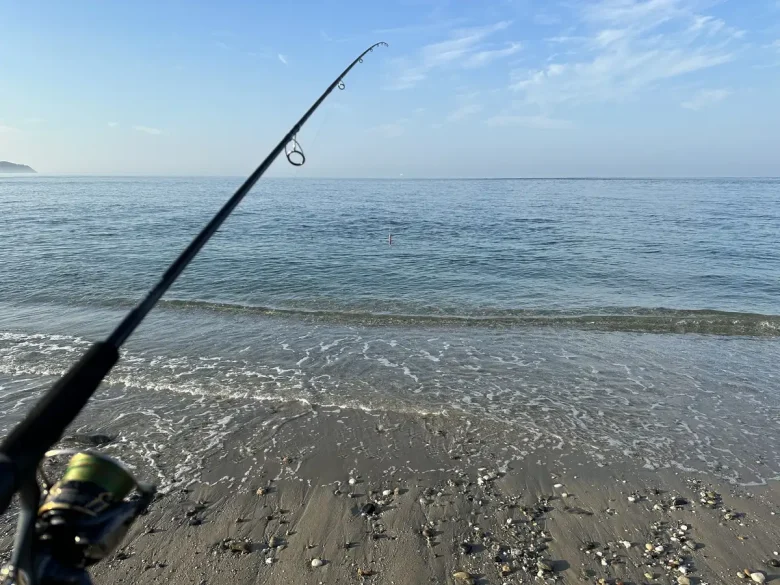
The slim body and rear weighting give it that stable, dart-like flight, and it fishes as simply as anything here: twitch it, jerk it, or just wind it back. Shimano lists it as a pilot lure, the one you tie on to find fish when you have no information, and that’s a fair description of how it earns a place in a salmon box. Both hooks come standard and both are thick-gauge, so an unexpected kingfish doesn’t end the session.
| Feature | Detail |
|---|---|
| Type | Compact match-the-bait casting jig |
| Profile | Anchovy (katakuchi iwashi) motif, slim silhouette |
| Balance | Rear-weighted for a stable, long flight |
| Cast distance | 30 g averaged 100 m+ in Shimano’s outdoor tests |
| Hooks | Front single #14 + rear treble #4, thick-gauge, fitted standard |
| Retrieve | Twitch, jerk and plain straight retrieve |
Three sizes, all salmon-relevant. The 20 g even throws nicely on a heavier seabass or flathead rod, which makes it a great crossover jig if you’re not running dedicated shore jigging gear yet.
| Size | Length | Hooks (standard) | Price (JPY, tax excl.) |
|---|---|---|---|
| 20 g (JM-C20R) | 68 mm | Single #14 + treble #4 | ¥730 (~A$7.30) |
| 30 g (JM-C30R) | 79 mm | Single #14 + treble #4 | ¥800 (~A$8) |
| 40 g (JM-C40R) | 87 mm | Single #14 + treble #4 | ¥850 (~A$8.50) |
Yes, if fussy surface feeders are your regular frustration. On the days salmon are gorging on micro bait, a small-profile jig is the difference between a bent rod and a photography session. Just don’t make it your only jig: in big surf or deep water the light, compact body gets pushed around, and that’s when you reach back for the Samurai Jig R.
Salmon fishing eats jigs. Rocks eat them, tailor bite them off, and big schools chew the paint off the survivors. So the last scene is less glamorous but very real: you want a proven jig you can buy three of without wincing. In Japan that jig is the Major Craft Jigpara Short, the standard-issue LSJ metal that a whole generation learned on, and it comes fully rigged with Japanese-made hooks front and rear straight out of the packet.
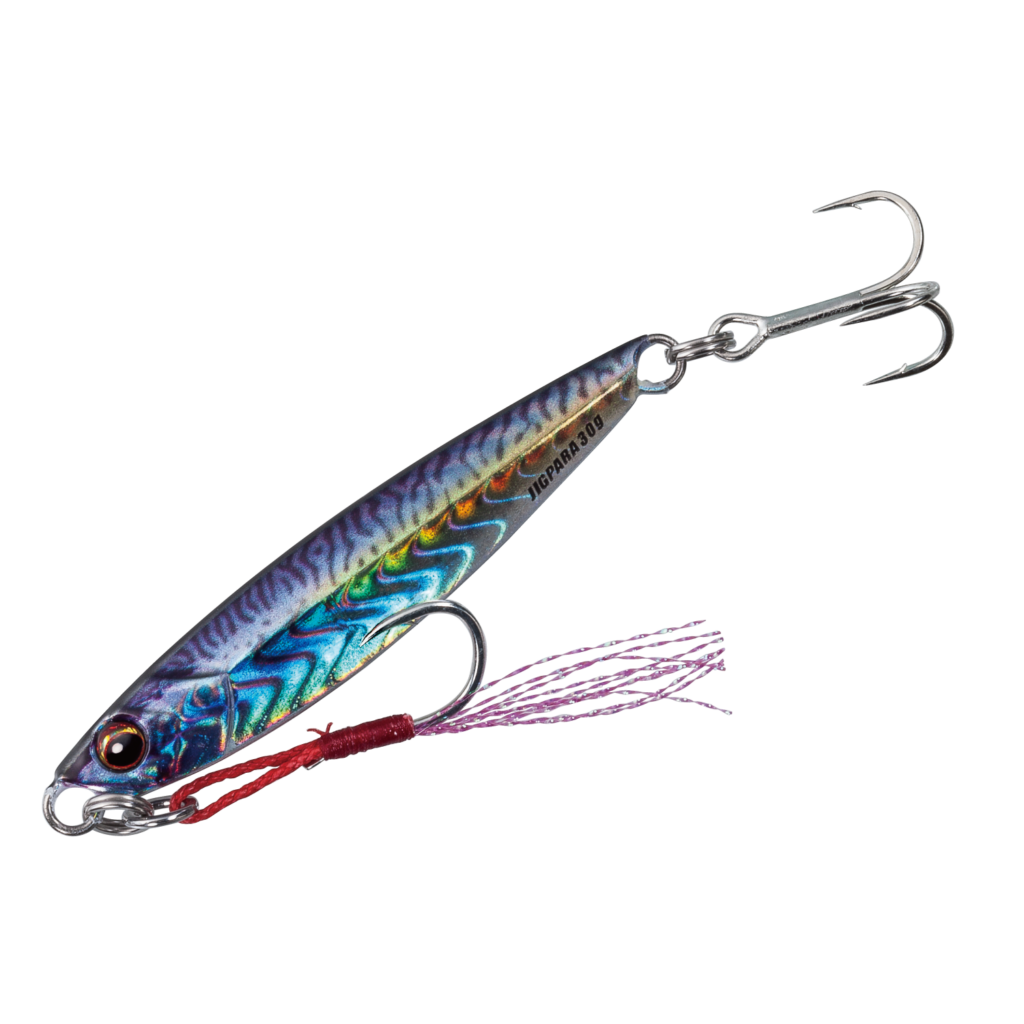
The design brief is versatility. A centre-balanced, left-right asymmetric body responds to every action style, from a lazy straight wind to full one-pitch jerking, and the compact silhouette casts well above its price tag. Major Craft also lays on a multi-layer coating, which matters for a jig that will spend its life being bounced off structure.
| Feature | Detail |
|---|---|
| Type | All-round casting metal jig |
| Balance | Centre balance, asymmetric body |
| Action | Handles every action, from straight wind to jerks |
| Hooks | Japanese-made originals fitted front and rear |
| Finish | Multi-layer coating for durability |
| Best for | First jigs, harbour and jetty sessions, high-loss spots |
The current range runs 20 to 60 g. Major Craft lists it at open price (no fixed RRP), and street prices in Japan sit comfortably under the four-figure mark, which is exactly why it’s the box-filler of choice.
| Size | Hooks (standard) | Typical salmon use |
|---|---|---|
| 20 g | Front + rear originals | Calm days, small bait, lighter rods |
| 30 g | Front + rear originals | The everyday all-rounder |
| 40 g | Front + rear originals | Wind, current, bigger water |
Anyone starting out, and anyone fishing snaggy, jig-hungry ground. It’s not the longest caster here and not the most specialised tool for any single scene, but it does everything to a solid standard for the least money. A handful of Jigpara Shorts in sardine and pink is the cheapest complete salmon kit on this page.
Australian salmon don’t swim in Japan, but their situation does. Our light shore jigging scene revolves around sagoshi (juvenile Spanish mackerel), small yellowtail and bonito herding tiny anchovies along breakwalls and beaches, and the fish behave the same infuriating way: boiling everywhere, eating nothing that doesn’t match the bait.
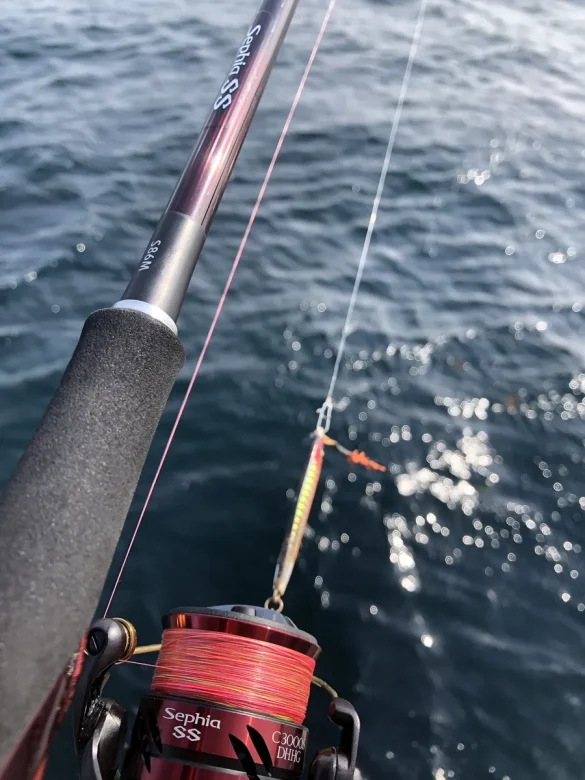
Three habits from that scene carry straight over. First, when fish refuse the jig, we go smaller before we go faster; dropping from 40 to 28 g solves refusals far more often than burning the retrieve does. Second, the default action isn’t violent: a relaxed one-pitch jerk (one rod stroke, one handle turn) with deliberate pauses, because a huge share of bites come on the fall, not the retrieve. Stay in touch with the jig as it sinks and you’ll feel takes you never knew you were missing. Third, we carry silver-sardine, blue-pink and one glow or zebra pattern, and rotate through those three before agonising over anything more exotic. That’s the whole colour theory. It works in Kansai and it’ll work in Kiama.
The four jigs side by side, matched to their home scene.
| Jig | Salmon scene | Weights | Hook setup | Price (JPY, tax excl.) |
|---|---|---|---|---|
| Daiwa Samurai Jig R | Surf beaches, wind, distance | 20-60 g | SaqSas tinsel assist + treble | ¥700-950 (~A$7-9.50) |
| Shimano Coltsniper Aomono Catcher | Rocks and breakwalls, fewer dropped fish | 28-60 g | Twin assist (front) | ¥820-920 (~A$8-9) |
| Shimano Coltsniper Iwashi Rocket | Bust-ups on tiny bait, pilot jig | 20-40 g | Single #14 + treble #4 | ¥730-850 (~A$7.30-8.50) |
| Major Craft Jigpara Short | Budget box-filler, snaggy ground, first jigs | 20-60 g | Originals front + rear | Open price |
If you only want two answers out of this whole page, here they are.
🏆 Top Pick: Daiwa Samurai Jig R (30 g & 40 g)
Salmon fishing is, more than anything, a reach-the-school game, and this is the jig engineered for it. Stable flight into the wind, a sticky SaqSas tinsel assist for slashing fish, and a fall action that keeps fishing between jerks. ¥750-800 (~A$7.50-8) per jig, tax excluded.
💰 Budget Pick: Major Craft Jigpara Short (20-40 g)
The proven, do-everything jig you can afford to lose. Fully rigged out of the packet, happy on any retrieve, and cheap enough to stock three colours before your first cast. Open price in Japan; check the live listing.
Australian salmon aren’t hard to catch when you meet them on their terms, and their terms are small, silver and moving. Carry a distance jig for the beach, a hold-everything jig for the rocks, a tiny-profile jig for the fussy days and a budget jig for the snags, and you’ve covered practically every salmon scene on the calendar. Two or three of the four will genuinely do.
To build out the rest of the setup, see our guides to JDM spinning reels for shore jigging and JDM shore jigging rods, or browse all of our Australia fishing guides.
All specifications in this article were taken from the manufacturers’ official product pages (Daiwa, Shimano and Major Craft), checked in July 2026. Prices are maker list prices in JPY (tax excluded) with approximate AUD conversions at the time of writing; the Jigpara Short is sold at open price, so check live listings. Product images are from the makers’ official pages. Affiliate links may earn us a commission at no extra cost to you. Australian salmon size and bag limits differ between states, so always check your local regulations.