Super Light Shore Jigging (SLSJ): Micro Jig Tactics & JDM Tackle
ちゃんま
マイボ!
Type “Daiwa Overthere” into a search bar from Australia and you get two sets of results that don’t agree with each other. Half are Japanese import listings for slim 10-footers with AGS guides and price tags close to ¥80,000. The other half are local shops selling an A$299 rod called the 21 Over There, sometimes marked sold out. Both say Daiwa on the blank. They aren’t the same rod, and they were never meant to be.
Daiwa Japan currently sells three Overthere series: the flagship EX, the new SX, and the standard Overthere. All three are surf lure rods built around 2.97 to 3.38 m lengths and plug or jig weights of 7 to 70 g, which puts them squarely in the Australian salmon and tailor bracket. None of them is sold through Daiwa Australia, so every one of them is an import. Amazon Japan ships internationally: check availability and shipping cost at checkout, and orders over A$59 may qualify for free international delivery.
In 2021 Daiwa Australia launched its own 21 Over There, two words, which it described as designed specifically for Australian salmon (Arripis trutta) and tailor (Pomatomus saltatrix) off beaches, breakwalls and rocky headlands. It ran five models from 10’3″ to 11′, all 2-piece spinning rods on HSD graphite, with Fuji stainless Alconite anti-tangle guides. The three lighter models used a Daiwa reel seat; the 110H and 110XH got a Fuji DPS seat for the thicker butt.
| 21 Over There model | Length | Power | Cast weight | PE | AU RRP |
|---|---|---|---|---|---|
| 103MH | 10’3″ / 312 cm | Medium Heavy | 15-60 g | 1.0-2.5 | A$299 |
| 109ML/M | 10’9″ / 328 cm | Medium Light | 7-45 g | 0.8-2.0 | A$299 |
| 109MH | 10’9″ / 328 cm | Medium Heavy | 15-60 g | 1.0-2.5 | A$299 |
| 110H | 11′ / 335 cm | Heavy | 20-80 g | 1.5-3 | A$299 |
| 110XH | 11′ / 335 cm | Extra Heavy | 25-100 g | 2-4 | A$299 |
The 21 Over There is no longer in Daiwa Australia’s current rod range. Its old product address now drops you on the general rods page, although the rod still turns up in some shops’ listings. The 110H and 110XH go heavier than anything in the Japanese Overthere family: 80 g and 100 g at the top, PE 3 and PE 4. No JDM Overthere is rated past 70 g or PE 2.5. If you owned a 110XH and liked it, the Japanese rods aren’t its replacement.
The Japanese side has its own clutter. Second-hand and Amazon Japan listings still carry the Overthere AIR, the Overthere AGS and the Overthere Grande. None of them is in Daiwa Japan’s current surf rod list, which shows exactly three Overthere names, and the old product pages for the Grande and the AGS now return a page-not-found. The SX, released in April 2026, is the newest of the three.
The code tells you most of what you need before you read a spec sheet.
PE ratings are Japanese go sizes. If you’re putting together a full outfit for the first time, start with our shore jigging beginner’s guide for Australia.
Daiwa calls the EX the high end of its surf multi-casting rods and pitches it on three things: distance, swing speed and sensitivity. The blank is high-modulus carbon rolled thin and wrapped in an outer 45-degree bias layer to stop it twisting on the cast, joined with a spigot ferrule. The butt diameters show it. At 12.9 to 14.1 mm, the EX is the slimmest of the three series at the handle end.

| ESS (Expert Sense Simulation) | Daiwa’s design system for analysing how the blank stores and releases energy as it bends |
| SVF NANOPLUS | High-density carbon combined with Toray’s Nanoalloy resin technology, for strength at a thinner wall |
| AGS (Type R) | Carbon-frame guides; Daiwa claims about three times the stiffness of titanium and a lighter tip |
| V-JOINT α | Nanoalloy ferrule that lets the joint be made thinner |
| X45 Full Shield | 45-degree bias carbon as the outermost layer, against twist |
| AIR SENSOR SEAT | Carbon-fibre reel seat, shaped for this type of rod rather than a generic seat |
| Model | Length | Weight | Lures | Jigs | PE | JDM RRP (excl. tax) | Approx. AUD |
|---|---|---|---|---|---|---|---|
| Overthere EX 99ML/M | 2.97 m | 155 g | 7-45 g | 7-50 g | 0.8-2.0 | ¥77,500 | A$680 |
| Overthere EX 109ML/M | 3.28 m | 168 g | 7-45 g | 7-50 g | 0.8-2.0 | ¥78,000 | A$684 |
| Overthere EX 103M | 3.12 m | 166 g | 10-45 g | 10-50 g | 0.8-2.0 | ¥78,000 | A$684 |
| Overthere EX 1010M/MH | 3.30 m | 190 g | 10-60 g | 10-70 g | 1.0-2.5 | ¥79,000 | A$693 |
| Overthere EX 103MH | 3.12 m | 177 g | 15-60 g | 15-70 g | 1.2-2.5 | ¥79,000 | A$693 |
| Overthere EX 103ML/MB | 3.12 m | 187 g | 10-45 g | 10-50 g | 0.8-2.0 | ¥80,000 | A$702 |
| Overthere EX 106MHB | 3.20 m | 200 g | 15-70 g | 15-60 g | 1.2-2.5 | ¥81,000 | A$711 |
Daiwa’s species chart for the EX includes oonibe, the Japanese name for Argyrosomus japonicus. That’s the same species Australians call mulloway. The 1010M/MH, 103MH and 106MHB get Daiwa’s top rating for it, alongside buri, the Japanese cousin of our yellowtail kingfish (Seriola lalandi). The lighter 99ML/M, 109ML/M and 103M are rated top for flatfish, seabass and young amberjack instead.
The awkward number is weight. In every model code the EX shares with the SX, the EX is heavier, by 5 g on the 103MH and up to 17 g on the 1010M/MH and 103ML/MB. You pay ¥26,000 to ¥28,500 more for a thinner, stiffer blank, not a lighter one. Best suited to anglers who already fish a long surf rod, know what they want from the cast, and plan to throw metals and heavy sinking minnows at the edge of range most of the day.
Released in April 2026, the SX is billed by Daiwa as the lightest surf rod it has ever made, and the spec sheet backs that up: 147 g for the 99ML/M and 187 g for the heaviest model, the 106MHB baitcaster. The guide set is where the weight comes out. The SX runs AGS on the first four guides below the tip-top only, which Daiwa says cuts tip weight on a long rod and helps swing speed.

| SVF carbon | Less resin, more carbon fibre by volume than HVF |
| AGS | Carbon-frame guides on the top four positions below the tip-top |
| X45 | 45-degree bias carbon against twist |
| V-JOINT | Bias-wrapped carbon at the ferrule for a more even bend |
| AIR SENSOR SEAT | Standard-type carbon-fibre reel seat |
| Model | Length | Weight | Lures | Jigs | PE | JDM RRP (excl. tax) | Approx. AUD |
|---|---|---|---|---|---|---|---|
| Overthere SX 99ML/M | 2.97 m | 147 g | 7-45 g | 7-50 g | 0.8-2.0 | ¥50,500 | A$443 |
| Overthere SX 911M/MH | 3.02 m | 158 g | 10-60 g | 10-70 g | 1.0-2.5 | ¥51,000 | A$447 |
| Overthere SX 106M | 3.20 m | 162 g | 10-45 g | 10-50 g | 0.8-2.0 | ¥51,500 | A$452 |
| Overthere SX 109ML/M | 3.28 m | 159 g | 7-45 g | 7-50 g | 0.8-2.0 | ¥52,000 | A$456 |
| Overthere SX 103MH | 3.12 m | 172 g | 15-60 g | 15-70 g | 1.2-2.5 | ¥51,500 | A$452 |
| Overthere SX 1010M/MH | 3.30 m | 173 g | 10-60 g | 10-70 g | 1.0-2.5 | ¥52,500 | A$461 |
| Overthere SX 103ML/MB | 3.12 m | 170 g | 7-45 g | 7-50 g | 0.8-2.0 | ¥52,000 | A$456 |
| Overthere SX 106MHB | 3.20 m | 187 g | 15-60 g | 15-70 g | 1.2-2.5 | ¥52,500 | A$461 |
The SX doesn’t share the EX’s parts list. Its carbon is SVF without the Nanoplus treatment, the ferrule is plain V-JOINT rather than V-JOINT α, and the anti-twist layer is listed as X45 rather than X45 Full Shield. The butt is thicker too, 14.7 to 15.7 mm. Daiwa also gave it a fatter foregrip on purpose, so you can hold on and pump when a big pelagic is on.
Two models the EX doesn’t have are worth noting for Australian water. The 911M/MH is a short 3.02 m rod with an MH butt, which Daiwa built for days when the bait is small and a long rod can’t get it done, with the butt to handle bigger fish. The 106M is what Daiwa calls its all-rounder, designed around the 30 g metal and the 12 cm minnow. Daiwa’s SX page carries no species chart, so there’s no maker rating to set against the EX’s mulloway ticks.
The standard Overthere is Daiwa’s entry to the family, on HVF carbon with Fuji K guides and an SiC tip-top. Daiwa’s pitch for it is fewer line tangles when you’re casting into a headwind, and it’s the only Overthere with a 4-piece version, 88 to 89 cm when broken down. For anyone flying to a beach, that counts for more than any grams saved elsewhere.

| HVF carbon | High-density carbon with reduced resin, tuned for toughness |
| AIR SENSOR SEAT | Slim standard-type carbon-fibre reel seat |
| K guides | Tangle-resistant frames; SiC ring on the tip-top |
| Butt guide | Double-foot on models with an MH butt, single-foot on M |
| Model | Length | Weight | Lures | Jigs | PE | JDM RRP (excl. tax) | Approx. AUD |
|---|---|---|---|---|---|---|---|
| Overthere 99ML/M | 2.97 m | 162 g | 7-45 g | 7-50 g | 0.8-2.0 | ¥29,500 | A$259 |
| Overthere 911M/MH | 3.02 m | 171 g | 10-60 g | 10-65 g | 1.0-2.5 | ¥30,000 | A$263 |
| Overthere 103ML/M | 3.12 m | 167 g | 7-45 g | 7-50 g | 0.8-2.0 | ¥30,000 | A$263 |
| Overthere 106M | 3.20 m | 177 g | 10-45 g | 10-50 g | 0.8-2.0 | ¥30,500 | A$268 |
| Overthere 109ML/M | 3.28 m | 175 g | 7-45 g | 7-50 g | 0.8-2.0 | ¥30,500 | A$268 |
| Overthere 1010M/MH | 3.30 m | 185 g | 10-60 g | 10-65 g | 1.0-2.5 | ¥31,000 | A$272 |
| Overthere 111M | 3.38 m | 185 g | 10-45 g | 10-50 g | 0.8-2.0 | ¥31,200 | A$274 |
| Overthere 109ML/M-4 | 3.28 m (4 pc) | 187 g | 7-45 g | 7-50 g | 0.8-2.0 | ¥36,000 | A$316 |
| Overthere 1010M/MH-4 | 3.30 m (4 pc) | 190 g | 10-60 g | 10-65 g | 1.0-2.5 | ¥37,000 | A$325 |
No AGS, no X45, no V-JOINT: those stay on the SX and EX. What you get instead is the widest spread of lengths, including the 111M at 3.38 m, which Daiwa calls its long-beam model for throwing minnows and sinking pencils further than anyone else on the beach. Daiwa’s species chart gives the 911M/MH, 1010M/MH and 111M its top rating for oonibe, the mulloway species.
You pay for the lower price in grams. The 1010M/MH is 185 g against 173 g for the SX version, and the four-piece adds another 5 g on top. After three hours of casting you’ll feel it. It still makes sense as a first long surf rod, and it’s the obvious one if the travel version is the reason you’re importing at all.
If you’d rather buy locally, Daiwa Australia’s own lure rod for the rocks is the 23 Seabass, which it describes as built for spinning lures and metals at tailor and mulloway. It runs HVF graphite with Braiding-X and Fuji’s anti-tangle O-ring guides, in seven models from the 862ML to the 1102XH, at A$179.99 to A$209 RRP. The range goes up to an XH, so it’s also the closer match for anyone who wanted a heavier rod than any Overthere. Find one through Daiwa Australia’s 23 Seabass page.
| Series | Models | Length range | Weight range | Lure range | Guides | Price |
|---|---|---|---|---|---|---|
| Daiwa Overthere EX | 7 (2 bait) | 2.97-3.30 m | 155-200 g | 7-70 g | AGS | ¥77,500-81,000 (~A$680-711) |
| Daiwa Overthere SX | 8 (2 bait) | 2.97-3.30 m | 147-187 g | 7-70 g | AGS on top four | ¥50,500-52,500 (~A$443-461) |
| Daiwa Overthere | 9 (2 four-piece) | 2.97-3.38 m | 162-190 g | 7-65 g | K guides | ¥29,500-37,000 (~A$259-325) |
| Daiwa 21 Over There (AU, discontinued) | 5 | 10’3″-11′ | Not published | 7-100 g | Fuji Alconite | A$299 RRP |
| Budget | Rod | Why this one |
|---|---|---|
| Under A$250, buy locally | Daiwa 23 Seabass | Local warranty, up to XH power, built for tailor and mulloway off the rocks |
| About A$260-330 | Daiwa Overthere | Longest model in the family (3.38 m) and the only 4-piece option |
| About A$440-460 | Daiwa Overthere SX | Lightest in every shared model code, AGS on the tip |
| About A$680-710 | Daiwa Overthere EX | Slimmest butt, full technology list, mulloway-rated heavy models |
Import pick: Daiwa Overthere SX 106M
¥51,500, about A$452. Daiwa built it around the 30 g metal and the 12 cm minnow, 10’6″ long and 162 g. That lines up with the 20 to 40 g metals most salmon and tailor are caught on, on the lightest blank in the family.
Standing on sand is the one place we get to put the whole rod into a cast. From a boat deck you can’t really wind up, so a full swing off the beach still feels like a treat, and that’s a big part of why we kept fishing from the shore after we bought the boat. We honestly thought we’d end up fishing from nothing else. The shore also narrows things down for you. You can only reach so much water, and there’s a game that comes from being limited like that, where on a boat the choice of spots is so wide that picking one gets harder. All of this is from our own fishing in Japan, not from Australian beaches.
A 10-foot surf rod is a tool for pushing that limit out a few more metres. It’s also why the gap between the three series can matter less than length and power. On a flat beach where the fish sit past a far gutter, the extra foot of a 109ML/M from the cheapest series may count for more than the EX blank on a 99ML/M.
Most Australian salmon and tailor are taken on 20 to 40 g metals, as our guides to Australian salmon on metal jigs and tailor and bonito on metal jigs both explain. That band sits inside the jig rating of every JDM Overthere model, so the choice comes down to length, butt power and how much the grams matter to you.
If you’re not sure which fish your local beach actually holds, our Australian shore jigging species guide lists 14 of them with the jig weight each one needs. Pick the fish first. The rod falls out of that.
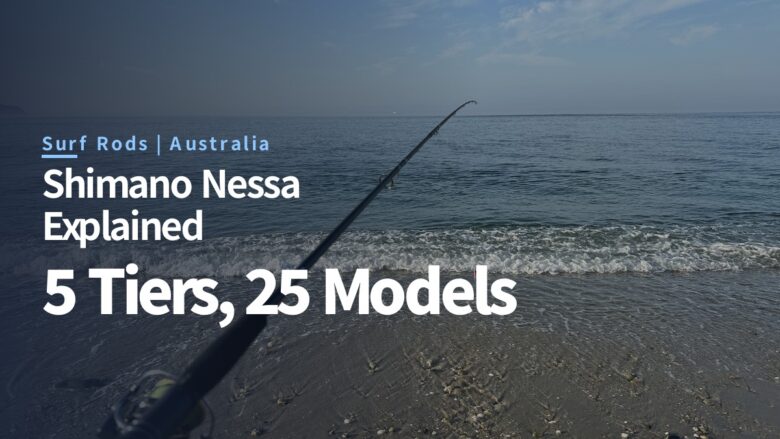
If you’d rather stay with Shimano, the five Shimano Nessa surf rod tiers, from the BB to the Limited are compared model by model on their own page.