Best JDM Shore Jigging Reels Under A$300 (2026)
ちゃんま
マイボ!

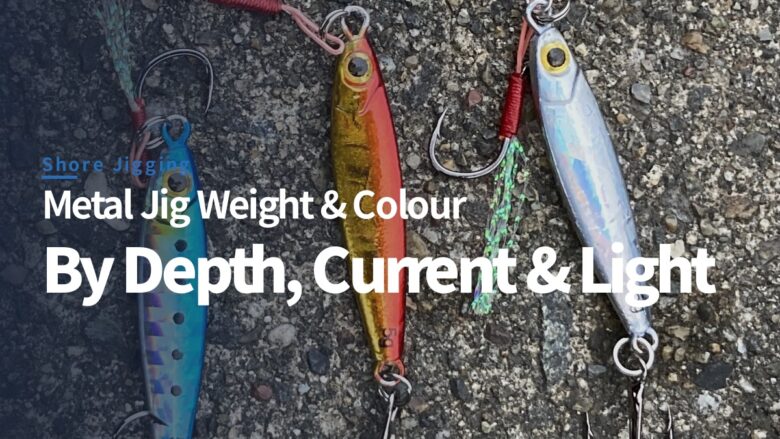
Every cast with a metal jig starts with the same two decisions: how heavy, and what colour. Get the weight wrong and nothing else matters, because a jig that isn’t reaching the fish, or is sinking past them too fast, can’t get eaten no matter how pretty it is. Get the colour wrong and you’ll still catch fish on the good days, but you’ll donate the tough ones to the bloke next to you. This guide walks through both decisions the way we make them in Japan, question by question, and then points at three JDM (Japan Domestic Market) jigs that let you act on the answers without buying half a tackle shop.
If you’re brand new to the technique, start with our shore jigging beginner’s guide for Australia. And this article deliberately stays out of detailed jig-by-jig reviews: those live in our Japanese metal jig round-up, plus the species guides for Australian salmon and tailor and bonito. Here we’re after the selection logic that sits underneath all of them.
A note on links and pricing: the Shimano and Daiwa jigs below are JDM catalogue items, so their buy links point to Amazon Japan, which ships internationally (check availability and shipping cost at checkout; orders over A$59 may qualify for free international delivery). The Major Craft links point to Amazon.com, available with international shipping to Australia. Prices are shown in JPY (tax excluded) with an approximate AUD conversion at the time of writing (A$1 = ¥100, July 2026).
Forget the offshore formulas. Boat jigging has tidy rules like “double the water depth in grams” because the jig drops straight down under the rod tip. From the shore your jig travels out, not down, so weight is really buying you three things: casting distance, a sink rate you can control, and contact with the jig in wind and current. Depth still matters, but it’s one input among several.
Here’s the practical starting grid we’d hand a mate fishing Australian platforms for the first time.
| Where you’re standing | Typical water | Starting weight |
|---|---|---|
| Calm harbour, jetty, estuary mouth | 2-6 m, little current | 20-30 g |
| Open surf beach, working the gutters | 3-8 m, side sweep | 30-40 g |
| Rock ledge or breakwall | 8-15 m, moderate current | 40-60 g |
| Deep ledge, strong current or hard wind | 15 m+, running tide | 60-80 g, or tungsten 40-60 g |
Two on-the-water checks tell you when to change. If you can’t feel the jig land, or your line points more sideways than seawards before it reaches the bottom, go heavier; you’ve lost contact, and every bite on the drop will go unnoticed. If bust-ups are on the surface and your jig is diving under the school before you’ve made three cranks, go lighter and let it hang in the zone.
One hard limit: never throw a jig above your rod’s rated casting weight. A rod rated to 40 g casts a 30 g jig sweetly and a 50 g jig dangerously. Most of the time the sweet spot sits around the middle to upper-middle of the rating, which is exactly why the 30-40 g band is the workhorse for typical Australian shore outfits.
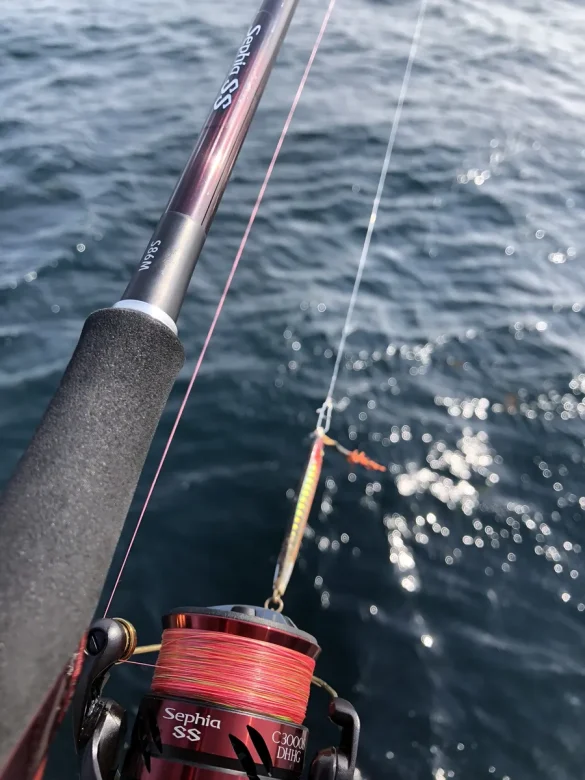
Tungsten is roughly 1.7 times denser than lead, which means the same weight fits in a much smaller body. Set the two makers’ official numbers side by side and the point makes itself: a 60 g TG Bait is 68 mm long, the same length as a 20 g lead Iwashi Rocket, so you’re casting triple the weight in the same baitfish silhouette. That one fact explains every situation where tungsten earns its price tag.
The trade-off is money. Tungsten jigs cost three to four times what lead does, and on snaggy reef where you expect to lose metal, feeding tungsten to the rocks gets old very fast. Our rule: carry one or two tungsten jigs as problem-solvers for the fussy or windy days, and let cheap lead do the everyday casting.
Japanese jig catalogues run to thirty-plus colours, and it’s easy to conclude you need all of them. You don’t. Nearly every pattern is a variation on three families, and the choice between them comes down to two conditions you can read in ten seconds: how much light there is, and how clear the water is.
| Conditions | First choice | Second choice |
|---|---|---|
| Bright sun, clear water | Silver / natural sardine | Blue-pink |
| Bright sun, stained water | Gold, akakin | Chart or high-contrast |
| Overcast or low light, clear water | Blue-pink | Silver with glow accents |
| Low light, stained water | Glow or zebra glow | Gold, akakin |
The makers themselves design to this logic. Daiwa splits its TG Bait finishes between parallel holo and flash holo foils that throw different amounts of flash, and Shimano’s colour notes for the Coltsniper Iwashi Rocket say the same thing out loud: the natural silver Scale Boost sardine is the base colour for rotation in any weather, while the subdued-flash versions are aimed at clear, hard-fished water where too much shine turns fish away. When the manufacturer’s own guidance matches what you see off the rocks, it’s worth listening.
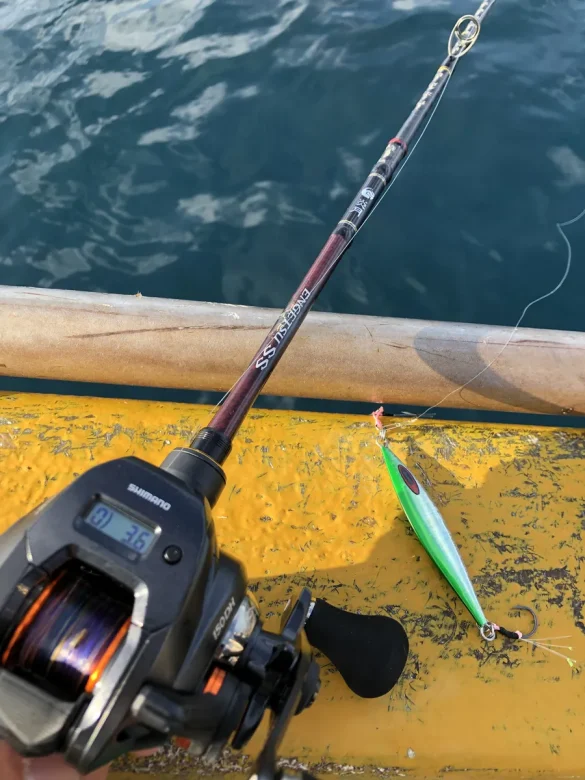
They do, in the specific situations they were built for. Full glow charges up and stays visible when almost nothing else is: pre-dawn starts, last light, deep water and heavily overcast, dirty days. Zebra glow, the striped version you’ll see across JDM ranges, is the compromise we reach for most, because glow stripes give the jig a visible edge in low light without wrecking the natural silhouette the way a fully glowing body can.
Keimura (ケイムラ, a UV-reactive finish) is the subtler tool. It fluoresces under ultraviolet light rather than storing charge, so it adds a quiet extra signal in exactly the conditions where flash dies: overcast skies and murky water. Shimano pairs its strongest-flash Iwashi Rocket colour with a keimura coat and recommends it for cloudy days and dirty water, which mirrors how we use UV finishes at home. What doesn’t work is buying six novelty colours of one weight and no spread of weights; cover 20 to 60 g first, then add colours. A practical box is three colours per weight you fish: one silver or natural, one blue-pink or gold depending on your water, and one zebra glow.
You could build the weight-and-colour system above from any maker’s range, but these three do it with the least money and the fewest gaps: a budget lead jig with an enormous colour chart, a long-casting match-the-bait jig whose colours track the light-and-clarity logic exactly, and a tungsten problem-solver. Specs below come from each maker’s official product page, checked July 2026. For deeper reviews of these and other jigs, see the full round-up.
Japan’s standard-issue shore jig, and the cheapest way to put the three-colour-family system into practice. The official chart runs past thirty patterns in the light sizes, from plain sardine, pink and red-gold through zebra glow, full glow and UV keimura live-bait prints, so whatever cell of the colour matrix your local water lands in, there’s a Jigpara for it at pocket-money prices. It’s centre-balanced, flies well for its size, and comes rigged with Japanese-made hooks front and rear.
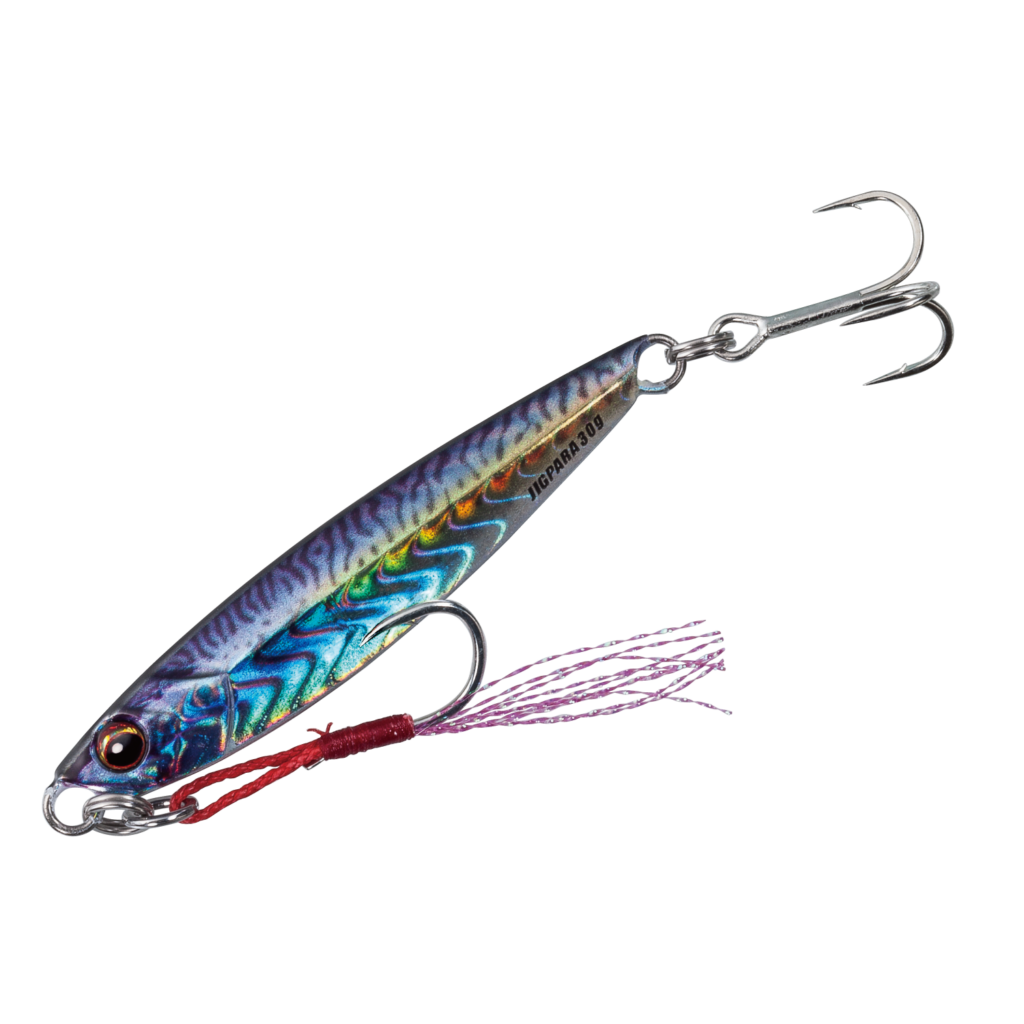
| Feature | Detail |
|---|---|
| Type | All-round casting metal jig (lead) |
| Balance | Centre balance, left-right asymmetric body |
| Colour chart | 30+ patterns in the light sizes (official JAN list) |
| Hooks | Japanese-made originals fitted front and rear |
| Finish | Multi-layer coating for durability |
| Size | Colour families available | Price |
|---|---|---|
| 20 g | Natural, glow, zebra, keimura, live bait | Open price |
| 30 g | Natural, glow, zebra, keimura, live bait | Open price |
| 40 g | Natural, glow, zebra, keimura, live bait | Open price |
The verdict: the box-filler. Three colours in each of 30 and 40 g costs less than one premium jig, and on toothy or snaggy ground that maths is the whole game. It’s not the longest caster in a hard wind; that’s where the next two picks come in.
A compact anchovy-profile caster that Shimano built around one number: the 30 g size averaged over 100 metres in their outdoor casting tests. What makes it interesting for this article is the colour lineup, because it’s a worked example of the logic above. The natural silver sardine is the official base-rotation colour for any weather, the subdued-flash glow colour is aimed at clear, high-pressure water plus dawn and dusk, and the strong-flash keimura colour is Shimano’s own recommendation for overcast skies and dirty water. Buy those three and you’ve bought the matrix.
| Feature | Detail |
|---|---|
| Type | Compact match-the-bait casting jig (lead) |
| Profile | Anchovy (katakuchi iwashi) motif, rear-weighted |
| Cast distance | 30 g averaged 100 m+ in Shimano’s outdoor tests |
| Finish | Scale Boost hologram, natural / subdued / strong-flash versions |
| Hooks | Thick-gauge single assist (front) + treble (rear) fitted |
| Size | Length | Hooks (standard) | Price (JPY, tax excl.) |
|---|---|---|---|
| 20 g (JM-C20R) | 68 mm | Single #14 + treble #4 | ¥730 (~A$7.30) |
| 30 g (JM-C30R) | 79 mm | Single #14 + treble #4 | ¥800 (~A$8) |
| 40 g (JM-C40R) | 87 mm | Single #14 + treble #4 | ¥850 (~A$8.50) |
Best suited for: beach and breakwall anglers whose fish eat small bait, which in Australia means most of them. Australian salmon (Arripis trutta), tailor (Pomatomus saltatrix) and bonito all key on finger-size baitfish, and this profile matches it at genuine distance. Past 40 g you’re out of luck: the range stops there, so deep-ledge work belongs to heavier metal or tungsten.
The tungsten benchmark. Daiwa lists eighteen colours in the shore-casting sizes, split between parallel-holo and flash-holo foils and including glow, zebra glow and keimura options, so the colour matrix applies here too. The body is asymmetric: it swims on the retrieve and slides nearly horizontal on the fall like a dying baitfish. When the fish are on matchstick bait, the wind is up, or the ledge is deep, this is the jig that turns an unfishable day into a fishable one.

| Feature | Detail |
|---|---|
| Type | Compact tungsten casting jig |
| Material | Tungsten, approx. 1.7x denser than lead |
| Action | Swimming retrieve, near-horizontal slide on the fall |
| Colours | 18 in shore sizes, incl. glow, zebra glow and keimura |
| Hooks | Sold without hooks (rig your own assist and treble) |
| Size | Length | Material | Price (JPY, tax excl.) |
|---|---|---|---|
| 30 g | 55 mm | Tungsten | ¥1,800 (~A$18) |
| 45 g | 64 mm | Tungsten | ¥2,200 (~A$22) |
| 60 g | 68 mm | Tungsten | ¥2,700 (~A$27) |
Should you buy it? As your third or fourth jig, absolutely. As your first, no. It costs three times what a lead jig does and arrives hookless, so budget for an assist hook and a treble on top. Keep it off the barnacles and it’ll pay you back on the days lead can’t.
Light shore jigging in Japan often revolves around sagoshi (juvenile Spanish mackerel) and hamachi-class yellowtail (Seriola quinqueradiata) pushing anchovies along urban breakwalls, and the standard routine is remarkably consistent. Most anglers start with a 30 g silver jig because it sits in the middle of the grid: far enough, deep enough, natural enough. Weight changes only when the water demands it, when the line angle grows too flat on the sink, or when fish start boiling out of casting range.
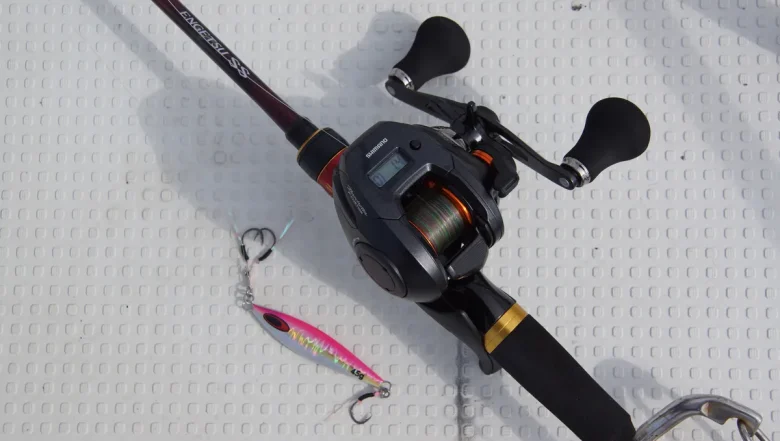
Colour changes on a simple clock. Silver or natural sardine while the sun is high, blue-pink as cloud builds or the light slides, and a zebra glow for the first and last half hour of the day. When the water turns dirty after rain, the standard move is to jump straight to gold or akakin and skip the natural patterns entirely. None of it is romantic, but the logic is sound, and every one of those habits transfers to an Australian beach or breakwall with different fish on the end.
The three jigs side by side, matched to the part of the weight-and-colour matrix each one covers best.
| Jig | Best job | Weights | Material | Colours | Price (JPY, tax excl.) |
|---|---|---|---|---|---|
| Major Craft Jigpara Short | Building the colour box cheaply | 20-60 g | Lead | 30+ patterns | Open price |
| Shimano Coltsniper Iwashi Rocket | Distance on small bait, light-matched colours | 20-40 g | Lead | 7 patterns | ¥730-850 (~A$7.30-8.50) |
| Daiwa TG Bait | Wind, depth, fussy micro-bait feeders | 30-250 g | Tungsten | 18 (shore sizes) | ¥1,800-2,700 (~A$18-27, 30-60 g) |
If you want the two-jig version of this whole article, here it is.
Top pick: Shimano Coltsniper Iwashi Rocket 30 g
The centre of the grid: a 30 g weight that suits almost any Australian shore outfit, 100 m-class casts, and a colour lineup designed around the exact light-and-clarity logic in this guide. Start with the natural silver, add the keimura for dirty days. ¥800 (~A$8) per jig, tax excluded.
Budget pick: Major Craft Jigpara Short 30 g
The cheapest way to own the full colour matrix. Grab a silver, a blue-pink and a zebra glow and you’ve covered bright, grey and dirty days for the price of a takeaway lunch. Fully rigged out of the packet. Open price in Japan; check the live listing.
Weight first: read the platform, the depth, the current and your rod rating, and pick the lightest jig that still keeps contact with the bottom of the zone. Colour second: read the light and the water clarity, and pick from the three families. That’s the whole system. It fits in a small box with three colours per weight, and it makes the decision at the water take seconds instead of turning into a confidence crisis.
From here, the species guides show the system at work on Australian salmon and on tailor and bonito, the Japanese metal jig round-up compares more models in depth, and you can browse all of our Australia fishing guides for the rest of the shore jigging series.
All specifications in this article were taken from the manufacturers’ official product pages and catalogue data (Major Craft, Shimano and Daiwa), checked in July 2026. Prices are maker list prices in JPY (tax excluded) with approximate AUD conversions at the time of writing; the Jigpara Short is sold at open price, so check live listings. Product images are from the makers’ official pages. Affiliate links may earn us a commission at no extra cost to you.