Shore Jigging for Beginners: How to Get Started in Australia
ちゃんま
マイボ!

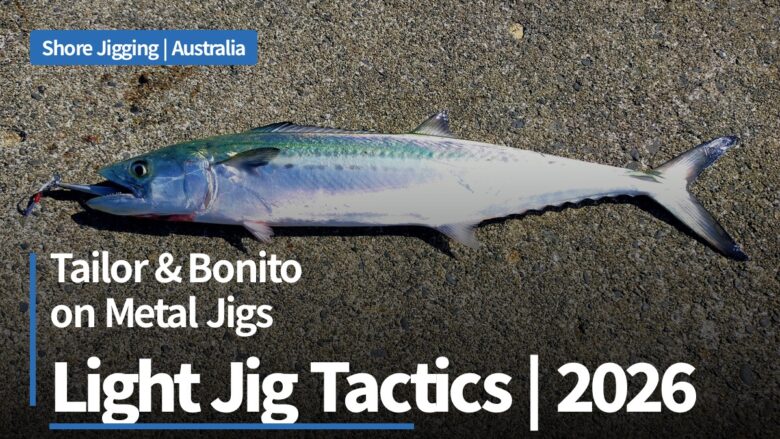
Two of the most reliable pelagic targets you can chase off an Australian rock ledge or beach both eat the same thing: small, fast, silver baitfish. Tailor (Pomatomus saltatrix) and Australian bonito (Sarda australis) will crash a metal jig with real violence, yet plenty of anglers still miss them by fishing gear built for kingfish. This guide answers the questions that actually decide whether you go home with fish, and it does it around light Japanese metal jigs, which suit these two species far better than a box of heavy slugs.
It’s a companion piece to our shore jigging beginner’s guide for Australia. If you want the wide, all-weights comparison of Japanese metal jigs across every shore target, that’s in our best Japanese metal jigs for shore jigging round-up, and there’s a species-specific one for Australian salmon too. Here we stay tight on tailor and bonito: the questions, then the jigs.
A note on links and pricing: the Daiwa and Shimano jigs below are JDM (Japan Domestic Market) catalogue items, so their buy links point to Amazon Japan, which ships internationally (check availability and shipping cost at checkout; orders over A$59 may qualify for free international delivery). The Major Craft Jigpara links point to Amazon.com, available with international shipping to Australia. Prices are shown in JPY (tax excluded) with an approximate AUD conversion at the time of writing (A$1 = ¥100, July 2026). Tailor and bonito size and bag limits differ between states, so always check your local regulations before you keep a fish.
This is the question that trips people up, because tailor fishing has a long tradition of heavy metal slices and that habit gets carried straight onto bonito. The honest answer is that most tailor and bonito are landed on jigs in the 20 to 40 g range, not the 60 g slabs. Both fish key on small bait: whitebait, blue sardines, anchovies and juvenile pilchards, none of which is bigger than your finger.
Weight is really about reaching the fish and controlling depth, not about matching size. Pick it by the conditions in front of you.
Bonito in particular reward a smaller profile than most people throw. When a school is picking off tiny baitfish on the surface and refusing everything, going up in weight is usually the wrong move; going down in silhouette is the right one. That’s exactly where a dense tungsten jig earns its keep, and it’s why one of our four picks is tungsten.
Tailor have a mouth full of small, sharp teeth and a habit of slashing at the tail of a lure, which is a fast way to lose jigs and fish. Bonito have jaws too, though theirs carry a single row of small conical teeth rather than the tailor’s cutting blades. So the trace question matters, and the answer is a genuine trade-off.
Our practical rule: start on heavy fluoro, and only switch to wire when the tailor are thick enough that bite-offs cost more than shy fish do. A jig with an assist hook up front, rather than a trailing treble the fish slash at, also cuts your bite-off rate, which is one more reason light JDM jigs suit these fish. Retie and check your leader for nicks after every few fish; tailor damage line even when they don’t cut it clean through.
Here the two species pull in slightly different directions, and knowing that changes how you fish a session.
Tailor want speed. They slash to cripple bait, so if you feel a sharp tap and slow down, the lure looks dead and they turn away. Keep winding fast, or even speed up, until the rod loads with real weight. A fast, flat-out straight retrieve with the odd rip of the rod tip is deadly, and it’s why long-casting slices have always caught tailor.
Bonito want a mix. They’ll chase a fast wind too, but they also eat on the drop and respond well to a sharp, erratic dart. A high-pitch retrieve, quick jerks with short pauses, lets a fluttering jig do the selling between strokes, and a big share of bonito bites come as the jig falls, not while it’s swimming. Stay in contact with the jig on the sink and you’ll feel takes you’d otherwise miss.
If you’re covering a mixed school, start fast for the tailor, and if you’re getting followed but not hit, drop in a couple of pauses to tempt the bonito. One jig can do both jobs, which is the whole point of choosing versatile metals.
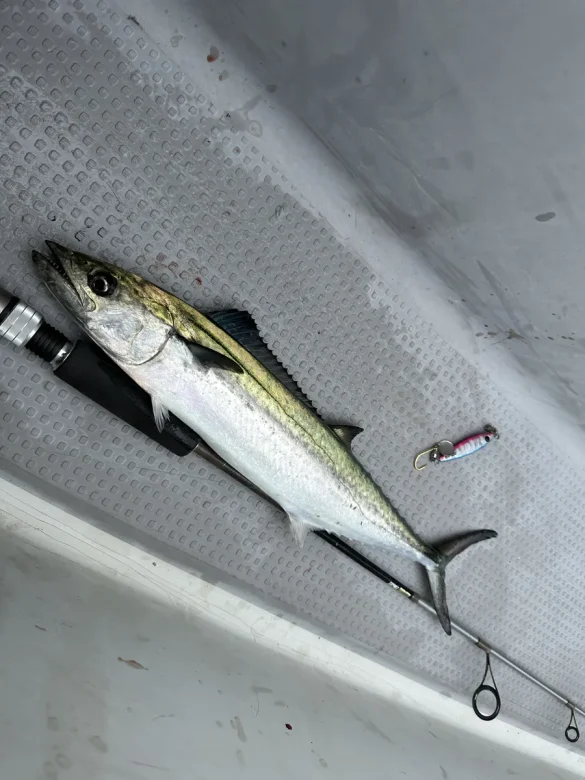
Four jigs cover the tailor and bonito problem from every angle: a slim distance jig for beaches, a compact caster for finding fish, a tungsten jig for wind and fussy bonito, and a budget all-rounder you can afford to feed to the teeth. Specs below come straight from each maker’s official product page, checked July 2026.
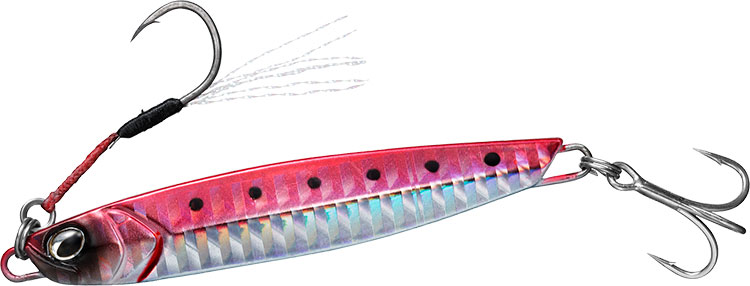
Beach tailor sit on the edge of your range more often than at your feet, and Daiwa rebuilt the Samurai Jig R for exactly that. The belly is slimmed and the centre of gravity nudged rearward, so the jig holds a stable flight path even into a headwind or crosswind, and the redesign cut the line-over-hook tangles that waste casts. Up front is a SaqSas assist hook, Daiwa’s fluorine-coated, tinsel-dressed single that pins fish slashing at the lure, backed by a heavy-gauge rear treble that survives a bigger-than-expected pelagic.
| Feature | Detail |
|---|---|
| Type | Casting metal jig (lead body) |
| Balance | Slimmed belly, slightly rear-weighted |
| Flight | Stable trajectory in head and cross winds |
| Front hook | SaqSas fluorine-coated assist with tinsel |
| Rear hook | Thick-gauge treble |
| Retrieve | Jerks and plain straight retrieve both work |
| Size | Length | Hooks (standard) | Price (JPY, tax excl.) |
|---|---|---|---|
| 20 g | 75 mm | Iseama #11 + treble #8 | ¥700 (~A$7) |
| 30 g | 83 mm | Iseama #13 + treble #6 | ¥750 (~A$7.50) |
| 40 g | 92 mm | Iseama #13 + treble #5 | ¥800 (~A$8) |
The verdict: if your tailor fishing happens off open beaches, start here. The extra metres turn schools you can see but not reach into schools you’re fishing, and the tinsel assist genuinely converts slashing fish. One caution: it’s a lead jig with a fine finish, so bouncing it across rock will chew the paint, so keep it for the sand.
Iwashi means anchovy or sardine in Japanese, and this jig is a deliberately small, anchovy-shaped profile that still casts a long way. Shimano built it around a single number: in their own outdoor tests the 30 g size averaged over 100 metres. For tailor and bonito that eat tiny bait, a 68 to 87 mm baitfish silhouette you can put on the horizon is close to the ideal tool. Both hooks come fitted and both are thick-gauge, so a stray kingfish doesn’t end your session.
| Feature | Detail |
|---|---|
| Type | Compact match-the-bait casting jig |
| Profile | Anchovy (katakuchi iwashi) motif, slim silhouette |
| Balance | Rear-weighted for a stable, long flight |
| Cast distance | 30 g averaged 100 m+ in Shimano’s outdoor tests |
| Finish | Scale Boost hologram (realistic scale flash) |
| Retrieve | Twitch, jerk and plain straight retrieve |
| Size | Length | Hooks (standard) | Price (JPY, tax excl.) |
|---|---|---|---|
| 20 g (JM-C20R) | 68 mm | Single #14 + treble #4 | ¥730 (~A$7.30) |
| 30 g (JM-C30R) | 79 mm | Single #14 + treble #4 | ¥800 (~A$8) |
| 40 g (JM-C40R) | 87 mm | Single #14 + treble #4 | ¥850 (~A$8.50) |
Best suited for: anglers who fish tailor and bonito that are locked onto micro bait, and anyone who wants a genuine pilot jig to find fish with. On the fussy surface-feeder days a small profile is the difference between a bent rod and a photo session. Just don’t lean on it in big surf or deep water, where the light body gets pushed around; that’s when you switch to the Samurai or the tungsten.
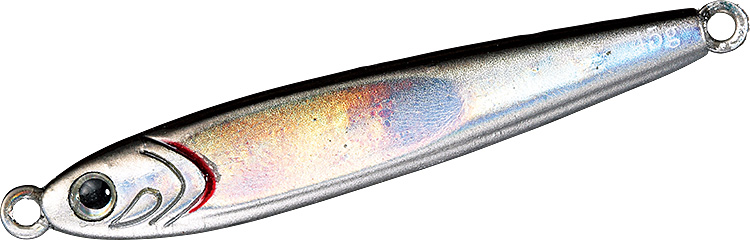
When bonito are boiling on bait the size of a matchstick and nothing works, this is the answer. The TG Bait is a tungsten jig, roughly 1.7 times denser than lead, so it packs a heavy jig’s cast and sink rate into a tiny sardine-shaped body. That combination, a small silhouette that still reaches the fish and cuts through wind, is precisely the situation that beats bonito. On the retrieve it swims like a baitfish; on the fall the asymmetric body slides almost horizontal, imitating a wounded bait. It’s also a proven sagoshi and small-pelagic jig in Japan, which is the same job it does here.
| Feature | Detail |
|---|---|
| Type | Compact tungsten casting jig |
| Material | Tungsten, approx. 1.7x denser than lead |
| Profile | Anchovy (katakuchi) shape, asymmetric body |
| Action | Baitfish swim on retrieve, near-horizontal slide on the fall |
| Hooks | Sold without hooks (rig your own assist and treble) |
| Best for | Wind, fussy bonito on micro bait, reaching distant boils |
| Size | Length | Material | Price (JPY, tax excl.) |
|---|---|---|---|
| 30 g | 55 mm | Tungsten | ¥1,800 (~A$18) |
| 45 g | 64 mm | Tungsten | ¥2,200 (~A$22) |
| 60 g | 68 mm | Tungsten | ¥2,700 (~A$27) |
Should you buy it? Yes, if fussy bonito on tiny bait are your regular heartbreak, or if you fish windy, deep ledges where a light jig can’t get down. It’s several times the price of a lead jig and it comes without hooks, so budget for an assist and treble. It also punishes contact with rock harder in the wallet than the others do. Treat it as your problem-solver, not your everyday jig.
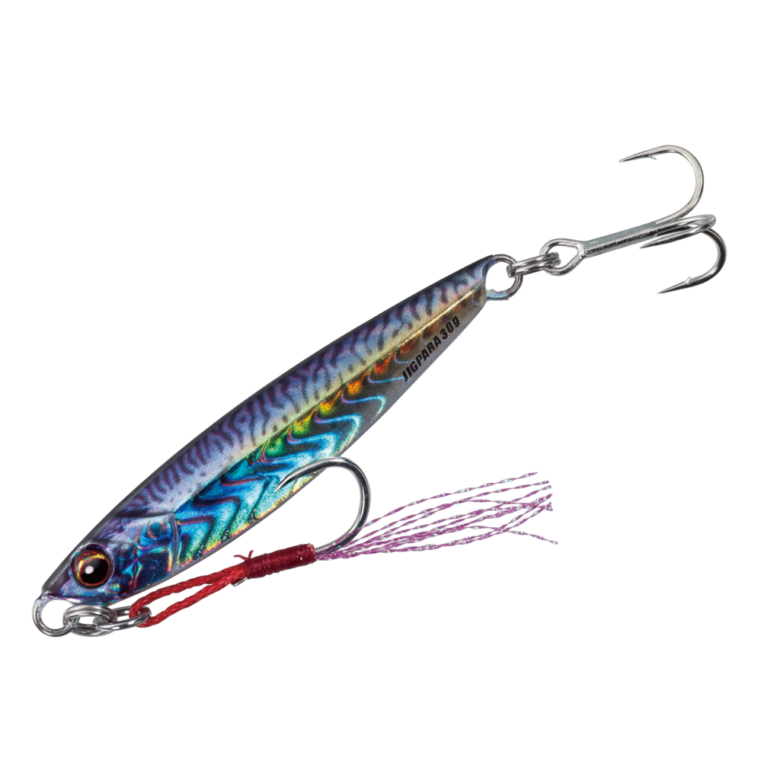
Tailor and bonito fishing eats jigs. Teeth bite them off, rocks chew them, and a hot school shreds the paint on the survivors. So the last pick is the one you can afford to lose: the Major Craft Jigpara Short, the standard-issue light shore jigging metal in Japan, and it comes fully rigged with Japanese-made hooks front and rear straight out of the packet. A centre-balanced, left-right asymmetric body handles every action from a lazy straight wind to hard one-pitch jerking, and a multi-layer coating helps it survive being bounced off structure.
| Feature | Detail |
|---|---|
| Type | All-round casting metal jig |
| Balance | Centre balance, asymmetric body |
| Action | Handles every action, from straight wind to jerks |
| Hooks | Japanese-made originals fitted front and rear |
| Finish | Multi-layer coating for durability |
| Best for | First jigs, jetty and harbour sessions, high-loss ground |
| Size | Hooks (standard) | Typical tailor / bonito use |
|---|---|---|
| 20 g | Front + rear originals | Calm days, small bait, light rods |
| 30 g | Front + rear originals | The everyday all-rounder |
| 40 g | Front + rear originals | Wind, current, bigger water |
Who is it for? Anyone starting out, and anyone fishing toothy, snaggy ground where losing jigs is a certainty. It’s not the longest caster here and not the most specialised, but it does everything to a solid standard for the least money. A handful in sardine and pink is the cheapest complete tailor-and-bonito kit on this page.
Tailor and Australian bonito don’t swim in Japan, but their situation does. Our light shore jigging revolves around sagoshi (juvenile Spanish mackerel, another toothy slasher) and maruso and hiraso, the two Japanese bonito-type fish, herding tiny anchovies along breakwalls and beaches. We fish the same 20 to 40 g jigs at them, and the habits carry straight across.
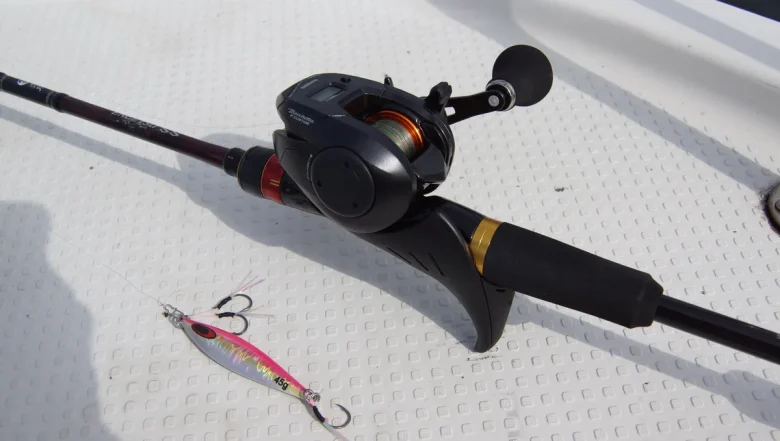
Three lessons stand out. First, on the toothy fish we lean on assist hooks and short heavy leaders, and we retie constantly, because a nicked leader loses the next fish. Second, when a bonito-type school refuses the jig, we go smaller and denser before we go faster; that’s the whole reason a tungsten jig lives in the box. Third, we carry silver-sardine, blue-pink and one glow or zebra pattern and rotate those three before agonising over anything exotic. That colour theory works in Osaka Bay, and there’s no reason it won’t work off a headland near you.
The four jigs side by side, matched to the job each one does on tailor and bonito.
| Jig | Best job | Weights | Material | Price (JPY, tax excl.) |
|---|---|---|---|---|
| Daiwa Samurai Jig R | Beach distance, wind, slashing tailor | 20-60 g | Lead | ¥700-950 (~A$7-9.50) |
| Shimano Coltsniper Iwashi Rocket | Compact caster, pilot jig, micro bait | 20-40 g | Lead | ¥730-850 (~A$7.30-8.50) |
| Daiwa TG Bait | Wind, deep ledges, fussy bonito | 30-250 g | Tungsten | ¥1,800-2,700 (~A$18-27, 30-60 g) |
| Major Craft Jigpara Short | Budget box-filler, toothy snaggy ground | 20-60 g | Lead | Open price |
If you want the short version, here are the three that earn their spot in a tailor-and-bonito box.
🥇 Gold: Daiwa Samurai Jig R (30 g & 40 g)
The best all-round starting point for both species. It reaches beach schools, holds its line in the wind, and the tinsel SaqSas assist pins slashing tailor better than a bare treble. ¥750-800 (~A$7.50-8) per jig, tax excluded.
🥈 Silver: Daiwa TG Bait (30 g)
The specialist that solves the fussy days. When bonito ignore everything, a tiny tungsten profile that still reaches the boil is the move. Dearer, and hookless, but it catches when nothing else will. ¥1,800 (~A$18), tax excluded, hooks not included.
🥉 Bronze: Major Craft Jigpara Short (20-40 g)
The one you can feed to the teeth. Fully rigged out of the packet, happy on any retrieve, and cheap enough to stock three colours before your first cast. Open price in Japan; check the live listing.
Tailor and bonito aren’t fussy fish once you meet them on their terms, and their terms are small, silver and fast. Carry a distance slice for the beach, a compact caster for finding fish, a tungsten jig for the windy and fussy days, and a budget metal you can afford to lose to the teeth, and you’ve covered practically every session. Run heavy fluoro until bite-offs force wire, wind fast for tailor and add pauses for bonito, and let the jig do the rest.
To take it further, see our light jig guide for Australian salmon, the full Japanese metal jig round-up, or start at our shore jigging beginner’s guide and browse all of our Australia fishing guides.
All specifications in this article were taken from the manufacturers’ official product pages (Daiwa, Shimano and Major Craft), checked in July 2026. Prices are maker list prices in JPY (tax excluded) with approximate AUD conversions at the time of writing; the Jigpara Short is sold at open price, so check live listings. Species facts (tailor, Pomatomus saltatrix; Australian bonito, Sarda australis) are from NSW DPI fisheries information. Product images are from the makers’ official pages. Affiliate links may earn us a commission at no extra cost to you. Tailor and bonito size and bag limits differ between states, so always check your local regulations.