Tailor & Bonito on Metal Jigs: Light Jig Tactics for AU Pelagics
ちゃんま
マイボ!

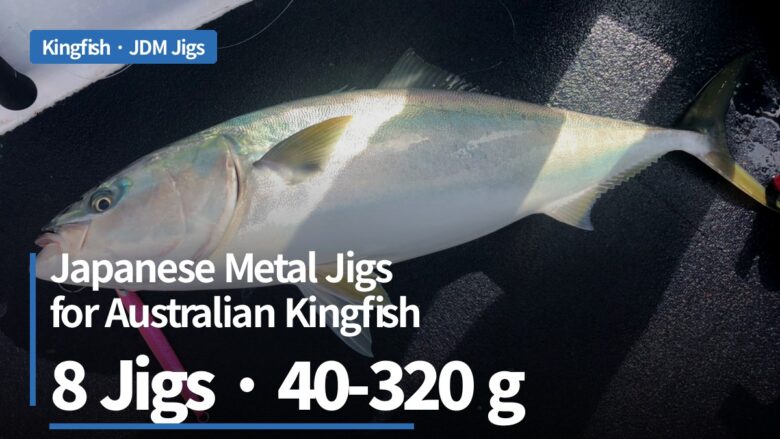
Walk into an Australian tackle shop and the kingfish jig wall is a wall of guesses. Half the packets are Japanese, the names mean nothing to most of us, and nothing on the card says whether the thing falls fast in 40 metres of running tide or hangs sideways for a sulky fish under the boat. The shop’s website lists a weight and a colour. That’s it.
There’s a reason it’s worth working out. Our Yellowtail Kingfish (Seriola lalandi) has a Japanese sibling: hiramasa, lumped into S. lalandi for decades and now usually treated as Seriola aureovittata. Same body plan, same appetite, same habit of shutting down when it feels like it. Japanese makers have been engineering metal for that fish for thirty years, and they publish the numbers: exact lengths, weights, list prices, and a written account of what the jig does in the water.
Below are eight jigs from five Japanese makers, 40 g to 320 g, specs taken from each maker’s own product page. For the rest of the outfit, see our guide to JDM reels for kingfish.
Prices are maker list prices in JPY, tax excluded, with an approximate AUD conversion at the time of writing (A$1 = ¥114, August 2026). Most of these are JDM-only models, so the buy links point to Amazon Japan: ships internationally from Amazon Japan, check availability and shipping cost at checkout. Orders over A$59 may qualify for free international delivery. Check your state’s size and bag limits for kingfish before you go.
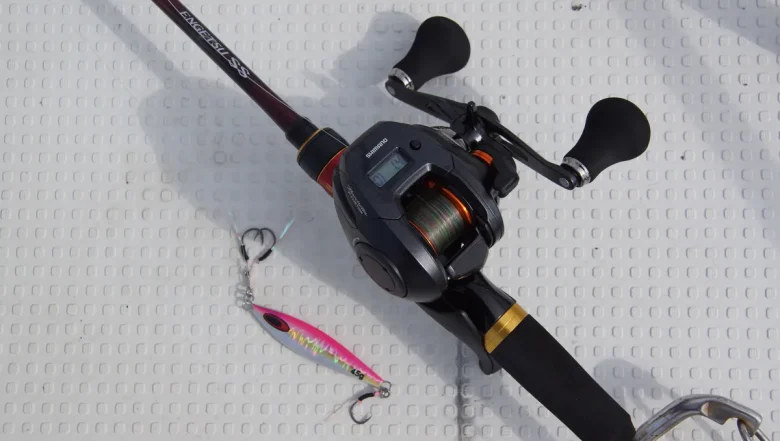
At ¥1,400 for the 100 g (about A$12), this is the cheapest jig here and the one most likely to still be in your box in two years. Shimano calls it a pilot jig, and their account of what it does on the drop is unusually specific: three fall patterns, backslide, a wobbling fall with a quick flick of direction, and a fore-and-aft slide, arriving in random order so the jig reads as bait knocked out of a school.

It was developed from the Center Sardine with the front section narrowed into a side-flat shape, which is what makes it feel light on the jerk despite being a chunky body. Shimano notes it sinks faster than the Stinger Butterfly Wing, so you can keep a decent tempo instead of waiting out a long flutter.
| Feature | Detail |
|---|---|
| Category | Pilot jig, fall-oriented |
| Fall actions | Backslide / wobbling fall / fore-and-aft slide, randomised |
| Body | Side-flat, narrowed front (developed from Center Sardine) |
| Fall speed | Faster than Stinger Butterfly Wing (Shimano’s comparison) |
| Suits | Anglers who want the jig to do the work |
| Model | Weight | Length | List price (excl. tax) |
|---|---|---|---|
| JT-410P | 100 g | 111 mm | ¥1,400 (~A$12) |
| JT-413P | 130 g | 121 mm | ¥1,500 (~A$13) |
| JT-416P | 160 g | 130 mm | ¥1,700 (~A$15) |
| JT-418P | 180 g | 135 mm | ¥1,900 (~A$17) |
| JT-420P | 200 g | 140 mm | ¥2,050 (~A$18) |
| JT-425P | 250 g | 151 mm | ¥2,300 (~A$20) |
The 160 g and 200 g are the two to buy for most Australian kingfish work. Its limitation is the flip side of its strength: a fat, water-grabbing body drifts a long way in heavy tide.
Deep water, hard drift, ripping current. Shimano’s headline for this jig names those three conditions and nothing else, which is refreshingly honest for marketing copy. The obsession, in their words, is fall speed.

| Model | Weight | Length | List price (excl. tax) |
|---|---|---|---|
| JT-215Q | 150 g | 189 mm | ¥2,040 (~A$18) |
| JT-218Q | 180 g | 201 mm | ¥2,150 (~A$19) |
| JT-220Q | 200 g | 208 mm | ¥2,270 (~A$20) |
| JT-224Q | 240 g | 221 mm | ¥2,490 (~A$22) |
| JT-230Q | 300 g | 238 mm | ¥2,800 (~A$25) |
The body is squeezed narrow to shed resistance and the balance sits slightly to the rear, which is why it drops harder than its stablemates the King Slasher and Drift Slasher. Shimano’s key claim is about what happens after the jerk: it keeps just enough slide, then snaps back to a straight vertical fall instead of sailing off downtide, so you get more bottom contacts per drift.
| Feature | Detail |
|---|---|
| Category | Slim speed jig |
| Balance | Slightly rear-weighted |
| Fall | Fast; faster than King Slasher / Drift Slasher |
| Post-jerk behaviour | Short slide, quick return to straight fall |
| Named targets | Hiramasa, buri, kanpachi (amberjack family) |
Buy this one if your boat drifts side-on in real current and you’re sick of watching 200 g of metal disappear at 45 degrees. In slack water it’s the wrong tool: the slim body that beats the tide gives fussy fish very little to look at.
Start with the bad news. The 100 g TG Gatling lists at ¥2,550 (about A$22), which is more than a 250 g lead jig, and it tops out at 150 g. Tungsten costs what it costs.

A tungsten core concentrates the mass, so the jig turns over easily and starts working the instant you load the rod. The volume stays tiny, which is the whole argument on micro-bait days when kings are locked onto something two centimetres long. Shimano built the body as a polyhedron with reflective faces on all four sides so it throws light everywhere, and dished the side flats slightly to improve water grip on short, tight rod strokes. Their advice for shallow ground and off-bite fish is to cut travel distance and raise the number of appeals, which is exactly what a short heavy body lets you do.
| Feature | Detail |
|---|---|
| Core | High-density tungsten |
| Body | Polyhedral short body, multi-directional reflective faces |
| Side flats | Slightly concave for water grip |
| Designed for | Micro-bait patterns, shallow ground, low-activity fish |
| Weight ceiling | 150 g |
| Model | Weight | Length | List price (excl. tax) |
|---|---|---|---|
| JT-804Q | 40 g | 60 mm | ¥2,050 (~A$18) |
| JT-806Q | 60 g | 73 mm | ¥2,150 (~A$19) |
| JT-808Q | 80 g | 81 mm | ¥2,250 (~A$20) |
| JT-810Q | 100 g | 86 mm | ¥2,550 (~A$22) |
| JT-812Q | 120 g | 93 mm | ¥2,650 (~A$23) |
| JT-815Q | 150 g | 100 mm | ¥2,950 (~A$26) |
Of everything here, this jig has the most direct claim on an Australian kingfish angler’s attention. Daiwa developed the original KY Jig to take big hiramasa in the Genkai Sea off Kyushu, against a brief Australians will recognise instantly: fish hammered daily and gone clever, in deep water, in fast tide, on a hard side-on drift. Their word for that drift is dotera nagashi, and it’s what a Sydney charter does on the deep reefs.
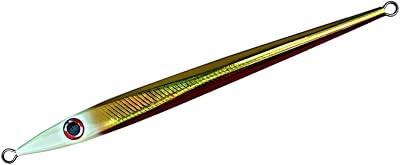
The cross-section is close to round, with a paddle-shaped flat on the head and a taper that goes brutally slim toward the tail. That combination cuts wave-making drag, which is how a 200 mm jig manages a fast fall and a light retrieve at once. On the second generation Daiwa reworked the edges to kill the flutter and noise that made the original hard to control. The wire through the body is deliberately thick-gauge, so a green fish thrashing on the deck can’t tear the hardware out.
| Feature | Detail |
|---|---|
| Type (Daiwa’s own) | Long jig for dotera (side-on) drift |
| Body | Asymmetric slim long, near-round section with head paddle flat |
| Material | Lead |
| Finish | Adel hologram, multiple patterns combined |
| Hooks included | None |
| Size | Length | Type | List price (excl. tax) |
|---|---|---|---|
| 150 g | 200 mm | Long jig, dotera | ¥2,000 (~A$18) |
| 180 g | 220 mm | Long jig, dotera | ¥2,250 (~A$20) |
| 200 g | 230 mm | Long jig, dotera | ¥2,350 (~A$21) |
| 220 g | 240 mm | Long jig, dotera | ¥2,600 (~A$23) |
| 250 g | 250 mm | Long jig, dotera | ¥2,800 (~A$25) |
Anglers who work long, slow, sweeping jerks rather than a fast one-pitch, and who fish the deeper southern kingfish grounds. If you’ve only ever fished short jigs, budget a session to get used to it. A 250 mm jig on a short-stroke retrieve just wallows. Our explainer on Japanese jigging actions covers the rod work these long jigs are designed around.
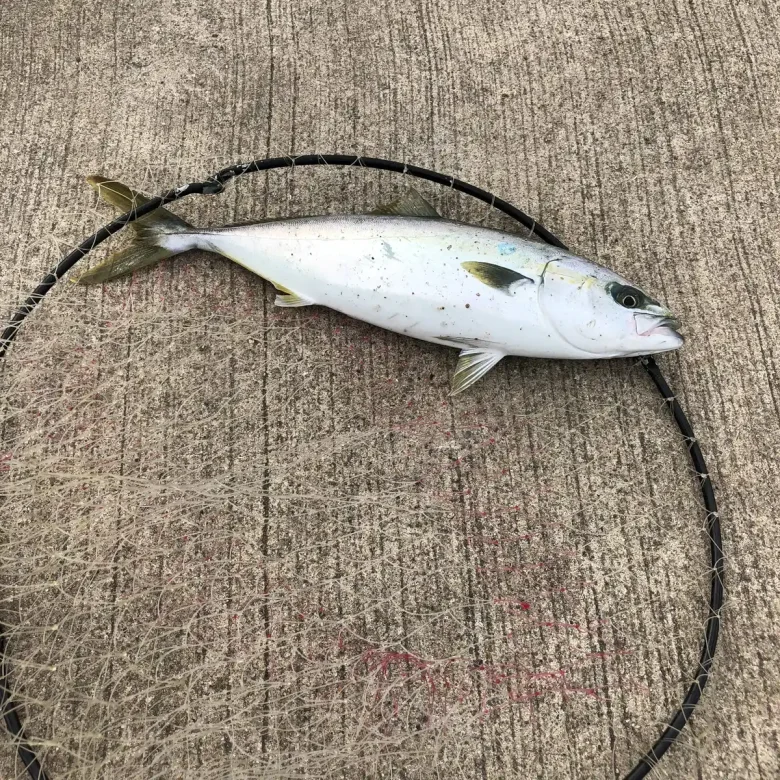
Daiwa’s name for the category is Fall Killer, and the question they set themselves is oddly precise: how fast does a damaged baitfish sink when it’s knocked out of a bait ball? The FK Jig is an asymmetric body tuned to that answer, not too quick and not too slow, flashing the whole way down. It’s a one-pitch jerk jig, so it suits the retrieve most Australians already use.

| Feature | Detail |
|---|---|
| Type (Daiwa’s own) | Fall Killer |
| Body | Asymmetric, flashing-fall tuned |
| Intended retrieve | One-pitch jerk |
| Material | Lead |
| Hooks included | None |
The length column below shows why it behaves differently to the KY Jig: the 250 g is only 170 mm long, a stubby, dense shape that hangs and rolls rather than gliding. On a boat where half the crew are on long jigs, this catches when the fish want something falling in one spot.
| Size | Length | List price (excl. tax) |
|---|---|---|
| 130 g | 135 mm | ¥1,900 (~A$17) |
| 150 g | 145 mm | ¥2,000 (~A$18) |
| 180 g | 155 mm | ¥2,250 (~A$20) |
| 210 g | 162 mm | ¥2,500 (~A$22) |
| 250 g | 170 mm | ¥2,800 (~A$25) |
CB ONE is a small Kanagawa maker with a cult following among Japanese amberjack and tuna anglers, and the C1 Semilong exists for the session everyone dreads: bright sun, no run, fish on the sounder that won’t eat. The catalogue text is blunt. This jig is for weak current and low activity, and it works by suppressing action rather than adding it.

A low-amplitude head shake plus a flat-sided slap, edges deliberately rounded off so the faceted body still grabs slow-moving water. CB ONE publish the balance point, which almost nobody does: 45:55, slightly forward, and that keeps the drag light even when you speed up.
| Feature | Detail |
|---|---|
| Category | Semi-long jig, mid-length |
| Balance | 45:55, slightly forward |
| Action | Low-amplitude head shake plus flat-side slap |
| Best conditions | Weak current, inactive fish |
| Also handles | Cast and jerk, swimming retrieve, lateral input |
| Size | Length | List price (excl. tax) |
|---|---|---|
| 110 g | 143 mm | ¥1,700 (~A$15) |
| 130 g | 153 mm | ¥1,850 (~A$16) |
| 150 g | 163 mm | ¥2,000 (~A$18) |
| 175 g | 176 mm | ¥2,150 (~A$19) |
| 200 g | 183 mm | ¥2,350 (~A$21) |
| 320 g | 205 mm | ¥3,100 (~A$27) |
Stock is the problem, not the jig. CB ONE is a small operation and popular colours vanish, so if a size you want shows up, buy two.
Sixty grams to three hundred, eight sizes, from about A$11. No other jig here covers that spread, which makes the Stay the easiest one to standardise a box around.
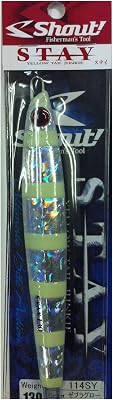
Shout designed the Stay around the pause, not the jerk. The delta-form body holds a straight line instead of spiralling, triple edges let it dart and ride the current, and when you stop it sits horizontal as though it’s suspending. That hanging moment is the bite window. One thing to know before ordering: it takes assist hooks only, and the weighting changes partway up the range, with 60 g to 100 g front-weighted and 130 g and above switching to centre weight. The two halves don’t fish the same.
| Feature | Detail |
|---|---|
| Body | Delta form, asymmetric, triple edges |
| Balance | Front weight; 130 g and above are centre weight |
| Signature | Horizontal, suspending posture on the pause |
| Hook design | Assist hooks only |
| Range | 60 g to 300 g (8 sizes) |
| Item | Weight | Balance | List price (excl. tax) |
|---|---|---|---|
| 111SY | 60 g | Front | ¥1,250 (~A$11) |
| 112SY | 80 g | Front | ¥1,350 (~A$12) |
| 113SY | 100 g | Front | ¥1,450 (~A$13) |
| 114SY | 130 g | Centre | ¥1,550 (~A$14) |
| 115SY | 160 g | Centre | ¥1,850 (~A$16) |
| 116SY | 200 g | Centre | ¥2,150 (~A$19) |
| 120SY | 250 g | Centre | ¥2,350 (~A$21) |
| 117SY | 300 g | Centre | ¥2,550 (~A$22) |
Here’s a spec that tells you almost everything: 95 g, 115 g, 135 g and 155 g, and every one is 185 mm long. Smith didn’t scale the jig up, they made it denser, so the four sizes share one silhouette and fall progressively faster. Change weight for depth, and the fish sees the same thing.

This is a centre-balance long jig for slow-pitch jigging, a technique Smith has pushed since 2003. The body is thinned to the limit with pronounced edges, and the flat faces that catch water pressure are long and narrow, which lets it produce a tight action on short and medium slow jerks instead of needing a full sweep. For deep, sulking kings that is a completely different presentation to anything else here. It needs a slow-pitch rod to work properly, so don’t clip it to a fast-action speed stick and expect results.
| Feature | Detail |
|---|---|
| Category | Centre-balance long jig, slow pitch |
| Shape | Laser-edge back and flat, thinned body |
| Length | 185 mm across all four weights |
| Hooks | Hookless spec (an assist-fitted 155 g version is sold separately) |
| Water | Coastal and near-offshore grounds |
| Weight | Length | List price (excl. tax) |
|---|---|---|
| 95 g | 185 mm | ¥1,550 (~A$14) |
| 115 g | 185 mm | ¥1,650 (~A$14) |
| 135 g | 185 mm | ¥1,750 (~A$15) |
| 155 g | 185 mm | ¥1,850 (~A$16) |
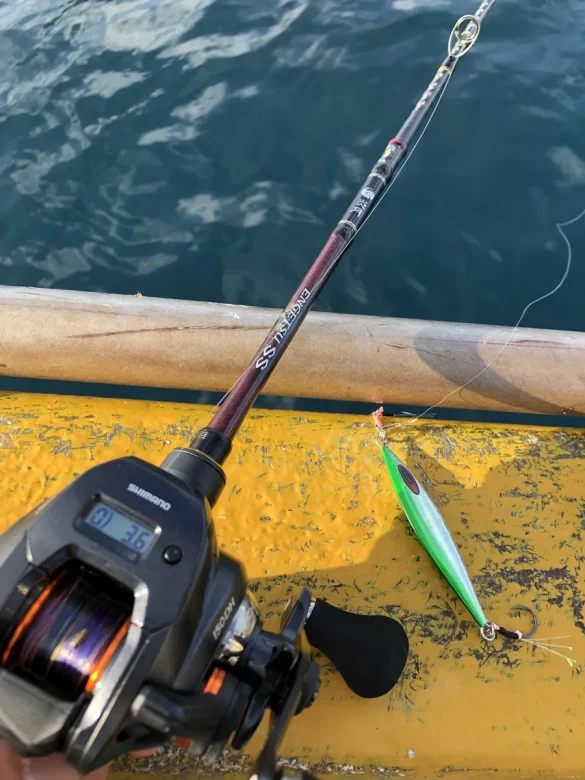
Our own jigging in Japan sits at the lighter end of this scale, 60 g to 150 g off a small private boat for yellowtail-class fish, not the 250 g deep-water hiramasa game the KY Jig was built for. What transfers is the habit of buying, and that’s what surprises Australians most.
You buy the metal bare. Look at the spec tables above and the hook column reads “none”, because in Japan the jig and the hooks are two separate purchases and everyone assumes you’ll match the assist length to the jig and the fish. A shop wall has jigs on one side and forty varieties of assist hook on the other. It sounds fussy. In practice it means a jig you can retune all season instead of binning when the factory trebles rust out.
The second habit is buying types rather than brands. A Japanese box for amberjack holds a fast-falling speed jig, one semi-long, one long jig and something small and heavy for micro-bait, in three or four colours. Nobody carries thirty colours. They carry four shapes and change the shape, not the colour, when the bite dies. The same logic underpins our shore jigging beginner’s guide, the cheapest place to learn the rod work.
| Jig | Weights | Type | Price range (excl. tax) | Buy it for |
|---|---|---|---|---|
| Shimano Sardine Waver | 100–250 g (to 500 g) | Pilot / fall | ¥1,400–2,300 (~A$12–20) | First jig, automatic action |
| Shimano Speed Slasher | 150–300 g | Slim speed | ¥2,040–2,800 (~A$18–25) | Deep water, hard tide |
| Shimano TG Gatling | 40–150 g | Short tungsten | ¥2,050–2,950 (~A$18–26) | Micro-bait, shallow reef |
| Daiwa Saltiga KY Jig II Adel | 150–250 g | Slim long | ¥2,000–2,800 (~A$18–25) | Deep drift, long jerks |
| Daiwa Saltiga FK Jig | 130–250 g | Asymmetric fall | ¥1,900–2,800 (~A$17–25) | One-pitch jerk, fall bites |
| CB ONE C1 Semilong | 110–320 g | Semi-long | ¥1,700–3,100 (~A$15–27) | Slack water, sulky fish |
| Shout! Stay | 60–300 g | Dart and pause | ¥1,250–2,550 (~A$11–22) | One family for the whole box |
| Smith CB.Masamune | 95–155 g | Centre-balance long | ¥1,550–1,850 (~A$14–16) | Slow pitch on deep, sulking kings |
If you’d rather order without dealing with Amazon Japan, Shimano’s globally distributed Butterfly Flat-Fall and Daiwa’s Saltiga SK Jig are both listed on Amazon.com with international shipping to Australia. They’re different jigs to the JDM models above, not equivalents, but they’ll get you fishing this weekend.
Three that earn their spot if you’re building a kingfish box from scratch.
🥇 Gold: Shout! Stay (130 g and 200 g)
The cheapest way to cover the widest range with one action you can learn properly. The horizontal pause is a genuinely different trigger to a straight speed jig, and at ¥1,550 to ¥2,150 (~A$14 to A$19) you can lose one to a reef without it ruining your day. Assist hooks are essential, not optional.
🥈 Silver: Daiwa Saltiga KY Jig II Adel (180 g)
The specialist for deep southern grounds and real tide, built from the ground up for pressured hiramasa on a side-on drift. If your charter fishes 60 m plus and the skipper talks about the run, this is the jig that keeps working when others slide away. ¥2,250 (~A$20), hooks not supplied.
🥉 Bronze: Shimano Stinger Butterfly Sardine Waver (160 g)
The cheap one that keeps catching. Three randomised fall patterns mean it fishes itself while you’re still learning the rhythm, and at ¥1,700 (~A$15) it’s the least painful jig in the box to donate to the bottom. A sensible first purchase before you spend on specialists.
Pick by water, not by brand. Shallow bommies and small kings on micro-bait: TG Gatling or a light Shout Stay. Standard 40 to 60 m reef on a moderate drift: Sardine Waver or the FK Jig, both around A$18. Deep, fast southern grounds where the boat swings side-on: Speed Slasher for a fast vertical drop, KY Jig II for long sweeping jerks. Flat calm and fish that won’t commit: C1 Semilong, or the CB.Masamune if you own a slow-pitch rod.
Three jigs cover most of an Australian kingfish season. For a first order: one fall jig, one speed jig, and a pack of good assists. Add specialists once you know which problem you keep running into.
Note: Amazon Japan ships most of these internationally, but availability changes by colour and size, so some links above open a filtered search rather than a single product page. Check current size and bag limits for kingfish with your state fisheries authority.