Japanese Seabass (Suzuki) Tactics for Mulloway
ちゃんま
マイボ!


Flathead will eat almost anything dragged past their nose, which is exactly why the lure question gets muddled. The fish are not fussy. What separates a good session from a slow one is usually whether the lure is holding the bottom, still swimming in the run-out, and still attached after the third oyster rack.
Japan has a whole tackle category for this. It is called flat fish game, and it targets hirame (Japanese flounder) and magochi, Japan’s own flathead from the same family, Platycephalidae. The lures are catalogued for exactly that: sand, current, a fish sitting flat on the bottom looking up. Dusky flathead (Platycephalus fuscus) is close enough in habit that the gear transfers without any adaptation at all.
Seven Japanese lures below, all with specs taken from the makers’ own pages. Four soft plastics, two blades, and one jig head that comes with its body already fitted.
Prices are maker list prices in JPY with approximate AUD conversion at A$1 = ¥110 (August 2026). Keitech and Bait Breath publish tax-included prices, Megabass and Daiwa publish tax-excluded, and Marukyu publishes no list price for Ecogear items at all. JDM buy links go to Amazon Japan, which ships internationally: check availability and shipping cost at checkout, and orders over A$59 may qualify for free international delivery. Where a lure is also stocked in the US, the Amazon.com link is available with international shipping to Australia. Flathead size and bag limits are set by each state, so check your local regulations before you keep anything.
If you want one lure and one backup, take a blade and a paddle tail. The blade covers ground and gets bitten in dirty water; the plastic handles the fish that follow and refuse.
Top pick: Ecogear ZX 40
40 mm, 6.4 g, sinking, and rigged from the factory with assist-style hooks rather than trebles. That hook layout is the reason it belongs in an estuary full of rack posts and weed rather than in a lure box you only open on clean sand. Nineteen colours in the 40 mm size, more than any other length in the range. Marukyu does not publish a list price, so budget from Australian retail.
The plastic to pair with it: Ecogear Power Shad 4 in
100 mm, seven to a bag, and built loud on purpose: Ecogear describes the body as designed for maximum vibration rather than subtlety. On a quarter-ounce head it is the standard estuary size, and the 5 in version covers the beach gutters when you need to cast further. Marukyu publishes no list price for this one either.
Everything after this is the reasoning, the numbers the makers publish, and the five other lures that earn a spot once you know what problem you are solving.
Ecogear is Marukyu’s lure brand, and the ZX has been on Australian tackle walls long enough that plenty of anglers here fish it without ever registering it as an import. It is a shrimp-shaped blade, sinking, in four lengths. What makes it worth writing about is not the shape but the hooks.
A conventional blade carries two trebles slung under a lure with no weed guard and no give. In an estuary that means you are fishing it over sand or not at all. Ecogear’s answer is a pair of assist-style hooks attached at deliberately offset lengths, and the maker’s stated reason is snag-free fishing plus solid hook-ups on short bites. Both hooks hang clear of the body, so the lure can be dropped into terrain a treble-rigged blade would never survive, and a flathead that swipes at the tail still finds a hook point.
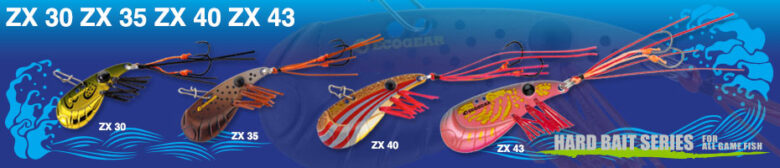
Ecogear also gives the blade more than one tow point, so the same lure swims flat or hops on a tighter, more vertical track. On a flathead flat that matters more than colour.
| Point | What Ecogear says |
|---|---|
| Body | Shrimp-shaped blade lure |
| Hook system | Assist-hook design, specially sized hooks at offset lengths, for snag-free fishing and hook-ups on short bites |
| Tow points | Positioned to give different actions at the angler’s choice |
| Line-up | Four sizes, each balanced and tuned separately |
| Size | Length | Weight | Type | Colours | List price |
|---|---|---|---|---|---|
| ZX 30 | 30 mm | 3.5 g | Sinking | 10 | Not published |
| ZX 35 | 35 mm | 5.0 g | Sinking | 10 | Not published |
| ZX 40 | 40 mm | 6.4 g | Sinking | 19 | Not published |
| ZX 43 | 43 mm | 8.8 g | Sinking | 11 | Not published |
Take the 40 if you are buying one. It is the middle of the range by weight, it carries the deepest colour selection, and 6.4 g casts on the same rod most people already use for bream and flathead plastics. The 43 is the one for a stiff run-out tide or a deeper channel edge. The gap in the data is price: Marukyu publishes none, so you cannot compare the ZX to anything on cost without checking a shop.
| Suits | Less suited to |
|---|---|
| Racks, weed edges, rubble, anywhere a treble-rigged blade gets left behind | Anglers who want a published RRP before they order |
| Covering a wide flat quickly, then slowing down over the drop-off | Very shallow, very clear water where a slow-sinking plastic draws more |
The Power Shad is the plastic Ecogear points at flatfish, rockfish and seabass, and its whole design brief is volume of movement rather than finesse. Ecogear’s own three bullets say it: a body shaped for maximum vibration, a range of rigs from no-sinker up to a heavy jig head, and enough buoyancy to swim on the surface unweighted for sight fishing.
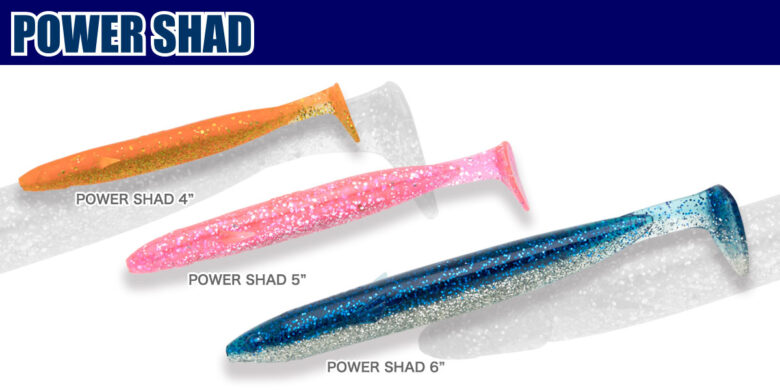
Sizing is where the Japanese range and Australian practice already agree. The 4 in is 100 mm, which is the standard estuary flathead plastic here, and the 5 in at 115 mm is the beach and headland size when you need weight to cast. Notice the pack counts drop as the lure grows: seven, six, five. Work out the cost per lure rather than per packet, because the bigger bags are not the expensive ones people assume they are.
| Point | What Ecogear says |
|---|---|
| Body | Special body design for maximum vibration in the water |
| Rigs | Suits everything from a no-sinker rig to a heavy jig head |
| Surface use | Swims well on the surface unweighted, for sight fishing |
| Size | Length | Pcs. per pack | List price |
|---|---|---|---|
| 4 in | 100 mm | 7 | Not published |
| 5 in | 115 mm | 6 | Not published |
| 6 in | 150 mm | 5 | Not published |
Daiwa Japan runs an entire sub-brand for flatfish called Flat Junkie, written with the kanji for flounder. The Rodem is its centrepiece, and the R is the current version. It arrives as a jig head with the worm already fitted, plus one spare body in the packet, which tells you what Daiwa thinks the running cost of a flathead lure actually is.
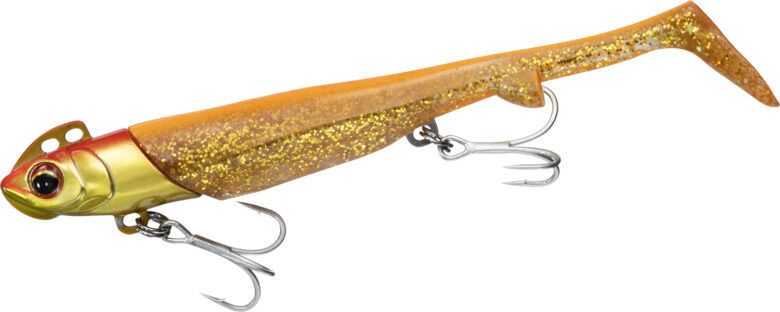
The body slides onto a rail and locks on three keepers, so a torn worm is a ten-second job on a rocking boat rather than a re-rig. Daiwa also moved the rear hook holder into a wide-lipped shape, which is meant to stop the stinger tangling and, as a side effect, adds a roll to the back half of the lure that the paddle tail alone would not produce. On the R4 there are two line eyes: forward when you want it running high over a shallow bank, rear when you want it digging into a gutter or a rip.
The catch is the same one that comes with every integrated system. Spare bodies are Rodem-specific, so once you commit, replacements come from Japan too.
| Feature | What Daiwa says it does |
|---|---|
| One-touch body change | Guide holes and a guide rail on the worm let the body be swapped in one movement |
| Wide-lipped rear hook holder | Stops the rear hook tangling and generates a roll action separate from the tail swing |
| Duck-fin tail | Shape taken from a waterbird’s foot, swinging widely for strong vibration and roll |
| Bottom touch sensor | Lower front of the head is shaped to sharpen the feel of the lure landing |
| 2-way action eye (R4 only) | Two line eyes for shallow running or deeper diving |
| Oversized eyes | Enlarged 1.5x over the previous model to take heavy rings and hooks |
| Item | Size | Weight | Hook / ring | List price (excl. tax) |
|---|---|---|---|---|
| Rodem R3 Shad 14 g | 3 in | 14 g | #10 treble / #2 | ¥1,200 (~A$10.90) |
| Rodem R3 Shad 18 g | 3 in | 18 g | #10 treble / #2 | ¥1,200 (~A$10.90) |
| Rodem R4 Shad 18 g | 4 in | 18 g | #6 treble / #3 | ¥1,200 (~A$10.90) |
| Rodem R4 Shad 21 g | 4 in | 21 g | #6 treble / #3 | ¥1,200 (~A$10.90) |
| Rodem R4 Shad 28 g | 4 in | 28 g | #6 treble / #3 | ¥1,200 (~A$10.90) |
Daiwa Australia builds its own plastic here and names flathead in the product copy, so this is the one pick on the page you can buy at a local shop without waiting on a parcel. The 3.2 in Minnow runs A$12.99 RRP, six to a pack, eighteen colours, with rigging lines moulded along the back. It is a plain jig-head plastic rather than a system, which is the trade: no spare-body dependency, no one-touch swap either.
Keitech’s straight Swing Impact is the flatter, less aggressive sibling of the FAT, and the engineering note that matters is the keel. Keitech runs it all the way to the bottom edge of the tail specifically to stop the tail folding upward under water pressure, which is what kills a thin paddle at speed. That is a fix for a real problem, and it is the reason this one keeps working when you wind faster to stay ahead of a run-out tide.
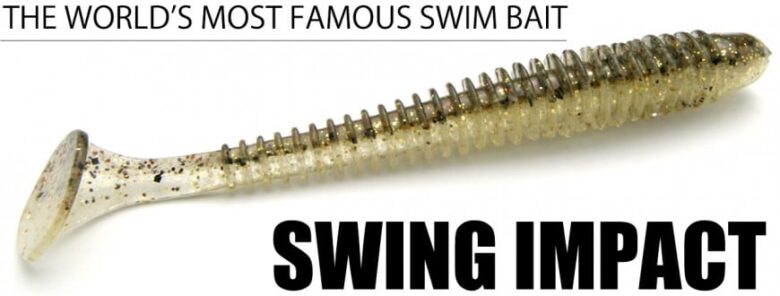
One thing to read carefully: Keitech prints a recommended offset hook size against every length, and those numbers are set for freshwater bass. A 4 in Swing Impact on the recommended 1/0 in bass wire is under-gunned for a metre-class dusky, so keep the size and step up the wire gauge.
| Point | What Keitech says |
|---|---|
| Tail | Thin, sharp tail design that catches water and swings wide |
| Keel | Extends to the lower edge of the tail to stop it curling up, so the action holds at any speed |
| Body section | Flattened horizontally at the head, vertically at the tail, for wide swing with overall stability |
| Slits | Fine slits along back and belly so an offset hook point sits hidden between the ribs |
| Size | Weight per lure | Pcs. per pack | Recommended offset hook | List price (incl. tax) |
|---|---|---|---|---|
| 3 in | 2.0 g | 10 | #3 | ¥682 (~A$6.20) |
| 3.5 in | 3.2 g | 8 | #2 or #1 | ¥814 (~A$7.40) |
| 4 in | 4.6 g | 8 | #1/0 or #2/0 | ¥814 (~A$7.40) |
| 4.5 in | 9.0 g | 6 | #3/0 | ¥814 (~A$7.40) |
Bait Breath files its saltwater range by target species, and one of the categories reads soi, ainame, kijihata, kochi, hirame. Kochi is flathead. This is not a plastic that happens to catch them; it is filed under them.
The 4.3 in is the newest size and the only one with a dedicated flat-fish colour block: Peach Shad, Blood Shad, Lime Shad and Nasu Violet Shad, carrying glow pigment and UV-reactive keimura content. Those four sit alongside ten two-tone laminates in the same length. Masaru Nakamura designed it for tournament rock fishing, so the emphasis is on the tail through the fall and the way the lure topples after it lands, not on how hard it thumps on the wind.
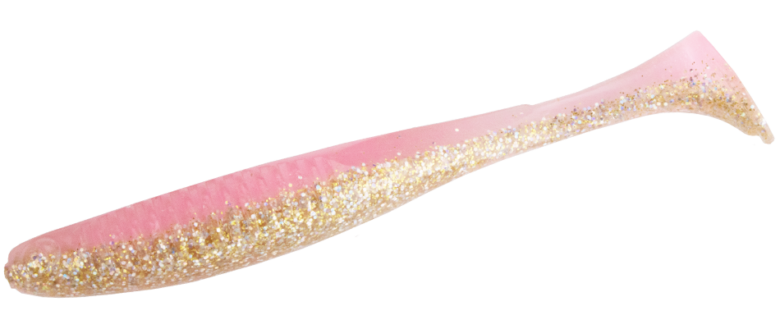
Six lures for ¥1,100 puts this in the same per-lure band as the Keitech, and unlike the Ecogear items you can see the number before you order.
| Point | What Bait Breath says |
|---|---|
| Category | Filed under rock fish and flat fish: soi, ainame, kijihata, kochi, hirame |
| Design focus | Body proportion, fine tail movement from swimming through the fall, and a natural appeal as it topples on landing |
| Rigs | Texas, jig head, heavy Carolina, drop shot, free rig, trailer |
| Flat colours (4.3 in only) | Four, aimed at hirame and kochi, with glow and UV-reactive keimura content |
| Size | Pcs. per pack | List price | Per lure |
|---|---|---|---|
| 2.8 in | 8 | ¥968 (~A$8.80) | ¥121 (~A$1.10) |
| 3.4 in | 7 | ¥1,100 (~A$10.00) | ¥157 (~A$1.43) |
| 4.3 in | 6 | ¥1,100 (~A$10.00) | ¥183 (~A$1.67) |
Megabass built the saltwater Hazedong around the retrieve speed most anglers skip. The tail is described as ultra-thin so that it keeps gripping water through a dead-slow wind or a small shake, which is the presentation for a cold morning, a slack tide, or a flat you have already worked over once. Megabass names rock fish, flat fish and seabass as the targets.
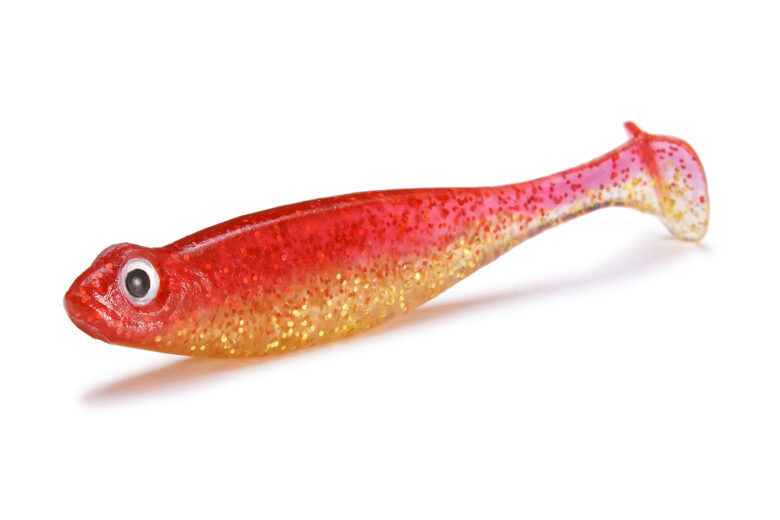
Two construction details make it worth the freight. The belly carries a high-density insert so a thin-tailed plastic still tracks upright, and there is a slit down the belly so an offset hook beds in cleanly. At ¥750 excluding tax it is the cheapest packet on this page, though the 4.2 in only holds five.
| Point | What Megabass says |
|---|---|
| Material | Different densities top and bottom of the body for stability |
| Belly slit | Makes offset hooking easy and lifts the hook-up rate |
| Tail | Ultra-thin, holds water on dead-slow retrieves and on the smallest shakes |
| Targets | Rock fish, flat fish, seabass |
| Size | Pcs. per pack | List price (excl. tax) | Per lure |
|---|---|---|---|
| 3 in | 8 | ¥750 (~A$6.80) | ¥94 (~A$0.85) |
| 4.2 in | 5 | ¥750 (~A$6.80) | ¥150 (~A$1.36) |
Where the ZX is a resin blade with assist hooks, the VX is a metal alloy vibe, and Ecogear positions it as the size-to-weight extreme of the two. The 45 mm runs 8.0 g against the ZX 43’s 8.8 g in a longer body, which tells you the VX is denser through the middle and drops faster for its profile.
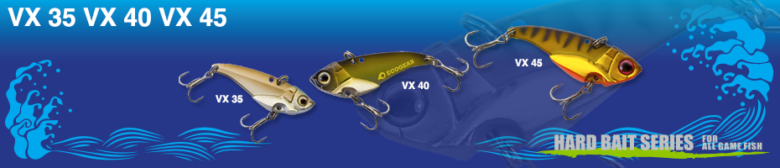
Two split-ring positions do the work. Ecogear says the front point gives the best vibration on a flat retrieve for searching wide areas, and the rear point gives a strong vibration when worked vertically for deeper fish. For flathead that means one lure covers both the long cast across a sand flat and the vertical drop down the edge of a channel where the tide has stacked the bait. The extra weight in the 45 also stops the lure being dragged sideways by run-out current before it reaches the depth you wanted.
| Point | What Ecogear says |
|---|---|
| Construction | Metal alloy blade, balanced for size against weight |
| Sensitivity | Detailed design makes it vibrate on the smallest rod movements |
| Front anchor point | Best vibration on flat retrieves, for casting far and searching wide |
| Rear anchor point | Strong vibration when worked vertically for deeper fish |
| Size | Length | Weight | Type | Colours | List price |
|---|---|---|---|---|---|
| VX 35 | 35 mm | 3.5 g | Sinking | 17 | Not published |
| VX 40 | 40 mm | 5.0 g | Sinking | 15 | Not published |
| VX 45 | 45 mm | 8.0 g | Sinking | 15 | Not published |
Now that the products are on the table, the buying criteria are easier to state, because most of them are things you can read off a Japanese packet before you spend anything.
Rigging is the part most people under-think. If you want the Japanese approach to hooks, rings and leaders in more detail, that sits in our guide to JDM assist hooks and terminal tackle, and the small-lure end of the same brands is covered in our JDM jig head and worm guide.
| Lure | Type | Size and weight | Pcs. | List price | Where it earns its place |
|---|---|---|---|---|---|
| Ecogear ZX 40 | Resin blade | 40 mm / 6.4 g | 1 | Not published | Racks, weed, rubble; searching a flat fast |
| Ecogear ZX 43 | Resin blade | 43 mm / 8.8 g | 1 | Not published | Deeper channel edges and hard run-out tide |
| Ecogear VX 45 | Metal vibe | 45 mm / 8.0 g | 1 | Not published | Vertical work down a drop-off; heavy current |
| Ecogear Power Shad 4 in | Soft plastic | 100 mm | 7 | Not published | The default estuary plastic on a 1/4 oz head |
| Keitech Swing Impact 4 in | Soft plastic | 100 mm / 4.6 g | 8 | ¥814 incl. (~A$7.40) | Faster winds where a thin tail usually folds |
| Bait Breath E.T.Shad 4.3 in | Soft plastic | 110 mm class | 6 | ¥1,100 incl. (~A$10.00) | Fall-bite fish; four dedicated flat colours |
| Megabass Hazedong Shad SW 4.2 in | Soft plastic | 4.2 in | 5 | ¥750 excl. (~A$6.80) | Dead-slow retrieves on a flat, slow tide |
| Daiwa Rodem R4 Shad 28 g | Jig head and body set | 4 in / 28 g | 1 + spare body | ¥1,200 excl. (~A$10.90) | Beach gutters and long casts off the sand |
One practical thing we have settled on in our own buying: when a Japanese page prints a recommended hook size, we treat the size as correct and the wire as a starting point. Keitech’s numbers come from bass fishing, where a 1/0 in light wire is plenty. Nothing on a Japanese bass packet has been sized for a flathead that has been eating whiting for eight years, so we keep the gap and go heavier in the wire.
The other habit is to batch. One packet from Japan costs about what six cost to post, which is also why the Daiwa Australia plastic is on this page: if you want one bag this week, buy it locally and save the freight for a real order later.
Different in the parts you can verify. The ZX ships with assist hooks instead of trebles. The Rodem ships with a spare body and a rail system to fit it. The E.T.Shad has a colour block created specifically for hirame and kochi. Those are design decisions written into the product, not claims about how many fish it catches.
Around 100 mm for plastics and 40 mm for blades. That is the 4 in Power Shad or Swing Impact, and the ZX 40 or VX 40. Both sit on the same rod, and both are the middle of their maker’s range rather than a specialist end of it.
Marukyu does not publish list prices on the Ecogear product pages, so every Ecogear cell in this article says so rather than carrying a guessed figure. Keitech and Bait Breath publish tax-included prices; Megabass and Daiwa publish tax-excluded ones. We have kept those distinctions in the tables instead of flattening them into one number.
Amazon Japan ships internationally, and Ecogear and Keitech also have enough US distribution that some items are easier to get through Amazon.com. Check the shipping cost at checkout before you commit, since it changes the per-lure maths more than the list price does.
They differ by state and they move. In NSW, dusky flathead sit inside a slot: the minimum legal length is 36 cm and the maximum is 70 cm, with a daily bag limit of five and a possession limit of ten, per NSW DPI. Other states set their own rules. Check your local regulations before the session, not after.
Buy the ZX 40 and one bag of 4 in plastics. Add the Rodem when the beach starts fishing, and the Hazedong for the mornings when nothing wants to move. That is three purchases spread over a season, not a restock.
Japanese gear for the other estuary predators runs through our JDM mulloway lure guide, and the offshore end of the same brands is in our Japanese plastics guide for snapper.