Eging in Australia: A JDM Angler's Guide to Squid Jigging
ちゃんま
マイボ!

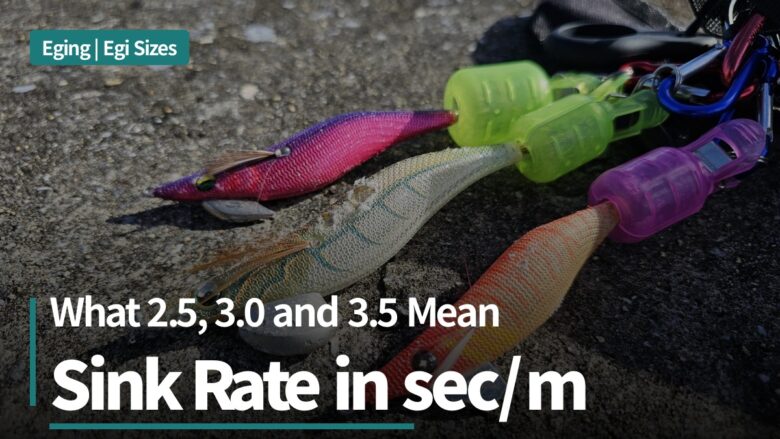
Turn over a Japanese squid jig packet and you get a little block of numbers: 3.5, 22 g, roughly 3 sec/m, maybe a letter like S or D. Most of us learn to grab “a 3.0” or “a 3.5” and leave it there, which works until you put two #3.5 egi from different brands side by side and notice one weighs 17 g and the other 22 g. Same size number, five grams apart. So what is that number actually telling you?
This piece is only about reading the numbers. I’ve pulled the published figures for nine standard-fall egi from Yamashita, Daiwa, Shimano and Duel (Yo-Zuri), straight from each maker’s Japanese product pages, and laid them on the same scale. If you want help choosing a size and colour for the water in front of you, that’s a different job, and it’s covered in our guide to egi size and colour for southern calamari. For the jigs themselves, see our shortlist of the best Japanese egi for Australia.
Figures are as of 11 November 2026. Your local tackle shop is the first place to look; where a buy link appears, it points to Amazon.com (available with international shipping to Australia).
Japanese egi packets and spec sheets carry the same four pieces of information, even if the layout changes from brand to brand. Once you know what each one controls, the wall of jigs in a shop gets a lot less confusing.
Length usually isn’t printed as a number at all. Of the four makers I checked, only Yamashita lists it on the product page.
Yamashita’s spec tables give the body length with the hooks excluded, and the pattern is very tidy: 60 mm at #2.0, 75 mm at #2.5, 90 mm at #3.0, 105 mm at #3.5 and 120 mm at #4.0. Every half step on the goh scale adds 15 mm, so one goh works out to about 30 mm of jig. The usual explanation in Japan is that egi sizes grew out of the old sun (寸) length unit of roughly 3 cm, and the numbers certainly fit that, but none of the product pages I read spell the history out, so treat it as the likely origin rather than a rule.
What the goh number doesn’t fix is weight. Here’s how the nine standard-fall jigs line up by size.
| Goh | Length (Yamashita, hooks excluded) | Weight range across makers | Sink-rate range across makers |
|---|---|---|---|
| #2.5 | 75 mm | 10–11 g | 3.9–5.5 sec/m |
| #3.0 | 90 mm | 14–16 g | 3.0–4.0 sec/m |
| #3.5 | 105 mm | 17–22 g | 3.0–3.7 sec/m |
The biggest jump in the whole scale isn’t in weight, it’s in sink rate between #2.5 and #3.0. Yamashita’s Egi-Oh K goes from about 3 sec/m at #3.0 to about 5 sec/m at #2.5, the LIVE from 3.5 to 5.5, Daiwa’s Dart LC from 4.0 to 5.5. Drop half a size here and the jig takes roughly 40 to 70 per cent longer to reach bottom. The odd one out is Duel’s EZ-Q Cast Rattle, which keeps its #2.5 at a brisk 3.9 sec/m, so check the packet rather than assuming every #2.5 floats down.
Going the other way, from #3.0 to #3.5, you mostly buy length and grams. The Egi-Oh K is about 3 sec/m at both sizes and gains 6 g and 15 mm. Duel’s EZ-Q Cast Rattle sits at 3.2 sec/m at both. Across the other eight jigs the #3.5 is listed at the same speed as its #3.0 sibling or up to 0.5 sec/m quicker, while Shimano’s Sephia Clinch Flash Boost goes the other way (3 sec/m at #3.0, 3.7 at #3.5, listed on separate product pages). So stepping up to a #3.5 won’t necessarily get you down much faster. It gives you a bigger profile and more weight to cast into wind, and if raw sink speed is the goal, the type code (below) does far more than the size number.
The weight spread is widest at #3.5 too. The Egi-Oh K #3.5 basic is 22 g; Duel’s EZ-Q Cast #3.5 is 17 g, with Shimano’s Sephia Clinch Flash Boost and Duel’s Aurie-Q in between at 19 g. If you swap brands and your casts suddenly fall short, or the rod feels overloaded on the jerk, that difference is usually why.
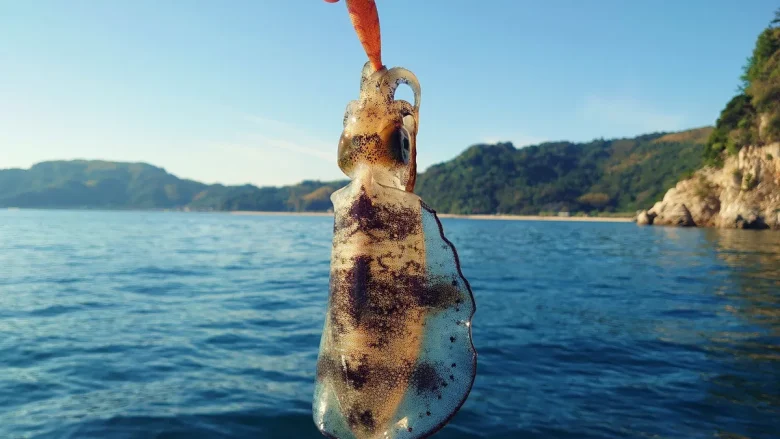
Every maker here quotes sink rate the same way: seconds for the jig to drop one metre. Yamashita writes “approx. 3 sec/m”, Daiwa labels its column a guide figure, Shimano calls it a reference value, and Duel writes “approx. 3.2 s/m”. All four are telling you the same thing, which is that the number is a calm-water benchmark and not a promise.
The useful trick is to turn it into a countdown. Multiply the sink rate by the depth and you have roughly how long to wait before the jig touches down. Here’s what that looks like using the four Egi-Oh K #3.5 versions, plus the #2.5 basic for comparison.
| Jig (official sink rate) | Count to 2 m | Count to 5 m | Count to 10 m |
|---|---|---|---|
| Egi-Oh K 3.5 Deep (~2.0 sec/m) | ~4 s | ~10 s | ~20 s |
| Egi-Oh K 3.5 Basic (~3 sec/m) | ~6 s | ~15 s | ~30 s |
| Egi-Oh K 2.5 Basic (~5 sec/m) | ~10 s | ~25 s | ~50 s |
| Egi-Oh K 3.5 Shallow (~6 sec/m) | ~12 s | ~30 s | ~60 s |
| Egi-Oh K 3.5 Super Shallow (~8 sec/m) | ~16 s | ~40 s | ~80 s |
Two things push the real count longer than the packet. The first is how you let the jig fall. Yamashita’s own how-to notes that a free fall on slack line comes close to the packet rate unless the current is strong, which is exactly why it’s the easier way to judge depth, while a tension fall on a tight line sinks noticeably slower. The second is everything between you and the jig: a high ledge, a stiff breeze bowing the braid, or tide pushing on the line all slow the drop, according to the same Yamashita material. If your count to bottom keeps coming out longer than the maths says, the water is usually deeper than you think or the line is catching wind and current, and it’s worth knowing which.
I’d treat the packet figure as a reference ruler rather than a fact. Count the first cast down on a slack line, stop when the braid stops running off the spool, and divide that count by the sink rate. That’s a rough depth for the water in front of you, measured with nothing but the jig.
The letter after the size is where the sink rate really moves. Yamashita’s Egi-Oh K is the clearest example, because it comes in four fall types across the same 90 mm and 105 mm bodies.
| Egi-Oh K type | How to spot it | #3.0 weight / sink | #3.5 weight / sink |
|---|---|---|---|
| Deep (D) | Size and “D” stamped on the sinker; red eyes and red feathers | 19 g / ~2.0 sec/m | 25 g / ~2.0 sec/m |
| Basic | No letter | 16 g / ~3 sec/m | 22 g / ~3 sec/m |
| Shallow (S) | “S” stamped on the sinker; blue eyes and blue feathers | 15 g / ~6 sec/m | 20 g / ~6 sec/m |
| Super Shallow (SS) | “SS” stamped on the sinker; blue eyes and blue feathers | 14.5 g / ~8 sec/m | 19.5 g / ~8 sec/m |
Look at the weights in that table. The #3.5 Super Shallow is only 2.5 g lighter than the basic, yet it takes more than twice as long to fall a metre. Grams alone don’t set the fall, so you can’t guess the sink rate from the weight printed next to it. The Deep goes the other way, adding 3 g to the #3.5 to get down a third quicker. Yamashita pitches the Deep at water deeper than about 10 m and at days when crosswind or current is dragging the line.
Other makers use their own labels for the same idea. Daiwa uses “Type S”: its Emeraldas Shine LC Type S #3.5 weighs 18.4 g and falls at 6.0 sec/m. Duel uses “Slow”: the EZ-Q Cast Slow #3.5 is 15.5 g at about 6.0 sec/m against 17 g at 3.2 sec/m for the standard EZ-Q Cast, and the Aurie-Q Slow sits at 5.5 sec/m in both its sizes. The letters don’t line up perfectly between brands, so read the seconds rather than the label. A Yamashita “S” and a Duel “Slow” are both around 6 sec/m, but a Super Shallow is slower again.
Here are the standard-fall #3.5 versions side by side, heaviest first, so you can see how much a “3.5” varies before any type code comes into it.
| Egi (#3.5, standard fall) | Maker | Weight | Sink rate | Length listed? |
|---|---|---|---|---|
| Egi-Oh K | Yamashita | 22 g | ~3 sec/m | Yes, 105 mm |
| Emeraldas Fall LC Rattle | Daiwa | 21.5 g | 3.5 sec/m | No |
| Egi-Oh LIVE | Yamashita | 21 g | ~3 sec/m | Yes, 105 mm |
| Emeraldas Dart LC | Daiwa | 20.0 g | 3.5 sec/m | No |
| Sephia Clinch Flash Boost | Shimano | 19 g | 3.7 sec/m | No |
| Aurie-Q | Duel (Yo-Zuri) | 19 g | ~3.2 sec/m | No |
| EZ-Q Dartmaster | Duel (Yo-Zuri) | 19 g | ~3.2 sec/m | No |
| EZ-Q Cast | Duel (Yo-Zuri) | 17 g | ~3.2 sec/m | No |
| EZ-Q Cast Rattle | Duel (Yo-Zuri) | 17 g | ~3.2 sec/m | No |
A couple of patterns stand out. The heavier jigs aren’t simply the faster ones: Daiwa’s two LC models are among the heaviest here but quote 3.5 sec/m, slower than Duel’s 17 g jigs at 3.2. And the whole field sits within 0.7 sec/m of each other, while the weights spread across 5 g. If you fish two brands side by side, matching the sink rate keeps your countdown honest; matching the size number only keeps the length the same.
If the numbers have done their job, building a small box becomes a question of covering a range of seconds rather than collecting sizes. I’d think of it as three bands on the packet.
Which colours to put on those three, and which band to start with on a given morning, depends on the light and water, and that’s where the size and colour selection guide picks up.
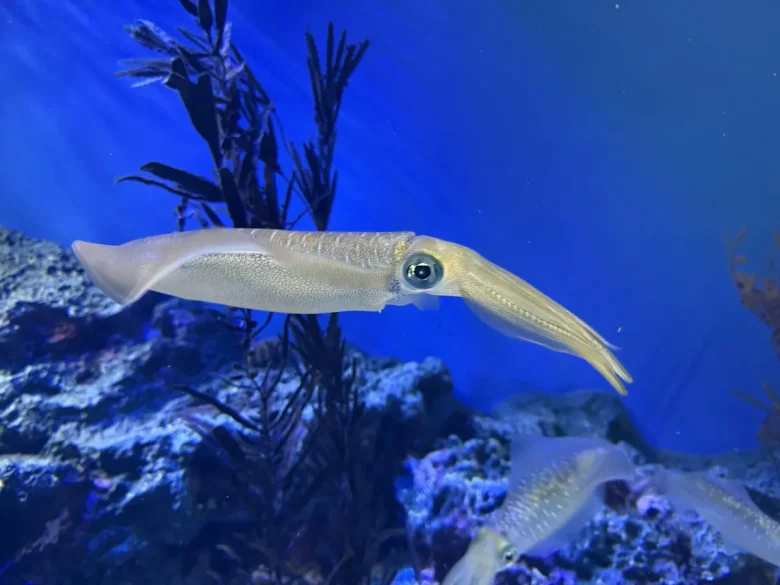
For southern calamari (Sepioteuthis australis) off the shore, the three sizes in this article are the ones you’ll buy most, and a basic #3.0 is the easiest of them to learn the numbers on, because its fall sits in the middle of the range. Yamashita’s beginner material gives one concrete marker worth borrowing: for squid you can see in less than a metre of water, it suggests a #2.5 or #3.0 that takes 4 to 5 seconds to sink a metre, so the jig hangs in front of them instead of crashing to the bottom.
Beyond that, the right size on the day comes down to depth, light and the mood of the squid, which is a selection question rather than a numbers one. Our size and colour guide for southern calamari works through those scenes. Boat anglers fishing a drift should also know that tip-run egi are built heavier for a moving boat and follow a different logic, which we cover in tip-run eging in Australia. And if you’re still putting the outfit together, a JDM eging rod rated for the egi sizes you’ll throw is the place to start.
Within one model, yes, but not across brands. Duel’s EZ-Q Cast #3.5 is 17 g, which is lighter than Yamashita’s Egi-Oh K #3.0 Deep at 19 g. The goh number is a length class of roughly 30 mm per goh; weight depends on the model and its fall type.
The packet figure is a calm-water reference, and Yamashita says a slack-line free fall comes close to it unless the current is strong. A tight line, wind bowing the braid, current, and fishing from a high ledge all slow the fall. Let the line go slack for your first count down if you want the number to match the packet.
They mark fall types. On Yamashita’s Egi-Oh K, S (Shallow) sinks at about 6 sec/m, SS (Super Shallow) at about 8 sec/m and D (Deep) at about 2 sec/m, against about 3 sec/m for the basic #3.5. Daiwa uses “Type S” and Duel uses “Slow” for similar slow-fall versions.
For the wider picture, start with our guide to eging in Australia.
Sink rates are the makers’ calm-water reference figures, and the depth counts in this article are simple multiplication of those figures. As an Amazon Associate, we may earn from qualifying purchases made through links on this page, at no extra cost to you.