Best JDM Travel Rods: 6 Daiwa Pack Rod Series Compared by Packed Length, Pieces and Price
ちゃんま
マイボ!

Most of the trouble visitors get into with Japan’s fishing rules has nothing to do with a fishing rod. It starts at low tide, with a turban shell on a rock, a sea urchin in a pool, or an octopus that came up on a lure and looked like dinner. In most coastal water, those are reserved for the local fishing cooperative, not for whoever finds them, and a few species are banned for everyone, everywhere.
Our guide to how to go fishing in Japan as a visitor covers licenses, the methods foreign nationals can use, bluefin tuna and party boats. This page goes one level down: what a fishing right actually covers, why the list changes from one beach to the next, and the size limits, closed seasons and gear rules as the prefectures themselves publish them. It’s a reading of official pages, not legal advice, and rules get revised. Check the prefecture’s own page before you go.
It helps to know where a rule comes from, because that tells you where to look it up. The national layer is the Fisheries Act and the Fisheries Resources Protection Act. They set the few rules that apply in every prefecture: the protected species, the penalty for infringing a fishing right, the ban on poisons and explosives, and the ban on taking salmon in fresh water.
The second layer is each prefecture’s fisheries adjustment regulations (漁業調整規則, gyogyo chosei kisoku). That’s where you’ll find the list of gear a non-fisher may use, the closed seasons, the minimum sizes and the closed areas. The Fisheries Act caps what a prefecture can attach to its regulations at six months in prison or a fine of up to ¥100,000.
The third layer is the easiest to miss. Each sea area has a fisheries adjustment commission (海区漁業調整委員会), and it issues instructions (指示, shiji) on top of the regulations: how much chum a boat angler may use, where anchoring to fish is banned, when a stretch around a river mouth is closed. Shizuoka’s fisheries page asks recreational anglers to follow them as well as fishers. The Fisheries Agency’s English page says the same about all three layers: foreign nationals have to follow them too.
A fishing right (漁業権, gyogyo-ken) is a license the prefecture grants a local cooperative to fish a defined stretch of water for defined species. For visitors, the one that matters is the first-class common fishing right (第1種共同漁業権), which covers seaweed, shellfish and other animals that stay put on the bottom. You can still fish there with a rod. What the right does is reserve those species for the co-op’s members, and taking one inside the area is an infringement with a fine of up to ¥1,000,000. It’s prosecuted when the right-holder files a complaint.
Chiba publishes the full list for its coast, and it’s long: fifteen seaweeds, fourteen bivalves including clams, oysters and hard clams, eight sea snails including abalone and turban shell, and then sea urchin, sea cucumber, spiny lobster, octopus and bait worms. Chiba also notes that the species differ from one right to the next. A shell that’s reserved in one cove can be outside the right in the next, which is why no single list works for a whole country.
Some things are outside the rights altogether. Chiba gives goose barnacles and razor clams as examples on its coast, and Shimane says the small top shells and limpets locals pick, and goose barnacles, are fine to take. Even then, Chiba suggests calling the local co-op before you go picking inside a rights area, because you could be taken for a poacher.
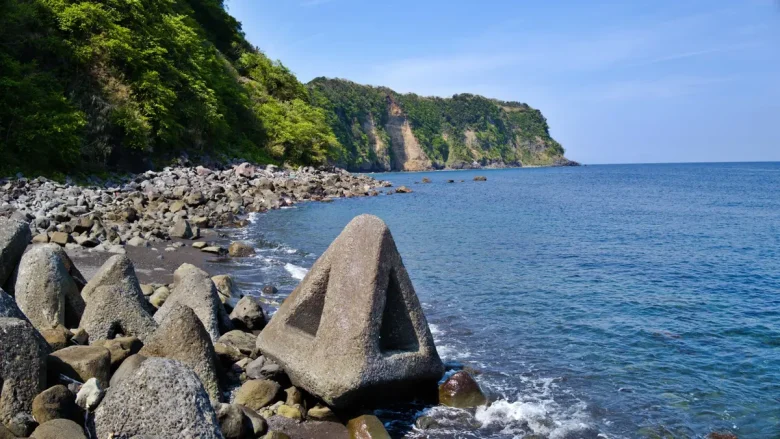
These three catch visitors out because they don’t look like shellfish, and two of them can end up on a hook. Shimane is blunt about octopus: it’s a fishing-rights species in almost all of its waters, so if one takes your lure, let it go straight away. The exception it names is Nakaumi, a brackish lagoon with no fishing right. Sea urchin is just as widely reserved, and Shimane counts the long-spined urchins under the same entry.
Spiny lobster (イセエビ, ise-ebi) is reserved along most of the Chiba coast where it’s caught. Where it isn’t, the prefecture’s size limit and closed season still apply, and so does the gear list. The English fliers from other prefectures list the same animals again and again: urchins, octopus, oysters, turban shells, wakame. Iwate adds sea squirts, Yamaguchi adds mantis shrimp.
Okinawa’s English pamphlet has a line that isn’t in the others. Foreigners aren’t permitted to catch the species subject to fishing rights even if they’re with Japanese fishers. The Okinawa list includes collector urchins, spiny and slipper lobsters, sea cucumbers, several octopuses, giant clams and turban shells, and in some areas seaweeds such as mozuku. Reef-building corals and sea turtles are protected on top of that, and spearguns are banned for recreational use.
Under the reformed Fisheries Act, three species are now designated “specified aquatic animals and plants” (特定水産動植物): abalone and sea cucumber since December 2020, and glass eels since December 2023. The ministry’s ordinance defines a glass eel as an eel of 13 cm or less in total length. The penalty is up to three years in prison or a fine of up to ¥30,000,000. Two details make this rule wider than visitors expect.
First, it doesn’t depend on a fishing right. Chiba’s answer to “can I take abalone where there’s no fishing right?” is a flat no. Second, Kanagawa notes that every species of sea cucumber is covered, whether or not people eat it. The Act also catches anyone who knowingly carries, stores or takes in one that was poached, so buying a “souvenir” abalone from someone on the rocks is its own offence.
The prefectures that publish their size limits and closed seasons on one page make good examples of how much the numbers move. These come from the fisheries pages of Kanagawa, Chiba and Ibaraki, three prefectures on the Pacific side around Tokyo.
| Species | Kanagawa | Chiba | Ibaraki |
|---|---|---|---|
| Spiny lobster (ise-ebi) | 13 cm or under (eye to tail); closed Jun 1 to Jul 31; egg-bearing banned all year | 13 cm or under; closed Jun 1 to Jul 31 | Not listed |
| Abalone | Shell 11 cm or under; closed Nov 1 to Dec 31 | Shell 12 cm or under; closed Sep 16 to Mar 31 | Shell 11 cm or under |
| Turban shell (sazae) | Operculum 3 cm or under | Shell height 7 cm or under; closed in June | Not listed |
| Japanese eel | 24 cm or under | 26 cm or under | 23 cm or under |
| Yellowtail (buri) | 15 cm or under | 15 cm or under | Not listed |
| Kuruma prawn | 8 cm or under (eye to tail) | 8 cm or under | Not listed |
| Manila clam (asari) | Shell 2 cm or under | Shell 2.7 cm or under | Not listed |
| Olive flounder (hirame) | Not listed | Not listed | Under 30 cm |
| Salmon and masu | Not listed | Not listed | 15 cm or under |
Read the table the right way round. A size limit isn’t permission. These rules apply to everyone, commercial fishers included, so they also list species that a visitor can’t take at all: abalone because it’s a specified species, spiny lobster and turban shell wherever a fishing right covers them. Okinawa’s pamphlet says it in so many words for its own waters: whatever the size and season limits, foreigners can’t harvest the animals they cover. The rows that matter most to a visitor with a rod are the finfish: a small hirame off an Ibaraki beach, a juvenile yellowtail in Tokyo Bay, a small eel on the Chiba coast.
Other seas have their own numbers. The Seto Inland Sea, for instance, has a summer rule for small madai, which is covered in tairaba fishing in Japan as a visitor.
Each of these prefectures lists the gear a non-fisher may use, and anything not on the list is out. Rod and line, a landing net, a cast net from shore and your bare hands are on all five. The edges are where the lists part ways.
| Gear or method | Kanagawa | Chiba | Ibaraki | Aomori | Shimane |
|---|---|---|---|---|---|
| Hand spear (yasu) | Yes, not at night or with a mask | No | Yes, fixed head, not thrown | Yes, no launcher | Yes, no speargun |
| Trolling | Not on the list | No | Approved tournaments only | No | No |
| Lights to draw fish | No | No | Squid and mackerel fishing only | Not stated | Yes |
| Crab net on a rod | No | No | No | No | No |
| Snagging (gang hooks) | Not stated | No | Not stated | Not stated | No |
| Traps, bottle or tube traps | Not on the list | No | Not on the list | No | No |
| Scuba tank | Not stated | No | No | No | No |
Two of these trip people up. Trolling from a rented boat feels like rod-and-line fishing, but Chiba quotes a Fisheries Agency answer that treats it as a separate method, and it isn’t on the list there. And the lights: a head torch for your feet is fine in Chiba, but a light hung over the water to pull fish in is banned in Kanagawa and Chiba, limited in Ibaraki and allowed in Shimane. Snorkel, mask and fins are fine in Chiba; it’s the air tank that makes it “diving gear”.
Chum has its own rules. In Chiba they come from the commission rather than the regulations: a boat angler may use up to 3 kg a day inside Tokyo Bay and up to 5 kg elsewhere, and shore anglers are asked to use the minimum. Some stretches ban chumming from boats altogether. On a party boat, using the rig and chum the boat gives you is the simplest way to stay inside them. If you’re booking one, party boat booking etiquette in Japan covers the rest.

Coming from a country where you fish salmon up the river on a license, this one is a surprise. Under the Fisheries Resources Protection Act, nobody may take salmon in rivers or lakes unless they hold a license or permit for it. Hokkaido extends the ban in its own rules to “masu”, which it defines as cherry salmon, pink, sockeye, coho and chinook, and its 2026 rulebook says plainly that catch and release counts as taking.
The sea has rules of its own. Hokkaido closes the water off the mouths of rivers used for salmon propagation, and Ibaraki closes zones off eleven river mouths; in Ibaraki they run from May 1 to December 31 and reach 200 m to 1 km out, depending on the river. Hokkaido also runs a boat license system: to fish cherry salmon from a boat off Iburi (December to March), Shiribeshi (March to May) or Hiyama (January to May), or for autumn salmon off part of the Okhotsk coast of eastern Hokkaido in September, you board a boat that holds the license. Some mouth zones are set year by year, so check the current list.
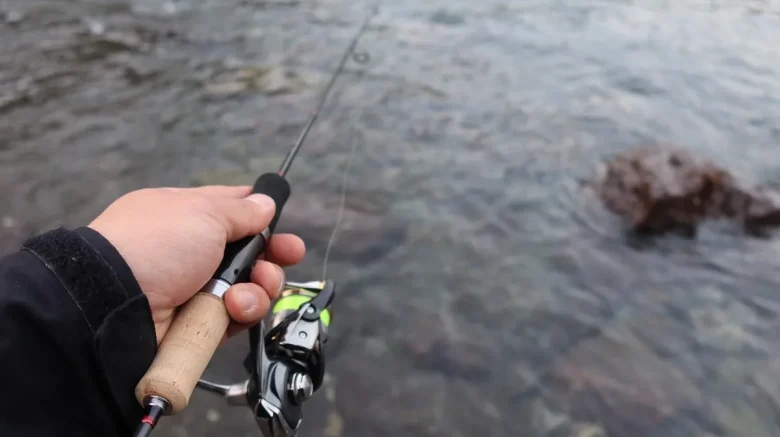
Trout and other river fish run on the co-op ticket system. Chiba’s Q&A adds a detail worth knowing: if you’re fishing for a species the co-op manages, you need the ticket even if you release everything. If you’d rather skip the river rules, area trout ponds in Japan sell their own day tickets.
The Fisheries Agency keeps a page of links to each prefecture’s recreational fishing rules, and that’s the quickest place to start. Most prefecture pages are in Japanese. Searching the prefecture’s name with 遊漁 ルール (recreational fishing rules) usually brings up the right page, and these are the words to look for once you’re there.
| Japanese | Reading | What it tells you |
|---|---|---|
| 漁業調整規則 | gyogyo chosei kisoku | The prefecture’s regulations: gear, seasons, sizes |
| 海区漁業調整委員会指示 | kaiku gyogyo chosei iinkai shiji | Commission instructions: chum, closed zones, salmon mouths |
| 共同漁業権 | kyodo gyogyo-ken | Fishing-rights areas and the species they cover |
| 禁止期間 / 採捕禁止 | kinshi kikan / saiho kinshi | Closed season / taking prohibited |
| 全長 / 殻長 | zencho / kakucho | Total length / shell length |
| 遊漁者 | yugyosha | Recreational angler, the rules written for you |
Several prefectures point to Umishiru (海しる), the Japan Coast Guard’s marine map, to show where fishing rights sit along the coast. And some print English fliers: Okinawa, Iwate, Tottori and Yamaguchi have them, and they’re the fastest way to get the local list of species you can’t take. When the page and the person in front of you disagree, ask the co-op or the prefecture’s fisheries office. A friendly local saying “it’s fine” doesn’t change who holds the right.
Usually not. Octopus is a fishing-rights species in most of Shimane’s waters and in many rights areas elsewhere, so the safe habit is to release it at once. Where it isn’t covered, Chiba says it can be taken with permitted gear, but you’d need to know the local right to be sure.
Yes. Hokkaido’s rulebook answers that releasing a fish is still taking it, and Chiba quotes a Fisheries Agency reading that “taking” doesn’t require you to keep the catch. Release doesn’t make a banned species or a closed season legal.
Only where the shells aren’t covered by a fishing right, and with permitted tools. Chiba limits rakes and trowels to handles of 50 cm or less, and Kanagawa to rakes 15 cm wide or less.
Yes. The boat decides most of it, such as the rig, the chum and where it fishes. What’s left to you is what you keep, so ask the crew before you put an unfamiliar catch in the cooler.
Rules here get revised. Kanagawa’s page was last updated in July 2026, Hokkaido’s rulebook carries the year in its title, and some of the Fisheries Act’s article numbers have moved since the older fliers were printed. Treat the tables above as a guide to what to look for, and confirm the current rules with the prefecture before you fish. For which fish are running when, see the Japan fishing season calendar.