Japanese Fishing Phrases for Visitors: Booking a Boat, Buying Tackle and Talking on the Deck
ちゃんま
マイボ!

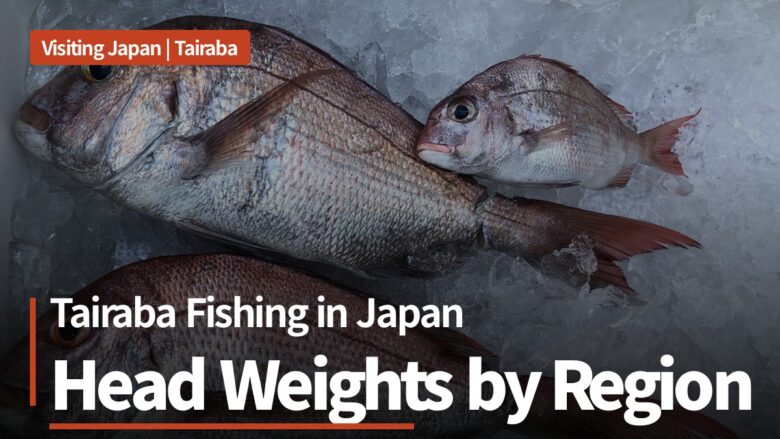
On a Japanese boat’s schedule, a tairaba trip almost never says “tairaba” in English. It’s タイラバ or 鯛ラバ, or just ラバー (rubber) tucked into a madai trip next to a bait option, and underneath there’s usually a head weight in grams and a braid size you’re expected to match. Those two numbers shape your day more than the rod you hire, and they change from one bay to the next and from spring to winter.
This page is about doing it from a Japanese boat: spotting the trip, what the boats ask you to bring, how the boat will drift, and which heads to pack for the region and the month. How the slow, steady retrieve works is in the tairaba fishing guide. Licenses, the lifejacket law and party-boat basics are in how to go fishing in Japan as a visitor, and booking messages, cancellation fees and seats are in booking a Japanese party boat.
Tairaba (鯛ラバ) is fishing for madai, red sea bream, with a weighted head and a bunch of rubber skirts that you drop to the bottom and wind slowly back up. A boat that runs it as its own shared trip will list タイラバ乗合 or 鯛ラバ乗合. Plenty of boats don’t split it out. One Yokohama boat in Tokyo Bay puts on an occasional afternoon madai trip with two ways in: tenya with bait, or “rubber” with no bait at all. The rubber seat was the cheaper one, ¥7,800 against ¥8,500, because there’s no bait in the price.
A handful of other words turn up on the same pages:
| Japanese | Reading | What it means on a tairaba boat |
|---|---|---|
| タイラバ / 鯛ラバ | tairaba | The method, and often the trip name |
| ドテラ流し | dotera-nagashi | The boat drifts sideways with the wind, lines go out at an angle |
| バーチカル | bāchikaru | “Vertical”: lines going more or less straight down |
| TG / タングステン | tangusuten | Tungsten head |
| 鉛 | namari | Lead |
| ネクタイ | nekutai | “Necktie”: the flat rubber tails behind the head |
| 乗っ込み | nottokomi | The spring run of madai into shallower water to spawn |
When you send the booking, add one question. Daiwa’s tairaba page, written with a skipper who also tests tackle for Daiwa, says the most up-to-date and accurate information is what you get by asking the captain, when you book, what weight and what color are catching right now. In Japanese that’s 今、何グラムの何色が釣れていますか? (Ima, nan-guramu no nani-iro ga tsurete imasu ka?). Paste it under your name, date and headcount and you’ll know what to pack before you leave the hotel.
Four boats in three regions, as their own pages listed them in early November 2026:
| Region | Trip | Fare | Tackle and extras | Line, heads and notes |
|---|---|---|---|---|
| Tokyo Bay, Yokohama | Afternoon madai, out 12:30, back about 17:00 | ¥7,800 for rubber, ice included | Rental rods and reels ¥300 to ¥1,000; lifejacket free and compulsory | Heads 80 to 120 g, 80 g as standard; PE 0.6 to 0.8, about 200 m |
| Akashi Strait, Kobe side | Morning shared trip, 6:00 to 13:00 | ¥9,000 | Rod and reel ¥2,000; ice free | PE 0.6 or 0.8 |
| Akashi | Morning shared trip, back about 12:15 | ¥9,000 with five or more aboard, ¥11,000 with four | Dedicated tairaba outfit ¥3,500, booked 7 days ahead; rigs, bait and ice are yours; lifejacket ¥500 | Tairaba weights of 15, 17 and 20 go sold on board |
| Fukuoka, long range | Priced by destination, out about 6:00, back about 15:00 | ¥20,000 to ¥35,000 | Tairaba rod and reel ¥3,000; lures and rigs are yours | Shared trips sail with six; weekdays are charter only |
The pattern is easy to miss from abroad. A rental usually means a rod and a reel, not the heads. The Fukuoka boat says so outright, one Akashi boat asks you to bring your own rigs, and the other Akashi boat rents a proper tairaba outfit only if you book it a week ahead. Heads stay on the bottom more often than you’d like, so bring more than one of each weight.
The line is the other thing to check. The Kobe-side boat and the Tokyo Bay boat both list thin braid, PE 0.6 to 0.8, for tairaba. If you’re bringing your own reel, spool it to that before you fly. The Akashi boat that sells weights lists them in go, the unit Japanese sinkers use: 15, 17 and 20 go come to roughly 56, 64 and 75 g.
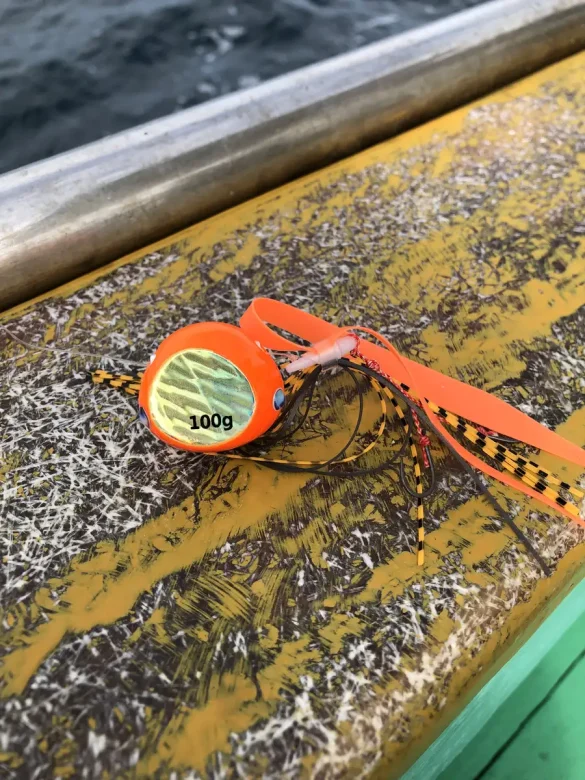
Daiwa describes dotera-nagashi like this: the captain puts the side of the boat to the wind and lets it slide sideways, everyone fishes from that one side, and the lines go out at an angle. It covers a lot of ground. The other way is to put out a parachute anchor, which slows the drift and keeps lines closer to straight down, the vertical style. Which one you get is the captain’s call on the day, and it changes how heavy you need to go.
A 2025 Shimano column from a trip off Yamaguchi, on the Sea of Japan side, shows how much it can matter. The current there runs one way and fast, so boats often fish dotera, and the skipper told the anglers to have heads of up to 200 g ready. That day he used a sea anchor instead. On the dotera drift the surface water had them moving at 2 knots. Under the anchor it was 1.3 knots on top and 0.9 below.
Daiwa’s rule for choosing is blunt: pick a weight you know will reach the bottom first, and let the angle come from that. Going light because you’ve read that an angled line catches more, and then never finding the bottom, gets it backwards.
Daiwa sells its tairaba starter kit in three weight bands and names the waters each one is for. It’s a useful first map of Japan:
| Band | Heads in the kit | Waters Daiwa names |
|---|---|---|
| Shallow | 60, 80, 100 g | The Seto Inland Sea area, Amakusa |
| Mid-range | 80, 100, 120 g | Tokyo Bay, Ise Bay, Kitakyushu |
| Deep | 150, 200 g | Genkai-nada, Kinko Bay, the Sea of Japan, Enshu-nada |
Real days spread wider than three bands. These are what anglers in Shimano’s and Daiwa’s own columns tied on, region by region. Treat them as a starting range to pack around, then go with the number the boat gives you.
Before a tournament off Akashi and Awaji at the end of June 2025, in shallow water, a Shimano pro said he expected to lean on tungsten heads of just 45 g and 35 g. His reasoning was that a small, light head finds the angle the fish want quickly and searches more water than a heavy one parked on a single spot.
Writing up a late-September 2025 tournament off Hiroshima, the same angler split the area in two. Inshore grounds of 15 to 60 m take 60 to 70 g or less. Offshore grounds of 90 to 100 m, or any day on a dotera drift, take 90 to 120 g. When the tide goes slack, he goes as light as he can while still finding the bottom. In autumn, the column says, the fish there feed on crabs and shrimp near the seabed.
Shimano’s Tokyo Bay column was shot at the end of summer in the middle of the bay, in roughly 23 to 33 m. Over the day, the two anglers between them went from 60 g up through 70, 80 and 90 g to a 120 g lead head, going heavier when a two-layer current pushed the boat into a dotera-style drift. In winter, the column says, the fish move deep and heads go up to 120 to 150 g. March and April bring the spring run into shallower water. The Yokohama boat in the table above sits in the middle of all that: 80 to 120 g, with 80 g as its standard.
This is where the heavy heads live. Off Fukui, on the Sea of Japan, a 2024 Shimano column fished 78 to 80 m on a dotera drift with 150 g heads, then a 120 g dotera head swapped for 80 g at the second spot, and the day produced a madai over 70 cm. On Genkai-nada, north of Fukuoka, an autumn column fished around 70 m of sand on a dotera drift with 120 g, picked so the first drop of the morning would find the bottom for sure. In Kinko Bay, Kagoshima, a mid-April tournament day in 71 m saw the Shimano guest on a 90 g tungsten head, and another angler who caught fish that morning was on 100 g. Daiwa’s Kinko Bay skipper adds that the fish there sit shallow in spring and summer and go deep in winter.
| Where | When | Depth | Heads used |
|---|---|---|---|
| Akashi and Awaji | Late June | Shallow | 35 and 45 g tungsten (planned) |
| Hiroshima, inshore | Autumn | 15 to 60 m | 60 to 70 g or lighter |
| Hiroshima, offshore or dotera | Autumn | 90 to 100 m | 90 to 120 g |
| Tokyo Bay, mid-bay | End of summer | About 23 to 33 m | 60 to 120 g |
| Tokyo Bay | Winter | Deep | 120 to 150 g |
| Off Fukui | Just after the spring run | 78 to 80 m | 80 to 150 g |
| Off Yamaguchi, Sea of Japan side | Early June | About 80 m | Up to 200 g on hand |
| Genkai-nada | Autumn | About 70 m | 120 g |
| Kinko Bay, Kagoshima | Mid-April | 71 m | 90 to 100 g |
The Tokyo Bay column lays out the trade. Tungsten makes a smaller head for the same weight and sinks faster, so it’s easier to tell when it lands. One of the two anglers adds that in winter, when madai are slow to bite, the small silhouette seems to get more takes. Lead is cheaper, which matters where tachiuo (hairtail) are around to bite through your leader, and its bigger silhouette suits the spring run.
I’ve had one day that made me take the small option seriously. The angler beside me kept hooking fish on an ultra-light 30 g tungsten head, and all I had in my box was lead, 60 g and up. It finished 13 fish to their side and 3 to mine. Going to a heavier lead head didn’t change anything for me, so getting down faster wasn’t the answer. I can’t promise you the size of the head was the reason, though. I never put on a 30 g lead head that day, so the material, the weight and the silhouette are all tangled together in that one result. What I’m sure of is the part about the box. I’d come out with no smaller heads at all, and there was nothing else I could try.
For a trip from abroad, that argues for packing a spread rather than a stack: the boat’s weight, one step lighter and one step heavier, and at least a couple of them in tungsten. Of the four boats in the table, only one lists tairaba weights for sale on board, and only in three sizes.
When the boat settles over the fish, the captain calls the depth and everyone drops together. Daiwa’s advice for the drop is simple. Open the spool, rest a thumb lightly on it, and watch for the instant the spool stops turning. That’s the head landing. Then wind the first few turns fast to take up the slack and start the retrieve straight away. A reel with a line counter tells you the depth as it happens.
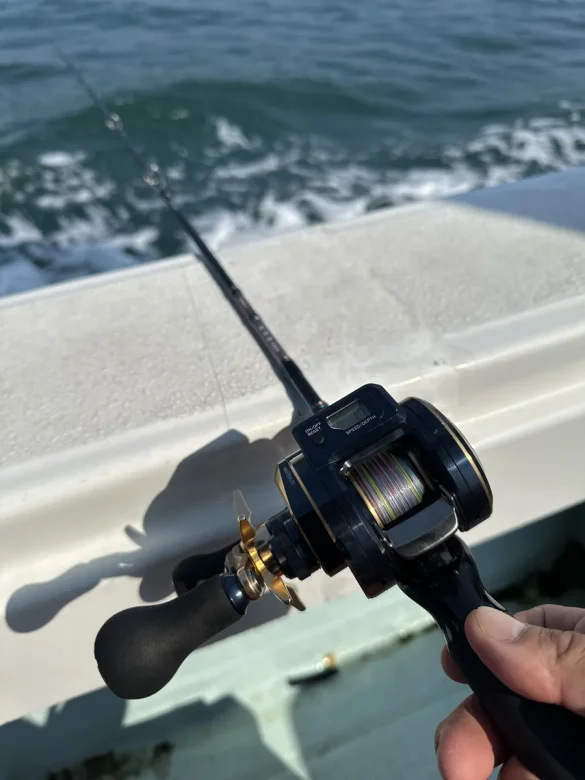
This is the step I got wrong when I first came to boats from the shore. From a harbor wall, line leaving the spool means the lure is still sinking, and I brought that habit with me. On a drifting boat it doesn’t hold. The boat keeps sliding away after the head has hit, so the spool keeps turning, and I’d sit there feeding out braid to a head that had landed long before. And a retrieve that never started from the bottom won’t catch anything, however well you wind it.
The counter helps, but it won’t settle it by itself. Daiwa notes that on a dotera drift over about 100 m, more than 200 m of line can go out, so a reading past the captain’s depth doesn’t prove the head has landed. Use the number to know when to pay attention: once the counter passes the depth the captain called, watch the spool for that pause. If it runs well past and you never saw one, wind in and drop again. On a dotera rail, all that extra braid is also heading under your neighbor’s line, and that’s where plenty of tangles begin. The common tairaba beginner mistakes covers what goes wrong after you’ve found the bottom.
Most of what you can keep is set prefecture by prefecture, and the visitor’s guide covers how that works. Madai have one rule that crosses those borders. Japan’s Fisheries Agency says that in the Seto Inland Sea only, every year from 1 July to 30 September, madai of 12 cm or less in total length, from the tip of the mouth to the tip of the tail, may not be taken. The penalty it lists is up to two years in prison or a fine of up to ¥500,000. Hiroshima Prefecture’s page on size limits under the Seto Inland Sea and prefectural rules says those rules apply to everyone, not only to commercial fishers.
A 12 cm madai is a small fish, and nobody on a tairaba boat is trying to keep one. Release small fish whatever the month, and ask the crew if you’re unsure about anything else that comes up.
Shimano’s beginner page calls spring and autumn the high seasons, though tairaba runs all year in many places. In spring, madai move shallow to spawn and the big fish show up, but the catch can be patchy on cold-water days. In autumn they feed hard, you get more bites, and Shimano points to it as the time to start. As the water cools, fish move deeper, and in some regions the winter winds or cold water close the season down.
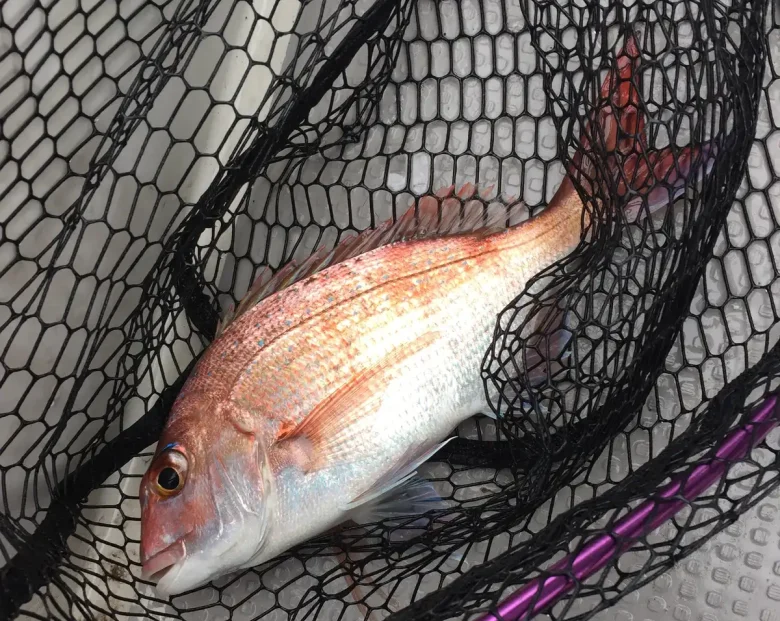
For packing, the seasons and the weights go together. Spring shallows let you go lighter, and in winter Tokyo Bay goes to 120 to 150 g. If you’re choosing a month, the Japan fishing season calendar shows what else is running alongside madai.
If you’re bringing your own heads, the best tairaba heads and skirts compares the main Japanese systems, lead and tungsten. Then drop on the captain’s call, watch the spool, and wind.