Best Tairaba Reels: JDM Models Explained
ちゃんま
マイボ!

Kabura jigs surface in American bottom fishing talk every so often, usually as a curiosity: a lead head, a bunch of silicone tassels, two small hooks on cords, and the claim that you catch fish by doing nothing except winding at one speed. The Japanese name is tairaba (鯛ラバ / タイラバ), from tai, the red sea bream it was built for. It has been the default lure for that fish here for about two decades.
I fish it out of a small boat in the Seto Inland Sea and Osaka Bay. I have never dropped one on a Gulf reef or off Cape Cod, and that distinction matters, because a lot of what gets called tairaba technique is really a description of Japanese water: 30 to 80 metres, an engine cut and a boat sliding sideways on the wind, and a soft-mouthed fish that eats small moving things a metre off the sand. Change those conditions and some of the method comes with you, some of it doesn’t. If the basics are new to you, our complete guide to tairaba fishing covers the mechanics first.
Pricing note: Hayabusa publishes Japanese retail prices including consumption tax, and those are the figures used here. USD is approximate at ¥154 = $1 (September 2026). Links for Japanese-market products point to Amazon Japan, which ships internationally. Check availability and shipping cost at checkout, and check live pricing before you buy.
Species lists are the wrong starting point. Look at what the lure physically does instead. It drops straight down, it gets wound straight back at one unchanging speed, and the skirt and hooks trail a few inches behind a dense head that’s already moving away from them.
Four questions decide whether a given fish fits that, and none of them is about the name on the regulation sheet. How high off the bottom does it feed? Does it chase moving prey, or wait for something dead to drift past? Can you pull it clear of structure on a light leader? And can you cover that ground at all without hanging up on every drop?
| Species | Where it sits | Fit | The catch |
|---|---|---|---|
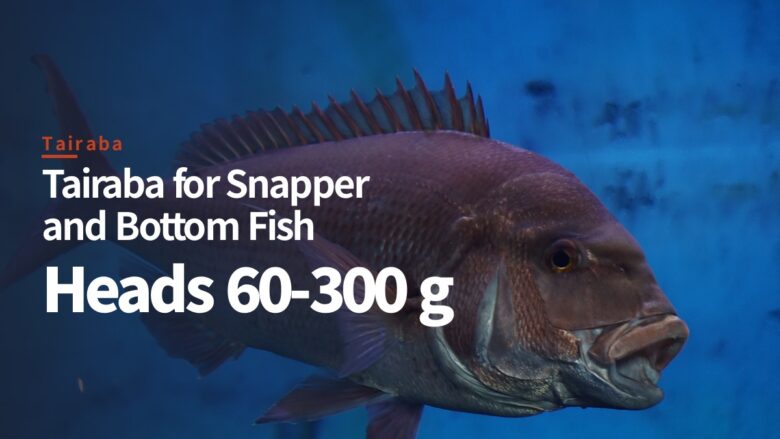
| Vermilion, lane and mangrove snapper | Low over reef and rubble | Good | Small mouths, they chase, and they hold right where the head lands |
| Black sea bass, scup, porgy | Hard bottom, within a metre | Good | They play the same role madai does in Japan, light bite included |
| Red snapper | Around structure, will rise well off it | Good, on a heavier leader | They’ll come up for it. A big one beside a wreck is a different problem |
| Gag and red grouper | In the structure | Marginal | Tairaba hooks are small and fine wire. A grouper that reaches its hole wins |
| Lingcod and rockfish | Deep, hard bottom, current | Good | The fish isn’t the obstacle. Getting a head down there is |
| Redfish over nearshore reefs and passes | Bottom, fished from a boat | Good | Shore fishing for them wants a different tool entirely |
| Greater amberjack, almaco jack | Anywhere in the column, fast | It will eat it | Then it straightens the assist hooks or parts the leader |
| Tilefish and the deeper groupers | 400 ft and beyond | Poor | Past the weights kabura heads are made in |
| Fluke and flounder on flat sand | Flat, ambush from below | Poor | A rising retrieve climbs away from them |
The pattern in that column is structure, not species. Japanese tairaba grounds are mostly sand, gravel and low broken bottom, which is why the standard rig gets away with two light-wire hooks on short cords and a 20 lb leader running through a lump of lead. Plenty of American reef bottom is harder and taller than that. The rig’s weak point is the fish only needing to reach one ledge, and high-relief structure hands it that chance on every hookup.
Before you plan anything around a species in that table: seasons, size and bag limits, and rules about permitted terminal tackle all vary by state and by federal region, and they change from year to year. Check the current regulations for the water you’re fishing rather than taking numbers out of any article, this one included.
Head weight is a narrow conversation in Japan. Most of my fishing sits between 30 and 80 m, and most of my heads are 45 to 120 g. That range exists because of how the boats work: engine off, beam to the wind, sliding across the ground the whole drop. Line keeps leaving the spool for as long as the drift lasts, so the head gets picked to keep the braid somewhere near vertical instead of streaming out behind the transom.
Two things move the numbers on an American boat. Depth is the obvious one: Gulf and South Atlantic reef work runs deeper than my usual ground, and West Coast rockfish and lingcod bottom runs deeper again. The less obvious one is that a lot of US bottom boats don’t drift at all. They anchor, or they sit on a trolling motor. Hold the boat still and your line goes down instead of out, and you can drop 40 or 60 g off whatever a drift would have needed. You’re also fishing one small patch of ground, which puts the burden back on the retrieve rather than the head.
| Depth | Drifting, or current running | Anchored or holding position |
|---|---|---|
| 60 to 100 ft (18 to 30 m) | 60 to 100 g (2 to 3.5 oz) | 45 to 60 g (1.6 to 2.1 oz) |
| 100 to 150 ft (30 to 45 m) | 100 to 150 g (3.5 to 5.3 oz) | 60 to 80 g (2.1 to 2.8 oz) |
| 150 to 200 ft (45 to 60 m) | 150 to 200 g (5.3 to 7 oz) | 80 to 120 g (2.8 to 4.2 oz) |
| 200 to 300 ft (60 to 90 m) | 200 to 300 g (7 to 10.6 oz) | 120 to 180 g (4.2 to 6.3 oz) |
| 300 ft and deeper | 300 g and up | 180 to 250 g (6.3 to 8.8 oz) |
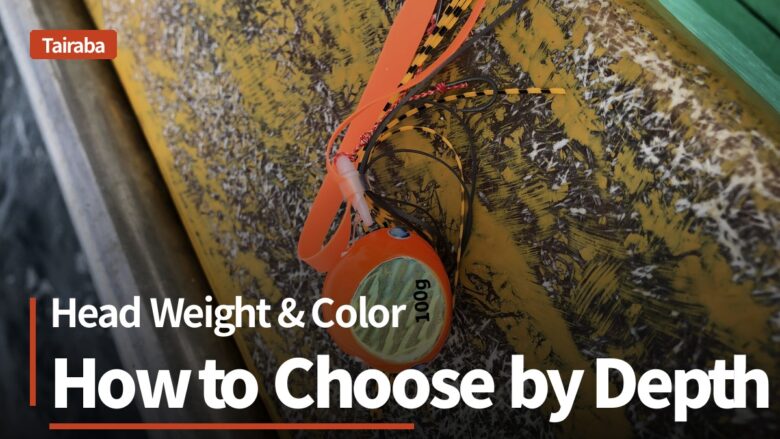
One drop settles which column you’re in. Watch where the braid cuts the surface. If the angle has gone past roughly 45 degrees before the head reaches bottom, the head is too light for that drift, and everything downstream of that gets worse: the skirt stops swimming properly, the hooks ride wrong, and you spend the retrieve dragging line rather than fishing. Going up 50 g fixes more problems than changing colour ever will. Colour and head shape are a separate argument, and we’ve written that one up in how to choose tairaba head weight and colour.
Worth knowing that the Japanese market has been moving the same direction. Hayabusa’s 2026 catalogue added 220, 250 and 300 g sizes to a head range that used to stop well short of that. The heavy end of the Japanese tairaba aisle now overlaps neatly with American depths.
Early summer, a few days after heavy rain had put colour in the water, on a boat off the Kansai coast. The man fishing next to me landed thirteen madai. I landed three. He was using a 30 g tungsten head. The lightest thing in my box that day was lead at 60 g and up. Same boat, same drift, same depth, skirts close enough to identical.
The only difference I could point at was how big the head looked in the water. At the same weight tungsten is a physically smaller object, and 30 g of it is smaller again than anything I had with me. I bought tungsten that week. The next trip was not suddenly easy.
I should be straight about the limit of that story. I’ve never gone back with a 30 g lead head to find out whether the metal mattered or only the size, so it’s one day and one observation, not a law. What I actually took away wasn’t “buy tungsten.” It was that on any given day there’s usually one variable worth copying from the person out-fishing you, and it isn’t the same variable next time. Some days it’s silhouette. Some days it’s colour, or the skirt, or something you can’t see from three feet away. Copying the whole setup is the lazy version and it mostly fails, because you copy nine irrelevant things along with the one that counted. And when nobody near you is catching, there’s nothing to copy at all and you have to guess at an answer and test it.
That habit is the part I’d carry onto a Gulf reef ahead of any weight chart or colour list, mine included. Nobody has run those experiments for American bottom yet.
Reels, mostly yes. A low-profile baitcaster or a small conventional with a smooth, slow retrieve is all this asks for. A depth counter earns its place when you’re trying to put the head back exactly where a fish ate two drops ago, and it costs less than most people expect on the Japanese models.
Line, also yes. Japanese heads and rods are speced around PE 0.8 to 1.5, roughly 16 to 30 lb braid in US terms, with three or four metres of fluorocarbon leader in a similar class. Over harder American structure most people will want to step the leader up and simply accept fewer bites for it. That’s a real trade, not a free upgrade.
The rod is where it falls apart. A grouper stick or a standard US bottom rod is built to lift and to stop fish, and the tip is stiff on purpose. A tairaba rod is deliberately soft through the top third and only firms up further down, and that softness is the whole hooking mechanism: the fish takes the skirt, turns away with it, and loads the rod against its own weight while you keep winding. On a stiff tip the fish meets resistance, drops it, and you never know it was there. Or the little hooks tear a hole and let go. If you own a slow-action slow-pitch jigging rod, start there. Otherwise this is the first thing to buy, and our roundup of the best tairaba rods covers what to look for.
Hooks deserve one warning. Stock tairaba assist hooks are small and fine-wire because madai have soft mouths and the rod does the work. They are not grouper hooks. Swapping to a heavier assist is easy on any of the modular Japanese systems, and you lose some bites from the smaller fish in exchange for landing the ones that count.
The Lucanus is the one kabura-style jig with a long history in English-speaking markets, and the only lure here that arrives ready to fish. Head, silicone skirt, glowing eyes and twin assist hooks come assembled in the packet. Shimano’s own line-up runs 60, 80, 100 and 150 g, all sinking, all on a #7 twin assist hook.
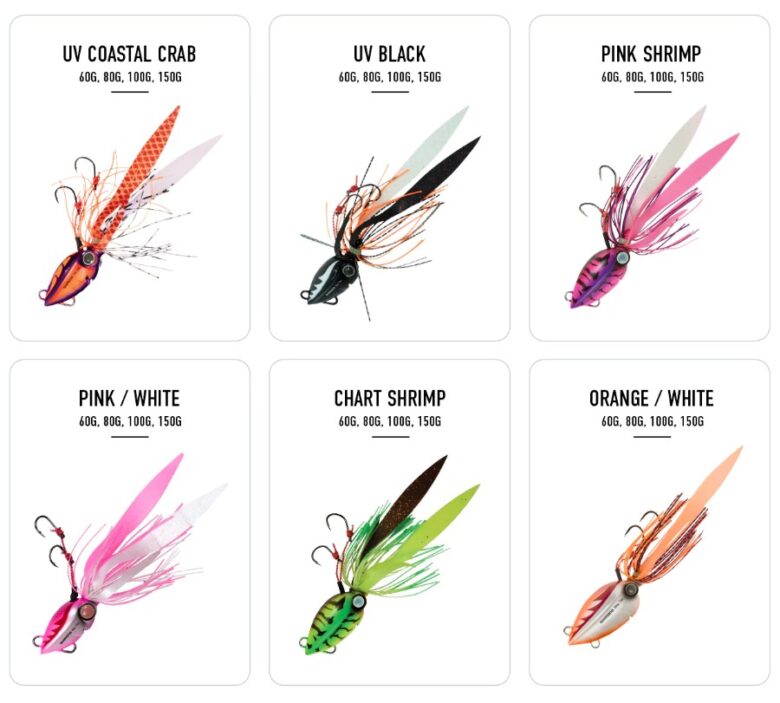
There’s a catch for American buyers in 2026. Shimano North America’s own store doesn’t list it: the saltwater jig section carries twelve products and the Lucanus isn’t among them, while Shimano Australia still catalogues the full colour range. Treat it as a retailer stock item rather than something the maker keeps feeding into the US channel.
| Feature | What Shimano says it does | Why it matters on US bottom |
|---|---|---|
| Hydrodynamic head | Stable falling posture, sinks quickly | Less wander on the drop when the boat is sliding |
| Glowing eyes | Visibility in deep water | Relevant past 150 ft, where colour has already gone |
| Silicone skirt | Pulses on a slow, varied retrieve | The moving part. It keeps working after the head stops |
| Twin assist hook, size #7 | Rigged as supplied | Sized for sea bream mouths, not for pulling fish out of rock |
| Weight | Buoyancy | Hook | Example item code |
|---|---|---|---|
| 60 g (2.1 oz) | Sinking | Twin assist #7 | JLC060PS Pink Shrimp |
| 80 g (2.8 oz) | Sinking | Twin assist #7 | JLC080NW Orange/White |
| 100 g (3.5 oz) | Sinking | Twin assist #7 | JLC100SC Sunset Crab |
| 150 g (5.3 oz) | Sinking | Twin assist #7 | JLC150UVB UV Black |
For the 60 to 150 ft band on a boat that isn’t ripping across the ground, this covers you. Past that it runs out of weight, and it’s the wrong lure to be hunting stock for when you need 250 g by Saturday.
Hayabusa’s Free Slide system is the value end of the Japanese tairaba market. Heads, skirt units and hook assemblies sell separately and interchange freely, so you build the rig rather than buy it. The VS Head Plus is the plain lead head in that family, and Hayabusa’s 2026 catalogue added 220, 250 and 300 g to it. That top end is the reason this head belongs in an American box. Very little else in the Japanese tairaba aisle goes that heavy.
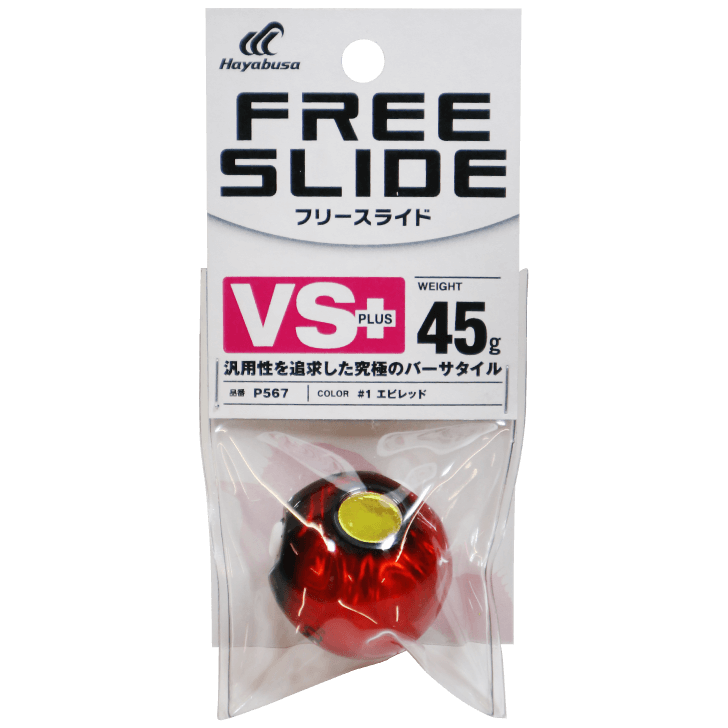
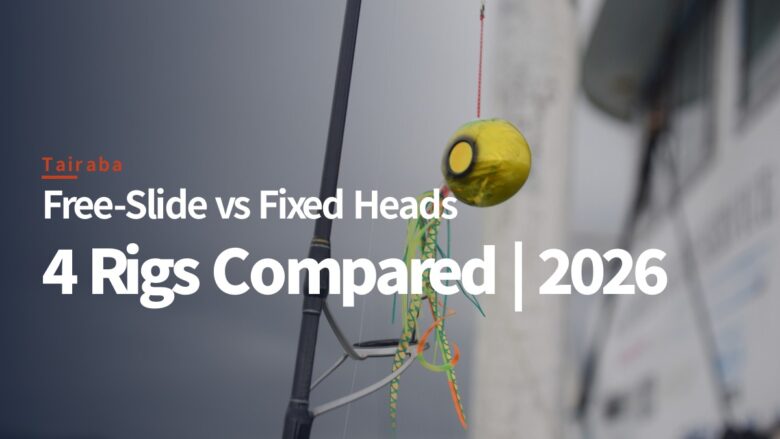
The head slides freely up the leader when a fish takes, which is the standard Japanese architecture now and the reason there’s a pipe through the middle at all. We’ve pulled that apart in free-slide versus fixed tairaba, so the short version here: the lead stops being attached to the hook the moment a fish turns.
| Feature | What it is | What it’s for |
|---|---|---|
| VS form | Edged shape that sheds water cleanly, bulged underneath | Stirs water behind the head to help the nectie move, and holds posture through lift and fall |
| Low-friction pipe | Resin tube through the middle of the head | Lets the head slide smoothly, and keeps lead off the leader |
| Polarised mirror eye | Reflective eye insert | Flash during a slow, constant wind |
| Size | Japanese RRP (incl. tax) | Approx. USD |
|---|---|---|
| 45 g (1.6 oz) | ¥825 | $5 |
| 60 g (2.1 oz) | ¥847 | $6 |
| 80 g (2.8 oz) | ¥869 | $6 |
| 100 g (3.5 oz) | ¥946 | $6 |
| 120 g (4.2 oz) | ¥1,023 | $7 |
| 150 g (5.3 oz) | ¥1,100 | $7 |
| 180 g (6.3 oz) | ¥1,210 | $8 |
| 220 g (7.8 oz) | ¥1,375 | $9 |
| 250 g (8.8 oz) | ¥1,485 | $10 |
| 300 g (10.6 oz) | ¥1,650 | $11 |
Eleven dollars for 300 g of lead is the cheapest way to reach American depths out of the Japanese catalogue, and a spread of five weights costs less than one premium head. A 300 g lead head is a genuinely large object in the water, though, and that bulk is what you’re accepting in exchange for getting down there.
Same system, same pipe, tungsten instead of lead. Because both heads come from one maker inside one product family, the comparison is unusually clean: hold the shape and the hardware constant and the only variable left is the metal. What the metal buys you is size, which is the whole tungsten argument in four words.
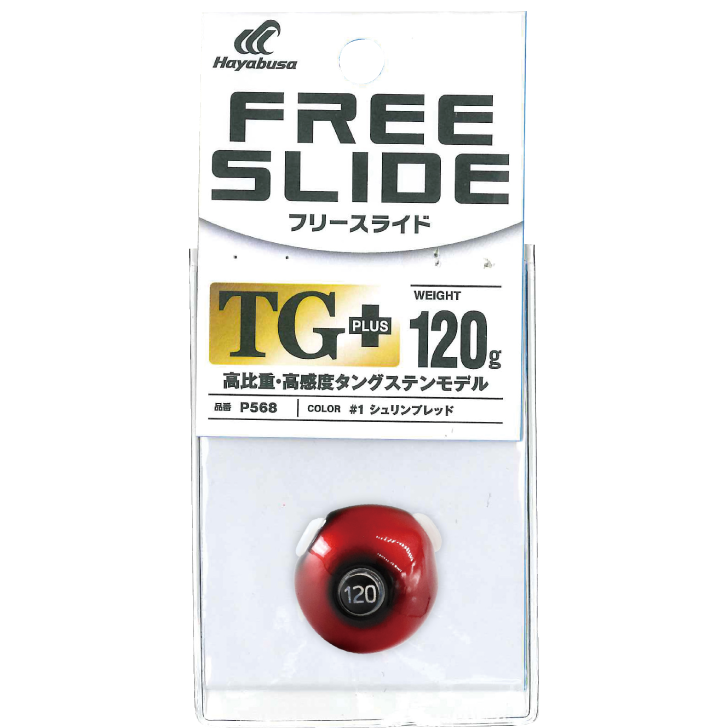
| Feature | What it is | What it’s for |
|---|---|---|
| Tungsten body | Denser than lead at the same weight | Smaller silhouette, and it punches through a current band faster |
| Low-friction pipe | The same resin tube as the lead head | The head still slides up the leader on the take |
| Unpainted finish option | Bare tungsten, no coating | Cheapest way into the material, and a duller flash than the plated colours |
| Size | Painted, incl. tax | Unpainted, incl. tax | Approx. USD (painted) |
|---|---|---|---|
| 60 g (2.1 oz) | ¥1,980 | ¥1,870 | $13 |
| 80 g (2.8 oz) | ¥2,530 | ¥2,420 | $16 |
| 100 g (3.5 oz) | ¥3,080 | ¥2,970 | $20 |
| 120 g (4.2 oz) | ¥3,630 | ¥3,520 | $24 |
Two numbers matter more than the feature list. At 120 g the lead head costs ¥1,023 and the tungsten head costs ¥3,630: three and a half times the money for the same weight in a smaller package. And the range stops dead at 120 g, against 45 to 300 g in lead. The moment depth or current pushes you past 120 g the tungsten conversation is over and you’re on lead regardless of preference. That ceiling is easy to miss when you’re reading Japanese tairaba content written for 40 m of water.
| Product | Material | Weight range | Rigged or parts | Japanese RRP | Where it earns its place |
|---|---|---|---|---|---|
| Shimano Lucanus Jig | Lead | 60 to 150 g | Complete, twin assist #7 | No US price published | Fishing this weekend without waiting on a parcel |
| Hayabusa VS Head Plus | Lead | 45 to 300 g | Head only | ¥825 to ¥1,650 incl. tax ($5 to $11) | Depth, hard drifts, and buying a spread of weights cheaply |
| Hayabusa TG Head Plus | Tungsten | 60 to 120 g | Head only | ¥1,870 to ¥3,630 incl. tax ($12 to $24) | Keeping the silhouette small when fish are fussy |
Inside 150 ft: Hayabusa VS Head Plus, 80 to 120 g
Three heads across that band come to roughly $20 before shipping, and they cover most snapper, sea bass and porgy ground on either coast. Order skirt units at the same time, since a head on its own is half a rig.
Deep water or a hard drift: the same head in 180 to 300 g
The 2026 sizes are what make a Japanese tairaba head usable on West Coast rockfish ground and deeper Gulf reef. At ¥1,650 including tax for the 300 g, feeding one to a snag costs about eleven dollars.
No time to import: Shimano Lucanus, 100 or 150 g
Ready to fish out of the packet, and the quickest way to find out whether the technique does anything on your ground before you spend money on a system. Stock is patchy, so check before you build a trip around it.
Tungsten is a second box, not a first one. Buy it once you’ve fished the ground enough to have a reason for wanting a smaller head at the same weight.
You need a soft tip, and Japanese tairaba rods are the easiest way to buy one. A slow-action slow-pitch jigging rod will do most of the job. A conventional bottom rod won’t, and no amount of technique fixes it, because the fish has to be able to swim off with the skirt without feeling the rod push back.
Sometimes, on the evidence I have. I’ve had one day where the angler beside me on a small tungsten head out-caught me four to one, and plenty of days where lead was fine. What tungsten reliably gives you is a smaller object at a given weight, which is worth something when fish are looking at the lure rather than reacting to it. It won’t fix a wrong retrieve or a wrong depth.
Badly. Tairaba wants a line hanging near vertical and a retrieve that climbs well off the bottom, which is a good recipe for crossing three neighbours on an anchored rail. A corner spot helps. A small boat with two or three anglers is where the method actually works.
Amazon Japan ships most of this internationally, and Japanese tackle shops with export desks handle the rest. Shipping and customs are the part people underestimate, and how that works is set out in buying JDM tackle from overseas.
The mechanism travels intact. A dense head, a skirt that keeps swimming after the head has stopped, one steady speed on the handle, and no hookset. That works on any fish holding low and eating things that move, and American bottom is full of them.
What doesn’t travel is the numbers attached to it. Japanese head weights assume Japanese depths and a drifting boat. Japanese hooks and leaders assume sand and gravel rather than high relief. Japanese colour charts assume a fish that isn’t in your water at all. Take the mechanism, then work the numbers out on your own ground, which is what anyone fishing a new mark in Japan has to do anyway.