Shimano Ocea Jigger vs Ocea Conquest: Which One Fits Your Fishing?
ちゃんま
マイボ!

A complete tairaba outfit, rod through heads, starts at about $220 of Japanese tackle. Add the import duty the US now charges on every package arriving from Japan and it’s roughly $248 sitting on your porch. That’s the floor. The ceiling, if you buy the reel Shimano built a specific gear ratio for, is a little under a thousand dollars.
Tairaba (鯛ラバ, also written タイラバ, and listed as tai kabura in some export catalogues) is a Japanese boat method. A lead or tungsten head slides free on the leader above a skirt, a rubber necktie and a pair of small hooks, and you wind it up off the bottom at a steady speed. It was developed for madai, the Japanese red sea bream. Our complete guide to tairaba fishing covers the method.
Pricing note: every figure is a Japanese manufacturer list price with consumption tax excluded, which is how Daiwa, Shimano and Major Craft publish them and roughly what an exporter charges before shipping. USD conversions use ¥154 = $1 (8 September 2026). Landed figures add import duty only. Shipping is not included, because a two-piece rod tube and a reel box price completely differently.
Four things, and one of them isn’t worth shipping across the Pacific.
| Part | What it has to do | Where to buy it |
|---|---|---|
| Rod | Bend on the bite instead of pulling the head away. Roughly 6’9″ to 7’0″, solid tip, rated to about 100 g | Japan. Nothing sold in the US is built to this taper |
| Counter reel | Wind at a constant speed and tell you the depth the fish took at. A low-profile baitcaster with a digital line counter | Japan |
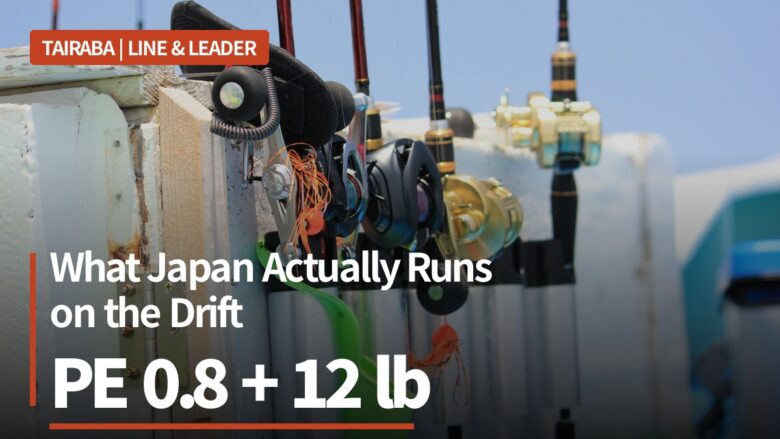
| Braid | PE 0.8 to 1.0. PE is the Japanese braid gauge, roughly 15 to 18 lb here. Marked in colours so you can read line-out, 200 to 400 m depending on how deep you fish | Japan, or a US multicolour braid if you already have one you trust |
| Heads and units | The head gets you to the bottom; the unit (skirt, necktie, hooks) is what the fish eats. Both are consumables | Japan |
| Leader | Fluorocarbon. Daiwa specifies 12 to 16 lb for heads up to 100 g and 16 to 20 lb above that | Your local shop. This is the one item not worth importing |
The leader is worth dwelling on for a second, because it’s the item most import guides quietly pad the bill with. Daiwa’s own spec sheet asks for 12 to 16 lb fluorocarbon under a 100 g head. That is an ordinary spool sitting on a shelf in every tackle shop in the country, and it gets taxed at the same rate as everything else in the box if you ship it. Buy it at home.
Heads first. Not because they’re the most interesting part but because a head that won’t reach bottom in the current you happen to get is a wasted trip, and there is no way to fix that on the boat. Daiwa’s lead range runs 45 g to 250 g, and three weights covering roughly 60 to 100 g will fish most US bottom structure inside 150 feet. Spend here before anywhere else, and spend on coverage rather than on the fancy version of one weight. The heads and skirts comparison goes through the sizing and the products themselves.
The reel comes second, and the useful surprise is how little you have to spend to get the part that matters. Daiwa fits a digital line counter to the Kohga X IC, the bottom rung of the series, at ¥16,000. Shimano’s own writing about the counter era says the same thing from the other end: depth stopped being a guess and hit patterns became repeatable. Everything above ¥16,000 buys you smoothness, weight and gear-ratio choice, not the counter.
Then the rod. It’s the biggest single line item in two of the three kits below and the one with the least immediate return, because a ¥11,100 Major Craft blank and a ¥47,500 Shimano blank both bend where a tairaba rod has to bend. What you buy at the top is 119 grams instead of 126, and a tip that tells you a fish is there half a second earlier. Real, but not what stops you catching in your first season. The tairaba rod rankings go through the whole ladder.
Braid last, and only 200 m of it if your local structure sits shallow. What can wait entirely: a second rod, tungsten heads, spare units in eight colours, and a landing net you’ll borrow from the boat anyway. Nothing on that list will catch you a fish you’d otherwise have missed.
Two pieces on the rod, deliberately. A 6’9″ tairaba blank splits to about a metre packed, which is the difference between a courier surcharge and a normal parcel, and Major Craft prices the two-piece Solpara identically to the one-piece.
| Item | Model | Key spec | List price (excl. tax) |
|---|---|---|---|
| Rod | Major Craft NEW Solpara Tai Rubber SPJTR-B692L/S | 6’9″, 2-piece, 114 g, lure to 100 g, PE to 1.2 | ¥11,100 (~$72) |
| Reel | Daiwa Kohga X IC | 240 g, 4.9:1, 5 kg drag, 54 cm per crank, PE 0.8-300 m | ¥16,000 (~$104) |
| Braid | Daiwa UVF Kohga Dura Sensor x8+Si2 0.8-200 m | 15 lb / 6.8 kg, 8-braid, 5 colours | ¥3,100 (~$20) |
| Heads | Daiwa Kohga Bayrubber Free β 60 g / 80 g / 100 g | Lead, complete with hooks, necktie and skirt fitted | ¥3,750 (~$24) |
| Leader | Any fluorocarbon leader | 12 to 16 lb, per Daiwa’s published head spec. Bought locally, not shipped | Not counted |
| Total | ¥33,950 (~$220) |

Here’s the part nobody puts in a starter guide. The Kohga X IC turns at 4.9:1 and takes 54 cm of line per crank, which is slower than either reel in the kits below. Tairaba is a constant slow retrieve, so the cheapest reel here has the gear ratio closest to what the technique actually wants. It’s heavier at 240 g and the drag tops out at 5 kg, and those are the real concessions. The ratio isn’t one.
| Feature | What it does |
|---|---|
| Digital IC counter | Reads depth off spool rotation. Lets you go back to the exact depth a fish came at instead of guessing off the boat’s sounder |
| Aluminium frame | Metal frame on a ¥16,000 reel. Keeps the gear mesh true under a decent fish. Gears are high-strength brass |
| 5+1 bearings | Entry count. You feel it as a slightly grainier wind, not as a reel that stops working |
| Solid tip (rod) | The Solpara’s tip section is a solid carbon splice rather than a hollow taper, which is what lets a rod this cheap load on a soft bite |
| Fuji K-guides (rod) | Sloped frames that shed braid tangles. ML models use a larger ring to cope with a knot passing through |
The Kohga Bayrubber Free β heads arrive rigged. Head, pipe, necktie, skirt and two Daiwa SaqSas hooks (their fluorine-plated finish) in one package, so three of them is three fishable lures rather than a parts bin. That matters more than it sounds on a first trip.

Ten thousand yen more on the reel buys a stronger drag and a longer pull per turn. The Kohga RX IC 150P runs 5.5:1 for 62 cm a crank against the X IC’s 54, holds 400 m of PE 1.0 instead of 300 m of PE 0.8, and carries a 6 kg drag. If you fish anywhere a big fish is genuinely possible, that drag number is the reason to move up rather than the gear ratio.
The rod jump is bigger in feel than in numbers. Shimano’s Engetsu TT is 126 g at 2.06 m, twelve grams heavier than the Solpara, and costs twice as much. What you’re paying for is the tip: TT sits in the middle of Shimano’s tairaba ladder, above the BB and below the SS, XR, XTUNE and Limited, and what separates the rungs is the tip, not the length or the rating. Four actions from L to MH means you can match the blank to your usual head weight instead of splitting the difference.
| Item | Model | Key spec | List price (excl. tax) |
|---|---|---|---|
| Rod | Shimano Engetsu TT B69ML-S | 2.06 m, 126 g, solid tip | ¥23,000 (~$149) |
| Reel | Daiwa Kohga RX IC 150P | 235 g, 5.5:1, 6 kg drag, 62 cm per crank, PE 1.0-400 m | ¥25,900 (~$168) |
| Braid | Daiwa UVF Kohga Dura Sensor x8+Si2 0.8-300 m | 15 lb / 6.8 kg, 300 m for deeper drops | ¥4,150 (~$27) |
| Heads | Kohga Bayrubber Free β 60/80/100 g plus one β TG head 80 g | Three complete lead lures plus a tungsten head for current | ¥6,150 (~$40) |
| Total | ¥59,200 (~$384) |
One thing to get right before you order: the TG item is a head only. No hooks, no skirt, no necktie. It works because Daiwa’s β system unit pulls off one head and onto another in seconds, so the tungsten head borrows the unit from one of the lead lures when the current picks up. A tungsten head bought on its own, with no unit to hang under it, is not a lure. That catches people out.
| Spec | Kohga X IC (entry) | Kohga RX IC 150P (mid) |
|---|---|---|
| Gear ratio | 4.9:1 | 5.5:1 |
| Retrieve per crank | 54 cm | 62 cm |
| Max drag | 5 kg | 6 kg |
| Weight | 240 g | 235 g |
| PE capacity | 0.8-300 m / 1.0-200 m | 1.0-400 m / 2.0-200 m |
| List price | ¥16,000 | ¥25,900 |
Shimano added an MG gear ratio to the Ocea Conquest CT 200 for one reason, and their product page says so plainly: to widen what the reel covers in tairaba. MG sits at 5.5:1 and 66 cm a crank, between the 4.8:1 PG that everyone in the Seto Inland Sea buys and the 6.5:1 HG that’s really a jigging ratio. Shimano had no ratio in that band before, and MG fills it.
At ¥72,000 it is also more than four times the entry reel, for a 7.5 kg drag, 300 g, an 11-bearing count and a counter with a distance alarm that beeps at set intervals off the bottom so you can stop staring at the display. Whether that’s worth $468 is your call, not mine. The tairaba reel rankings put it against everything else at the top.
| Item | Model | Key spec | List price (excl. tax) |
|---|---|---|---|
| Rod | Shimano Engetsu XR N-B610ML-S | 2.08 m, 119 g, solid tip | ¥47,500 (~$308) |
| Reel | Shimano Ocea Conquest CT 200MG | 300 g, 5.5:1, 7.5 kg drag, 66 cm per crank, PE 1.0-400 m, 11+2 bearings | ¥72,000 (~$468) |
| Braid | Daiwa UVF Kohga Dura Sensor x8+Si2 0.8-400 m | 15 lb / 6.8 kg, 400 m | ¥5,400 (~$35) |
| Heads | β TG heads 80/100/120 g plus complete β lures 60/80 g | Three tungsten heads plus two rigged lead lures to supply the units | ¥11,050 (~$72) |
| Total | ¥135,950 (~$883) |

Tungsten is the honest upgrade in this kit, and it’s the cheapest part of it. Daiwa publishes a diameter for the TG heads and not for the lead ones, which tells you where the engineering effort went: the 100 g tungsten head is 25.0 mm across, and the pitch is that a denser alloy lets the same weight sit in a smaller body that falls faster and gets pushed around less by current. The catch is ¥2,850 a head instead of ¥1,300, and you will donate some to the bottom.
| Head weight | Lead β (complete lure) | β TG head (head only) | TG diameter |
|---|---|---|---|
| 60 g | ¥1,200 | ¥1,900 | 21.5 mm |
| 80 g | ¥1,250 | ¥2,400 | 23.5 mm |
| 100 g | ¥1,300 | ¥2,850 | 25.0 mm |
| 120 g | ¥1,350 | ¥3,350 | 27.0 mm |
| 150 g | ¥1,400 | ¥4,400 | 29.5 mm |
| Kit | Rod | Reel | Goods total | Duty at 12.5% | Landed |
|---|---|---|---|---|---|
| Entry | Major Craft Solpara Tai Rubber | Daiwa Kohga X IC | ¥33,950 (~$220) | ~$28 | ~$248 |
| Mid | Shimano Engetsu TT | Daiwa Kohga RX IC 150P | ¥59,200 (~$384) | ~$48 | ~$432 |
| No-compromise | Shimano Engetsu XR | Shimano Ocea Conquest CT 200MG | ¥135,950 (~$883) | ~$110 | ~$993 |
Read that duty column twice. The tax bill on the top kit, about $110, costs more than the entry kit’s entire reel. That’s the shape of buying Japanese tackle in 2026: the gap between the tiers isn’t just the sticker, it’s the sticker plus a percentage of the sticker plus a percentage of the shipping you paid to get it here.
If you have never fished tairaba, buy the entry kit. If you already own a light jigging outfit and know you like this, the mid kit is where the drag stops being the limiting factor. The top kit is for someone who has decided tairaba is their fishing.
The $800 de minimis exemption, the rule that used to let a rod tube from Japan walk through customs untaxed, was suspended on 29 August 2025 and that suspension is now indefinite. Every parcel is assessed. There is no threshold to stay under and no way to split an order to duck it.
The rate then moved twice in 2026. The 10% Section 122 global surcharge expired by statute on 24 July 2026, and a Section 301 tariff on goods from Japan took effect the same day. For fishing tackle classified under HTS heading 9507, which covers rods, reels and terminal tackle, the Section 301 duty is applied net of the standard MFN rate (most-favoured-nation, the default rate the US charges on imports from a normal trading partner), so the two together land at roughly 12.5%. That’s the number in the table above. The de minimis suspension is set out in the CBP fact sheet of 29 August 2025 and made indefinite in the Federal Register notice of 24 June 2026; the duty a shipment actually pays is set by CBP at entry.
Three things that figure doesn’t include. Brokerage and disbursement fees, which the carrier charges for handling the entry and which are flat rather than proportional, so they hurt the entry kit hardest. The Merchandise Processing Fee. And duty on the shipping charge itself, since it forms part of the declared value. Classification and the final rate are decided by CBP at the time of entry, not by the seller and not by this page, and the rate has changed three times in eighteen months. Check the current position before you order. Our guide to buying JDM tackle from overseas covers forwarders, exporters and what each one does to the total.
Anyone doing this arithmetic gets to the same idea eventually: lead is cheap, skirts are cheap, why buy heads at all. I spent a few years finding out. Dozens of homemade tairaba, out of the Seto Inland Sea and Osaka Bay. Lead in fifty-piece bags, skirt material from Daiwa and Shimano set packs mixed with loose curly tails and straight worms, abalone sheet glued onto some of the heads because I’d read it helped.
It was much cheaper. I stopped anyway, for two reasons, and only one of them is about fish. The shop-bought stuff the other guys on the boat were using, tungsten especially, and whatever was in fashion that season, quietly out-fished mine. Not dramatically. Just consistently enough that I noticed.
The other reason is that nobody talks about a homemade head. Turn up with a new lure and there’s a conversation. Turn up with a bag of lead you painted yourself and there isn’t. It’s plain. Nobody asks. Cheap, but plain. So: if you enjoy making tackle, make tackle, and ignore the money argument because that isn’t why you’d do it. If you’re doing it purely to shave $24 off the entry kit, that ¥3,750 head line is the wrong place to be saving.
Order the entry kit, buy the leader at home, and put the difference toward a second day on the boat. A rod, a counter reel, 200 m of braid and three rigged heads is a complete tairaba outfit, and at roughly $248 landed it costs less than most people spend on a single offshore reel. If it turns out you love it, the reel is the first thing to replace and the rod is the last.
Reading from here: the tairaba line and leader setup for how to join PE to fluorocarbon and how long to run the leader; the beginner mistakes list for the ones that cost fish rather than money; and budget JDM tackle under $200 if you want the cheapest workable answer across shore jigging and light game as well, rather than a tairaba kit costed to the dollar.